Showing posts with label catholic church. Show all posts

Tuesday, September 22, 2015

Pope Francis Tuesday

The Pope has been visiting Cuba over the weekend. That visit called to mind this song by Kate Campbell that references an earlier papal visit to the island.

Rosa's Coronas 11/30/2014


Joshua McElwee reports on Pope Francis' major speech in La Habana at the Plaza de la Revolución in Under image of Che Guevara, Francis says Christian service 'never ideological' National Catholic Reporter 09/20/2015

This combination of images of two of the most famous Argentines is surely more jarring for an American audience than for Argentines. When I visited the Presidential Palace Casa Rosada) in Buenos Aires in 2012, the entry hall had two portraits prominently displayed together: Che Guevara and the Salvadoran Archbishop Óscar Romero, murdered by a death squad while presiding over Mass in a hospital. Pope Francis formally declared Romero a martyr this year and he's on the road to sainthood. I doubt any Pope will canonize Ernesto Guevara. Although there was and maybe still is a folk shrine to "St. Che" near the place in Bolivia where he was assassinated in 1967. I think a few miraculous cures have been reported there. Go figure.

The staunchly anti-Communist and theologically conservative Pope Juan Paul II also celebrated mass in Plaza de la Revolución on his visit to Cuba in 1998.

This was also an interesting part of the Pope's message: "At the end of the Mass, the pope appealed to Colombia's government and Marxist FARC guerrillas to ensure that nearly three years of peace talks in Cuba are successful in order to end their 'long night' of war." (Pope meets Fidel Castro, warns against ideology on Cuba trip Buenos Aires Herald 09/20/2015) Cuba has hosted peace talks to end that long-running conflict.

Darío Pignotti notes in Página/12 (Cuba se viste de blanco y amarillo por el Papa 19.09.2015) that the chatter in Cuba he heard before Francis' arrival included many mentions of the "Argentine Pope." (Pignotti goes a bit Tommy Friedman in this piece and reports on an interview with a taxi driver.)

How much of the Pontiff's worldview is actually consistent with that of a government like Cuba's?

Eric Bugyis in a post which,so far as I can tell, is supportive of Pope Francis, argues that there is a great deal of philosophical/ideological agreement It Is Marxism! Commonweal 09/22/2015:

In Bolivia, Francis called for "the just distribution of the fruits of the earth and human labor" saying that this is "about giving to the poor and to peoples what is theirs by right." Linking the fruits of labor to rights in this way suggests the "labor theory of value" that one finds in Thomas Aquinas and in the social encyclicals beginning with Rerum Novarum, but it is also the theory of value that one finds in Marx. It is the theory that says that those who work to produce goods and services, through agriculture or manufacture, ought to have a share in the ownership of those goods. It is a rejection of the wage slavery whereby workers are shackled by policies that seek to interrupt the worker's relationship with the fruits of his or her labor by turning this labor into a commodity itself. The price of this commodity, then, must be weighed against the expected profits to be gained through the sale of commodities owed by stockholders. On this account, it should be made clear, the stockholder owns both the workers (now often more honestly referred to as "human resources") and the commodities that these workers produce and profit to the extent that the stockholder (and the market) values the former less than the latter. Thus, when Francis talks about a "formal market" in which people are "exploited like slaves," what else could he be talking about but the alienation of workers from the means of production? And when he calls for governments to promote "the strengthening, improvement, coordination and expansion of forms of popular economy and communitarian production," what could he be referring to other than supporting the formation of unions (another thing endorsed by the social encyclicals) and empowering local commerce by limiting the monopolistic practices of transnational corporations? All of which, I assume, Mr. Langone would rightly identify as "Marxism." [my emphasis]
Now, I'm hardly allergic to Marxist perspectives, as any of my numerous posts about the Frankfurt School thinkers can illustrate. And I'm definitely in sympathy with the perspectives of the Pope described here.

But this just gets some history wrong. No St. Thomas Aquinas (1224/25-1274) did not invent the "labor theory of value." Marx' version built on those of the distinctly modern philosophers and political economists Adam Smith (1723-1790) and David Ricardo (1772-1823). Marx also made a clear distinction between chattel slavery, where the workers actually are owned, and wage labor, which Marxists also call wage slavery, in which it is not the case that "the stockholder owns ... the workers," as Bugyis puts it.

A great undergraduate professor of mine, the late Howard Bavender, was my adviser on this now long-ago paper ("Just War Concept and American Churches in the American Antiwar Movement" 1974). As I was trying to sort through the relationship of Catholic theology to dissenting movements, he stressed that while the Church took strong positions on issues of social justice and the just war that at times were in accord with left political positions, the Church had never abandoned its criticism of Marxism on matters where it contradicted the Church's view of the nature of humanity.

In fact, what I wrote where I took his advice on that wasn't bad:

The Roman Catholic Church, in the United States and around the world, had been staunchly opposed to "atheistic Communism" before and after World War II. The American hierarchy continued to speak strongly against Communism even during the wartime alliance with Soviet Russia. Many Roman Catholic churchmen really believed that the United States was threatened by Communism, but they were also interested in acquiring American aid in their world-wide battle with Communist governments, particularly in Eastern Europe where the Soviet Urion attempted to break the political power of the church. ...

However, around the time of Pope John XXIII's ascendancy, Catholic attitudes toward international relations began to change. Pope John issued his encyclical Pacem in Terris, which many Catholics took to be "a clear call for total pacifism in a nuclear age." [1970 quote from Francine du Plessix Gray] Pope John stated in that famous document, as quoted above, that war was unacceptable in the nuclear era. The support of the Catholic Church for such projects as the Cold War against Communism was clearly decreasing, although the Church has never abandoned its opposition to those elements of Communism which challenge the Christian conception of man. This notable decrease in support nevertheless was to be an element in the future Catholic opposition to Vietnam policies in the United States.
It's also important to remember that when the Church has criticized capitalism or aspects of it, that also comes from centuries of theoretical development that has some of its roots in pre-capitalist concepts and economic arrangements, i.e., European feudalism. "Corporate state" arrangements like those in Mussolini's Italy or the Austrian Standestaat of Engelbert Dollfuß and Kurt von Schuschnigg were forms of government with which the Catholic Church of that time were generally comfortable.

The Catholic Church is a worldwide institution that has congregations within the entire spectrum of contemporary forms of government: secular ones and ones with established religions (Christian and otherwise); military and civilian; democracies and dictatorships, and varying degrees of both. The Catholic Church doesn't take the position of American neocons that they shouldn't even have formal conversations with governments they finding displeasing. On the contrary, they are interested in negotiating the best possible arrangements for the Church and its members even in countries hostile to the Catholic Church.

Eduardo Valdés, the Argentine Ambassador to the Vatican, notes that Cardinal Jaime Ortega, Archbishop of La Habana, has played a key role in the current process of rapprochement between the US and Cuba which the Holy See has helped to mediate. (Premonición Página/12 19.09.2015)

The Catholic News Service provides this description of Fidel Castro's view of Christianity as expressed in a 1985 book of interviews with Fidel in which he positioned himself as supportive of the views of liberation theology: Cathy Lynn Grossman, Christ, Marx and Che: Fidel Castro offers pope his religious views National Catholic Reporter 09/21/2015. Pope Francis has views more friendly to liberation theology than his two immediate predecessors. John Paul II was a bitter opponent of it. Benedict XVI was known before and during his Papacy as generally reactionary on theological and political issues. However, both of them also took positions based on Catholic social teaching (feudal roots and all) that challenged politically conservative positions. They also took pacifist positions at odds with the normal power politics on which the world runs far too much.

Vatican Radio reports on the meeting between Francis and Fidel in Pope Francis meets former Cuban president Fidel Castro 09/20/2015:

Pope Francis gave Castro several books, including one by Italian priest Alessandro Pronzato and another by Spanish Jesuit Segundo Llorentea. The Holy Father also gave him a book and two CDs of his homilies, as well as his two encyclical letters, Lumen Fidei and Laudato si'.

In return, Castro gave Pope Francis an interview book entitled, "Fidel and Religion," written in 1985 by Brazilian priest Frei Betto. The dedication reads: "For Pope Francis, on occasion of his visit to Cuba, with the admiration and respect of the Cuban people."

The head of the Vatican Press Office, Jesuit Father Federico Lombardi, said the meeting was "familiar and informal," and the two men spoke about "protecting the environment and the great problems of the contemporary world."

Father Lombardi compared the private encounter to that which took place with Pope Benedict XVI in 2012, saying Fidel Castro asked Pope Benedict many questions, while Sunday's meeting with Pope Francis was "more of a conversation."
Emphasizing some of the differences between the Church and the Cuban regime, Martín Granovsky reports (Ortega, el cardenal de las negociaciones secretas Página/12 19.09.2015):

¿Piensa el cardenal Ortega que el proceso de normalización ya es irreversible? Está en camino a serlo, pero según él “Obama y Raúl tienen enemigos y hay que protegerlos a ambos porque los dos saben que antes de irse todavía tienen mucho que hacer”. Cuando habla de los retos a Raúl, Ortega describe el peso de lo que él llama “ideología”, o sea el resabio del modelo soviético y de la rigidez. Para el cardenal el efecto se nota aún en sectores del Partido Comunista Cubano, en los medios controlados por él, en la TV, la radio y la prensa escrita.

Contó un ejemplo. El periodista Amaury Pérez lo entrevistó para la tele cubana y en vez de la media hora habitual le dio una hora. Era el primer reportaje televisivo en 60 años. El director de TV se opuso. Quería revisar y cortar partes. “La entrevista se pasa sin tocar una coma”, le dijeron a Ortega que fue la frase de Castro. El diálogo se puede ver haciendo click en http://bit.ly/1JCqhe7.

[Does Cardinal think that the process of normalization is now irreversible? It's on the way to being so, according to him: "Obama and Raúl {Castro} have enemies, and we have to protect both of them because the two know that before they leave {the political scene}, there is still a lot to do." When he speaks of Raúl's challenges, Ortega describes the weight of what he calls "ideology," that is, the bad taste of the Soviet model and the rigidity. For the cardinal, the effect can be observed even in sectors of the Cuban Communist Party, in the media controlled by them, in TV, radio and the written press.

He gave an example. The journalist Amaury Pérez interviewed him for Cuban television and gave him an hour instead of the usual half hour. It was the first television report {featuring Ortega?} in 60 years. The TV director opposed it. He wanted to edit it and cut parts. "The interview will air with touching a comma," Ortega was told was the phrase {Raúl} Castro used.]
It's reasonable to assume that when Francis spoke about the problem of "ideology" in Cuba, his meaning was the same or similar to that in which Cardinal Ortega is using it.

In the TV interview referenced, Ortega recounts a conversation he had with Pope Benedict XVI, in which Benedict said that the Church is not in the world to change governments. It's in the world to spread the Gospel. Ortega says it in a context that makes it clear he agrees with that perspective. And he also says that is the perspective of Pope Francis.

Granovsky continues to report on Church-related consequence of the long-standing embargo:

El desafío para la Iglesia es ganar feligreses, sobre todo entre la juventud, y conseguir fondos propios para ayuda humanitaria. Por el bloqueo la Iglesia no puede recibir dólares porque los aportes de afuera son interferidos en algún punto de su curso por Estados Unidos. Ocurrió con fondos regalados por Los Caballeros de Colón, por la Isla de Malta y por grupos irlandeses. Llegaron a Cuba tras operaciones clandestinas e incluso algún obispo debió recorrer el mundo con 200 mil dólares ocultos en una valija. En La Habana no hubo problemas.

[The challenge for the Church is to win parishioners, above all among youth, and obtain its own funds for humanitarian support. Because of the {US} blockade, the Church is not able to receive dollars because donations from outside are intercepted at some point in their course from the United States. That has occurred with funds donated by the Knights of Columbus, from the island of Malta and from Irish groups. They arrived in Cuba after {via} clandestine operations, including one bishop who has said to have traversed the world with $200,000 hidden in a valise. In Havana, he had no problems.]
Meanwhile, columnist George Will prior to the Pope's arrival in the US is griping about the Jesuit Francis defending science on the topic of climate change. (Anthony Annett, On Fact-Free Flamboyance: George Will vs. Pope Francis Commonweal 09/21/2015) Awesome.

Tuesday, February 12, 2013

Cardinal Roger Mahony and the Catholic Church sexual abuse scandal

The National Catholic Reporter has an editorial about the case of former Los Angeles Archbishop and Cardinal Roger Mahony, previously a widely respected figure, who we now know was extensively involved in shielding priests who had committed crimes against minors in the part of the abuse scandal that came under his jurisdiction, Truth stings worse than rebuke of Los Angeles cardinal 02/11/2013.

The Catholic Church hierarchy at all levels needs to come clean on the abuse cases and the coverups. Even if it decimates a lot of senior officials. I hope the next Pope will be very, very serious and focused on doing so.

The editorial says:

Some truth exists in the "We didn't know" defense. Few knew, years ago, the seriousness of the disease borne by those who molest children. Much of it remains a mystery today.

But the "We didn't know" defense quickly wears thin against the details contained in the 12,000 pages of documents recently released by the court in Los Angeles, just as it wore thin against the truth revealed when documents were released in other places like Philadelphia and Boston.

That's why Mahony spent so much time and money over nearly a decade attempting to keep the documents sealed. It's why, even after agreeing to release documents as part of a 2007 settlement with 508 victims costing $660 million, he continued to fight tooth and nail to keep them secret. It is why he and the archdiocese's lawyers tried as a last-ditch attempt to get the courts to redact the names of church officials from the documents so it would be difficult to tell who did what. The documents put the lie to the "We didn't know" defense.

What they demonstrate is that diocesan officials, while they may not have understood the intricacies of the sex abuser's mind and motivation, did know laws were being broken, that children were being raped and otherwise abused. They knew they had to take extraordinary lengths -- sending priests to counselors who were also lawyers so they could claim their conversations were privileged, sending some priests out of the country and others from parish to parish and diocese to diocese -- to avoid detection by the law and by the very Catholic community the officials were charged to serve. They knew enough to understand they had to hide the crimes and the behavior if they didn't want to ruin the reputation of the clergy culture. Consideration of what was happening to the abused children and their families was incidental, at best. [my emphasis]
Here is a CNN report on Mahony's coverups, Retired Los Angeles cardinal relieved of duties 02/01/2013:


Mahony actually had a fairly liberal reputation. Here is a 03/03/2006 report from The Young Turks, Cardinal Roger Mahony is Disobeying the Rules! Here Cenk Uygur is complimenting Mahony for being a "real Catholic" because of a pro-immigrant stand he took:


Cenk was right in 2006 in saying that Mahony's stand then was more humane and more genuinely Christian than that of the xenophobes. But his allegiance to protecting the hierarchy was neither. From the National Catholic Reporter editorial:

The action by Archbishop Jose Gomez, relieving Cardinal Roger Mahony of "any administrative or public duties," was remarkable on two levels. [Update: that sentence first appeared here outside the quotation indicator. I regret the error.]

First, it broke with the unspoken but nearly ironclad rule of the culture of Catholic hierarchy that bishops do not publicly criticize other bishops. That courtesy extended even to the most egregious examples of ecclesial malfeasance -- the deliberate and persistent hiding of criminal activities by priests. No one to this point had uttered a word against a predecessor, not in New York or Connecticut, not in Philadelphia or Milwaukee, not in Seattle or Santa Fe. There were "mistakes made," they would say, and offer vacuous apologies. For reasons yet unknown, Gomez broke the code.

Second, the language Gomez used was blunt and unqualified. The behavior he found in the files, he said, was "evil." The acts themselves and the handling of these matters, as the files revealed, showed more than mistakes made, they showed a "terrible failure."

"I find these files to be brutal and painful reading. The behavior described in these files is terribly sad and evil. There is no excuse, no explaining away what happened to these children. The priests involved had the duty to be their spiritual fathers and they failed," wrote Gomez, who also referred to Mahony's sorrow "for his failure to fully protect young people entrusted to his care." [my emphasis]
Tags: ,

Monday, April 05, 2010

Hans Küng on the current crisis with the Pope


Ecumenical Christian theologian Hans Küng

Ecumenical theologian Hans Küng, who lost his Catholic franchise from a decision of the now-Pope Cardinal Joseph Ratzinger, writes about the current crisis over the Catholic Church's handling of priestly sexual abuse cases in Why Celibacy Should Be Abolished NYRblog 04/01/10. Küng is one of the leading living Christian theologians, probably the leading one. So his opinion carries considerable weight in the Christian world.

He begins with a formulation that may not reflect his actual argument so well: "The rule that Catholic priests must be celibate is responsible for the crisis in the church."

I think it would be a mistake to see ending the celibacy rule as a magic fix for the problem of sexual abuse by priests - and Küng isn't making that argument. As I understand it, the most typical profile of a child molester is a married man with children of his own.

But Küng makes some important arguments about the effects of the rule celibacy for priests in the Catholic church today. He writes:

Although there is no question that abuse also occurs in families, schools, and youth organizations, as well as in churches that do not have the rule of celibacy, why are there such an extraordinary number of cases specifically in the Catholic church, whose leaders are celibate?

Of course, celibacy is not solely responsible for these crimes. But it is the most important structural expression of the Catholic hierarchy’s inhibitions with regard to sexuality, evident also in its attitude toward birth control and other questions. In fact, a glance at the New Testament shows that although Jesus and Paul led celibate lives, they left others complete freedom to do so or not. Based on the gospel, clerical celibacy can be advocated only as a freely-chosen calling (charisma), not as a compulsory rule for everyone. Paul decisively contradicted those contemporaries who were of the opinion that “it is good for a man not to touch a woman.” As he wrote, “to avoid fornication, let every man have his own wife, and let every woman have her own husband” (1 Corinthians 7: 1-2). According to 1 Timothy 3:2, “A bishop then must be blameless, the husband of one wife” (not “of no wife”!).

During their ministry, Peter and the other apostles were married. For many centuries, married life was normal for bishops and presbyters and - outside the Roman Catholic Church - remains so today, at least for priests, in all the churches of Eastern rites united with the Holy See as well as in Orthodox Christianity. Rome’s rule of celibacy contradicts the gospel and ancient Catholic tradition. It should be abolished.
And he makes the important point that the celibacy rule contributes in a major way to the shortcomings of the Church hierarchy that creates tremendous pressures to handle scandals like the current ones defensively and in a self-defeating manner:

Yet the rule of celibacy, together with papal absolutism and exaggerated clericalism, became one of the pillars of the “Roman system.” Unlike priests in the Eastern churches, the celibate clergy of the West remain completely separated from the laity, primarily by abstaining from marriage. They constitute a dominant social class of their own, fundamentally superior to ordinary Christians, but completely subordinate to the pope in Rome. The rule of celibacy is the main reason for the catastrophic shortage of priests, the serious neglect of the Eucharist, and the widespread breakdown of pastoral care—a problem that has been papered over by merging parishes into “pastoral units” ministered to by badly overworked priests. [my emphasis]
Also in Church-scandal news, Maureen Dowd is starting to seriously creep me out. She's now done three columns on the Church scandal, all of them using it for cutesy word plays, the latest being Devil of a Scandal New York Times 04/03/10. As I said before, it trivializes both the real harm done to the victims and the serious issues of responsibility that the Church is confronting to treat it this way. Exceptionally bad taste on her part. (I would also avoid using the term "tragic death of six million Jews" to describe the Holocaust; "tragic death" implies that Fate or a traffic accident or something was responsible.)

Melinda Henneberger in About That Vast Anti-Catholic Conspiracy ... Politics Daily 04/05/10, doesn't display the exceptionally bad taste as MoDo, but her judgment is about as tacky. The Church scandal makes her think of, uh, Bill and Hillary Clinton and the Monica Lewinsky scandal. Bob "the Daily Howler" Somerby is very right about our sad press corps and and Lewinsky: they can't stop loving her.

The Jesuit magazine America has a worthwhile piece by Thomas Meese, Taking Responsibility: What can Europe learn from the U.S. sexual abuse crisis? 04/12/10 edition (accessed 04/02/10).

America also has an editorial on the current controversy, The Millstone 04/12/10 edition (accessed 04/05/10).

Tags: ,

Wednesday, March 31, 2010

Pope Benedict XVI's latest controversy


I've never liked the current Pope Benedict XVI, either as Pope or as Cardinal Joseph Ratzinger, the long-time head of the Congregation for the Doctrine of the Faith (CDF), known in earlier times as the Sacred Congregation of the Universal Inquisition. He has been a theological reactionary and still is, although in his younger days he was a liberal partisan of the Third Vatican Council reforms. Or maybe that was just opportunism. In any case, his story goes that the rowdy and baudy youth rebellion of the 1960s in Germany and elsewhere horrified his tender soul so much that he became a rightwinger.

I particularly have held it against him that as head of the CDF, he removed the Catholic franchise from Hans Küng, who I consider the leading living Christian theologian. Removing the authority to teach as a Catholic from your time's leading Christian theologian is a dubious legacy, and a dubious qualification for the Papacy. The particular issue over which Küng was sanctioned was Küng's criticisms of the doctrine of Papal infallibility. (Which doesn't mean everything the Pope says and does is infallible; it means that the Pope has the authority to designate certain pronouncements on doctrines as infallible.)

Küng met with him not long after Ratzinger became Pope. As I recall the interview, he said that he wasn't interested in pursuing a reinstatement of his Catholic teaching authority. But his comments about the new Pope were generous for someone who had been seriously wronged by him.

I'm not terribly surprised to see Benedict XVI now involved in a big controversy over handling priestly sexual abuse cases. That was a big issue in the United States two decades ago and then again more recently in the 2000s. The Archbishop of Vienna, Hans Hermann Groër (1919-2003), had to resign his position in 1995 over mishandling of sexual abuse cases in the Austrian Church. The case sparked a popular reform movement by the Austrian laity to make the Church more accountable.

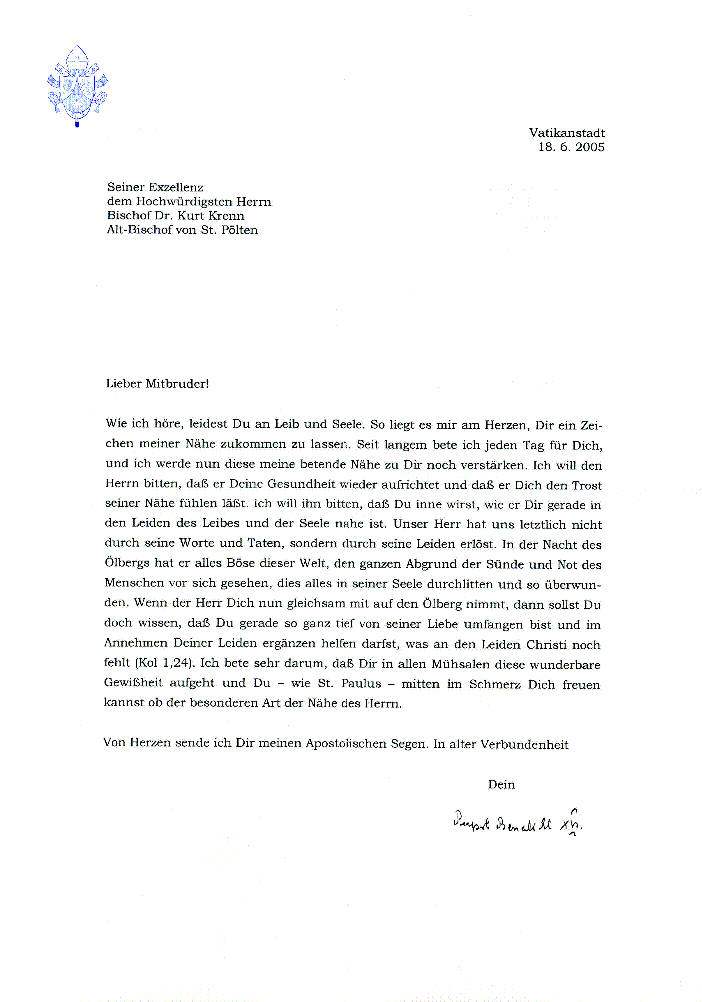
A similar issue later lead the Austrian Bishop Kurt Krenn to leave his post. Groër and Krenn were both reactionaries, and both were much favored by the previous Pope John Paul XI and Ratzinger, who was known when head of the CDF as "the Pope's Rotweiler". Pope Benedict XVI sent the disgraced former bishop a gushing letter on the occasion of Krenn's 70th birthday, emphasizing his closeness to Krenn and comparing Krenn's suffering from illness at the time to Jesus' anguish on the Mount of Olives.

I haven't commented on the current scandal, not least because the "ick" factor on it is so high. But after reading Maureen Dowd's second consecutive column taking the current scandal as the opportunity to make what she probably thinks are delightfully clever wordplays, I decided to at least post a couple of links that give more reality-based perspective that MoDo's latest dingy column, Should There Be an Inquisition for the Pope? New York Times 03/30/10.

The Christian Science Monitor (not a Catholic publication) spells out the basic elements of the controversy in Catholic sex abuse scandals: Three key cases facing Pope Benedict by Jason Walsh.

The liberal Catholic magazine Commonweal, editorially no big fan of the current Pope's direction generally, presents and editorial on the current scandal, Benedict in the Dock 03/30/10, for the 04/09/10 number of the print magazine. It gives a serious, critical-minded look at the scandal and concludes:

Some are now calling for Benedict’s resignation. That seems very unlikely. But an act of penitence on the part of the pope and the world’s bishops, one that goes well beyond pro forma apologies to victims, is desperately needed.
Religion Dispatches presents these two pieces: The Year of the Abusive Priest by Anthea Butler 03/30/10 and Abuse of Power is at the Heart of Catholic Church Scandal by Louis Ruprecht 03/29/10.

Butler writes, with perhaps an excessive touch of pessimism (or maybe she means it as optimism?) about the long-term viability of the Catholic Church:

In a sense, the Vatican has known, but has never completely grasped as an organizational entity, the scope of the scandal worldwide. The ponderously top heavy organizational Church structure prevents it from acting quickly and decisively. Hence the Vatican doublespeak and rustling cassocks rushing to declare the Pope’s bravery and determination. Meanwhile, it is left up to the secular world to judge and find wanting the ramblings of a dying institution whose complicity in its own demise is astounding.
Ruprecht argues:

I suggested in a previous post that the abuse at issue here is the abuse of power, not sexual abuse per se. I hope it is clear that, in saying this, I am not unaware of the enormous damage that is done to young children when they are sexualized before their time. But I am concerned that the Left, to the degree that it participates in the sexual obsessions of the media and the culture, runs the risk of diluting the real cause for outrage here.

The paradox at issue in these cases is that sexual abuse of children, like rape, is not primarily a sexual offense. It is primarily an exertion of power.
I really think columns like Maureen Dowd's serve to trivialize the very real issues and exhibit a cynical indifference to the victims and to the problems the Church urgently needs to address.

Tags:

Friday, January 30, 2009

Another Ratzinger special

Schismatic, reactionary Archbishop Marcel Lefebvre (1905-1991)

Pope Ratzinger I (formally Benedict XVI) just lifted the excommunication of four schismatic hard-right bishops, one of whom is an overt Holocaust denier.

Dave Neiwert gives a great account in Pope Benedict reaches out to anti-Semitic Catholics, but liberals still talk to the hand (video fixed) Crooks and Liars by David Neiwert 01/25/09. I have to admit that "talk to the hand" is a figure of speech I only recently learned what it means, i.e., talk to the hand because the ears ain't listening to you.

Lefebvre movement: long, troubled history with Judaism by John Allen, Jr. National Catholic Reporter 01/26/09. The four bishops that Ratzinger just accepted back into the Catholic Church were ordained by the late schismatic Catholic archbishop Marcel Lefebvre. Allen reports:

A troubled history with Judaism has long been part of the Catholic traditionalist movement associated with the late French Archbishop Marcel Lefebvre — beginning with Lefebvre himself, who spoke approvingly of both the World War II-era Vichy Regime in France and the far-right National Front, and who identified the contemporary enemies of the faith as “Jews, Communists and Freemasons” in an Aug. 31, 1985, letter to Pope John Paul II.

Reacting to the furor over [Bishop Richard] Williamson [the reinstated Holocaust denier], the Vatican has stressed that lifting the excommunication is not an endorsement of his views on the Holocaust, and has repeated its firm commitment to Catholic-Jewish dialogue and to combating anti-Semitism. The pope’s outreach to traditionalists should instead be seen, spokespersons said, as an "act of peace" intended to end the only formal schism in the wake of the Second Vatican Council (1962-65).
The PBS Newshour reported on the issue in Pope Draws Criticism for Pardoning Bishop 01/28/09. Their report shows Williamson declaring:

I believe that the historical evidence is hugely against 6 million Jews having been deliberately gassed in gas chambers as a deliberate policy of Adolf Hitler. I believe there were no gas chambers.
Holcaust denial is a variety of pseudohistory. But it's main purpose is sneering at Jews and victims of the Nazi dictatorship. It's also an attempt to rehabilitate the image of Hitler and Nazism, but I see that as a distinctly secondary function. Holocausts deniers' approach is so full of far-right, crackpot features that I find it hard to take seriously that most of them actually believe their own line.

Williamson's brief statement is typical. Denying that there were gas chambers in the extermination camps is straightforward denial of historical facts. But the rest of his statement is full of the kind of double-talk rightwing kooks love.

"I believe that the historical evidence is hugely against 6 million Jews having been deliberately gassed in gas chambers as a deliberate policy of Adolf Hitler, he said.

No one claims that six million Jews were killed in gas chambers. Large numbers were shot, starved or beaten to death, and so on. The "deliberately" is a nice weasel word.

The six million number originated with Adolf Eichmann, who was in a better position than most to know. I believe that most historians of the Holocaust would put the number of clearly documented deaths at between 5.2 million and 5.8 million. But they also don't challenge six million as a likely number. Leading Holocaust historians did react against a claim several years ago that newly-released files from the Soviet Union showed that the number was significantly higher than six million. The higher estimate was a serious misreading of the material.

But Holocaust deniers and Hitler apologists love to comma-dance over numbers. They insist on minimizing the number of Jews and others killed in the Holocaust. But exaggerating the number of Germans killed in the Dresden bombing in particular has been a favorite obsession of the same crowd.

Also, Williamson specifies a "deliberate policy of Adolf Hitler". A variation on Holocaust denial is to deny that Hitler himself ordered it or even knew about it. In response to David Irving's work in particular, historians have looked closely at both issues. And, despite the extreme efforts to shield Hitler from documentable responsibility, there is no serious doubt that he both ordered the killing and knew what was going on.

This is part of the problem of responding in a careful way to bald-faced liars. I say "no serious doubt" because despite overwhelming circumstantial and other evidence, we don't have a handwritten order from Hitler saying "Kill.All.The.Jews." Someone looking at the question carelessly or superficially might have some doubt. But not anyone who actually is aware of the evidence. Christopher Browning deals with this particular question in The Path to Genocide: Essays on Launching the Final Solution (1995).

Additional sources on the controversy over Ratzinger's action:

Replacing dialogue with deafness by Jonathan Romain Guardian 01/26/09

Pope’s Embrace of Renegade Bishops Dooms Jewish-Catholic Summit by Nathaniel Popper The Forward 01/27/09:

The most significant impending meeting between Jewish leaders and Pope Benedict XVI is being called off due to the Catholic Church’s recent decision to reconcile with four renegade ultra-conservative Catholics, including one who has a history of denying the Holocaust.

Israel’s chief rabbinate sent a letter to the Vatican indefinitely postponing a March summit in Rome that was to include the pope. The letter came a few days after the Vatican revoked the excommunication of four bishops from the Society of Saint Pius X, a group that opposed modernizing reforms adopted by the church during the 1960s, including efforts to reconcile with Jews. One of the four bishops in question, Richard Williamson, has said that no Jews were killed in Nazi gas chambers and has accused Jews of striving for “world dominion.”
Pope decision to rehabilitate Holocaust-denying bishop sparks Jewish-Catholic row Haaretz 01/25/09:

The Yad Vashem Holocaust Museum and Memorial in Jerusalem decried as
"scandalous" Benedict's decision to lift excommunications on British-born bishop, Richard Williamson, who has said there were no gas chambers and only 300,000 Jews perished in Nazi concentration camps in World War Two. Foreign Ministry spokesman Yigal Palmor, said, however, the pontiff's planned visit in May to Israel was not in doubt. "This has nothing to do with relations between states," he said.
Tags: , , ,

Wednesday, March 14, 2007

Vatican criticizes work of Jesuit liberation thologian Jon Sobrino

Vatican bogeyman Jon Sobrino (Photo: El Mundo/EFE)

The Vatican's Holy Office (Congregation for the Doctrine of the Faith, known previously as the Inquisition) has issued a condemnation of two works by the liberation theologian Jon Sobrino, a Spainard who has spent most of his career as a Jesuit priest in El Salvador: Vatican criticizes Jesuit liberation theologian, issues no sanctions by John Thavis, Catholic News Service 03/14/07; Vaticano reitera obra jesuita muestra discrepancias con Fe Diario de Hoy (El Salvador) 14.03.07.

Ironically, Pope Benedict XVI when he was Archbishop Ratzinger of Munich had Sobrino's doctoral thesis translated into German.

The official criticism was directed toward two of Sobrino's works in particular: Jesucristo liberador: Lectura históricoteológica de Jesús de Nazaret and La fe en Jesucristo. Ensayo desde las víctimas. Normally when a theologian's works are denounced this explicitly, a sanction is imposed forbidding the theologian to teach as an official Catholic theologian. I call it "yanking the Vatican franchise". Sometimes the person is "silenced", meaning they are forbidden to give public presentations of their ideas at all. Such sanctions do not mean that the criticized theologian is excommunicated from the Church.

In this case, the initial reports stress that there is no news of sanctions being imposed on Sobrino. But reporters may have fallen for Vatican spin on that one. The opinion piece by Elilio de Benito linked below quotes the Archbishop of San Salvador, Fernando Sáenz, as saying that if Sobrino doesn't renounce the parts of his work criticized in the Holy Office's report, he would be banned from teaching as a Catholic. You could say his Catholic "franchise" has been suspended, with removal an immediate option.

Sobrino's best-known early work was Christology at the Crossroads, which is one of the basic texts of "liberation theology". This was a viewpoint on Christian theology that stemmed from the experience of Latin American Christians who suffered from both economic deprivation and bad government, often a dictatorial kind. It grew out of an official position of the Latin American Church that emphasized a "preferential option for the poor".

It's essentially impossible to summarize a serious theological movement in a few words. But if I had to do so, I would say that it was an attempt to elaborate the social doctrines of Christianity in a way relevant to the conditions of the late 20th century, with heavy emphasis on the prophetic tradition.

One of the institutions associated with liberation theology was known as "base communities". These were associations of local people who tried to cooperatively address very practical problems in their local villages, such as digging wells. Priests working with those communities encouraged discussion of Scriptural texts in light of the social experience of the local communities.

It's not surprising that this led to a perspective on Christianity that was not comforting to the comfortable.

A favorite text of those active in the base communities and liberation theology was the passage from Luke known as the Magnificat of Mary, which includes these lines (RSV):

He has shown strength with His arm:
He has scattered the proud in the imagination of their hearts.
He has put down the mighty from their thrones,
and exalted those of low degree.
He has filled the hungry with good things;
and the rich He has sent empty away.

Sobrino teaches at the University of Central America. Fortunately for him, he was out of the country on a teaching assignment on November 16, 1989, when Salvadoran soldiers murdered six priests on the campus, including the rector of the university. An event worth remembering when we hear references to a possible "Salvador option" in Iraq.

The news articles are also fairly vague about the nature of the Holy Office's criticisms. They accused the criticized works for being in error in both methodology and content. The essential argument seems to be that Sobrino's emphasizes the humanity of Jesus too much in comparison to his divine nature. According to the Christian doctrine of the Trinity (which is so hard to understand that even theological-minded Christians wind up calling it "a mystery"), Jesus of Nazareth was both fully human and fully divine.

Though liberation theology as a movement or intellectual trend has been largely suppressed by the Church for the moment, I continue to think that approach offers some real insight into how the Christian religion can conceptualize the challenges of the Church in today's conditions. I don't think it's going away.

Other news reports:

El Vaticano hace una advertencia contra las tesis del teólogo español Jon Sobrino El Mundo 14.03.07

Jon Sobrino espera ser sancionado por el Vaticano por 'falsear la figura del Jesús histórico' El Mundo 13.03.07

La primera condena del papa Benedicto XVI El País 13.03.2007

El Vaticano sanciona a Jon Sobrino, el principal teólogo de la liberación de Emilio de Benito El País 13/03/2007

Vaticano condena la obra de Jon Sobrino, importante teólogo de la liberación El Comercio (Ecuador) 03/14/07

On the mixed performance of the current Pope Benedict XVI: The Puzzling Pope: Who Is Benedict XVI? by Andrew Greeley Commonweal 11/03/06

Tags: , , ,

Thursday, July 07, 2005

Fundamentalists and history

One of the more intriguing books I've come across on Christian fundamentalism is one that may seem somewhat unlikely: Catholicism and Fundamentalism: The Attack on "Romanism" by "Bible Christians" (1988) by Karl Keating. As the title suggests, it's a polemical work aimed at defending official Catholic beliefs against Protestant fundamentalist criticism.

In religious terms, he is writing popular "apologetics," or defending the faith against critics. Keating was trained as an attorney, which probably contributes to the appeal of apologetics for him. An organization he founded called Catholic Answers has a Web site where one can explore such arguments at greater length, if one is so inclined. They must have gotten online early, because their address is www.catholic.com. So if you've wondered about "Hunting the Whore of Babylon" or "Is Catholicism Pagan?" , this is the Web site for you.

On that last point, by the way, it's just not true that Catholics regularly practice nekkid pagan dancing on High Holy Days. Charming as the thought may be. It doesn't happen, I tell you! It doesn't!!

As Keating writes in his preface, he intended his book to focus "on those fundamentalists, whether blessed with notoriety or with anonymity, who try to convince Catholics to forsake Rome [i.e., the Roman Catholic Church] and on the arguments they make against Catholicism." In other words, he makes no claim to a dispassionate perspective.

"Apologetics" is considered a bit old-fashioned in religious education these days. (Though not in fundamentalist schools.) But sometimes polemics like this can bring out some important observations. I was particularly struck, for instance, at Keating's discussion of how fundamentalists approach history.

In a section where he talks about polemical Protestant fundamentalist claims about the adoption of Christianity as the religion of the Roman empire and about those "pagan" influences on Catholicsm, he writes (my emphasis):

If few fundamentalists know the history of their own religion - and distressingly few do - even fewer have any appreciation for the history of the Catholic Church. They become easy prey for purveyors of fanciful histories that claim to account for the origin and advance of Catholicism. ...

The first, which might be called the "pagan convert" theory, begins, most commonly, with a listing of Catholic "inventions". These are doctrines or practices that the Church allegedly adopted for the most part from paganism long after apostolic times. The first thing to notice is that in any list of "inventions" doctrines are mixed up with practices, fundamentalist writers apparently not understanding the difference.

Or, to put it another way, secular and "faith-based" history become intermixed with each other. "Mixed up" with each other is probably a better description.

To continue with the first kind of "history": Fundamentalist writers begin by listing "inventions", mixing doctrines and practices indiscriminately. They then assign dates of origin to them. They generally claim the "inventions" postdate the Edict of Milan, which was issued in 313 and made Christianity legal in the Roman Empire. This is the cutoff date, all the bad things in Catholicism supposedly arising after that point. In fact, the dating of the "inventions" is often grossly wrong or, where right, irrelevant to the point in question, which is: When did Catholicism begin?

There are a couple of interesting points here. One is that the ministers in fundamentalist churches often have a more narrow education than ministers in more mainstream denominations or, for that matter, in the Catholic Church.

But what caught my attention about this is the way that a careless mixture of the "faith-based" and the "reality-based" can be and often is encouraged by fundamentalist views of religion and history.

Now admittedly, this is an anecdotal observation. Keating is writing a religious polemic, not conducting a social science study. But I'm confident he's right about this phenomenon. (Here's where I'm expected to put in the qualification is that general observations like this don't apply to all evangelical Protestants or even to all fundamentalists; so I hereby officially insert the qualification.)

There is also a element of mysticism in Protestant fundamentalism. Limited, to be sure, but there. This is something that has continued from the heritage of Pietism, which is a significant influence on modern fundamentalism.

All of which can combine to encourage devout fundamentalists to swallow some highly ideological versions of history. Or "fanciful" versions, as Keating puts it.

We're likely to hear of lot of such "fanciful" history from the Christian Right during the upcoming battle over Bush's first Supreme Court nomination.

The notion that Christian Right advocates routinely assert that the Founders of the Constitution had no concept of the separation of church and state is a good example of what can emerge when a hodgepodge of religious militancy, vague and highly-ideologized notions of heritage/tradition/history allies itself to political authoritarianism.

Tags: , , ,

Saturday, June 18, 2005

Catholic conservatives

George Weigel of the Ethics and Public Policy Center gives us a good snapshot of the viewpoint of a conservative Catholic (himself) on the new Pope Benedict XVI in this article: What Benedict XVI Means by George Weigel The Catholic Difference 05/06/05.

The opening paragraph gives a good clue to where he's going, because it praises the new Pope, Joseph Ratzinger, as "one of the great Christian minds and spirits of our time." Ratzinger is a theologian. But his main contribution - if we can call it that - to Christian theology has been to enforce a rigid and reactionary policy in his former office as head of the Congregation of the Doctrine of the Faith.

Weigel makes his agenda even more clear in the second paragraph:

In the long view of history, though, April 19, 2005 [the date of Benedict's election as Pope], may mark the moment at which the forty-year effort to force Catholicism to tailor its doctrine and its message to the tastes of secular modernity crashed and burned.
That is a hostile polemical reference to the Second Vatican Council of 1962-65, in which the Church officially abandoned most of its effort to cling to the Middle Ages.

Catholic conservatives are currently saying that it what they see as the namby-pamby Vatican II outlook has caused a decline in the Church because of its lack of religious zeal. Now, this criticism makes some superficial sense in Europe and North America, where a probably irreversable secular trend has been at work for some time. But the reality is that in Latin America and Africa in particular, the Church has enjoyed a spectacular growth in recent decades.

Weigel explicitly complains about the reform Council:

Ever since the Second Vatican Council, some Catholics and most of the world media have expected - and in certain cases, demanded - that the Catholic Church follow the path taken by virtually every other non-fundamentalist western Christian community over the past century: the path of accommodation to secular modernity and its conviction that religious belief, if not mere childishness, is a lifestyle choice with no critical relationship to the truth of things. These expectations have involved both doctrinal accommodation (e.g., the question of whether Jesus is the unique savior of the world) and moral accommodation (e.g., the many issues involved in the post-Freudian claim that human beings are essentially bundles of desires). [my emphasis]

That quotation gives a glimpse at some of the religious and cultural perspectives that provide emotional, religious and political common ground for the various elements of what we call the Christian Right in the US. The fear of "modernity" (i.e., the last six hundred years of Western history), the exclusive claim of the Christian faith to religious truth and a pronounced fear of normal human "desires," he touches all of them in that short comment.

And he dismisses the ecumenical goals and modernizing impulses of Vatican II - including such changes in the ritual as using the language of the congregation rather than Latin in church services - with the following sneer:

Yet it is very, very difficult to argue that this strategy of cultural accommodation - which in some cases bleeds into cultural appeasement - has solved the two hundred fifty year old problem of being Christian in the modern world. Nor is it possible to demonstrate, empirically, that cultural accommodation or appeasement produce vital, growing, compelling Christian communities. Precisely the opposite is the case. Christian communities with porous doctrinal and moral boundaries wither and die. Christian communities with clear doctrinal and moral borders flourish, even amidst the acids of modernity.

Yet it was expected that the Catholic Church would, indeed must, take the path of accommodation: that has been the central assumption of what's typically called "progressive" Catholicism. That assumption has now been decisively and definitively refuted. The "progressive" project is over - not because its intentions were malign, but because it posed an ultimately boring question: how little can I believe, and how little can I do, and still remain a Catholic?

Protestant fundamentalists don't want to have church services in Latin. But this essentially reactionary impulse, the desire to go back to an idealized good old days, is very much a common denominator among the fundamentalists, Pentecostals and conservative Catholics that are attracted to the Christian Right and its causes.

Tags: , ,