Showing posts with label commander-in-chief. Show all posts

Thursday, June 02, 2016

Hillary's foreign policy speech

The big political news today was Hillary Clinton's foreign policy speech in which she attacked Trump pretty aggressively.

It got favorable reaction from the Democratic side, of course. Charlie Pierce praised it in Hillary Is Finally Figuring Out How to Attack Trump Esquire Politics Blog 06/202/2016. His post includes this pithy comment, "He, Trump is a leap in the dark on every issue known to man."

But Pierce isn't an uncritical Hillary-bot by any means:

But the speech doesn't do anything to assuage the concerns of people who wonder if she might be a tad too hawkish herself.

If the only difference between her and He, Trump is that she's not as reckless as he is, that's a cold consolation after 20 years of stalemated conflicts. Nobody's as reckless as he is.
The Hillary-bots at the somehow-Hillary-campaign-connected Blue Nation Review of course thought it was wonderful (Melissa McEwan, Hillary’s Epic Takedown of Donald Was One of the Best Moments of 2016 06/02/20160. And that the villain of the day was ... Bernie Sanders. Of course. (Melissa McEwan, One Person Attacked Hillary for Her Brilliant, Blistering Destruction of Donald: Bernie Sanders 06/02/2016)

Those folks at Blue Nation Review should review propaganda articles from the former Communist East Germany. I'm sure they would get some tips on subtlety and sophistication. But then it doesn't really take either to write variations every day on the sole theme of "Hillary is wonderful, Hillary is the best, Hillary can do no wrong, Hillary is invicible except for nasty Bernie Sander taking primary votes away from her."

Fred Kaplan in Hillary Clinton Just Kicked Trump in the Shins Slate 06/02/2016 wasn't quite in Blue Nation Review mode. But almost: "The all-but-inevitable Democratic nominee showed that she’s fit to be her own attack dog, mauling her ill-matched Republican foe to shreds without getting muddy in the process." His column is actually just a summary of some of her main applause lines. He ends with, "This election suddenly got a little bit fun."

Give Hillary this: she's attracted quite a bit of uncritical adulation!

Time has the full text of her speech. (Katie Reilly, Read Hillary Clinton’s Speech on Donald Trump and National Security 06/02/2016)

Here are some of my highlights: "If Donald gets his way, they’ll be celebrating in the Kremlin. We cannot let that happen." Yeah, Cold War nostalgia, that's just what everyone wants to hear from a Democratic Presidential candidate. Maybe she can run campaign commercials like this, How to Spot a Communist:


On the Iran agreement: "I got to work leading the effort to impose crippling global sanctions." And:

Now we must enforce that deal vigorously. And as I’ve said many times before, our approach must be “distrust and verify.” The world must understand that the United States will act decisively if necessary, including with military action, to stop Iran from getting a nuclear weapon. In particular, Israel’s security is non-negotiable. They’re our closest ally in the region, and we have a moral obligation to defend them.
And this is different from the neocon position, how? Oh, right, Hillary can do no wrong.

"Moscow has taken aggressive military action in Ukraine, right on NATO’s doorstep." But encouraging and supporting destabilizing regime changes in Ukraine, Honduras, Paraguay, Brazil, who knows how many countries in the Middle East, why that's being "firm but wise with our rivals."

"And I understand a lot of Americans have concerns about our trade agreements – I do too." Oh, yeah. So she's been saying during the campaign. Not terribly convincingly, but at least she expressing some concern during the campaign.

Over the past year, I’ve laid out my plans for defeating ISIS.

We need to take out their strongholds in Iraq and Syria by intensifying the air campaign and stepping up our support for Arab and Kurdish forces on the ground. We need to keep pursuing diplomacy to end Syria’s civil war and close Iraq’s sectarian divide, because those conflicts are keeping ISIS alive. We need to lash up with our allies, and ensure our intelligence services are working hand-in-hand to dismantle the global network that supplies money, arms, propaganda and fighters to the terrorists. We need to win the battle in cyberspace.
At least she didn't repeat her proposal for the war escalation a no-fly zone would mean, although she has advocated just that during this campaign. And she didn't talk about those famous Syrian Moderates. So we can at least be thankful for that.

"And of course we need to strengthen our defenses here at home." Because we don't have nearly enough intrusive surveillance and abusive law-enforcement practices, I guess.

And through all his loose talk, there’s one constant theme: demonizing Muslims and playing right into the hands of ISIS’. His proposal to ban 1.5 billion Muslims from even coming to our country doesn’t just violate the religious freedom our country was founded on. It’s also a huge propaganda victory for ISIS. And it alienates the very countries we need to actually help us in this fight.

A Trump Presidency would embolden ISIS. We cannot take that risk.
Because we have to evaluate everything from the standpoint of the immediate existential threat to the United States represented by ISIS. Hillary is the best.

"America stands up to countries that treat women like animals, or people of different races, religions or ethnicities as less human." Particularly when we want to bomb them and kill lots of men, women and children of whatever race or religion happens to be near our exploding bombs.

I find only four uses of "commander-in-chief" in this speech. I guess by today's standards that quasi-pacifist. Here one of them, "Americans aren’t just electing a President in November. We’re choosing our next commander-in-chief – the person we count on to decide questions of war and peace, life and death."

I know it's become common as dirt for politicians to talk about the President as "our" Commander-in-Chief. But what that quaint old Constitution of 1789 actually says is, "The President shall be the Commander-in-Chief of the Army and Navy of the United Sates, and of the Militia of the several States, when called into the actual service of the United States." The President is not anybody else's Commander-in-Chief, ever. (See: Gary Wills, At Ease, Mr. President New York Times 01/27/2007)

Hillary: "He has said that he would order our military to carry out torture and the murder of civilians who are related to suspected terrorists – even though those are war crimes." But will Hillary be any more willing than Barack Obama has been to prosecute high American officials involved in those very war crimes? I suppose there's a vanishingly small possibility that she would.

And what would a Democratic speech be with putting in a plug for some nice moderate Republican? Like John McCain: "he has the gall to say that prisoners of war like John McCain aren’t heroes." Of course, that was a scummy thing for Trump to say. But it didn't seem to phase his supporters a bit.

"I believe with all my heart that America is an exceptional country." How much more damage to the world and to the US itself is going to continue to be done in the name of that ugly brand of narrow nationalism commonly known as American Exceptionalism?

"His economic plans would add more than $30 trillion – that’s trillion with a “t” – $30 trillion to our national debt over the next 20 years." Nobody but a few unreconstructed 1990s style Clintonites actually care about the national debt. Or the deficit.

Obviously I've highlighted passages of the speech to criticize them from an antiwar perspective. But her criticisms of Trump in the speech are on the mark. And most of what she had to say about American policy was couched in sensible, realistic terms. And she is certainly more qualified to be President and Commander-in-Chief (in the Constitutional sense) than Donald Trump.

But, as Charlies Pierce also notes, "If the only difference between her and He, Trump is that she's not as reckless as he is, that's a cold consolation after 20 years of stalemated conflicts. Nobody's as reckless as he is."

And the speech doesn't do much to eliminate my chronic worry about Clinton's campaign. The underlying themes of the speech were her competence and At Least I'm Not A Republican. Or even more narrowly, At Least I'm Not Trump. For all the nice rhetoric jabs at Trump, it's essentially an appeal to the comfortable that she will keep them comfortable. And, once again, that may be enough this year against Trump.

A couple of critical perspectives on Hillary Clinton's foreign policy:

Deirdre Fulton, Clinton's Foreign Policy Speech Marred by Inherent Contradictions Commons Dreams 06/02/2016

Lesley Clark, Clinton pillories Trump’s foreign policy, but history says it won’t help McClatchy News 06/02/20106

Robert Parry, Yes, Hillary Clinton Is a Neocon Consortium News 04/16/2016

Friday, February 16, 2007

Joe Lieberman: More Republican than the Republicans?

Josh Marshall quotes the administration toady, "Independent" Joe Lieberman, pleading with the Senate to let Dear Leader Bush and Dark Lord Cheney do whatever they want:

Even as our troops have begun to take Baghdad back step-by-step, there are many in this Congress who have nevertheless already reached a conclusion about the futility of America’s cause there, and declared their intention to put an end to this mission not with one direct attempt to cutoff funds, but step by political step. No matter what the rhetoric of this resolution, that is the reality of the moment. This non-binding measure before us is a first step toward a constitutional crisis that we can and must avoid. Let me explain what I mean by a constitutional crisis. Let us be clear about the likely consequences if we go down this path beyond this non-binding resolution. Congress has been given constitutional responsibilities. But the micro-management of war is not one of them. The appropriation of funds for war is. I appreciate that each of us here has our own ideas about the best way forward in Iraq, I respect those that take a different position than I, and I understand that many feel strongly that the President’s strategy is the wrong one. But the Constitution, which has served us now for more than two great centuries of our history, creates not 535 commanders-in-chief, but one - the President of the United States, who is authorized to lead the day to day conduct of war. Whatever our opinion of this war or its conduct, it is in no one’s interest to stumble into a debilitating confrontation between our two great branches of government over war powers. The potential for a constitutional crisis here and now is real, with congressional interventions, presidential vetoes, and Supreme Court decisions. If there was ever a moment for nonpartisan cooperation to agree on a process that will respect both our personal opinions about this war and our nation’s interests over the long term, this is it. (my emphasis)
How does a democracy die? This is one way.

The Cheney-Bush administration has been trampling on the Constitution even before the day they took office, thanks to invaluable assistance from the Scalia Five in taking office despite Al Gore's election victory in 2000.

The only reason there hasn't been a "Constititional crisis" is because the Republican Congress and, for the most part, the Republican-dominated federal judiciary were willing to roll over and play dead for Cheney's theory and practice of the Unilateral Executive form of government in which the President is bound neither by law or the Constitution. It's advocates call it the "Unitary Executive" theory, but Gore's "Unilateral Executive" label is more descriptive.

The phrase "Constitutional crisis" is normally used these days when there is an actual conflict among branches of the federal government over some substantive issue. So you could say that from 2001-2006, we had a "Constitutional trampling" instead of a Constitutional crisis.

Lieberman says a Constitutional crisis is something "that we can and must avoid". And he makes it clear that what he means is that Congress should avoid such a crisis by refusing to exercise its own war powers and by meekly agreeing to continued illegal and un-Constitutional practices by Cheney and Bush.

In other words, if we just act like there's no Constitution, we won't have any crisis over it!

Lieberman gets more and more pitiful as time goes on.

The reality is more like what Paul Krugman wrote earlier this year, that 2007 and 2008 are likely to be one long, rolling Constitutional crisis.

For more on the Cheneyist notion of the "commander-in-chief", see the post by Jack Balkin that I've referenced here before, Two Concepts of Commander-in-Chief Balinization blog 02/05/07.

Tags: , , ,

Sunday, January 28, 2007

More on the "Commander-in-Chief" power

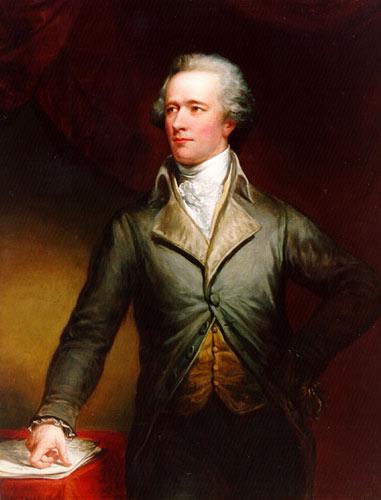
Alexander Hamilton (Photo courtesy http://www.foundingfathers.info/)

I've been thinking more about the Commander-in-Chief role of the President in the American Constitutional system. Because whether the Democrats like it or not, they have been placed in the position where in order to prevail politically, they have to fight for the Consititution against the Cheney theory of the Unilateral Executive. And the war power is the most important element in that fight, though by no means the only one.

Alexander Hamilton addressed the "commander-in-chief" role of the President in Federalist #69 (1788) in which he argued for the adopted of the proposed Constitution where he wrote:

The President is to be commander-in-chief of the army and navy of the United States. In this respect his authority would be nominally the same with that of the king of Great Britain, but in substance much inferior to it. It would amount to nothing more than the supreme command and direction of the military and naval forces, as first General and admiral of the Confederacy; while that of the British king extends to the DECLARING of war and to the RAISING and REGULATING of fleets and armies, all which, by the Constitution under consideration, would appertain to the legislature [Congress]. (my emphasis)
Hamilton compared the virtues of the Constitutional office of the President to that of the British monarchy. Hamilton in this piece takes a very different view of the status of the Presidency than the worshipful attitude today's Republicans show to George W. Bush:

The President of the United States would be an officer elected by the people for FOUR years; the king of Great Britain is a perpetual and HEREDITARY prince. The one would be amenable to personal punishment and disgrace; the person of the other is sacred and inviolable. The one would have a QUALIFIED negative upon the acts of the legislative body; the other has an ABSOLUTE negative. The one would have a right to command the military and naval forces of the nation; the other, in addition to this right, possesses that of DECLARING war, and of RAISING and REGULATING fleets and armies by his own authority.
Commenting on that essay by Hamilton, the great Constitutional scholar Edward Corwin wrote in Total War and the Constitution (1947):

Rendered freely, this appears to mean that in any war in which the United States becomes involved — one presumably declared by Congress — the President will be top general and top admiral of the forces provided by Congress, so that no one can be put over him or be authorized to give him orders in the direction of the said forces. But otherwise he will have no powers that any high military or naval commander who was not also President might not have. Additional testimony as to the purely military significance originally attached to the clause is afforded by Story's statement in his Commentaries, written nearly half a century later, that the only objection leveled against it in the States' ratifying conventions was that "it would be dangerous to let him [the President] command in person." "The propriety," Story adds, "of admitting the President to be Commander-in-Chief, so far as to give orders and have a general superintendency, was admitted." (my emphasis)
Corwin also cites Hamilton during the Washington administration as follows on Congressional war powers. This is made more notable by the fact that Hamilton, leader of the emerging Federalist Party, tended to advocate a more expansive view of Presidential power than the Jeffersonians:

Nevertheless, the executive cannot thereby control the exercise of that [Congressional] power. The legislature is still free to perform its duties, according to its own sense of them; though the executive, in the exercise of its constitutional powers, may establish an antecedent state of things, which ought to weigh in the legislative decision. The division of the executive power in the Constitution creates a concurrent authority in the cases to which it relates.
And Corwin quotes the following from the Supreme Court decision in Fleming v. Page (1850) - which does not seem to be available online, *%^$#@! - on the Commander-in-Chief power. The particular issue was whether the President on his own authority could annex the Mexican port of Tampico, which had been seized in the Mexican War:

His [the President's] duty and his power are purely military. As commander-in-chief, he is authorized to direct the movements of the naval and military forces placed by law at his command, and to employ them in the manner he may deem most effectual to harass and conquer and subdue the enemy. He may invade the hostile country, and subject it to the sovereignty and authority of the United States. But his conquests do not enlarge the boundaries of this Union, nor extend the operation of our institutions and laws beyond the limits before assigned to them by the legislative power. ...

In the distribution of political power between the great departments of government, there is such a wide difference between the power conferred on the President of the United States, and the authority and sovereignty which belong to the English crown, that it would be altogether unsafe to reason from any supposed resemblance between them, either as regards conquest in war, or any other subject where the rights and powers of the executive arm of the government are brought into question. (my emphasis)
(Hello, Supreme Court? Library of Congress? Shouldn't the full text of all Supreme Court decisions be available on-line by now? Has Cheney classified all the ones prior to 1890 or something?)

We should remember that at the time of the approval of the Constitution there were essentially no regular national Army and only a small Navy. To raise an Army, the national government had to call up state militias into national service, the same power being exercised today when National Guard (state militia) troops are called to regular service in the national armed forces. So these early discussions often talk about the national forces and the state militias when called into national service interchangeably.

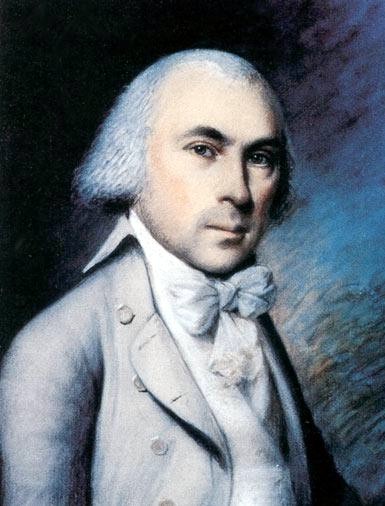
James Madison (Photo courtesy http://www.foundingfathers.info/)

In a debate in the Virginia Constitutional Covention of June 1788, James Madison addressed control over the state militias under the proposed Constitituion. He said:

The State Governments are to govern the militia, when not called forth for general national purposes; and Congress is to govern such part only as may be in the actual services of the United States. Nothing can be more certain and positive than this. It expressly empowers Congress to govern them when in the service of the United States. (my emphasis)
In other words, even though the President is Commander-in-Chief of the armed forces, it is Congress who governs them. "Nothing can be more certain and positive than this," said Madison.

Cheney's and Bush's supporters today are trying to make it sound altogether inappropriate for Congress to use its appropriation powers to set limits to the Executive's military discretion. The Founders saw the war powers of Congress very differently.

Madison's Federalist #41 1788) is particularly interesting in this regard. It was a general assumption among Americans at that time that a standing army, i.e., permanent professional national armed forces, were inherently a danger to freedom. A big reason for the Founders wanting to abandon the Articles of Confederation in favor of the Constitution was to provide more effective means for raising a national army and otherwise providing for the common defense than had been possible under the Articles.

Madison here is arguing for the Constitution and federal government's enhanced powers in that regard. But he did not at all discount the danger to free institutions of a standing army. Rather, he argued that a single nation could not determine solely on its own whether to have a standing army in given historical circumstances:

The fifteenth century was the unhappy epoch of military establishments in the time of peace. They were introduced by Charles VII. of France. All Europe has followed, or been forced into, the example. Had the example not been followed by other nations, all Europe must long ago have worn the chains of a universal monarch. Were every nation except France now to disband its peace establishments, the same event might follow. The veteran legions of Rome were an overmatch for the undisciplined valor of all other nations and rendered her the mistress of the world.

Not the less true is it, that the liberties of Rome proved the final victim to her military triumphs; and that the liberties of Europe, as far as they ever existed, have, with few exceptions, been the price of her military establishments. A standing force, therefore, is a dangerous, at the same time that it may be a necessary, provision. On the smallest scale it has its inconveniences. On an extensive scale its consequences may be fatal. On any scale it is an object of laudable circumspection and precaution. A wise nation will combine all these considerations; and, whilst it does not rashly preclude itself from any resource which may become essential to its safety, will exert all its prudence in diminishing both the necessity and the danger of resorting to one which may be inauspicious to its liberties.
Madison argued that a virtue of the proposed Constitution was that it allowed raising a sufficient national army when required but placed definite restrictions on it so that three people's elected representatives could control them. James Madison certainly did not suffer from the idolatry for the military that we see in today's authoritarian Republican Party, especially the Christian Right, and, sadly, in all to many Democrats. Madison wrote:

The clearest marks of this prudence are stamped on the proposed Constitution. The Union itself, which it cements and secures, destroys every pretext for a military establishment which could be dangerous.
And that vital safeguard was Congress' power of appropriation. The Constitution specifically limits the ability of Congress to appropriate funds for the military for longer than two years at a time, so that the elected representatives will be required to consider it again at least every two years:

Next to the effectual establishment of the Union, the best possible precaution against danger from standing armies is a limitation of the term for which revenue may be appropriated to their support. This precaution the Constitution has prudently added. I will not repeat here the observations which I flatter myself have placed this subject in a just and satisfactory light. But it may not be improper to take notice of an argument against this part of the Constitution, which has been drawn from the policy and practice of Great Britain. It is said that the continuance of an army in that kingdom requires an annual vote of the legislature; whereas the American Constitution has lengthened this critical period to two years. This is the form in which the comparison is usually stated to the public: but is it a just form? Is it a fair comparison? Does the British Constitution restrain the parliamentary discretion to one year? Does the American impose on the Congress appropriations for two years? On the contrary, it cannot be unknown to the authors of the fallacy themselves, that the British Constitution fixes no limit whatever to the discretion of the legislature, and that the American ties down the legislature to two years, as the longest admissible term.
See also Gleen Greenwald's post on this issue: Public servant v. Military Commander Unclaimed Territory blog 01/27/07.

Tags: , , ,