Showing posts with label confederate heritage month 2010. Show all posts

Friday, April 30, 2010

Confederate "Heritage" Month, April 30: Debating slavery

In my entry for April 28, I quoted from Gary Gallagher in Causes Won, Lost, and Forgotten : How Hollywood and Popular Art Shape What We Know About the Civil War (2008) about four major narratives interpreting the Civil War, including what Gallagher calls the Emancipation Cause narrative. One is the Lost Cause narrative, which is my main target of criticism in what I write about Civil War history every April.

He cites an important early historical work elaborating the Emancipation Cause narrative:

Although not as widely popular as the Union Cause, the Emancipation Cause was well represented in postwar writings. Henry Wilson’s massive History of the Rise and Fall of the Slave Power in America, published in three hefty volumes between 1872 and 1877, laid out a direct challenge to the Lost Cause. A leading Republican during and after the war, Wilson attacked slaveholders who had “organized treasonable conspiracies, raised the standard of revolution, and plunged the nation into a bloody contest for the preservation of its threatened life.” Like Douglass, Wilson considered emancipation rather than reunion to be the great triumph of the conflict — a triumph that "opened the continent to the forces of a fresher energy and a higher civilization." Seldom read or cited by historians, Wilson’s trilogy is less well known than the standard Lost Cause texts. [my emphasis]
I thought it would be a good conclusion to this year's series of posts to quote from Vol. 1 of Wilson's book. This section deals with the Virginia legislature's debate over slavery in 1831-2, which was held in the wake of Nat Turner's slave rebellion;

But the most eloquent and effective speech of this great debate was made by James McDowell, afterward governor of the State and a representative in Congress. It was a masterly portrayal of the ruin and demoralization wrought by slavery in his native State. Its wonderful and almost magical effect upon the convention is a matter of tradition in Virginia to this day. In describing the panic and terror wrought by the Southampton insurrection [Nat Turner's], and in reply to a member who had characterized it as a petty affair, he declared that it drove families from their homes, assembled women and children in crowds, in every condition of weakness and infirmity, and every suffering that want and terror could inflict, to escape the terrible dread of domestic assassination. " Was that," he asked, "a ' petty affair,' which erected a peaceful and confiding portion of the State into a military camp; which outlawed from pity the unfortunate beings whose brothers had offended; which barred every door, penetrated every bosom with fear or suspicion; which so banished every sense of security from every man's dwelling, that, let but a hoof or horn break upon the silence of the night, and an aching throb would be driven to the heart? The husband would look to his weapon, and the mother would shudder, and weep upon her cradle! Was it the fear of Nat Turner and his deluded, drunken handful of followers, which produced such effects? Was it this that induced distant counties, where the very name of Southampton was strange, to arm and equip for a struggle? No, sir, it was the suspicion eternally attached to the slave himself, — a suspicion that a Nat Turner might be in every family, that the same bloody deed might be acted over at any time and in any place, that the materials for it were spread through the land, and were always ready for a like explosion. [my emphasis in bold]
Tags: , , ,

Wednesday, April 28, 2010

Confederate "Heritage" Month, April 28: Four narrative trends about the Civil War

Gary Gallagher in Causes Won, Lost, and Forgotten : How Hollywood and Popular Art Shape What We Know About the Civil War (2008) describes four major narratives about the Civil War. One is the Lost Cause narrative, which is my main target of criticism in what I write about Civil War history every April.

The other narratives he calls the Union Cause; the Emancipation Cause which "emerged shortly after the war from black and white abolitionists and Radical Republicans"; and, the Reconciliation Cause, "a movement toward reconciliation that gained power in the late nineteenth century and remains widely evident today." The Lost Cause and Emancipation Cause narrative are largely mutually exclusive interpretations. But both mixed at various time with elements of the Union Cause and Reconciliation Cause narratives.

The Union Cause was the narrative based on the goal of preserving the Union, which was always the explicit formal war aim of the Union. With the Emancipation Proclamation, the destructive of slavery became officially part of the Union goals.

Gallagher quotes the antislavery leader Frederick Douglass defending the Emancipation Cause narrative and criticizing the Lost Cause version. He notes that Lincoln also laid out important aspects of this interpretive approach:

Abraham Lincoln’s second inaugural address foreshadowed two crucial parts of the Emancipation Cause. Delivered on March 4, 1865, it left no doubt about slaveholders’ role in precipitating the war and held up emancipation as an outcome that, to a significant degree, preceded final restoration of the Union. “One eighth of the whole population were colored slaves, not distributed generally over the Union, but localized in the Southern part of it,” Lincoln said in regard to the situation in 1860. “These slaves constituted a peculiar and powerful interest. All knew that this interest was, somehow, the cause of the war. To strengthen, perpetuate, and extend this interest was the object for which the insurgents would rend the Union, even by war; while the government claimed no right to do more than to restrict the territorial enlargement of it. Neither party . . . anticipated that the cause of the conflict might cease with, or even before, the conflict itself should cease.” At Gettysburg fifteen months earlier, Lincoln also had acknowledged the centrality of emancipation, placing “a new birth of freedom” alongside restoration of the Union as a fundamental goal of the United States war effort. [my emphasis]
The reconciliation cause was the tradition of celebrating the reconciliation of Americans North and South - white Americans, that is. Gallagher writes:

The Reconciliation Cause included major military and political figures who advocated a memory of the conflict that muted the divisive issue of slavery, avoided value judgments about the righteousness of either cause, and celebrated the valor and pluck of white soldiers in both Union and Confederate armies. It was because of American traits showcased on Civil War battlefields, the reconciliationist interpretation maintained, that a United States economic colossus stood poised by 1900 to assume a central position on the world stage. Reconciliationists often pointed to Appomattox, where Grant and Lee behaved in a way that promoted peaceful reunion, as the beginning of a healing process that reminded all Americans of their shared history and traditions. Although sometimes combining with elements of the Union Cause and even the Emancipation Cause, the Reconciliation Cause most often was characterized by a measure of northern capitulation to the white South and the Lost Cause tradition. [my emphasis in bold]
One part of this happy reconciliation of white people was that Northern whites agreed to look away from the fact that the national Constitution was being daily trampled upon by the denial of basic rights to African-American citizens in the former Confederacy.

Tags: , , ,

Tuesday, April 27, 2010

Confederate "Heritage" Month, April 27: Re-writing history

Historian Gary Gallagher in Causes Won, Lost, and Forgotten : How Hollywood and Popular Art Shape What We Know About the Civil War (2008) gives a clear example about how the former Confederate President and Vice President, Jefferson Davis and Alexander Stephens told a very different story about the role of slavery in bringing on the Civil War after the war was over than the did when they were beginning the war:

In the spring of 1861, as the Confederate government began its stormy life, both Stephens and Davis acknowledged slavery’s importance to their experiment in nation-building. On March 21, in his famous “Cornerstone Speech,” Stephens observed that the new Confederate constitution “put at rest forever all the agitating question relating to our peculiar institution— African slavery as it exists among us. . . . This was the immediate cause of the late rupture and present revolution ,” Stephens averred, adding without equivocation, “Our new government is founded upon . . . , its foundations are laid, its cornerstone rests, upon the great truth that the negro is not equal to the white man; that slavery, subordination to the superior race, is his natural and moral condition. This, our new Government, is the first, in the history of the world, based upon this great physical, philosophical, and moral truth.”

Shortly thereafter, Davis justified secession on the grounds that Abraham Lincoln and the Republican Party planned to exclude slavery from the territories, in turn rendering “property in slaves so insecure as to be comparatively worthless, and thereby annihilating in effect property worth thousands of millions of dollars.” Confronted with this threat to economic “interests of such overwhelming magnitude,” added Davis, “the people of the Southern States were driven by the conduct of the North to the adoption of some course of action to avert the danger with which they were openly menaced.”? The two men’s postwar memoirs told a different story. In A Constitutional View of the Late War between the States, a tedious two-volume work published in 1868 and 1870, Stephens did his best to push slavery into the background. He claimed that the “war had its origin in opposing principles . . . a strife between the principles of Federation, on the one side, and Centralism, or Consolidation, on the other. Slavery, so called, was but the question on which these antagonistic principles, which had been in conflict, from the beginning, on divers other questions, were finally brought into actual and active collision with each other on the field of battle.” Davis took a similar tack in his two-volume memoir titled The Rise and Fall of the Confederate Government. He asserted that the South waged war solely for the inalienable right of a people to change their government— to leave a Union into which, as sovereign states, they had entered voluntarily. “The truth remains intact and incontrovertible,” Davis stated, echoing Stephens, “that the existence of African servitude was in no wise the cause of the conflict, but only an incident.”?
Yes, these great honorable Southern white men just made stuff up to fit their postwar needs. How will we tell the children?

Tags: , , ,

Monday, April 26, 2010

Confederate "Heritage" Month, April 26:

I quoted yesterday from the two-part particle by Lee Benson and Cushing Strout took on some then-contemporary issues in professional historiography in "Causation and the American Civil War. Two Appraisals" [i.e., separate ones by Benson and Strout] History and Theory 1:2 (1961). Today I want to look at another aspect of the issue of historical causation Cushing Strout discusses, the need to examine "what if" scenarios. Or, as Stout calls it, the "conditional query".

Looking at an alternative "what if" scenario can be useful in evaluating the significance of a particular event in the narrative flow the historian is developing. Stout uses the example of an alternative speculation about the 1860 Presidential election:

If the historian wonders why the South seceded after Lincoln's election, he might ask himself what would have happened if Senator Douglas had been elected. Since Southern Democrats had already rejected Douglas at the Charleston Convention, they might have found him intolerable as president. The historian cannot be sure, but the question points up the South's demands and highlights the importance to Southern eyes of Lincoln's being the leader of a sectional party committed to containment of slavery. Since men who act in history must calculate the possible consequences of various alternatives, the historian in trying to understand them is led to do the same.
He offers a different sort of example with considering scenarios in which the Civil War was avoided:

A merely utopian conditional question allows equally plausible but contradictory answers. It has, for example, been argued that if the North had let the South secede in peace, the two nations would have enjoyed future friendly relations, thus saving the terrible costs of war. It is not surprising that a Southerner might find this assumption convincing, but it clearly includes too many imponderables to justify any firm judgment. To raise questions that cannot be reasonably answered is an exercise in futility unless they are treated only as the indirect means of drawing attention to elements of an actual situation. Asking what would have happened if the North had "let the erring sister go", only serves to force a weighing of Lincoln's policy reasons for holding a symbol of federal authority in the South, as well as of the nationalistic sentiments of the Northerners who supported him. Provided the historian maintains his primary interest in what actually did happen, he may with propriety, under certain conditions, ask what might have happened or what would have happened. Such questions are especially useful for evaluating policy. [my emphasis]
Stout's point is that while such devices can be useful in evaluated what actually happened, what's important for the historian is the narrative of what actually happened in its various dimensions. The consideration of hypotheticals is valid as an aid to understanding and explaining what happened, but not as an excuse for ducking that task.

Or, as Strout puts it:

The historian conventionally speaks of "multiple causes" because he knows he has no monistic formula to explain the course of history and no single generalization to cover all the necessary and sufficient conditions for a civil war. This fashion of speech is, however, misleading because he cannot escape his difficulties by multiplying them. If he does not believe that each of the many "causes" could have produced the Civil War by itself, then he must assume that the whole collection of them acted together as one in bringing about that effect. He is then left with the familiar problem of accounting for this causal relation- ship by reference to confirmed generalizations. What he cannot do for one "cause", he cannot do for a set of them acting as one. [my emphasis]
Lost Cause Civil War revisionists like to use the complexity of the events leading up to the war to try to detract attention from the centrality of slavery to causing the war. But if approached realistically, that only multiplies the difficulties in the way that Stout says. If something other than slavery led to the war, one would have to explain how it was that all the major sectional controversies leading up the war somehow turned around the institution of slavery.

And, as Stout says, "It is worth emphasizing that the ultimate verification of any particular explanation of the Civil War will imply the elimination of all other explanations." Lost Cause dogma attempts to do exactly that with slavery: eliminate it as an explanation of the Civil War. But that just cannot be done with honest history.

Tags: , , ,

Sunday, April 25, 2010

Confederate "Heritage" Month 2010, April 25: Causation in history

Back in 1961, Lee Benson and Cushing Strout took on some then-contemporary issues in professional historiography in "Causation and the American Civil War. Two Appraisals" [i.e., separate ones by Benson and Strout] History and Theory 1:2 (1961). They focused on some of the challenges presented by determining causation for historical events. They were primarily addressing academic historians, so they weren't specifically addressing deliberate falsifications of history like those so common to Lost Cause/neo-Confederate pseudohistory. The Lost Cause/neo-Confederate narrative, of course, is also found in academic history, unfortunately. Though in the professional context, historians have tended to treat the Lost Cause arguments of historians like those of J.G. Randall and Avery Craven as mistaken analysis. There is a difference between bad analysis and just making stuff up, though the former can encourage the latter.

Cushing Stout makes this important point about how the notion of causation emerges in history writing:

The causal problem would be greatly clarified if both historians and philosophers realized that in telling a story the historian is committed to the "logic" of drama. In explaining the Civil War he necessarily seeks to recreate the strife of opposing forces out of which the war came. The connective tissue of his account then has a dialectical form: a person or group takes a position and performs an action because of and in relation to the position or action of another person or group. The historian's story becomes a narrative of this reciprocal response.
This was during the Cold War, so he is careful to specify that his use here of a "dialectical method does not entail any Hegelian scheme."

Thus, by a crude sketch, the explanation of the event would have this character: Lincoln saw in the South's pro-slavery position a threat to the democratic traditions of the American community; the South saw in his election the menace of future interference with their "peculiar institution" and growing domination by an industrial North; Lincoln and the North saw in Southern secession a challenge to federal authority and the prestige of national union; the South saw in the provisioning of Fort Sumter an intolerable danger to independence of the Confederacy... [ellipsis in original] In such terms, but with much greater richness and concreteness, the historian tries to reconstruct the dramatic "logic" of a sequence of events which demands to be humanly understood rather than scientifically explained. [my emphasis]
Stout puts the matter of slavery within the context of the narrative nature of history:

The pragmatic meaning of the assertion that slavery was "the fundamental cause" is only that the institution was so deeply entangled in the issues that divided the sections that it provides a valuable focus for examining the skein of events which culminated in war. [my emphasis]
Taken in isolation, that statement could be twisted to say that Stout was saying that slavery is just a convenient way for telling the story but not the actual cause of the Civil War. But in the context of his article, that is clearly not what he is saying. He continues directly:

The historian does his work in good conscience, despite the difficulties of causality, because so much of his labor does not depend upon causal judgment. Whatever some philosophers may say, he knows that explanation is broader than causal explication. He may tell his readers much about the issues between Lincoln and Douglas, the legal status of slavery, the structure of classes in society, the economic interests of the sections, the character of the abolitionist movement, the balance of power in the Senate, the social and ideological differences between North and South, and the chronology of events without venturing beyond descriptive analysis into causal judgment. Characteristically, the historian explains by showing how a certain process took shape, answering the "why" with more of the "what" and "how". "The careful, thorough and accurate answer to the question How", writes the English historian C. V. Wedgwood, "should take the historian a long way towards answering the question Why..." The historian is inescapably committed to narrative. [my emphasis in bold]
In other words, it is possible for historians to honestly and legitimately disagree about the particular roles that some individuals played in events or what weight should be given to which factors in evaluating what happened.

Making up claims that don't accord with the facts, e.g., Robert E. Lee's alleged prewar opposition to slavery, is a different issue. So is arbitrarily constructing the narrative in a way that falsifies actual occurrences, i.e., the pretension that Southern leaders were so deeply dedicated to "states rights" in the decades leading up to the Civil War that the fact that slavery was also a "states rights" issue made slavery incidental to their commitment to "states rights" as their reason for seceding. And so is deliberately ignoring the obvious, like the Lost Cause habit of ignoring the many prominent, explicit, and unambiguous references to slavery as the central concern of the secessionists.

Stout's point about the why emerging from the narrative of the what and how (and, obviously, the who) is important. Causation in history can't be tested in a laboratory experiment where the laboratory conditions are repeated many times and by separate teams in different places. They have to be deduced from events, each of which has significant unique features. As Stout puts it:

Grateful as the historian may be for generalizations about, say, the voting behavior of Americans, he is ruefully aware that recurring evidence for the behavior of Americans in civil wars is fortunately not available.
But that doesn't mean that determining causation in history is impossible. Or even necessarily all that difficult, depending on the situation. It just means that history isn't chemistry or physics.

Tags: , , ,

Saturday, April 24, 2010

Confederate "Heritage" Month 2010, April 24: Racial voting patterns in 2008

Stephen Ansolabehere, Nathaniel Persily and Charles Stewart III did an article that publicly available for the April 2010 Harvard Law Review called Race, Region, and Vote Choice in the 2008 Election: Implications for the Future of the Voting Right Act. There's a lot of talk these days about the role of racism in current politics. More specifically, white racism, though out star pundits are reluctant to be quite that specific most of the time: that might imply that there's an issue on which "one side" is the main problem.

Our Big Pundits often do a sloppy job of talking about it. (Big surprise there!) But this article by Ansolabehere et al is a reminder that a very official determination about racial voting patterns and the heightened risk of racial discrimination in voting is part of the legal system in connection with the Voting Rights Act.

The current Voting Rights Act is a continuation of the Voting Rights Act of 1965, which delivered the death blow to the old, corrupt segregation-era of suppressing African-American votes in Deep South states. Maybe "death blow" is too strong a term, since the Republicans are now attempting vote-suppression efforts straight out of the old segregationist playbook and doing it on a nationwide basis. But the Voting Right Act remains a legal barrier to that practice.

The opening Abstract of the article summarizes the bottom line:

The election of an African American as President of the United States has raised questions regarding the continued relevance and even constitutionality of various provisions of the Voting Rights Act (VRA). Barack Obama’s apparent success among white voters in 2008 has caused some commentators to question the background conditions of racially polarized voting that are key to litigation under section 2 of the VRA. His success in certain states, such as Virginia, has also raised doubts about the formula for coverage of jurisdictions under section 5 of the VRA. This Article examines the data from the 2008 primary and general elections to assess the geographic patterns of racial differences in voting behavior. The data suggest that significant differences remain between white and minority voters and among jurisdictions that are covered and not covered by section 5 of the VRA. These differences remain even when controlling for partisanship, ideology, and a host of other politically relevant variables. This Article discusses the implications of President Obama’s election for legal conceptions of racially polarized voting and for decisions concerning which jurisdictions section 5 ought to cover.
Conservatives like to use the argument that Obama's election as President shows that white racism is effectively ended for all practical purposes. Whether they imagine that anyone believes that, least of all the most devoted followers of Rush Limbaugh, Glenn Beck and the lesser lights of hate radio. But that argument not only becomes a one-size-fits-all excuse to deny that there's any manifestation of white racism among conservatives. It also serves as an argument to weaken the protection of the VRA at a time when Republicans have been mounting aggressive efforts at suppression on nonwhite voting. Ansolabehere et al give this more realistic summary of the racial implications of the Obama election:

Obama’s relative success in many other states may reveal the potential for minority candidates in those jurisdictions. In many states, all outside the South, Obama was able to win the white vote and therefore win the state. In still others (ten states according to the exit polls, including North Carolina, Virginia, and Florida), he lost among whites, but minority voters put him over the top. Finally, there are the states he lost, where he did not win a substantial share of the white vote and/or the minority population was not sizable enough for him to make up for that loss. To use the parlance of [VRA] section 2 to describe the geography of his victory: some states exhibited low rates of white bloc voting, and in others, despite high bloc voting, the minority community could still elect its candidate of choice. [my emphasis]
As the article explains, VRA opponents have mounted a Constitutional challenge to a section of the current version of the law which states, "The continued evidence of racially polarized voting in each of the [covered] jurisdictions ... demonstrates that racial and language minorities remain politically vulnerable, warranting the continued protection of the Voting Rights Act of 1965." The article deals with the issue of the constitutionality of the "racially polarized voting" provision. But my main interest here is in the factual determination that racially polarized voting is a reality in several states, most of them from the old Confederacy.

States currently covered by VRA, which requires additional monitoring and review of those states' voting procedures and practices, include all of the states of Alabama, Alaska, Arizona, Georgia, Louisiana, Mississippi, South Carolina, Texas, and Virginia, though some municipalities in Virginia have been excluded. Individual counties in some other states are also covered. See the Justice Department's current map at Section 5 Covered Jurisdictions.

Yes, Sarah Palin's home state is one of the two states not from the old Confederacy that have statewide coverage under VRA. Does anyone need to wonder why Arizona is included? Although as the irrepressible JC Christian ("Jesus' General) points out, Arizona has made Jim Crow into "Jose Crow". He also tweets, "Lester Maddox family to sue AZ for trademark infringement" and "AZ's new #JoseCrow law is the perfect way to end Confederate Heritage Month."

The article also discusses some real problems complicating the effort to fairly estimate the racial component of voting patterns, such as the correlation between party affiliation and race. They observe:

... in a strict statistical sense, neither race nor party causes someone to vote for a particular candidate. Rather, at most, they represent group characteristics that might shed light on the reasons — racial identity or animus on the one hand, or ideological affinity and partisan loyalty on the other — why a voter might prefer one candidate over another. Even if multivariate analysis might demonstrate that partisanship is a more powerful predictor of candidate preferences than race, divergent voting behavior is still what prevents minorities under certain districting arrangements from having an “equal opportunity to elect” their preferred candidates.
Equal opportunity to elect is a particular legal concept used in voting rights law.

The Ansolabehere et al piece provides a wealth of voting statistics and analysis to warm the hearts of political junkies everywhere. But the point I'm emphasizing here is that their findings point to the same phenomenon documented in the "Old Times There Are Not Forgotten: Race and Partisan Realignment in the Contemporary South" American Journal of Political Science 49:3 (July 2005) article that I discussed two days ago. Voting patterns in the South continued to show significant differences from the rest of the country with race counting as a major factor, a heritage of generations of Jim Crow laws and Lost Cause ideology and education - a heritage enthusiastically continued by today's Republican Party.

Ansolabehere et al were looking at "covered" states and counties, i.e., those falling under the VRA, which therefore include Alaska and Arizona and a few other non-Southern counties. They found, if anything, racial polarization in voting increased in the covered areas between the 2004 and 2008 Presidential elections. And this is after controlling statistically for both partisan and ideological factors:

Almost half of the variance in presidential voting results [in 2008] between covered counties can be explained by their racial makeup. ...

Although demographic and ideological variables account for much of the difference between whites in the covered and noncovered states, living in a covered state was a statistically significant factor for whites voting against Obama in 2008. This was not the case in 2004. The differences between whites in the covered and noncovered states could be attributed to such demographic and ideological variables when John Kerry ran against George W. Bush. The same cannot be said when Barack Obama ran against John McCain.
Tags: , ,

Friday, April 23, 2010

Confederate "Heritage" Month 2010, April 23: Christopher Centner on neo-Confederacy

I wish the article by Christopher Centner, "Neo-Confederates At the Gate: The Rehabilitation of the Confederate Cause and the Distortion of History" Skeptic 9:3 (2002) were freely available online. It gives a solid overview of the Lost Cause/neo-Confederate pseudohistory scam. A portion of it is available here.

Centner writes (perhaps a touch overdramatically):

The Neo-Confederates' power is in their conviction and their dedication to ancestral, religious and ethnic pride. History is a full-contact sport and the Neo-Confederates take their evangelism seriously. Neo-Confederates are well organized, educated, and have a vision. They have heard the call to battle, and wage it relentlessly with revisionist zeal. Those more loyal to historical accuracy need to defend historical truth or lose the future to an ugly past.
Centner discusses several strands of neo-Confederate propaganda: "heritage defenders" like the Sons of Confederate Veterans (SCV) and the United Daughters of the Confederacy (UDC); "Agrarian Romantics" inspired by the essays in I'll Take My Stand (1930) which romanticized the Old South and segregation - he writes that Southern Partisan magazine "takes much of its inspiration" from that book: libertarians, in particular the LewRockwell.com website; "Christian Soldiers" who bring a fundamentalist religious emphasis to idolizing the Confederate - he cites Jim Langcuster and Charles Jennings as examples of this tendency; and, overt racists, among whom he includes Michael Andrew Grissom and far-right groups who emphasize their supposed Celtic heritage.

Although he doesn't group them all under those classifications, he also mentions several organizations and individuals then prominent among the neo-Confederate set: the Council of Conservative Citizens (CCC; the successor organization to the White Citizens Council); the Heritage Preservation Association (which may be defunct now); the League of the South (which is pretty much a white supremacist group); the Southern Party (which if this Wikipedia entry is correct was a front group for the League of the South and was disbanded in 2003); the Lawful Government of the South Fellowship (also apparently defunct); Mad Annie Coulter; columnist Charley Reese; and, The Washington Times. It's not unusual for fringe groups to come and go. They merge and change their names, dissolve in faction fights, lose all their members, whatever. But, as Republican Governors Bob McDonnell of Virginia and Haley Barbour of Mississippi have reminded us this month, neo-Confederacy is alive and well, including among senior figures in the Republican Party.

Centner makes a couple of good points about typical styles of neo-Confederate/Lost Cause arguments. One is technically known as, making stuff up (I've inserted an extra paragraph break):

Inaccurate or made-up quotes are favorite Neo-Confederate tools. Fraudulent quotations are nearly impossible to falsify, since they have no antecedent. Thus, Neo-Confederates have Grant keeping slaves until the Thirteenth Amendment passed, justifying his actions by saying, "Good help is so hard to come by these days."

"As for the alleged quotation from Grant, I have never seen it before and cannot believe it for a single moment," commented the Ulysses S. Grant Association's John Y. Simon. "[H]e freed the only slave he ever owned in 1857. The slaves to whom the writer referred were owned by his wife, which was a different matter. These slaves, incidentally, would have been freed by Missouri law in early 1865, rather than awaiting the ratification of the 13th Amendment. Old Confederates used to crow that Grant owned slaves when he accepted the surrender at Appomattox, Lee did not. This is wrong."
He also does a take-down of the "Black Confederates" claim that African-Americans served in the Confederate army. As he points out, most of these claims are "based upon second-hand reports, obviously false reports, and folklore." The claim of Black Confederates has been a favorite hobby-horse of the Lost Cause crowd for years now. It's used to reinforce their key pseudohistorical claim, that slavery was not the cause of the Civil War.

For a more recent takedown of one current favorite piece of SCV propaganda on this topic, see Kevin Levin's Looking For Silas Chandler Civil War Memory 03/28/10.

Tags: , , ,

Thursday, April 22, 2010

Confederate "Heritage" Month 2010, April 22: The Republican Southern Strategy


Nicholas Valentino and David Sears reported on their study about white racism in Southern voting patterns in "Old Times There Are Not Forgotten: Race and Partisan Realignment in the Contemporary South" American Journal of Political Science 49:3 (July 2005). They concluded that what pretty much everyone involved with politics assumes is actually demonstrably true: that appeals to white racism among Southern white voters played a decisive role in the shift of national voting patterns to the Republican Party since the mid-1970s.

Their article is a reminder, though, of how challenging it is to measure the actual effects on voting patterns of a factor like racism, which doesn't translate easily into numerical factors, in contrast to a factor like income levels or occupation.

I won't try here to recite the various results of their regression analysis. But they tried to differentiate between what they call "Jim Crow racism" and "symbolic racism", which roughly translate to, respectively, support for explicit official segregation and emotional racism. They note of "symbolic racism":

In recent years, ... it has consistently been conceptualized and measured in terms of four themes: the denial of discrimination, criticism of blacks' work ethic, and resentment of blacks' demands and treatment by the broader society, which together form a logically, psychologically, and statistically coherent belief system ...
They also tried to differentiate between racial attitude and more general ideological attitudes in Southern whites' voting patterns. They state their findings this way:

This result is consistent with the conventional wisdom about the increasing regularization [i.e., alignment] of ideology and party in the South. What we add is that the impact of specifically racial conservatism on party identification also has been growing in the white South. ...

The regional difference in the effects of symbolic racism, but not in the effects of ideology, suggest that specifically racial attitudes have structured the Southern-based partisan realignment of the past four decades. ...

We would conclude that racial conservatism seems to continue to be central to the realignment of Southern whites' partisanship since the Civil Rights era. [my emphasis]
They make an important point, though their explanation doesn't make it jump out at the reader. But what they found is that during the three-decade period under review, white racism had become increasingly important in the South in attracting white voters to the GOP.

They also found:

... that at the end of the Civil Rights era Southern whites were more racially conservative than whites living elsewhere. More important for our purposes, the regional gap in racial conservatism has not closed since then, despite the sharp drop in Jim Crow racism. Southern whites remain more racially conservative than whites elsewhere on every measure of racial attitudes ordinarily used in national surveys. ...

Racial policy attitudes were more closely linked to the vote in the South than elsewhere in the 1990s, but nonracial policy attitude yielded no such regional differences.[my emphasis]
They caution, however, that their study may have over-controlled for the effects of non-racial ideology, and therefore they may have "underestimated the effects of racial conservatism." (my emphasis) In other words, "seemingly race-neutral conservatism may itself have become partially racialized" in a way that they approach couldn't adequately distinguish.

Part of the evidence for the salience of racial issues among Southern white voters comes from Lost Cause/neo-Confederate themes:

... a number of quite heated and largely symbolic racial issues have arisen in the South. Several states have witnessed roiling debates about the use of Confederate battle symbols on public insignia. The NAACP organized a boycott of tourism in South Carolina in 2000 until the state legislature voted to remove the Confederate battle flag from atop the state house. The victory for opponents of the flag was limited, since the agreement provided that it be flown near a Confederate monument on the statehouse lawn. A similar flag controversy played out in Mississippi in 2001. Georgia's flag controversy may have contributed to the victory of the state's first Republican governor since Reconstruction, Sonny Perdue.

The Southern parties today are split quite decisively along racial lines. Republicans are almost all white, and blacks are the dominant core of the Southern Democratic party ... [my emphasis]
They make these informed speculations about the reasons for the larger role of white racism in Southern politics:

We have argued that racial conservatism has been a significant contributor to party realignment in the white South. But what have been the mechanisms by which this has happened? At the level of the individual voter, the primary cause of the persistence of these regional differences is presumably the transmission of a broad culture of racial conservatism in the South across generations. For example, lifelong white Southerners seem to be more racially conservative than in-migrants ... and even young white Southern adults were consistently more racially conservative than their counterparts in other regions in the late 1980s ... Beyond that, our reasoning suggests that the linkage between racial attitudes and political preferences should be strongest for the youngest white Southerners, who were socialized as the parties were realigning. In-migrants to the South in the latter half of the twentieth century may also have adopted partisan identities consistent with their racial attitudes prior to, or following, their migration. It is also possible that race continues to be more salient in Southern culture than elsewhere, which might explain the added potency of racial attitudes there. These questions go beyond the scope of this article, but they are important for understanding the persistence of regional cultures and the dynamic processes underlying partisan realignments. [my emphasis]
They called it a presumption. But in many cases, it's a cold fact, and one that still gives me a particularly sad feeling, though it's not surprising at all: "the transmission of a broad culture of racial conservatism in the South across generations." Racial conservatism is, of course, in plain English, white racism.

Tags: , ,

Wednesday, April 21, 2010

Confederate "Heritage" Month 2010, April 21: Neo-Confederacy in present-day politics

Frank Rich, like most star pundits, is often careless in his analysis and not always as careful of factual narrative as we should be able to expect. But in Welcome to Confederate History Month New York Times 04/17/10, he does a reasonable job of placing the Lost Cause/neo-Confederate ideology into the context of today's politics. He gives an example of the kind of make-up-your-own-facts approach that the whole Lost Cause/neo-Confederate tradition has always promoted:

It's kind of like that legendary stunt on the prime-time soap "Dallas," where we learned that nothing bad had really happened because the previous season's episodes were all a dream. We now know that the wave of anger that crashed on the Capitol as the health care bill passed last month — the death threats and epithets hurled at members of Congress — was also a mirage.

Take it from the louder voices on the right. Because no tape has surfaced of anyone yelling racial slurs at the civil rights icon and Georgia Congressman John Lewis, it’s now a blogosphere “fact” that Lewis is a liar and the “lamestream media” concocted the entire incident. The same camp maintains as well that the spit landing on the Missouri Congressman Emanuel Cleaver was inadvertent spillover saliva from an over-frothing screamer — spittle, not spit, as it were.
Obviously, there are other sources of people making up their own facts, as we see with the creationists and climate-change deniers.

Rich mentions the long history of Lost Cause dogma:

In “Race and Reunion,” the definitive study of Civil War revisionism, the historian David W. Blight documents the long trajectory of the insidious campaign to erase slavery from the war’s history and reconfigure the lost Southern cause as a noble battle for states’ rights against an oppressive federal government. In its very first editorial upon resuming publication in postwar 1865, The Richmond Dispatch characterized the Civil War as a struggle for the South’s “sense of rights under the Constitution.” The editorial contained not “a single mention of slavery or black freedom,” Blight writes. That evasion would be a critical fixture of the myth-making to follow ever since. [my emphasis]
And Rich gives a good, brief description of the weird contradiction the present-day Republican Party has embraced:

What is known is that the nearly all-white G.O.P. is so traumatized by race it has now morphed into a bizarre paragon of both liberal and conservative racial political correctness. For irrefutable proof, look no further than the peculiar case of its chairman, Steele, whose reckless spending and incompetence would cost him his job at any other professional organization, let alone a political operation during an election year. Steele has job security only because he is the sole black man in a white party hierarchy. That hierarchy is as fearful of crossing him as it is of calling out the extreme Obama haters in its ranks.
Tags: , , ,

Tuesday, April 20, 2010

Confederate "Heritage" Month 2010, April 20: John Wilkes Booth's racism


John Wilkes Booth (1838-1865), actor, assassin and white supremacist

David Talbot reviewed the biography of Abraham Lincoln's assassin, the actor John Wilkes Booth, American Brutus: John Wilkes Booth and the Lincoln Conspiracies (2004) by Michael Kauffman, in Old times there are not forgotten Salon 11/19/2004. Wilkes was a passionate Confederate sympathizer who infamously shot President Lincoln in the head in Ford's Theater on April 11, 1865. As Talbot characterizes it, Lincoln's assassination "was the first act of political terror as public spectacle in American history."

Talbot's review draws some forced and not very perceptive comparisons to the sectionalism of the Civil War and that of American politics in 2004. But he also gives this description of Booth's outlook that shows what a prominent role white racism played in his decision to kill Lincoln:

According to Kauffman, Booth found the resolve he needed to carry out his monumental deed on the evening of April 11, as a crowd gathered underneath a window in the north portico of the White House to hear President Lincoln speak on the recent surrender of Gen. Robert E. Lee to Gen. Ulysses S. Grant. Among those at the front of the crowd were Booth and his co-conspirator Dave Herold. When Lincoln told the crowd that he favored giving voting rights to those "colored" men who were "very intelligent" and who had served in the Union Army, that was all Booth needed to hear. "That means nigger citizenship. Now, by God, I'll put him through," spat Booth, as he spun on his heels and pushed his way out of the throng.

Much of Booth's anti-Lincoln zeal derived from his code of Southern white supremacy. He believed that slavery was not a sin, but a boon for black Americans, who were much better off living on a Southern plantation than in Africa. "I have been through the whole South," he declared, "and have marked the happiness of master and of man." According his sister Asia's memoir, young Booth liked to spread happiness on his family farm in Maryland by throwing candies from his saddlebag onto the ground and watching "the Nigs" scramble to pick them up. "After it Nigs! Don't let the dogs get it!" Booth would yell to the family servants. "The never-forgotten bag of candies was longingly looked for by the blacks, young and old, whenever 'Mars Johnnie' came from town or village," Asia lovingly recalled. Booth's idyllic society -- where whites and blacks, the well-bred and the common, all knew their place -- was threatened by Lincoln, a man Booth, steeped in Southern chivalry, reviled as a coarse demagogue. A reporter once told Booth that the president, who was an avid theatergoer, had "rapturously" applauded one of his performances; he'd rather have the applause of a black, snapped the actor. [my emphasis]
Tags: , ,

Monday, April 19, 2010

Confederate "Heritage" Month, 2010: April 19


Jon Grinspan in "'Young Men for War': The Wide Awakes and Lincoln's 1860 Presidential Campaign" The Journal of American History 96:2 (Sept 2009) writes about a Republican campaign organization in 1860 called the Wide Awakes, which organized young men to take active part in the Republican campaigns that year, including Lincoln's Presidential campaign.

Grinspan makes an argument that fits nicely into a Lost Cause version of the Civil War. It's validity as historical analysis is another matter.

The argument is that the Wide Awakes were nonviolent groups but organized on military-like disciplines. And their existence scared white Southerners into thinking the Black Republicans (as the Southerners called them) were out to forcibly conquer them. And thus the existence of the Wide Awakes was an important factor in the outbreak of the Civil War. As he frames his argument:

The militarism of the Wide Awakes helps explain how the election of Lincoln sparked the Civil War. Historians have long pondered the missing link between the complex politics of the 1850s and the war. It is difficult to believe that the Civil War could have erupted as a popular conflict—with hundreds of thousands of excited volunteers—unless political debates were transformed into larger cultural motivators. The Wide Awakes enabled that transformation. The movement’s dangerous use of militarism for political purposes unintentionally bled into powerful cultural agitation that terrified southerners. Young northerners equipped with uniforms and torches sent an ominous message to those already apprehensive about the Republican party’s antisouthern attitudes. While certainly not a cause of the war, the Wide Awakes’ presence ratcheted up sectional pressure and invested Lincoln’s election with weighty significance. Understanding how the organization worked helps connect the political and military campaigns. [my emphasis]
His article shows signs of trying to put some original conclusion on top of a set of arguments that don't begin to bear its weight.

Grinspan's argument that the Wide Awakes particularly alarmed the South doesn't amount to much more than finding the occasional reference to the Wide Awakes as one more sinister sign of the North's nefarious intentions. The slave states were finding more immediate dangers to fret over during 1860s than peaceful demonstrations by Republicans campaigners in Yankee cities. As William Freehling describes in The Road to Disunion, Vol. 2: Secessionists Triumphant, 1854-1861 (2007), during 1860 they were obsessing over the possibilities of arson and poisonings by their loyal, loving slave property. Like most of these types of things, the rumors were at least 99% paranoia.

The real threat to slavery from a Lincoln victory came from two key considerations. Having immediate emancipation forced upon the slaveholders was not one of them; Lincoln and the Republicans had no intention of imposing such a solution. Nor was the danger of Republicans inciting slaves to insurrection. But the Republicans did intend to block the further extension of slavery, either from expanding slavery into existing territories or through acquiring new territories in the Caribbean or Central America.

And once the Republicans had the Presidency, they would control federal patronage in the Southern States. That meant they could use their power to appoint postmasters and other officials to build an active Republican Party in the South and thus overcome the near-total block on dissenting opinions among whites over the basic issue of slavery's existence in many parts of the South.

The two things together would have eventually meant the end of slavery. The slaveowners and their white publics were rational in seeing that threat. The fears they built around that rational core were something else again. And the decisions they made in relation to the situation after Lincoln's election were truly disastrous.

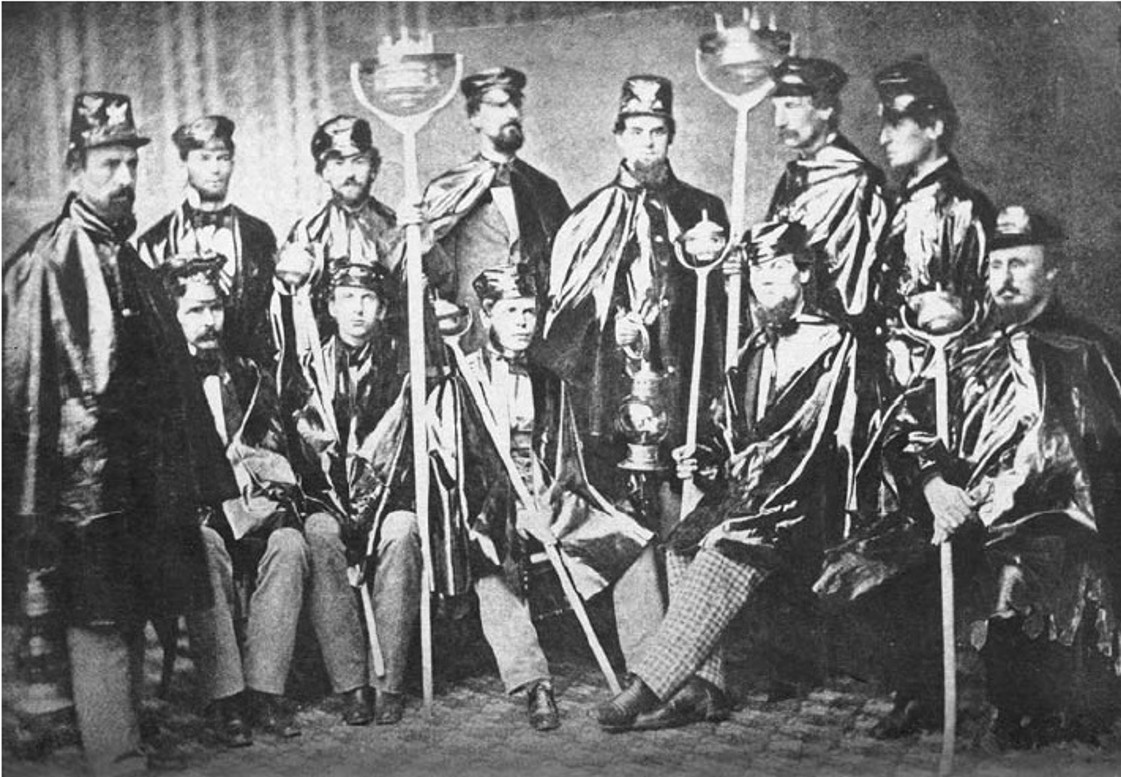
Grinspan's argument for the so-called "militarism" of the Wide Awakes doesn't come down to much more than the fact that they were generally well-organized and carried out orderly marches when they staged such demonstrations: "the Wide Awakes maintained a martial seriousness that distinguished them from the rowdy political clubs of the era," as he puts it. They also sported uniforms:


Original Wide Awake club, Hartford CN 1860

In fact, the following sounds more like peaceful democratic activism - in the best Jacksonian tradition, I might add - than anything that could reasonably be described as militaristic:

The tools that built the Wide Awake machine—partisan competition, social bonds, political newspapers, and youthful activism—were rarely forged by nefarious bosses. Though the deliberate construction of the network challenges the facile image of a “spontaneous outburst” by an undifferentiated mass of Republicans, the individuals who assembled it were rarely members of established elites. The young men who directed the movement, such as Henry Sperry, had little or no previous campaign experience or party standing. Popular interest from below, in the form of thousands of unsolicited letters, helped push them into action, and the movement’s immense social appeal to young men and women demonstrates an easy fit between the political club and contemporary culture.
He gives a dramatic account, taking off from the New York demonstration pictured at the top of this post (the picture is from Harper's Weekly 10/13/1860):

The march that shook New York was one of thousands that poured through America’s cities, towns, and villages in 1860, started by a revolutionary new political organization. Stumping for the Republican candidate, Abraham Lincoln, the strange movement electrified the presidential election. Young men from Bangor to San Francisco and from huge Philadelphia clubs to tiny Iowa troupes donned uniforms, lit torches, and “fell in” to pseudomilitary marching companies. They flooded every northern state and trickled into upper South cities like Baltimore, Wheeling, and St. Louis. Launched in March by “five young dry goods clerks” in Hartford, Connecticut, by November the Wide Awakes had developed into a nationwide grassroots movement with hundreds of thousands of members. Many of the movement’s supporters—and even some of its vociferous opponents—believed “there never was, in this country, a more effective campaign organization than the Wide Awakes.” [Quote from “Wide Awakes” Chillicothe Scioto Gazette 10/02/1860]

Youth and militarism distinguished the Wide Awakes from the hundreds of other clubs milling around nineteenth-century American elections. The organization appealed to white men in their teens, twenties, and thirties, attracting ambitious upstarts sporting youthful goatees who were “beginning to feel their true power.” Using popular social events, an ethos of competitive fraternity, and even promotional comic books, the Wide Awakes introduced many to political participation and proclaimed themselves the newfound voice of younger voters. Though often remembered as part of the Civil War generation stirred by the conflict, these young men became politically active a year before fighting began. The structured, militant Wide Awakes appealed to a generation profoundly shaken by the partisan instability of the 1850s and offered young northerners a much-needed political identity. [my emphasis]
Their composition also sounds very Jacksonian:

Established party leaders also looked askance at the Wide Awakes because of their non-elite roots. Though the movement incorporated members from most sections of society, wage laborers and farmers predominated. Some Republican leaders even complained about the absence of “the intelligent classes” in the Wide Awake ranks, which they claimed were made up of “the mechanic, or laborer, or clerk.” Census records from Ohio and Connecticut indicate many farmers, factory workers, and carpenters in the Wide Awakes, in addition to some middle-class young men employed as store clerks or railroad ticket agents.
Grinspan's description of the Wide Awakes here indicates some far more powerful factors spurring Southerners to revolt over their "sacred institution" of slavery than well-organized political marches in far-away Northern states:

Born in the years between the elections of John Quincy Adams in 1824 and William Henry Harrison in 1840, most Wide Awakes were infants during the shift from “corrupt bargain” [Adams' 1824 election] to the hard cider populism [Jacksonian Democracy] that signaled the democratization of American politics. Unfortunately, these boys came of age during less optimistic times and were shaken by the bitter tensions and overwhelming political malaise of the 1850s. The sectional pressures of the Mexican War, the Compromise of 1850, the Kansas-Nebraska conflict, and the caning of Charles Sumner combined to create the political world view of a generation of northerners. They inherited a nation that had just gained five hundred thousand square miles of Mexican territory but had lost its two-party system and some of its most prominent elder statesmen. Many young men were painfully aware of the capacities of their political system, both to conquer abroad and to crumble at home. [my emphasis]
Grinspan also explains that although there were acts of violence in some of the more competitive areas of the North, they tended to be attacks by Democratic pro-slavery rowdies on the Wide Awakes:

It is deceptively easy to see a link between the militarism of the movement and those violent episodes, but to do so ignores key aspects of the Wide Awakes’ clashes. Despite their imposing image, the clubs’ mode of demonstrating made its members more vulnerable to the guerrilla warfare of nineteenth-century political violence. A tightly packed group of Wide Awakes surrounded by large crowds of anonymous spectators made an easy target for a few teenage brick throwers. When violence did occur, Wide Awakes rarely maintained their formation. As it broke up, some individual members charged their opponents while others fled for cover. The Wide Awakes also never displayed weapons, and those who used knives or revolvers brought them individually and hid them beneath their capes. Even the torches, though often used as clubs, proved unreliable. With a few highly publicized exceptions, the Wide Awakes fought like Democrats or Know-Nothings, not as an organized militia.
In the end, the historical material he discusses undermines rather than supports his contention that it was the Wide Awake organizations in particular "that alerted the public to the organizational power of militarism."

Tags: , ,

Sunday, April 18, 2010

Confederate "Heritage" Month, April 18: Lincoln and liberty, too

This brief article from the print edition or The Wilson Quarterly 34/1 (Winter 2010), "Slave States, Free Press", refers to a strange anomaly of the Civil War. The Union was harsher on dissent during wartime than the Confederacy:

While Abraham Lincoln suppressed more than 300 newspapers during the Civil War, Jefferson Davis took pride in not suppressing any. On the contrary, media historian Debra Reddin van Tuyll writes in an unpublished paper, Confederate leaders often stepped in and protected journalists from would-be censors in the military. ...

Jefferson Davis suspended the writ of habeas corpus (as did Lincoln) and imprisoned some critics, according to van Tuyll, but he never went after the press. Press freedom was a foundation of the U.S. Constitution, and, Davis asserted, the Confederacy "alone has remained true to the original principles of the United States." To a friend, he reportedly said, "It is a dangerous thing to interfere with the liberty of the press, for what would it avail us if we gain our independence and lose our liberty?"
The Wilson Quarterly is a good publication from the Woodrow Wilson International Center for Scholars with a generally liberal bent and not some neo-Confederate rag. But I'd have to say this article is pretty credulous.

Let's put it another way. The Confederate administration had less formal restrictions on what white people could write about war-related issues than was the case in the Union. The portion of the Southern population that was African-American, virtually all of them slaves, had no freedom of the press or freedom of speech. It was a serious crime to even teach a slave how to read. There certainly weren't any slaves newspapers being legally published.

Debate among whites over the desirability of slavery had begun to be suppressed in the slave states after the Virginia legislature's debate over the issue in 1831-2. That ban wasn't absolute. And especially in the border states, there's was some open debate about the phasing out of slavery right up until the Civil War.

The Wilson Quarterly article is the sort of thing that can be twisted by neo-Confederates to argue for pseudohistory, that Lincoln was a dictator and the Confederacy was a freer, more benign government. The neo-Confederate LewRockwell.com site has a whole King Lincoln Archive of propaganda along those lines.

The late Chief Justice William Rehnquist did a book called All the Laws but One: Civil Liberties in Wartime (1998) about Lincoln's wartime abridgements of civil liberties. Rehnquist was a very conservative Justice and not one whose jurisprudence I admire. But that book actually does a decent job of putting those measures into some perspective. One of the important arguments that he makes was that many of the measures that were held legally to be invalid were actually new measures that Lincoln was trying. The country had never faced a civil war situation and there were no precedents at the time for some of what Lincoln did. The Constitutional government was six decades old at the time of the Confederate revolt.

Tags: , ,

Saturday, April 17, 2010

Confederate "Heritage" Month 2010, April 17: Mississippi Gov. Haley Barbour's neo-Confederacy

Haley Barbour, Republican Governor of Mississippi and chairman of the national Republican Governor's Association, stepped up to the plate to defend his own proclamations of Confederate Heritage Month in Mississippi (not Confederate History Month as in Virginia):Barbour Criticized for Slavery Insensitivity by Ward Schaefer Jackson Free Press 04/13/10.

Here's ole Haley's interview with CNN's Candy Crowley that is the topic of Schaefer's article.


Barbour actually manages to make an important point in the process of trying to make the whole issue of singling out the Confederacy for special honor and recognition sound just routine. Mississippi Democrats in the legislature and previous Mississippi Democratic Governors have also proclaimed Confederate "heritage" observances. While neo-Confederacy is a speciality of the Republican Party these days, Democratic politicians will sometimes pander to neo-Confederates, as well. Edward Sebesta did a run-down on the 2008 Presidential candidates and neo-Confederacy: Presidential Candidates' Confederate Records.

Probably the most embarrassing Democratic example there was Joe Biden. Poor Joe. He's got a sort of classic glad-hand style which I usually find more endearing than otherwise. But it also sometimes leads him to say dumb things, like in this interview with Chris Wallace quoted at Ed's site:

WALLACE: And, finally, Senator Biden — finally, we've got about 30 seconds left, but I can't let you go without some politics. As we've mentioned, you're in South Carolina right now, on the campaign trial. Thirty seconds or less, what kind of a chance would a Northeastern liberal like Joe Biden stand in the South if you were running in Democratic primaries against southerners like Mark Warner and John Edwards.

BIDEN: Better than anybody else. You don't know my state. My state was a slave state. My state is a border state. My state has the eighth-largest black population in the country. My state is anything from [i.e., but] a Northeast liberal state.
But back to Haley Barbour. Ward Schaefer writes:

Marty Wisemann, director of Mississippi State University's Stennis Institute of Government, said that Barbour's comments may have played well to a staunchly Republican base in the South but were likely to hurt his stature nationally.

"I think he might have underestimated the fact that that wound had already been reopened," Wisemann said. "When you take that southern accent, and you add this comment to it, it might be a heavy load to get out from under."

Mississippi NAACP President Derrick Johnson said that the very idea of honoring the state's Confederate history was grossly mistaken.

"Any time you commemorate an event or an incident such as the Confederacy, whose premise was built on enslaving other human beings, it becomes a very big deal," Johnson said. "That's like saying that we should commemorate the birth of Hitler and the rise of the Nazi Party. All those things were atrocities against human beings that we should not repeat. We should learn from them, so we don't repeat (them), but we should not celebrate."

On April 26, State offices will be closed to honor Confederate Memorial Day. [my emphasis]
This Hitler-Nazi reference at the end isn't as egregious as Roland Martin's blundering comments that I discussed in yesterday's post. But it's a confusing message, these days. With Rush Limbaugh and Glenn Beck and their many imitators spending the last year-plus saying that Obama is like Hitler and the Nazis, lots of people who hear that comparison would think it means that the Confederacy provided everyone access to buy health insurance.

The analogy is so overused, it's almost become banal. And it shouldn't be banal. And, in practice, I doubt that Derrick Johnson would mistake the difference between someone displaying a Confederate flag and someone displaying a Nazi flag.

On the other hand, I wouldn't want to push the difference. If you see a Confederate battle flag in Germany, it's normally a substitute for a Nazi flag, which is illegal to display there. I remember seeing one on the door of an office in Majorca, a Spanish island that is a famous tourist destination for Germans. I knew immediately that it was some far-right group for them to be displaying the Confederate flag. Not a "heritage" I want anyone to identify me with.

I will say, though, that it would not be unreasonable comparison to observe that the Nazi's treatment of Jews and other minorities Germany up until the annexation of Austria in 1938 didn't approach the level of brutality of the slavery of African-Americans in the antebellum US. Jews could emigrate from Germany, though they had to forfeit basically all their property and money to do so. Slaves didn't have the option to leave, and they were property.

Tags: , ,

Friday, April 16, 2010

Confederate "Heritage" Month 2010, April 16: Neo-Confederacy and the mass media


Confederate guerilla fighter William Quantrill (1837-1865)

This year, I could almost do a whole month's worth of posts just piggy-backing off Kevin Levin's excellent blog Civil War Memory.

In this post, Kevin looks at the way cable TV has tried to handle the Viginia controversy over "Confederate History Month": Mainstream Media Tackles Confederate History Month = Fail Civil War Memory 04/12/10. Kevin writes of the Establishment media coverage of the neo-Confederate controversy touched off by Virginia Gov. Bob McDonnell's proclamation of Confederate History Month:

I ended up watching more of the “debate” on the major news channels than I care to admit. It was downright painful to watch. The most disappointing aspect of it all was the almost complete absence of any professional historians. You would think that the major networks could have mustered up at least one legitimate historian. The closest I saw was a half-way decent interview that Rachel Maddow conducted with Patricia Harris-Lacewell, who teaches politics and African American Studies at Princeton. Unfortunately, the professor’s distinction between two southern pasts didn’t quite address all of the salient issues involved.

More often than not the audience was treated to the same talking heads who clearly do not understand the relevant history. CNN’s Roland Martin had a field day with this issue, which included a lively debate with Brag Bowling. No surprise that Bowling was at times inarticulate, but Martin’s comparison of Confederate soldiers with Nazis and suggestion that they were “domestic terrorists” shut the door on any chance of rational debate. You can read Martin’s recent essay comparing Confederates with terrorists on the CNN site. It is one of the most incoherent arguments that I’ve seen in a long time; I would love for someone to explain it to me. Finally, check out Martin in this little clip with Republican adviser Mary Matalin, who retreats to the old saw that most white southerners were not slaveowners and that most northerners were not abolitionists. [my emphasis]
Apparently this is the essay of Martin's to which Kevin is referring: Confederates, Al-Qaida are the Same: Terrorists Roland S. Martin Blog 04/09/10. His argument certainly is frivolous. He's using "terrorist" as a vague synonym for "bad" and his whole argument is puffery.

Terrorism in wartime is one tactic that armies use. "Terror" in the political sense in the first two-thirds of the 19th was understood more as state repression, as in the Terror during the French Revolution. Guerrilla warfare was certainly used; the word "guerilla" first became attached to such warfare during the Spanish War of Indepedence of 1808-14 against Napoleonic France. They employed small-unit ambushes, assassinations, destruction of property and retaliation against collaborators as tactics. And the Confederacy did make limited use of guerrilla warfare, most famously (or rather infamously) with Quantrill's Raiders, of which the young Jesse James was one.

This Harper's Weekly article of 08/27/1862 (see also the illustration; scroll down on both pages; illustration included below) describes one of Quantrell's raids as follows:

About one o'clock Sunday morning, the 7th inst., Quantrell, with two hundred and thirty men, dashed into and took possession of Olathe, the county seat of Johnson County, Kansas. From that time until he left, at an early hour in the morning, he and his men were engaged in the work of murder, plunder, and devastation.

Mr. Skinner and Mr. Wiggins, both recruits, were killed for making resistance. Mr. Blanchard, of Spring Hill, was also killed. They took fifty horses and mules, attached them to the best wagons they could find, and loaded them with goods seized from the stores. Private houses were entered, furniture broken, blankets stolen, and doors and windows beaten down. A Union flag suspended over the recruiting-office of Captain Hayes was torn to shreds and trampled in the dust by these mad assailants.

Quantrell said when he left that he was going to Paola, and that he should not rest until he had laid the border in ruin.


But Martin's silly article is not about the small guerrilla aspect of the Confederate war effort. It's just a polemic generalization that, as Kevin rightly says, "shut the door on any chance of rational debate". Or even historically literate discussion.

Here's video of Martin's on-air version:


Tags: , ,

Thursday, April 15, 2010

Confederate "Heritage" Month 2010, April 15:


Georgia Congressman Preston Brooks displays his version of Southern honor by sneaking up to antislavery Massachusetts Sen. Charles Sumner sitting at his Senate desk and clubbing him senseless

Every year when I do these April posts on neo-Confederacy and related issues, I worry that I won't be able to find material for it. And every year I wind up not getting to things that I had planned to cover.

Finding things to use is even less of a problem this year, thanks to Gov. Bob McDonnell of Virginia casting new attention on "Confederate heritage" and how problematic is is. This is one of many articles assessing the current issues: Carl M. Cannon Why Liberals Are Right to Refuse to Honor the Confederacy Politics Daily 04/12/10. Cannon's assesses the outcome of MCDonnell's Confederate flap well:

McDonnell's six-paragraph proclamation declared April to be "Confederate History Month." The governor appears to have seen the offending document as innocuous, and much of it was, but it was underpinned by a sentiment that does not reflect a universal view among Virginians; namely, that it is important to pay homage to "the sacrifices of the Confederate leaders, soldiers and citizens during the period of the Civil War." The proclamation also had had an important omission, these critics asserted, namely any reference to slavery.

In the outcry that followed, including personal protests from some high-profile African American Democrats from Virginia who had bolstered McDonnell's 2009 Republican candidacy, McDonnell quickly made amends. A new paragraph was inserted into the document:

WHEREAS, it is important for all Virginians to understand that the institution of slavery led to this war and was an evil and inhumane practice that deprived people of their God-given inalienable rights and all Virginians are thankful for its permanent eradication from our borders, and the study of this time period should reflect upon and learn from this painful part of our history ...

This is a pretty thorough mea culpa, and as direct a refutation of Southern revisionism as anyone could ask for, so continued criticism of McDonnell from liberal Democrats can understandably be viewed as partisan posturing. But political jockeying notwithstanding, liberals are indeed right to confront this issue forcefully, whenever it arises. [my emphasis in bold]
I wouldn't say that Democrats shouldn't criticize McDonnell's decision to proclaim Confederate History Month in the first place. But given his initial blunder, I've had the same praise for his amendment to his proclamation. It does directly refuse the historical lie that is at the core of neo-Confederate "Southern revisionism".

I don't assume in non-blog publications that the authors are responsible for the titles put on their articles. But it shouldn't be only liberals who are right to criticize McDonnell's proclamation of a Confederate History Month. But given the extent to which today's Republican Party has embraced neo-Confederate ideology, the headline is understandable. Why would anyone assume today's conservatives in America would criticize a glorification of the Confederacy?

Cannon goes on to give a useful discussion of the historical issue of slavery bringing on the Civil War:

Jefferson Davis, in a speech to the Confederate Congress in April 1861, extolled slavery as a benevolent invention that allowed a "superior race" to transform "brutal savages into docile, intelligent, and civilized agricultural laborers." Alexander H. Stephens, Jefferson Davis' vice president, proclaimed that Jefferson and the Founders' high-minded declarations of universal liberty were "in violation of the laws of nature." This was profoundly wrong, Stephens said.

"Our new government is founded on exactly the opposite idea," thundered the vice president of the Confederacy. "Its foundations are laid, its cornerstone rests upon the great truth that the Negro is not equal to the white man; that slavery, subordination to the superior race, is his natural and moral condition."

This was the kind of thing said by a group of now-forgotten men called "secession commissioners." They were dispatched in 1860 from South Carolina, Georgia, Mississippi and Alabama to other state capitals in the South urging state legislatures to prepare for secession. These men outlined a bloody apocalyptic scenario of black rebellion and the attendant slaughter of whites – with frequent allusions to mass rape and throat-slitting. They invariably mentioned Haiti as the relevant example, and stated flatly that this is what Lincoln wished on the South.

"The [Haitian] Negro ... arose with all the fury of the beast, and scenes were then enacted over a comparatively few planters, that the white fiends [of the North] would delight to see re-enacted now with us," Andrew Pickens Calhoun – son of John C. Calhoun – said in Columbia, S.C. ...

"Our fathers made this a government for the white man, rejecting the Negro as an ignorant, inferior barbarian race incapable of self-government, and not therefore, entitled to be associated with the white man upon terms of civil, political or social equality," Mississippi secession commissioner William L. Harris told Georgia's Legislature. Lincoln, he said, was committed on a course "to overturn and strike down this great feature of our Union."
That is why the Confederacy existed, to preserve slavery and the white supremacist and racist doctrines used to justify and defend it. It was anything but an honorable cause.

Tags: , ,

Wednesday, April 14, 2010

Confederate "Heritage" Month 2010, April 14: Mississippi's Articles of Secession, 1861


Jefferson Davis, Mississippi's only President to date: President of the Confederate States of America

This is the official declaration that Mississippi, the second state to secede from the Union, put out to state its reasons for the action (1861). It was called A Declaration of the Immediate Causes which Induce and Justify the Secession of the State of Mississippi from the Federal Union. The emphases in bold are mine:

Our position is thoroughly identified with the institution of slavery-- the greatest material interest of the world. Its labor supplies the product which constitutes by far the largest and most important portions of commerce of the earth. These products are peculiar to the climate verging on the tropical regions, and by an imperious law of nature, none but the black race can bear exposure to the tropical sun. These products have become necessities of the world, and a blow at slavery is a blow at commerce and civilization. That blow has been long aimed at the institution, and was at the point of reaching its consummation. There was no choice left us but submission to the mandates of abolition, or a dissolution of the Union, whose principles had been subverted to work out our ruin.

That we do not overstate the dangers to our institution, a reference to a few facts will sufficiently prove.

The hostility to this institution commenced before the adoption of the Constitution, and was manifested in the well-known Ordinance of 1787, in regard to the Northwestern Territory. [Which excluded slavery from those territories]

The feeling increased, until, in 1819-20, it deprived the South of more than half the vast territory acquired from France.

The same hostility dismembered Texas and seized upon all the territory acquired from Mexico.

It has grown until it denies the right of property in slaves, and refuses protection to that right on the high seas, in the Territories, and wherever the government of the United States had jurisdiction.

It refuses the admission of new slave States into the Union, and seeks to extinguish it by confining it within its present limits, denying the power of expansion.

It tramples the original equality of the South under foot.

It has nullified the Fugitive Slave Law in almost every free State in the Union, and has utterly broken the compact which our fathers pledged their faith to maintain.

It advocates negro equality, socially and politically, and promotes insurrection and incendiarism in our midst.

It has enlisted its press, its pulpit and its schools against us, until the whole popular mind of the North is excited and inflamed with prejudice.

It has made combinations and formed associations to carry out its schemes of emancipation in the States and wherever else slavery exists.

It seeks not to elevate or to support the slave, but to destroy his present condition without providing a better.

It has invaded a State, and invested with the honors of martyrdom the wretch whose purpose was to apply flames to our dwellings, and the weapons of destruction to our lives.

It has broken every compact into which it has entered for our security.

It has given indubitable evidence of its design to ruin our agriculture, to prostrate our industrial pursuits and to destroy our social system.

It knows no relenting or hesitation in its purposes; it stops not in its march of aggression, and leaves us no room to hope for cessation or for pause.

It has recently obtained control of the Government, by the prosecution of its unhallowed schemes, and destroyed the last expectation of living together in friendship and brotherhood.

Utter subjugation awaits us in the Union, if we should consent longer to remain in it. It is not a matter of choice, but of necessity. We must either submit to degradation, and to the loss of property worth four billions of money, or we must secede from the Union framed by our fathers, to secure this as well as every other species of property. For far less cause than this, our fathers separated from the Crown of England.

Our decision is made. We follow their footsteps. We embrace the alternative of separation; and for the reasons here stated, we resolve to maintain our rights with the full consciousness of the justice of our course, and the undoubting belief of our ability to maintain it.
Tags: , ,

Tuesday, April 13, 2010

Confederate "Heritage" Month, April 13: Responding to a defense of Confederate "heritage" celebration


One of my Facebook friends, a white man from Mississippi, posted a long comment inspired by Jon Meachem's Southern Discomfort op-ed New York Times 04/10/10. He disputed Meachem's contention that Lost Cause/neo-Confederate ideology has historically been identified with white racism. The following is an expanded version of the response I left to his comment.

I don't think very highly of Jon Meachem's work as a pundit. But in that op-ed, he got the basic idea right, that in fact the Lost Cause narrative has been closely associated historically with the disenfranchisement of African-American voters and the Jim Crow/segregation system. This essay, Neo-Confederacy and the New Dixie Manifesto by Euan Hague, Edward Sebesta, and Heidi Beirich, the Introduction to their book Neo-Confederacy: A Critical Introduction (2008), shows how that has played out in recent years.

Anyone who is serious about promoting a Lost Cause version of history and not wanting it to be understood as some form of white-identity politics should be very realistic about how neo-Confederate ideology has actually been used in American politics since the end of the Civil War.

My Facebook friend wrote defensively that it looked to him like "the liberal intelligentsia and avant garde" were trying to "generate an 'intellectual' attack on 'neo-Confederates';" aka 'white, Christian, hood-wearing, cross-burning racists'--by none other than a 'fellow, albeit enlightened Southerner'." I think he got carried away with his quotation marks, because the version of Meachem's article on the Times' Web site as of this writing doesn't contain the phrase "white, Christian, hood-wearing, cross-burning racists."

The notion that slavery had nothing to do with the Civil War became a part of the political position of conservative white Southerners about the time of Lee's surrender at Appomattox. Slavery had been totally discredited by the war, and conservative Southerners who had supported the Confederacy wanted to disenfranchise and otherwise restrict the freedom of freed slaves. The term "Lost Cause" is usually traced to the 1866 book The Lost Cause by Edward Pollard, who made the slavery-had-nothing-to-do-with-it argument. It was pseudohistory then and is now.

Of course, even in Pollard's account, he couldn't hide the fact that every major disagreement leading up to the Civil War had slavery at its core: the Mexican-American War, the Wilmot Proviso, the Compromise of 1850, the Fugitive Slave Law of 1850, the Kansas-Nebraska Act, the mini-civil war in Kansas, the Lecompton Constitution, the Dred Scott decision, John Brown's raid at Harper's Ferry, Lincoln's election.

States-rights was an issue in those disputes. The Fugitive Slave Act had the federal government requiring state officials and even private citizens to act as slavecatchers for escaped slaves, with severe penalties for refusing to do so. The Dred Scott decision was a federal decision that directly threatened the ability of free states to legislate against slavery in their own borders. Southern spokesmen demanded that the federal government suppress antislavery advocacy within free states. The slaveowners were always unambiguous in their support for using the federal government to override states rights when it came to defending what Southern orators called "our sacred institution of slavery".

After Lincoln's election, the slaveowners rediscovered the virtue of states rights when it came to preserving slavery, which took precedence with them about any other Constitutional theory and certainly over elementary American patriotism. All the agitation for secession stressed the central role of defending slavery. The most striking thing to me about the amendment Virginia's Gov. Bob McDonnell made to his original proclamation for Confederate History Month 2010 was that it states explicitly, "it is important for all Virginians to understand that the institution of slavery led to this war."

It's true that not all Confederate soldiers were slaveowners. But soldiers on both sides knew very well that slavery was the cause of the war and the reason for the Confederate revolt, whatever their personal opinions may have been on the subject.

It's also not the case that non-slaveowning Southern whites had no direct prewar connection to enforcing slavery. Southern states had required non-slaveowning men to participate regularly in "slave patrols" to look for escaped slaves. They had unchallenged authority to stop and abuse any black person free or slave they saw out in public, whether or not the victim was authorized to be there. And they often did so. It was an effective way to create an emotional bond to the slave system even among nonslaveowners. Betram Wyatt-Brown has a good description of the slave patrols in his Southern Honor: Ethics and Behavior in the Old South (1982) They were also a direct precursor to the post-war, Klan-type white terrorist groups who committed so much violence.

I suppose that it will always be difficult to separate history from politics, since a lot of history is, after all, politics of the past. If present-day conservatives want to continue making Lost Cause ideology one of their defining issues, that's really up to them.

Neo-Confederate advocacy groups like the Sons of Confederate Veterans and the United Daughters of the Confederacy were promoting the notion that the Confederacy had nothing to do with slavery, even long before more overt white supremacists types took over the leadership of the SCV around 10 years ago.

I don't know exactly what the current state of that particular internal battle in the SCV is. But they are continuing to promote the same pseudohistory. You can easily see in most of their advocacy material that the idea of the Confederacy having nothing to do with slavery is primarily a way of sneering at black people, such as the latest hobby-horse, the false claim that many slaves fought voluntarily for the Confederacy. In fact, giving slaves guns and military training was the last thing the slaveowners wanted to do.

Tags: , ,