Showing posts with label hegel. Show all posts

Monday, December 11, 2017

Reason and history

I didn't set out to write a series of posts on theories and approaches to history. But I have another one.

This one has to do with an essay by philosopher Terry Pinkard, who specializes in German philosophy from the late 18th century (Kant) on to the present. The essay is on the contemporary philosopher Charles Taylor, "Taylor, 'History,' and the History of Philosophy" (From Charles Taylor, Ruth Abbey, ed., 2004).

Describing Taylor's view of history, Pinkard writes, 'The line [of development] in history does not, and need not, run in a straightforwardly progressive direction." This, of course, speaks to the Enlightenment concept of progress in history. This view envisions progress in human societies over time, but recognizes that there can be setbacks, even huge setbacks. It's often said that in the West, the First World War was a major inflection point after which it was difficult or not impossible to view history as a story of continual human progress.

Taylor's view of history gives emphasis to understanding history from the "inside," by which Taylor means understanding how people at a given time viewed what was happening to them, as well as from the "outside," looking at larger sociological, economic or other collective processes and how they shape events without the full consciousness of the individuals involved.

Pinkard likens this to the distinction that Hegel made between "empirical" and "philosophical" history, which Pinkard describes this way:
Philosophical history cannot challenge the facts of empirical history, and it must be consistent with them; its task, though, is different in that it looks at the meaning of history and whether there is any rationality, or reconciliation, to be found in its events. It does not ask if history, or any particular agent or collective was actually aiming at the result in which we find ourselves; it asks instead if there is any way to say that any of the transitions in the understanding of what it means to be human can be counted as more rational than what came before in some nonquestion-begging way that does not presuppose at the outset some conception of rationality that is itself at issue.

Such philosophical history need not recount all the contingencies of history that go to make up the story we now tell about it. [my emphasis]
This is Taylor's way of accounting for reason in history.

Hegel based his theory of history on the view he elaborated in his Phenomenology of Spirit. He viewed all developments in the material world as an unfolding of reason in a dialectical process within what he called the World Spirit. By the mid-19th century, even thinkers working in the Hegelian tradition found the concept of the World Spirit no longer usable. But the notion of reason unfolding in history is very much with us today.

Pinkard illustrates that view of rationality in history with this quote from Taylor in his Sources of the Self, “What probably made Locke the great teacher of the Enlightenment was that he offered a plausible account of the new [Galilean] science as valid knowledge, intertwined with a theory of rational control of the self; and that he brought the two together under the idea of rational self-responsibility.”

Thursday, December 08, 2016

Analogy to the "end of history" peirod

Interesting thought piece from Paul Mason, The Soviet Union collapsed overnight. Don’t assume western democracy will last forever Guardian 12/05/2016:

Since Putin stole the 2011 election, and the subsequent protest movement was suppressed, the young people who took part in it have retreated into an angry silence. It’s not exactly a new situation for Russian intellectuals. Lenin was arrested here in 1887 for leading a student protest and spent most of the next 30 years in exile or underground. Then the Bolsheviks suppressed free speech and political opposition for another 70 years and Russia’s capitalist oligarchs are doing their best to suppress it now.

In the face of this, why do Russian artists, philosophers and journalists persist in their belief in change? In short, because they have seen the moral and physical collapse of something that once seemed permanent: the Soviet Union.
He ties it to the present moment by saying, "Since Trump’s victory in November 2016, it has become possible to believe a similar collapse will happen in the west, to globalisation and liberal values."

He uses the example of Putin's emergence after the strong medicine of neoliberalism and austerity economics applied to Russia after the fall of the Soviet Union:

Compared with the chaos of the 1990s, Putinism has felt like a redemption. Putin has, at the cost of diplomatic isolation and the suppression of democratic rights, restored growth, order and national pride. Now all over the world there are mini-Putins: the Hungarian PM, Viktor Orbán; the Turkish president, Recep Tayyip Erdoğan; the would-be French fascist president, Marine Le Pen. If – as they desire – the west descends into economic nationalism, everybody under the age of 50 will go through the same kind of ideological shock the Russians went through in the late 80s.
There are historical trends. The problem is, they're tricky to discern as they are happening. Which brings me to one of my favorite Hegel quotes: "The Owl of Minerva takes its flight only when the shades of night are gathering."

Meaning that we can't tell what a historical period really was about until it's ending. On the pessimistic side, I know, but a useful caution. Because people do make history and aren't completely at the mercy of broad trends.

Friday, August 26, 2016

More on Clinton's alt-right speech

As I mentioned in the previous post, I have a mixed reaction to Hillary's "alt-right" speech yesterday. I like that she goes after specific individual nasties associated with Trump and even repeatedly calls them "white supremacists" and "white nationalists." With no "Sister Souljah moment" to toss in a both-sides-do-it element. After eight years of Obama's fudging and endless "bipartisan" talk, it's a relief to see.

But she also sticks to the framing that somehow this is a problem of Trump and a clique around him, not the way the Republican Party has been functioning for a long time. Trump may be ruder than nasty Ted Cruz or John Kasich, the hardline rightwinger who passed himself off to the press this year as the Last Republican Moderate. But his racial and xenophobic politics are not outliers in today's Christian Republican White Man's Party.

Trying to draw a sharp distinction between Trump and some imagined more responsible conservatives in today's Republican Party reminds me of how white Mississippians in the 1960s made a conventional distinction between their "courtly" hardline segregationist Senator John Stennis and the meaner image of their other hardline segregationist Senator Jim Eastland.

I was also struck at how she recycled boilerplate rhetoric from 1964 and 1980, "Of course there has always been a paranoid fringe in our politics, a lot of it rising from racial resentment. But it’s never had the nominee of a major party stoking it, encouraging it, and giving it a national megaphone." And, "A fringe element has effectively taken over the Republican Party." There was much more reason to frame things this way in 1964, when there actually were liberals in the Republicans Party. And in 1980, when there was a recognizable moderate faction of people like John Anderson.

Also, "all of this adds up to something we’ve never seen before." I guess that's okay if she's referring to an orange-haired Republican candidate for President. It was Hillary herself who famously referred to the "vast rightwing conspiracy" going after Bill, and the Gingrich "Revolution" (that word that so panics Democrats) was every bit as nasty as Goldwater in 1964. There was that little impeachment business going on, too. John Kasich was one of the lead players in the impeachment drive. The fact that Kasich counts as the Last Republican Moderate is a sign of how the rudeness of the rhetoric, rather than substantive policy ideas, is now the main distinguishing public feature of the various Republican factions.

Jeet Heer at the New Republic argues that Hillary "is trying to heighten the contradictions in the Republican Party." (In Her Alt-Right Speech, Hillary Gave the GOP a Mafia Kiss 8/26/2016)

I think that may be the first time I've ever seen anyone actually use that "heighten the contradictions" phrase without sneering at the concept as a bad idea. Heer argues that Hillary is warning people like Paul Ryan that they will suffer from the judgment of history if they don't renounce Trump. I think that's too imaginative a reading of Hillary's speech. And I doubt seriously that Paul Ryan and most other Republican in Congress actually give a rip about the judgment of history. They're worried about keeping their corporate sponsors happy.

I just think the ideological conformity of today's Republican Party is so strong that this is a long shot, especially for the woman who has been the right's most hated Harpy Demon for 25 years. Or to put it in the quasi-Hegelian terminology, Republicans see their enmity to Hillary as the "primary contradiction" here; any embarrassment over Trump's nasty mouth is taken as a "secondary contradiction."

(As an aside here, the "primary contradiction" thing made me wonder if Hegel actually used the concepts of primary and secondary contradictions. I know that at some point between Hegel's passing in 1831 and now, those concepts were taken up in Marxist political theory and left propaganda. But I don't know where it originated. Note to self for a geeking-out research project.)

The PBS Newshour had this report on Hillary's alt-right speech, Why the ‘alt-right’ is coming out of online chat rooms to support Trump 08/25/2016:


Sleepy Mark Shields and Bobo Brooks took up the alt-right speech today, Shields and Brooks on the alt-right and a general lack of trust in Clinton 08/26/2016:


Wednesday, April 20, 2016

Contradictions, Contradicciónes and Andrew Jackson

I've changed the name of the blog from "Old Hickory's Weblog" to Contradicciónes (Contradictions).

Not because I've given up the positive image I have of Andrew Jackson as a historical figure. It's that his image at the moment among left-leaning Americans is so bad and, bizarrely, white supremacists are "defending" him over the Treasury Department's just-announced decision to put the image of black Abolitionist Harriet Tubman on the front of the $20 bill and move Jackson to the back.

Somewhere in Hell, John C. Calhoun is cackling madly in delight. About his political descendants the white supremacists praising Jackson, that is, not about me changing the name of the blog.

I don't have the text immediately at hand. But I recently read something by the left-Peronist Argentine leader John William Cooke (1919-1968) about Juan Manuel de Rosas (1793-1877), a major Argentine political leader in the 19th century. Known as the Restaurador de las Leyes (Restorer of the Laws), he served as Governor of Buenos Aires province in 1828-1832 and 1835-1852. He was a contemporary of Andrew Jackson and his governorship overlapped in time with Jackson's Presidency.

Juan Manuel de Rosas (1793-1877)

Rosas was a representative of the Federalist political current of that time, the main carrier of the democratic tradition in Argentina at that time. The more conservative trend was represented by the Unitarians. Or as, Rosas' followers called them, "the wild Unitarians." The Unitarian name had nothing to do with religion. It referred to the centralism of that faction which wanted Buenos Aires to have dominance over the other provinces that became the nation of Argentina.

But actually it was Rosas that first forged an effective national grouping of various provinces.

Rosas was a large landowner and a shrewd and ambitious politician. But he had particular appeal to the gauchos, the small farmers. He also gave strong support to the black Argentines who were a numerous group in the urban area of Buenos Aires. Slavery was never large in Argentina, nothing like in Brazil. But it Rosas explicitly abolished slavery.

Rosas promoted voting. But one could scarcely say that he was a "Jacksonian democrat." (Nor were the Wild Unitarians.) But he also empowered the lower classes in ways they had never been empowered before.

He also defended the Argentine national honor and independence against Britain and France. In 1845, when those two empires were blockading Argentine ports, Rosas mounted a naval attack known as the Vuelta de Obligado. He didn't have the forces that would have been necessary to force the lifting of the blockade. But it has been remembered ever since as an important moment in the defense of Argentine independence. José de San Martín (1778-1850), one of the great heroes of Argentina and of Latin American independence, sent his sword to Rosas in recognition of his actions in the Vuelta de Obligado.

Cooke's comment on Rosas that struck me was that though there were bad things about Rosas, it's also important to recognize that democracy and freedom come into being in the messy process of real history, not in pure declarations of principle. And left-leaning history in Argentina recognizes Rosas as a major figure in the development of freedom, democracy and national independence in Argentina. In her last speech as President celebrating the national day May 25 in 2015, Cristina Fernández mentioned Rosas and how San Martín had honored him by sending him his sword.

Rosas was a kind of Argentine Andrew Jackson, in other words. (Yes, Rosas fought Indians, too.) Or maybe Jackson was an American version of Rosas. Neither were model democrats by the standards terms of 2016. But they both led important advances in democracy in their respective countries.

History is messy. Which is my cue to roll out one of my favorite Hegel quotes that cautions us against expecting perfection in real history and reminds us to recognize the good parts: "World history is not the ground of happiness. The periods of happiness are blank pages in it ..." - Philosophy of History (German original: "Die Weltgeschichte ist nicht der Boden des Glücks. Die Perioden des Glücks sind leere Blätter in ihr ...")

Saturday, March 28, 2015

José Pablo Feinmann on why he rejects postmodernism

José Pablo Feinmann explains his own reckoning with postmodern philosophy in Vattimo, dialectos y transparencias Página/12 22.03.2015. He does so in the context of commenting on the thought of Gianni Vattimo, a postmodern philosopher who was recently visiting Argentina.

Feinmann quotes Vattimo to give a description of the aspect of postmodernism on which he focuses in this brief but dense essay. The development of the media of communication, in this postmodern model, allows for the abolition of the Cartesian ego and of the unity of opposites in the Hegelian philosophy, which latter Feinmann references here as the One:

El mundo de la comunicación permite el desarraigo de la dictadura de lo Uno y la liberación de las diferencias. A esto le debemos llamar, dice, el dialecto. Ya no hay una razón. Hay racionalidades locales, dialectos. “Minorías étnicas, sexuales, religiosas, culturales o estéticas, como los punk, por ejemplo” (Ibid, p. 17). Esto no es una manifestación irracional de la espontaneidad. Las diferencias se manifiestan, se emancipan de la dictadura de lo Uno.

[The world of communication permits the uprooting of the dictatorship of the One and the liberatio of differences. This we can call, say, the dialectic. But there is no Reason. There are local rationalities, dialectics. "Ethnic, sexual, religious, cultural or aesthetic minorities, like the punks, for example." {Vattimo} This is not an irrational manifestation of spontaneity. The differences manifest themselves, they emancipate themselves from the dictatorship of the One.]
Feinmann responds with a contemporary Hegelian argument, one based in actual history. He looks at the end of the Cold War circa 1989 and the subsequent enormous expansion of neoliberal "globalization" and argues against what he views as a conservative tendency in postmodernist philosophy:

Voy a decirlo de una vez por todas: los intentos posmodernos han fracasado estrepitosamente. El sujeto cartesiano y el sujeto hegeliano están, hoy, más centrados que nunca. Nadie descentró al sujeto. Nadie lo adelgazó. Nadie lo deconstruyó. El sujeto absoluto es hoy el Sujeto del Poder Bélico Comunicacional. (Así: con mayúsculas fascistas, porque es de derecha y colonialista.) Este sujeto está globalizado y coloniza día tras día las subjetividades de los ciudadanos de este mundo. Su constitución ha sido reciente. Ni Sartre ni Foucault lo vieron. Y los posmodernos, que presenciaron su surgimiento y consolidación, lo interpretaron idílicamente, como el fruto maduro de una democracia comunicacional por cuyo medio se expresarían las distintas, mútiples voces de la libertad, sobre todo una vez caído el coloso comunista. ¿Error, ingenuidad o colaboracionismo? No son – arriesguemos – filósofos del “neoliberalismo”. Pero son –sin la menor duda– filósofos de la caída del comunismo, expresada en el colapso de la Unión Soviética. La distancia entre una cosa y la otra es demasiado estrecha.

[I'm going to say once and for all: the postmodern intentions have failed ostentatiously. The Cartesian subject and the Hegelian subject are today more central than ever. No one removed the subject from its central place. Nobody slimmed it down. Nobody deconstructed it. The Absolute subject is today the Subject of the Communicational Power of War. (Thus: with fascist capital letters, because it is rightwing and colonialist.) This Subject is globalized and day after day colonizes the subjectivities of the citizens of this world. Its construction has been recent. Neither Sartre nor Foucault saw it. And the postmodernists, who were present at its upsurge and consolidation, interpreted it idyllically as the mature fruit of a communicational democracy by whose medium the multiple voices of liberty express themselves, above all when the Communist colossus fell. Error, naivety or collaborationism? There are no - we'll take a risk to say - philosophers of "neoliberalism." But there are - without any doubt - philosophers of the fall of Communism, expressed in the collapse of the Soviet Union. The distance between one thing and the other is too narrow.]

There's a nice word play there in the sentence, "Nadie descentró al sujeto." I translated it above as, "No one removed the Subject from its central place." It could also be translated, "No one put the subject off its game."

In my reading - to use the polite postmodern expression! - Feinmann is arguing that postmodernism as derived from Heidegger and Foucault has a tendency to remove any intellectual basis for challenging the established order because it effectively gives up the concepts of Reason and objective truth. It does rule out efforts to change. But it puts the claims of the powerful on the same level normative as those of the weak, the claims of the tyrants on the same normative level as the claims of their subjects demanding freedom.

Feinmann isn't willing to give up the Hegelian historical subject, nor the Enlightenment standard of Reason, nor the Humeian/Hegelian goal of perceiving objectively material reality accurately.

Feinmann here is on the side of the Frankfurt School of critical theory. Gary Aylesworth in his 2015 entry on Postmodernism in the Stanford Encyclopedia of Philosophy summarizes the criticism that "second generation" Frankfurt theorist Jürgen Habermas makes of postmodernism:

Habermas argues that postmodernism contradicts itself through self-reference, and notes that postmodernists presuppose concepts they otherwise seek to undermine, e.g., freedom, subjectivity, or creativity. He sees in this a rhetorical application of strategies employed by the artistic avant-garde of the nineteenth and twentieth centuries, an avant-garde that is possible only because modernity separates artistic values from science and politics in the first place. On his view, postmodernism is an illicit aestheticization of knowledge and public discourse. Against this, Habermas seeks to rehabilitate modern reason as a system of procedural rules for achieving consensus and agreement among communicating subjects. Insofar as postmodernism introduces aesthetic playfulness and subversion into science and politics, he resists it in the name of a modernity moving toward completion rather than self-transformation. [my emphasis]
Habermas and other Frankfurt School theorists are not only very much aware of the "nightmares of reason." They have been leaders in pointing them out. But they haven't abandoned Reason and the necessity of understanding empirical reality in doing so.

Feinmann also makes his own reckoning with Hegel's unifying concept of the One in the context of Islam's role in world history in El estruendo de los fanáticos Página/12 22.03.2015.

There are also Spanish-language lectures of his on YouTube from a Canal Encuentro series on Michel Foucault (1926–1984).

T2 CAP 11: Foucault [1]:


T2 CAP 12: Foucault II:


Also one on postmodernism more generally, T2 CAP 13: Los posmodernos:


Saturday, January 10, 2015

The thesis-antithesis-synthesis mystery

Well, it's been a mystery to me, anyway.

Dialectic(s) has been a part of philosophy at least since Heraclitus (circa 500 BCE) and remains so today.

Some of the more notable dialecticians included Socrates (469–399 BCE), Plato (circa 429–347 BCE), the Stoics, Kant (1724–1804), Hegel (1770-1831), Nietzsche (1844–1900) and, of course, Karl Marx (1818–1883). The great Christian theologian Friedrich Daniel Ernst Schleiermacher (1768-1834) carried on a debate with his friend and colleague Hegel over dialectics.

The most common way most people have heard about dialectic in in some connection with Marxism, or Marxism-Leninism as the official doctrine of the Soviet Union and the Eastern bloc, and for a long time that of the People's Republic of China, was called. And the most typical description description involved the triad thesis-antithesis-synthesis.

David Riazanov (1870-1938) then head of the Marx-Engels Institute in Moscow, writing in Karl Marx and Friedrich Engels (English edition, 1927), describes Hegel's dialectic this way:

To comprehend the circumambient phenomena, one must not only study them as they exist, but one must understand how they have been developing; for everything about one is the result of a past development. Furthermore, a thing may appear at first glance as being in a state of immobility which on closer scrutiny, however, will disclose within itself incessant movement and conflict, numerous influences and forces, some tending to preserve it as it is, others tending to change it. In each phenomenon, in each object, there is the clash of two principles, the thesis and the antithesis, the conservative and the destructive. This struggle between the two opposing principles resolves itself into a final harmonious synthesis of the two.

This is how it was expressed in the Hegelian idiom. [my emphasis in bold]
Except it wasn't.

That is how the dialectic functions in Kant, for whom it was a part of formal logic.

For Hegel, dialectic was a description of how all of the natural world works. And he described it as reality developing from one positive state through a negation of the positive state to the Aufheben (sublation) of the negation, Aufheben implying that the previous state is cancelled while being preserved and lifted up to a higher state. In this view, a seed is a positive reality. It contains it's own negation, its own internal drive to become something different, a not-seed, and it grows into a tree. As a tree, it achieves its full development (Aufheben) in which it still contains an essential part of the seed, as well as its negation in growing beyond a seed, and achieves the higher state of becoming a full-grown tree.

I finally looked up a source that explains the origins of this particular twist of Hegel's dialectics, Gustav Mueller in The Hegel Legend of "Thesis-Antithesis-Synthesis" Journal of the History of Ideas 19/3 (June 1958). Mueller refers to the thesis-antithesis-synthesis triad as "Fichtean terms." referring to the philosophy of Johann Gottlieb Fichte (1762–1814), who understood his philosophy as a further development of Kant's. "In all the twenty volumes of Hegel's 'complete works' he does not use this "triad" once; nor does it occur in the eight volumes of Hegel texts, published for the first time in the twentieth century," Mueller writes.

So how did this description of the Hegelian dialectic become so embedded in the teaching of philosophy? Especially from Marxists who had no particular reason to read Hegel through a Kantian perspective?

It turns out that it was Marx himself that picked up that reading of Hegel from a Kantian:

In the winter of 1835-36, a group of Kantians in Dresden called on Heinrich Moritz Chalybäus, professor of philosophy at the University of Kiel, to lecture to them on the new philosophical movement after Kant. They were older, professional men who in their youth had been Kantians, and now wanted an orientation in a development which they distrusted; but they also wanted a confirmation of their own Kantianism. Professor Chalybäus did just those two things. His lectures appeared in 1837 under the title Historische Entwicklung der speculativen Philosophie von Kant bis Hegel, Zu näherer Verstdndigung des wissenschaftlichen Publikums mit der neuesten Schule. The book was very popular and appeared in three editions. In my copy of the third edition of 1843, Professor Chalybäus says (p. 354): "This is the first trilogy: the unity of Being, Nothing and Becoming . . . we have in this first methodical thesis, antithesis, and synthesis ... an example or schema for all that follows." This was for Chalybäus a brilliant hunch which he had not used previously and did not pursue afterwards in any way at all. But Karl Marx was at that time a student at the University of Berlin and a member of the Hegel Club where the famous book was discussed. He took the hunch and spread it into a deadly [?], abstract machinery. Other left-Hegelians, such as Arnold Ruge, Ludwig Feuerbach, Max Stirner use "thesis, antithesis, synthesis" just as little as Hegel. [my emphasis]
Mueller notes that Hegel:

... refers to " thesis, antithesis, and synthesis " in the Preface of the Phaenomenology of Mind, where he considers the possibility of this "triplicity " as a method or logic of philosophy. According to the Hegel-legend one would expect Hegel to recommend this "triplicity." But, after saying that it was derived from Kant, he calls it a "lifeless schema," "mere shadow " and concludes: " The trick of wisdom of that sort is as quickly acquired as it is easy to practice. Its repetition, when once it is familiar, becomes as boring as the repetition of any bit of sleight-of-hand once we see through it. The instrument for producing this monotonous formalism is no more difficult to handle than the palette of a painter, on which lie only two colours. . ." (Preface, Werke, II, 4849).

Marx himself referred to the Hegelian dialectic with the thesis-synthesis-antithesis triad in The Poverty of Philosophy (1847), his polemic against Pierre-Joseph Proudhon's book, Philosophy of Poverty:

If we had M. Proudhon’s intrepidity in the matter of Hegelianism we should say: it is distinguished in itself from itself. What does this mean? Impersonal reason, having outside itself neither a base on which it can pose itself, nor an object to which it can oppose itself, nor a subject with which it can compose itself, is forced to turn head over heels, in posing itself, opposing itself and composing itself – position, opposition, composition. Or, to speak Greek – we have thesis, antithesis, and synthesis. For those who do not know the Hegelian formula: affirmation, negation and negation of the negation. That is what language means. It is certainly not Hebrew (with due apologies M. Proudhon); but it is the language of this pure reason, separate from the individual. [my emphasis]
Mueller treats this passage and other of Marx's comments about Hegel in the same chapter this way:

The legend was spread by Karl Marx whose interpretation of Hegel is distorted. It is Marxism superimposed on Hegel. Thesis, antithesis, synthesis, Marx says in Das Elend der Philosophie [The Poverty of Philosophy], is Hegel's purely logical formula for the movement of pure reason, and the whole system is engendered by this dialectical movement of thesis, antithesis, synthesis of all categories. This pure reason, he continues, is Mr. Hegel's own reason, and history becomes the history of his own philosophy, whereas in reality, thesis, antithesis, synthesis are the categories of economic movements. (Summary of Chapter II, Paragraph 1.)
Mueller, in the fashion of "respectable" Cold War scholarship, is careful to note his distaste for Marx, e.g.:

But "thesis, antithesis, synthesis" is not the only Hegel legend fabricated by Marx. Brutal simplifications are Marxistic specialties. "Thesis, antithesis, synthesis" is said to be an "absolute method" of Hegel's alleged "rationalism." Marx says: "There is in Hegel no longer a history in the order of time, but only a sequence of ideas in reason." Hegel, on the con- trary, says: " The time-order of history is distinguished from the sequence in the order of concepts" (Werke, XII, 59).
Mueller's own account quoted above of how Marx very likely got the idea from Heinrich Moritz Chalybäus would seem to give Chalybäus rather than Marx the claim to having fabricated the triad into the "Hegel legend." But it's safe to say that Marx having incorporated the triad into what became a canonical criticism of Hegel was far more influential in promoting the idea than Chalybäus' little-known work.

Mueller also makes these points about a couple of major works of Hegel scholarship:

In the first important book about Hegel by his student, intimate friend and first biographer, Karl Rosenkranz (Hegels Leben, 1844), "thesis, antithesis, synthesis" are conspicuous by their absence. It seems Hegel was quite successful in hiding his alleged "method" from one of his best students.

The very important new Hegel literature of this century has altogether abandoned the legend. Theodor Haering's Hegels Wollen und Werk (2 vol., Teubner, 1929 and 1938) makes a careful study of Hegel's terminology and language and finds not a trace of "thesis, antithesis, synthesis." In the second volume there are a few lines (pp. 118, 126) in which he repeats what Hegel in the above quotation had said himself, i.e., that this "con- ventional slogan" is particularly unfortunate because it impedes the understanding of Hegelian texts. As long as readers think that they have to find "thesis, antithesis, synthesis" in Hegel they must find him obscure - but what is obscure is not Hegel but their colored glasses.
But outside the specialized Hegel literature, the Marxist tradition's view of Hegel through Marx's writing insured that the thesis-antithesis-synthesis would endure as a misunderstanding of Hegel's central concept of the dialectic.

Friday, December 26, 2014

José Pablo Feinmann on Hegel and the Master-Servant Dialectic, Philosophy Here and Now (Temporada 1-7)

This is Chapter 7 of the first season of Argentine philosopher José Pablo Feinmann's public TV series Filosofía aquí y ahora, "T1 CAP 7. Hegel, Dialéctica del amo y el esclavo” Encuentro n/d Filosofía y Praxis YouTube 02/05/2013:


In this installment, Feinmann deals with Hegel's famous analysis of the master-slave relationship in the Phenomenology of Spirit (1807), one of the best-known and most influential in Hegel's work. Feinmann calls it "one of the highest moments of philosophy."

He brings several twentieth-century philosophers into the discussion here: Alexandre Kojève (1902—1968); Jacques Lacan (1901-1981); Maurice Merleau-Ponty (1908-1961); Raymond Queneau (1903-1976); Jean-Paul Sartre (1905–1980)

Monday, November 03, 2014

Jürgen Habermas on the line of Hegel's philosophical influence

Jürgen Habermas, who has been one of Germany's leading public intellectuals for decades, offers this description of the long-lasting influence of Hegel's philosophy, from the European Journal of Philosophy 7:2 (1999), "From Kant to Hegel and Back again – The Move Towards Detranscendentalization":

We could describe the history of the most interesting currents of post-Hegelian philosophy as a movement towards detranscendentalizing the knowing subject, in one version or another. But we would not include Hegel in that movement in spite of the fact that nobody did more to set the stage for it. Hegel was the first to put the transcendental subject back into context and to situate reason in social space and historical time. [Wilhelm von] Humboldt [176-1835], [Charles Sanders] Peirce [1839–1914], [Wilhelm] Dilthey [1833–191], [John] Dewey [1859-1952], [Ernst] Cassirer [1874-1945], and [Martin] Heidegger [1889–1976] are among those post-Kantian philosophers who were or, if we think of [Ludwig] Wittgenstein [1889-1951], could have been influenced by Hegel in their attempts to treat language, practice and historical forms of life as dimensions of the symbolic embodiment of reason. In his Jena period, Hegel did in fact introduce language, work and symbolic interaction as media through which the human mind is formed and transformed. Considering Hegel’s notion of spirit, it is difficult to understand why we are hesitant to describe Hegel as a protagonist of detranscendentalization. One might suppose, perhaps, that his rationalism separates him from the following generations. But though linguistic philosophy, pragmatism, and historicism undermined the status of a noumenal subject beyond space and time, they do not necessarily lead to the kind of contextualism that has given rise to the familiar debates concerning the ethnocentricity or incommensurability of rationality standards. [my emphasis; links added]
Habermas writes further about Hegel's situating of reason in history:

The choice of the term ‘Geist’ [for "Spirit"] reminds us of the origin and rise of the ‘Geisteswissenschaften’ after 1800. Though the great works of the founding fathers – of Leopold Ranke [1795-1886], Jakob and Wilhelm Grimm [1785-1863 and 1786-1859, respectively], Carl von Savigny [1779-1861] and the others had not yet been published, a new historical consciousness and a philosophy of historicism already formed a background for the emerging disciplines that would revolutionize the classical concept of the humanities in the course of Hegel’s life-time. They were already manifest in the earlier works of Justus Möser [1720-1794], Gottfried Herder [1744-1803] and Johann Georg Hamann [1730–1788], of Friedrich Schleiermacher [1768-1834], Wilhelm v. Humboldt, and Friedrich Schlegel [1772–1829]. With this historical mode of thought, three dimensions gained philosophical significance for the first time: (a) the historicity of the human mind, (b) the objectivity of symbolic forms and (c) the individuality of actors and their historical contexts. [my emphasis in bold; links added]
Habermas is the best-known figure of what came to be known as the "second generation" of the Frankfurt School, who framed their perspective as "critical theory."

Their philosophical approach is heavily rooted in the classical German philosophical tradition, of whom Kant and Hegel were the leading figures.

Axel Honneth, a "third generation" Frankfurt School thinker and, as head of the Insitute for Social Research, the formal head of the "Frankfurt School," said in an interview in 1993 ("Critical Theory in Germany Today: An Interview with Axel Honneth," Radical Philosophy 65:1993), "in all the productive approaches of Critical Theory: it's always an ongoing tension between Kant and Hegel. I would say that the most productive element - one of the most productive elements of the Critical Theory tradition - is to be unable to decide which side you are on here." (my emphasis)

Friday, September 19, 2014

Thomas Jefferson's secular "trinity" (3a): John Locke

"Bacon, Locke and Newton, ... I consider them as the three greatest men that have ever lived, without any exception, and as having laid the foundation of those superstructures which have been raised in the Physical & Moral sciences." - Thomas Jefferson, 1787

John Locke in A Letter Concerning Toleration (1689) made an argument for the separation of Church and State primarily from the point of view of a Protestant Christian perspective on freedom of conscience. It became one of the classic works of liberal democracy.

The conflict that has come down in history as the First English Civil War, conventionally dated 1842-46, occurred during Locke's childhood. The conflict was precipitated by efforts of Charles I and his Catholic wife Henrietta Maria to impose unpopular reforms in the Church of England in England itself and to impose Church of England rules in Scotland and Ireland. It would be neither the first or the last time in history that religious ideas and secular forces would achieve a convenient alliance. But there was little doubt to contemporaries like Locke that religion was very much involved.

François Dubois painting of the St. Bartholmew's Day Massacre, part of what John Locke saw as the nightmare side of the merging of Church and State

It's become a common theme among American and European conservatives that Islam is stuck in "medieval" viewpoints. This is not the case for Christianity, the argument goes, because Christianity had the Protestant Reformation that brought Christianity into the modern world. And so Islam needs its own Reformation. The implication in this argument that Islam as a religion is centuries more "backwards" than the religion of the consistently peaceful and civilized Christians.

Sadly, many American Christians are not quite so clear on how ludicrous it is to consider Christianity of the last several centuries as a predominantly peaceful religion. In the case of a repeat of the Protestant Reformation for Islam, conservatives should really be careful what they pray for.

The Protestant Reformation, conventionally dated from 1517, was followed by the so-called Wars of Religion, featuring highlights such as the St. Bartholomew's Day Massacre of 1572. The following century saw the Thirty Years War of 1618-48, with which the First English Civil War was contemporary. The Thirty Years War was the most death-dealing conflict in world history prior to the First World War (scroll down at the link). And while not strictly religious, confessional conflicts were a major part of the Thirty Years War.

It's useful to think of this in relation to Thomas Jefferson's life. He wrote and signed the Declaration of Independence in 1776. That was 138 years after the end of the Thirty Years War. Today is 2014, which means the American Civil War ended 149 years ago. And the issues of that war and Americans' varying understandings of it continue to shape our ideas about politics and government very much in 2014.

Jefferson and his contemporaries were intensely aware of what religious wars could do and had done. Locke himself was a contemporary of the Thirty Years War. And religious tolerance - making religion no business of the government and government no part of the formal business of the Church, any church - was a revolutionary, democratic demand in 1689, the date of the Letter Concerning Toleration, 41 years after the end of the Thirty Years War.

Locke writes in the Letter:

I esteem it above all things necessary to distinguish exactly the business of civil government from that of religion and to settle the just bounds that lie between the one and the other. If this be not done, there can be no end put to the controversies that will be always arising between those that have, or at least pretend to have, on the one side, a concernment for the interests of men's souls, and, on the other side, a care of the commonwealth.
He distinguishes the legitimate role of the State as concerning "civil interests": "Civil interests I call life, liberty, health, and indolency of body; and the possession of outward things, such as money, lands, houses, furniture, and the like."

From the side of the Church, it is the responsibility of Christians to win others to the faith and to promote Christian conduct among the faithful. And it must be done by non-coercive means. Certainly without the coercion of the kind exercised by the State:

Because the care of souls is not committed to the civil magistrate any more than to other men. It is not committed unto him, I say, by God; because it appears not that God has ever given any such authority to one man over another as to compel anyone to his religion. Nor can any such power be veiled in the magistrate by the 'consent of the people;' because no man can so far abandon the care of his own salvation, as blindly to leave it to the choice of any other, whether prince or subject, to prescribe to him what what faith or worship he shall embrace: for no man can, if he would, conform his faith to the dictates of another. All the life and power of true religion consists in the inward and full persuasion of the mind; and faith is not faith without believing.
He argued that "the care of the salvation of men's souls cannot belong to the magistrate; because, though the rigour of laws and the force of penalties were capable to convince and change men's minds, yet would not that help at all to the salvation of their souls."

Choice of religion, Catholic, Protestant or otherwise, are not legitimate concerns of the State. "I affirm," Locke writes, "that the magistrate's power extends not to the establishing of any articles of faith, or forms of worship, by the force of his laws."

Locke stressed that freedom is essential to honest religion:

A church, then I take to be a voluntary society of men, joining themselves together of their own accord in order to the public worshiping of God in such manner as they judge acceptable to Him, and effectual to the salvation of their souls.

I say it is a free and voluntary society. ... No man by nature is bound unto any particular church or sect, but everyone joins himself voluntarily to that society in which he believes he has found that profession and worship which is truly acceptable to God.
And both the civil and religious perspectives Locke articulates stress the practical consequences of melding Church and State:

... neither single persons nor churches, nay, nor even commonwealths, have any just title to invade the civil rights and worldly goods of each other upon pretence of religion. Those that are of another opinion would do well to consider with themselves how pernicious a see3d of discord and war, how powerful a provocation to endless hatreds, rapines, and slaughters they thereby furnish unto mankind.
Christian Right theocrats in the US today who make the bizarre argument that if Hobby Lobby can't dictate the sex lives of their female employees weren't around in that form in the England of 1789. But they and their allies on the Roberts Supreme Court preach the same kind of theocracy that Locke condemned as both illegitimate government and bad Christianity.

Locke didn't limit his view of the value of tolerance to matters of religion. As he says in the dedication of his An Essay Concerning Human Understanding (1689), "Truth scarce ever yet carried it by vote anywhere at its first appearance: new opinions are always suspected, and usually opposed, without any other reason but because they are not already common."

Tolerance for scientific and political ideas were important for him, as well. Locke provided some of the most important classical liberal political theory on freedom of speech, as well as freedom of religion.

Sources:

Christoph Halbig, Michael Quante und Ludwig Siep, "Hegels Erbe- eine Einleitung" Hegels Erbe; Suhrkamp 2004

G.W.F. Hegel, Glauben und Wissen oder Reflexionsphilosophie der Subjektivität in der Vollständigkeit ihrer Formen als Kantische, Jacobische und Fichtesche Philosophie (1802). The version used here is that of G.W.F. Hegel Werke 2, Jenaer Schriften (1801-1807); Suhrkamp; 1970.

The John Locke Collection: 6 Classic Works (Waxkeep Publishing; Kindle edition)

John Locke, On Politics and Education (Classics Club edition; introduction by Howard Penniman)

John Locke, An Essay Concerning Human Understanding with introductory material by Alexander Campbell Fraser (Dover; 1959; 2 vols.)

Dumas Malone, Thomas Jefferson: A Brief Biography (1933)

William Uzgalis, "John Locke" (2012) Stanford Encyclopedia of Philosophy

Tags: , ,

Thursday, September 18, 2014

Thomas Jefferson's secular "trinity" (3): John Locke

"Bacon, Locke and Newton, ... I consider them as the three greatest men that have ever lived, without any exception, and as having laid the foundation of those superstructures which have been raised in the Physical & Moral sciences." - Thomas Jefferson, 1787

John Locke is the third member of Jefferson's secular trinity that I'm discussing, along with Bacon and Newton.

John Locke 1632-1709

However much or little Jefferson may have been directly influenced by Locke's writing, it's hard not to see a strong philosophical kinship between Jefferson's insistence on separation of church and state of the document of non-sectarian government Locke elaborated in A Letter Concerning Tolerance, first published in Latin in 1685 in Holland.

Religious freedom and the separation of church and state was a key political principle for Jefferson. Dumas Malone writes in Thomas Jefferson: A Brief Biography (1933):

His Bill for Establishing Religious Freedom, presented in 1779 by John Harvie of Albemarle and passed, with slight but significant modifications in the preamble in 1786 when Jefferson was in France, was regarded by him as one of his greatest contributions to humanity. In its assertion that the mind is not subject to coercion, that civil rights have no dependence on religious opinions, and that the opinions of men are not the concern of civil government, it is indeed one of the great American charters of freedom. [my emphasis]
He emphasized how important it was to him in the arrangements for his burial. As Malone writes:

On the simple stone over his grave in the family burial ground at Monticello, he is described as he wished to be remembered, not as the holder of great offices, but as the author of the Declaration oflndependence and the Virginia statute for religious freedom, and as the father of the University of Virginia. [my emphasis

Back in 2008, I posted about Locke and the development of democratic theory (Why democracy and Christianity need science 08/05/2008), summarizing the argument of F.S.C. Northrup in The Meeting of East and West (1946):

The Jeffersonian notions of freedom of speech and religion and the need for rule by a democratic majority were heavily based on the ideas of English philosopher John Locke (1632-1704), who derived his basic understanding of human equality from working out the implications of the physics of Galileo Galilei and Isaac Newton.

I won't go into the more excruciating details here. But basically, Locke's philosophy addressed the nature of the observer in the theoretical scheme of the physics of his day, in which "the sensed qualities in sensed space and time" are not considered direct qualities of the object being observed, but qualities perceived "indirectly by way of the observer".

There are obviously quite a few intermediate steps to get from there to the American Revolution, the Declaration of Independence and the Continental Congress. Freedom in practice had to be obtained through a political and military revolution against the British, not by arguments over the philosophy of science. But Northrup's point is valid and important. Our democratic notions of freedom stem from a scientific understanding of the world, as well as from moral and religious notions of the dignity of the individual human. Science is an integral part of democracy, not a luxury that can be treated as a fad or partisan preference without undercutting the basis of democracy.

Locke's philosophical influence extended well beyond political theory. Hegel in his Glauben and Wissen (Faith and Knowledge) of 1802 quotes the following passage from John Locke's An Essay Concerning Human Understanding (1689):

For I thought that the first step towards satisfying several inquiries the mind of man was very apt to run into, was, to take a survey of our own understandings, examine our own powers, and see to what things they were adapted. Till that was done I suspected we began at the wrong end, and in vain sought for satisfaction in a quiet and sure possession of truths that most concerned us, whilst we let loose our thoughts into the vast ocean of Being; as if all that boundless extent were the natural and undoubted possession of our understandings, wherein there was nothing exempt from its decisions, or that escaped its comprehension. Thus men, extending their inquiries beyond their capacities, and letting their thoughts wander into those depths where they can find no sure footing, it is no wonder that they raise questions and multiply disputes, which, never coming to any clear resolution, are proper only to continue and increase their doubts, and to confirm them at last in perfect scepticism. Whereas, were the capacities of our understandings well considered, the extent of our knowledge once discovered, and the horizon found which sets the bounds between the enlightened and dark parts of things; between what is and what is not comprehensible by us, men would perhaps with less scruple acquiesce in the avowed ignorance of the one, and employ their thoughts and discourse with more advantage and satisfaction in the other. [my emphasis]
Hegel cited this as something that Kant could have said of his own view, as a way of emphasizing how deeply Kant's philosophy drew from the English empiricist tradition of which David Hume and John Locke were leading lights. Along with the other two members of Jefferson's secular trinity, Francis Bacon and Isaac Newton.

Hegel also used this quote to flag a core feature of this tradtion which he found extremely problematic, the ways in which is defined certain features of empirical reality as beyond the full cognition of human beings. Hegel's thesis, as Christoph Halbig et al describe it, was "that there is no outer border to which can be conceptualized" ("dass es keine AuBengrenze des Begrifflichen gibt"; Hegels Erbe; 2004)

Sources:

Christoph Halbig, Michael Quante und Ludwig Siep, "Hegels Erbe- eine Einleitung" Hegels Erbe; Suhrkamp 2004

G.W.F. Hegel, Glauben und Wissen oder Reflexionsphilosophie der Subjektivität in der Vollständigkeit ihrer Formen als Kantische, Jacobische und Fichtesche Philosophie (1802). The version used here is that of G.W.F. Hegel Werke 2, Jenaer Schriften (1801-1807); Suhrkamp; 1970.

The John Locke Collection: 6 Classic Works (Waxkeep Publishing; Kindle edition)

John Locke, On Politics and Education (Classics Club edition; introduction by Howard Penniman)

John Locke, An Essay Concerning Human Understanding with introductory material by Alexander Campbell Fraser (Dover; 1959; 2 vols.)

Dumas Malone, Thomas Jefferson: A Brief Biography (1933)

William Uzgalis, "John Locke" (2012) Stanford Encyclopedia of Philosophy

Tags: , ,

Wednesday, September 17, 2014

Thomas Jefferson's secular "trinity" (2a): Isaac Newton

"Bacon, Locke and Newton, ... I consider them as the three greatest men that have ever lived, without any exception, and as having laid the foundation of those superstructures which have been raised in the Physical & Moral sciences." - Thomas Jefferson, 1787

As I mentioned in the first Jefferson-Newton post, Martin Gardiner in "Isaac Newton: Alchemist and Fundamentalist" Skeptical Inquirer Sept/Oct 1996, summarized Isaac Newton's accomplishments this way:

For several centuries the best-known Newton has been the great mathematical physicist who in his early twenties invented calculus, discovered the binominal theoren, introduced polar coordinates, proved that white light was a mixture of colors, explained the rainbow, built the first reflecting telescope, and showed that the force causing apples to £all is the same as the force that guides the planets, moons, and comets, and produces tides. His discoveries revolutionized physics. His genius is undisputed.
And, as one might expect from the article's title, Gardiner goes on, "Unknown to most people, even today, are two other Newtons. One is the alchemist who struggled for decades to turn base metals into gold. The other is Newton the Protestant fundamentalist."

Isaac Newton (1642–1727)

The former list of accomplishments includes the things that constituted Newton's influence during most of the time since his death. Including during Thomas Jefferson's lifetime.

The latter aspects are important biographically. And it's not as though his religious writing was unknown. His Observations upon the Prophecies of Daniel and the Apocalypse of St. John was published posthumously in 1733.

Newton might have felt pretty comfortable theologicvalloy among today's Christian Right. He wrote extensively on his generally very conservative ideas about Protestant theology, much of which would be considered "fundamentalist" today. In fact, he thought that he would be remembered for those writings more than for his science.

But his rejection of the doctrine of the Trinity certainly distinguishes him from today's Christian fundamentalists. And he scarcely can be accused of being anti-science!

Gardiner's article mainly focuses on Newton's religious ideas. But he seems to hold both Newton's religious and alchemical work and writing against him, as some kind of weakness of character. He writes of Newton's religious work, "It is sad to envision the discoveries in mathematics and physics Newton might have made if his great intellect had not been diverted by such bizarre speculations."

Of course, that too is speculation. Not unlike the cliche about how soldiers killed in war might have gone on in life to be Homers or Shakespeares. The real existing Isaac Newton wrote seriously on religion and did serious experiments on alchemy, as well his now more respectable scientific work. Who's to say he would have accomplished the latter had he not also indulged the former?

Newton was a prominent member of the Royal Society, the institution that supposedly was inspired by Francis Bacon's The New Atlantis. He also served as Master of the Mint, in which role he became known for successfully cracking down on currency counterfeiters. Gardiner notes, "He was the first to recommend gold as a monetary standard."

As George Smith reminds us (Isaac Newton, Stanford Encyclopedia of Philosophy 2007):

Only the public Newton influenced the eighteenth and early nineteenth centuries, yet any account of Newton himself confined to this material can at best be only fragmentary. Second is the contrast, often shocking, between the actual content of Newton's public writings and the positions attributed to him by others, including most importantly his popularizers. The term “Newtonian” refers to several different intellectual strands unfolding in the eighteenth century, some of them tied more closely to Voltaire, Pemberton, and Maclaurin — or for that matter to those who saw themselves as extending his work, such as Clairaut, Euler, d'Alembert, Lagrange, and Laplace — than to Newton himself.
Sources:

Wolfgang Bonsiepen, "Die Aktualitat der Hegelschen Naturphilosophie" Philosophische Rundschau 35:3; 1988

Martin Gardiner, "Isaac Newton: Alchemist and Fundamentalist" Skeptical Inquirer Sept/Oct 1996,

G.W.F. Hegel, Vorlesungen über die Geschichte der Philosophie (Lectures on the History of Philosophy) Bolland edition; 1908

Antonio Pérez-Ramos, "Bacon's legacy" The Cambridge Companion to Bacon (1996)

George Smith, "Isaac Newton" (2007) Stanford Encyclopedia of Philosophy

Richard Westfall, "Sir Isaac Newton" (2012) Encyclopædia Britannica Ultimate Reference Suite; 2014 Online version: "Sir Isaac Newton"

Tags: , ,

Tuesday, September 16, 2014

Thomas Jefferson's secular "trinity" (2): Isaac Newton

"Bacon, Locke and Newton, ... I consider them as the three greatest men that have ever lived, without any exception, and as having laid the foundation of those superstructures which have been raised in the Physical & Moral sciences." - Thomas Jefferson, 1787

Isaac Newton (1643-1727) is the second member I'm discussing of Thomas Jefferson's "trinity of the three greatest men the world had ever produced." There is some irony in the inclusion of Newton in that group, because in his religious writing Newton took an anti-Trinitarian position, one that he was discreet about making known publicly. Jefferson also held an anti-Trinitarian view, so we could speculate that may have been a factor in his particular admiration for Newton. But it's likely his scientific work is what particularly impressed Jefferson.

William Blake's vision of Issac Newton 

Newton is of course known for the theory of gravity. Which, for our science-denying, anti-evolution Republican friends, I should note is "just a theory." He is also known for his three laws of motion, his theory of optics, and the discovery of calculus. He shares credit for the latter with his German contemporary Gottfried Wilhelm Leibniz (1646-1716). Who deserved how much credit for the latter was the subject of some lively dispute in Newton's and Leibniz' lifetimes.

Newton's theory of gravity enabled a better understanding of the rotation of the planets around the sun and to understand that those orbits were elliptical.

A popular misconception about Newton, particularly heard among the esoteric/New Age crowd, is the claim that Albert Einstein somehow proved that Newton was wrong. This is a broad claim, and a groan-inducing one to those more familiar with the history of science. It generally is put in the context of the Newtonian theory of gravity. But you can try it for yourself. Take one of those apples that legend has it gave Newton a flash of revelation about gravity. Drop it. Drop it several times. It still falls to the ground.

The main difference between Newton's theory of gravity and Einstein's was better telescopes. Newton discovered how gravity works and build a scientific theory to explain it. Einstein observed phenomena that the telescopes of Newton's time couldn't detect and built theories to explain those. Fundis are fond of fusing the English colloquial meaning of "theory" with the meaning of "theory" in science and saying, "Evolution is just a theory." As in, evolution is just a guess.

Pete Seeger used to keep a bumper sticker in his house that said, "Gravity is just a theory." I don't recommend trying to walk on air from the tenth story of a building on the assumption that gravity is an unproven theory. Or that Newtonian gravity has been abolished.

Newtonian gravity works well in the solar system, though there is some tiny variation in the orbit of the outer planets that the Newtonian theory of gravity doesn't completely explain. But the fact that Einstein discovered that gravity exists because spacetime is curved doesn't mean Newtonian science or his theory of gravity were wrong. Eistein's theories of relativity were a broader theory that include Newtonian gravity but are based on better telescopes. And presumably on mathematical developments that Newton facilitated as well.

Newton's most important work is the Philosophiae Naturalis Principia Mathematica, which the Britannica article on Newton edited by Newton biographer Richard Westfall calls "not only Newton's masterpiece but also the fundamental work for the whole of modern science." (Westfall's 1980 biography of him is is Never at Rest: A Biography of Isaac Newton).

Martin Gardiner in "Isaac Newton: Alchemist and Fundamentalist" Skeptical Inquirer Sept/Oct 1996, summarized Isaac Newton's accomplishments this way:

For several centuries the best-known Newton has been the great mathematical physicist who in his early twenties invented calculus, discovered the binominal theoren, introduced polar coordinates, proved that white light was a mixture of colors, explained the rainbow, built the first reflecting telescope, and showed that the force causing apples to £all is the same as the force that guides the planets, moons, and comets, and produces tides. His discoveries revolutionized physics.

Hegel considers Newton's empiricism as halting itself at the point where genuine philosophical reflection begins. He calls the Principia "a writing that contains only the methodology of finite science through observation and conclusion." (p. 805) From a materialist philosophical perspective, of course, that is quite a lot! (Vorlesungen über die Geschichte der Philosophie [Lectures on the History of Philosophy ; I'm quoting here from the Bolland edition of 1908; translations mine])

Antonio Pérez-Ramos in "Bacon's legacy," The Cambridge Companion to Bacon (1996) notes that beginning with Scottish Enlightenment philosopher Thomas Reid, "from the very start the successes of Newtonian science was attributed to its author's faithful following of the rules laid down in the Novum organum some fifty or seventy years earlier. It is true that Newton does once refer to the 'argument from induction'". In other words, Newton was generally seen as a philosopher-scientist working very much in Bacon's tradition.

Hegel associated both Newton and Locke with "the English manner of philosophizing." And, in a bit of Hegelian humor, he explained this by interpreting Newton admonition to physics to guard itself against metaphysics as meaning, "Science, guard yourself against thought." (p. 919)

Newton thought very highly of his own accomplishments. This is not unusual among academics since, of course, though Newton perhaps had more objective justification for his faith in his work than most.

But though his theory of light has been validated by later work, he had something of a challenge in convincing his contemporaries. And that was in part because duplicating his prism experiment required clear and detailed instructions from Newton. And he found that a challenge to provide. He discovered that white light was composed of the various colors of the light spectrum that combined to form white light. He speculated that light was composed of particles. It took quantum physics and much better measuring instruments to determine that the components of light are photons, which both waves and particles.

Goethe worked with Hegel on light experiments, which led Goethe to intensely challenge Newton's theory of light and vision. Hegel agreed with Goethe's criticism of Newton. As Wolfgang Bonsiepen explains, Hegel rejected both the particle and wave theories of light, took light to be weightless, and in fact saw light as the opposite principle to weight. On of the key validations of Einstein's theory of relativity was the observation by 20th-century telescopes that light in fact curved, being affected by the gravity of heavenly bodies. ("Die Aktualitat der Hegelschen Naturphilosophie" Philosophische Rundschau 35:3; 1988)

Bonsiepen also speculates that Hegel must have been particularly attracted to the aspect of Goethe's theory that focused on the contrast between light and dark as an explanation of the refraction of light into colors, because it resonated with Hegel's concept of light as the opposite principle of weight.

Hegel also was skeptical of Newton's theory of gravity, not least because of a problem of which Newton was aware, which is that he had no convincing explanation of the mechanism by which gravity exerts a force on distant bodies. That problems was not solved until Einstein's theories of relativity showed how gravity is a function of the curvature of spacetime.

Sources:

Wolfgang Bonsiepen, "Die Aktualitat der Hegelschen Naturphilosophie" Philosophische Rundschau 35:3; 1988

Martin Gardiner, "Isaac Newton: Alchemist and Fundamentalist" Skeptical Inquirer Sept/Oct 1996,

G.W.F. Hegel, Vorlesungen über die Geschichte der Philosophie (Lectures on the History of Philosophy) Bolland edition; 1908

Antonio Pérez-Ramos, "Bacon's legacy" The Cambridge Companion to Bacon (1996)

George Smith, "Isaac Newton" (2007) Stanford Encyclopedia of Philosophy

Richard Westfall, "Sir Isaac Newton" (2012) Encyclopædia Britannica Ultimate Reference Suite; 2014 Online version: "Sir Isaac Newton"

Tags: , ,

Monday, September 15, 2014

Thomas Jefferson's secular "trinity" (1a): Francis Bacon

"Bacon, Locke and Newton, ... I consider them as the three greatest men that have ever lived, without any exception, and as having laid the foundation of those superstructures which have been raised in the Physical & Moral sciences." - Thomas Jefferson, 1787

Bacon's Utopian literary project, The New Atlantis (1614-1617), described an island society organized largely along the principles of scientific learning, apparently implemented by a elite not unlike the English monarchy of Bacon's own time (1561-1626).


New Atlantis articulated a vision of science as a social process with scientists having particular social obligations that should be governed by ethical considerations. Antonio Pérez-Ramos argues "that the ethos [Bacon] infused into modem science as something inherently related to social development remains by and large a substantial part of our categorial framework." ("Bacon's legacy," The Cambridge Companion to Bacon; 1996)

In it, the Government of Bensalem, the name of the island society, describes the realm's social organization to the narrator. For example:

"We have also a mathematical-house, where are represented all instruments, as well of geometry as astronomy, exquisitely made.

"We have also houses of deceits of the senses, where we represent all manner of feats of juggling, false apparitions, impostures, and illusions, and their fallacies. And surely you will easily believe that we, that have so many things truly natural which induce admiration, could in a world of particulars deceive the senses if we would disguise those things, and labour to make them seem more miraculous. But we do hate all impostures and lies, insomuch as we have severely forbidden it to all our fellows, under pain of ignominy and fines, that they do not show any natural work or thing adorned or swelling, but only pure as it is, and without all affectation of strangeness.["]
They reverenced inventors in Bensalem:

"For our ordinances and rites, we have two very long and fair galleries: in one of these we place patterns and samples of all manner of the more rare and excellent inventions: in the other we place the statues of all principal inventors. There we have the statue of your Columbus, that discovered the West Indies: also the inventor of ships: your Monk that was the inventor of ordnance and of gunpowder: the inventor of music: the inventor of letters: the inventor of printing: the inventor of observations of astronomy: the inventor of works in metal: the inventor of glass: the inventor of silk of the worm: the inventor of wine: the inventor of corn and bread: the inventor of sugars: and all these by more certain tradition than you have. Then we have divers inventors of our own, of excellent works, which since you have not seen, it were too long to make descriptions of them; and besides, in the right understanding of those descriptions you might easily err. For upon every invention of value we erect a statue to the inventor, and give him a liberal and honourable reward. These statues are some of brass, some of marble and touchstone, some of cedar and other special woods gilt and adorned; some of iron, some of silver, some of gold.["]
It's easy to imagine that Jefferson found such a reverence of inventors appealing.

The narrator informs us that the residents of Bensalem are Christians. Mostly. There are Jews there, too:

By that time six or seven days were spent, I was fallen into straight acquaintance with a merchant of that city, whose name was Joabin. He was a Jew and circumcised; for they have some few stirps [kinship groups] of Jews yet remaining amongst them, whom they leave to their own religion. Which they may the better do, because they are of a far differing disposition from the Jews in other parts. For whereas they hate the name of Christ, and have a secret inbred rancour against the people amongst whom they live; these, contrariwise, give unto our Saviour many high attributes, and love the nation of Bensalem extremely. Surely this man of whom I speak would ever acknowledge that Christ was born of a Virgin and that He was more than a man; and he would tell how God made Him ruler of the seraphim, which guard His throne; and they call Him also the Milken Way, and the Eliah of the Messiah, and many other high names, which though they be inferior to His divine majesty, yet they are far from the language of other Jews.

And for the country of Bensalem, this man would make no end of commending it, being desirous by tradition among the Jews there to have it believed that the people thereof were of the generations of Abraham, by another son, whom they call Nachoran; and that Moses by a secret cabala ordained the laws of Bensalem which they now use; and that when the Messiah should come, and sit in His throne at Jerusalem, the King of Bensalem should sit at His feet, whereas other kings should keep a great distance. But yet setting aside these Jewish dreams, the man was a wise man and learned, and of great policy, and excellently seen in the laws and customs of that nation.p. 209)
Joabin also notes of his Christian fellow islanders, "I have not read of any such chastity in any people as theirs." Scientific and organized, but evidently not such a fun bunch!

Hostility to Jews had been particularly intent in England in the Middle Ages. As Josef Joffe wrote, "Britain ... tolerated murderous pogroms [against Jews] in the Middle Ages [and] was judenrein [free of Jews] for 400 years." (Goldhagen in Germany New York Review of Books 11/28/1996 issue) Jews were expelled from England by an edict in 1290 by Edward I's Edict of Expulsion and all their property confiscated.

Hans Küng writes in Das Judentum (1991):

The development of modern capitalism therefore did not have to do, as Max Weber thought, with Protestant-Calvinist ethics, but also with Jewish pragmatism. For these economic-political (in any case theological-Messianic) reasons, under Oliver Cromwell and the philo-Semitic Puritans, in 1656 the Jews were again allowed into England, and at the same time into the migration to North America ... (pp. 238-9, my translation)
So it appears that Bacon's vision of religious tolerance toward Jews was a broader one than English attitudes and practices of his time. He seemed to be willing to admit that a Jew could have decent enough qualities to be allowed to live among Christians without being persecuted, denied the practice of his religion, expelled or having his property confiscated by thieving Christians acting with or without the cover of law.

But Bacon's mythical Joabin is a proto-Christian who the narrator assumes believes in the Virgin Birth of Christ. The Jews of Bensalem that Bacon describes call Jesus by "high names, which though they be inferior to His divine majesty, yet they are far from the language of other Jews." In other words, they are tolerable because they aren't real Jews. And even these fictional Good Jews of Bacon's "hate the name of Christ, and have a secret inbred rancour against the people amongst whom they live." Christ-haters, if maybe not quite Christ-killers, and enemies of whatever nation it is in which they live. This seems to be a far cry from the "philo-Semitic Puritans" that Küng describes of the time of Cromwell's reign!

Jefferson had a far more expansive view of religious toleration than the Baconian member of his "trinity."

Sources:

Francis Bacon, Achievement of Learning/Novum Organum/New Atlantis (Encyclopeadia Britannica edition; 1952)

Barbara Friedberg, "Francis Bacon and the True Ends of Skepticism" Skeptical Inquirer Nov/Dec 2000

G.W.F. Hegel, Vorlesungen über die Geschichte der Philosophie (Lectures on the History of Philosophy) Bolland edition; 1908

Jürgen Klein, "Francis Bacon" (2012) Stanford Encyclopedia of Philosophy

Hans Küng, Das Judentum (1991)

Antonio Pérez-Ramos, "Bacon's legacy" The Cambridge Companion to Bacon (1996)

Anthony M. Quinton, Baron Quinton, "Bacon, Francis, Viscount Saint Alban (or Albans), Baron of Verulam" (2012) Encyclopædia Britannica Ultimate Reference Suite; 2013 Online version: Francis Bacon, Viscount Saint Alban

David Simpson, "Francis Bacon (1561-1626)" (2005) Internet Encyclopedia of Philosophy

Tags: , ,

Sunday, September 14, 2014

Thomas Jefferson's secular "trinity" (1): Francis Bacon

Thomas Jefferson in a letter to Benjamin Rush of 01/16/1811 (Works of Thomas Jefferson, Vol. 11:168 [1905]), who was another of the leading intellectuals of the early US, described a meeting during the Washington Administration among himself (the Secretary of State), Vice President John Adams and Treasury Secretary Alexander Hamilton:

Another incident took place on the same occasion, which will further delineate Mr. Hamilton's political principles. The room being hung around with a collection of the portraits of remarkable men, among them were those of Bacon, Newton and Locke, Hamilton asked me who they were. I told him they were my trinity of the three greatest men the world had ever produced, naming them. He paused for some time: "the greatest man," said he, "that ever lived, was Julius Cæsar." Mr. Adams was honest as a politician, as well as a man; Hamilton honest as a man, but, as a politician, believing in the necessity of either force or corruption to govern men. [my emphasis]
In the pious and fake American history promoted by Christian fundamentalist homeschoolers, such a conversation couldn't have taken place, because of course all the Founders would have had to name Jesus Christ as the greatest man who ever lived.

But in the real world where real history takes place, this passage is interesting in several ways. For one thing, it enunciates the biggest difference in political outlook Jefferson had with Hamilton. He judged Hamilton's review to be a monarchist, anti-democracy view that democratic self-government was not possible because he assumed "the necessity of either force or corruption to govern men."

That was also the main basis of Jefferson's objection to the Bank of the United States that Hamilton championed, because he understood Hamilton to view it as a method of corruption to manipulate the Congress. And that is how it functioned in practice and continue to function in years in which President Andrew Jackson fought successfully to abolish it.

It's also fascinating that Jefferson named as his "trinity of the three greatest men the world had ever produced" the philosophers Francis Bacon (1561-1626), Isaac Newton (1642–1727) and John Locke (1632-1704). Of those three, only Locke is mainly known as a political theorist.

In a letter of 02/15/1789 to John Trumbull from his post in Paris as US Minister to France, Jefferson wrote of the three scientist-philosophers: "Bacon, Locke and Newton, ... I consider them as the three greatest men that have ever lived, without any exception, and as having laid the foundation of those superstructures which have been raised in the Physical & Moral sciences." (A Library of Congress image of the handwritten letter is linked; a less legible image from the LOC is here. An HTML version of the quote is also available from the LOC.)
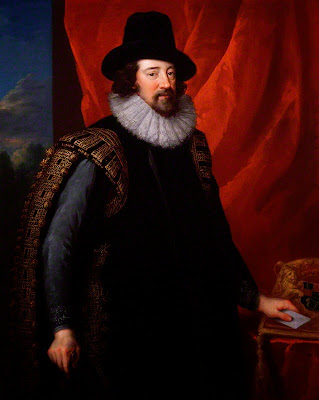
Francis Bacon, Viscount Saint Alban, Baron of Verulam (1561-1626)


Bacon had an interesting political career, including serving as Lord Chancellor under King James I, an office which in that time was mainly devoted to overseeing the judiciary, and seems to have been generally of a conservative, royalist turn of mind. Which didn't manage to get him out of a short stint as a prisoner in the Tower of London on charges of bribery at one point.

Jefferson's younger contemporary Hegel (1770-1831) wrote about Francis Bacon in his Lectures on the History of Philosophy (Vorlesungen über die Geschichte der Philosophie; I'm quoting here from the Bolland edition of 1908; translations mine). Hegel's framework for European history was a tripartite one that he applied to philosophy, as well, designating three major periods: the Greco-Roman, the medieval and the modern period. He wrote that the third period "first emerged since the time of the Thirty Years War with Bacon, Jacob Bœhme and Descartes." (p. 89) Hegel seemed to think the outlook of the practical, scheming statesman, "an educated man of the world," weighed heavily on Bacon's philosophical thought:

So he had experienced the depravity of men who were at the rudder of the state. Next to the depravity of his character he was a man of intellect and clear sight, but did not have the ability to reflect according to general thoughts and concepts. A methodical scientific view is not available from him, but rather only the superficial reflection of a man of the world above all. (p. 821)
Jefferson presumably didn't take quite such a dim view of the depravity of Bacon's character. Hegel nevertheless rated Bacon's contributions to philosophy highly. Hegel's German Idealist tradition was a distinct one from the British empirical tradition of which Jefferson's "trinity" of Bacon, Newton and Locke was very much a part. But Hegel valued the empiricist tradition highly. He praises Bacon especially for his critique of the theological-idealist philosophical tradition of the Catholic scholastics and for his emphasis on the value of empirical observation and experimentation.

Hegel points out that Bacon's two best-known works are the Novum Organum and De augmentis scientiarum. The latter was a translation into Latin with some revision of The Advancement of Learning, considered the first major work of philosophy written originally in English. In both works, Bacon polemicized against the scholastic Aristotelian metaphysical methodology that had become common in his time. That method involved reasoning from Scriptural assumptions and established theological premises to frame all experience. Bacon called instead for beginning with sensual experience and drawing conclusions from that experience, an "explanation" or "reading out" of Nature. Bacon strived to draw "conclusion by induction and analogy," Hegel quotes him from Novum Organon. In the later work, Bacon postulates four basic causes (Ursachen): matter, form, effective cause, and final cause.

Hegel argues that while Bacon assumed to derive "immanent, true perception" out of empirical observation and experimentation, without relying on pre-established assumptions or concepts, in fact Bacon was relying on assumptions and concepts in the classifications of knowledge he made in De augmentis scientiarum. (Hegel p. 818)

But Hegel's criticism of Bacon focuses more on what he sees as Bacon's insufficient empiricism than on his lack of an idealist perspective. In Hegel's view of philosophy as the Idea progressively manifesting itself in the history of thought, Bacon's refutation of scholastic Aristotelianism and his focus on investigating the material world were critically important advances in thought. It's notable that Hegel makes his point about Bacon's claims for deductive understanding of empirical observations by citing physical phenomenon that nevertheless are not understandable in a purely deductive sense such as that posited by Bacon:

Man does not remain with isolated facts and cannot. He seeks the general; but this is "thoughts," if not also "concepts." The most distinguished form of thought is that of "force"; so one speaks of a force of electricity, of magnetism, of weight. But "force" is a general thing, not directly empirically observable [nicht Wahrnehmbares]; therefore, the empiricist is completely uncritical, unconscious in devoting himself to such analyses [as those of Bacon's deductive approach]. (p. 819)
Hegel saw Bacon as having made a major advance in the research of natural phenomenon by focusing on the search for "effective causes" instead of teleological ones. Hegel also praised Bacon for his arguments against astrology, magic and other forms of superstition.

Given his passion for classification, it's fitting that Bacon should be especially remembered for lists of categories, such as his four types of "idols," his metaphor for major errors in thinking that prevent accurate perception of material realities: Idols of the tribe (careless but common assumptions), idols of the cave (individual preferences), idols of the marketplace (limitations of language) and idols of the theater (philosophical systems). He also classified three major faculties of knowledge: memory, imagination and reason. Though what troubled Hegel about the later was it was so heavily restricted to inductive reasoning without, in Hegel's view, adequate reflection on the underlying theoretical assumptions of his approach.

Bacon also is known for stressing the importance of the idea of falsification in physical experiments, a key part of the present-day scientific method which assumes that hypothesis need to be carefully formulated in a way that the possibility of their falsehood can be directly tested - although Bacon himself has been criticized for not sufficiently appreciating the importance of hypotheses. Jürgen Klein in very useful, long 2012 article about Bacon in the online Stanford Encyclopedia of Philosophy.

Bacon's Utopian fable The New Atlantis described his model for an institution devoted to scientific research for the benefit of humankind and is considered influential in the formation of the British Royal Society, founded in 1660.

In his Francis Bacon in entry for the Internet Encyclopedia of Philosophy, David Simpson observes of The New Atlantis:

The work ... stands in the great tradition of the utopian-philosophical novel that stretches from Plato and More to Huxley and Skinner.

The thin plot or fable is little more than a fictional shell to contain the real meat of Bacon’s story: the elaborate description of Salomon’s House (also known as the College of the Six Days Works), a centrally organized research facility where specially trained teams of investigators collect data, conduct experiments, and (most importantly from Bacon’s point of view) apply the knowledge they gain to produce "things of use and practice for man's life." These new arts and inventions they eventually share with the outside world.

In terms of its sci-fi adventure elements, the New Atlantis is about as exciting as a government or university re-organization plan. But in terms of its historical impact, the novel has proven to be nothing less than revolutionary, having served not only as an effective inspiration and model for the British Royal Society, but also as an early blueprint and prophecy of the modern research center and international scientific community.

Barbara Friedberg in the popular journal Skeptical Inquirer, Francis Bacon and the True Ends of Skepticism Nov/Dec 2000, calls attention to Bacon's emphasis on debunking superstition and the need for methodological corrections against psychological prejudice in evaluating scientific findings:

Bacon's paradoxical message- the mind is faulty, the mind can achieve wonders - is usually misunderstood, ignored, or quoted misleadingly.' Yet it is at the heart of the mission of SKEPTICAL INQUIRER. For Bacon grasped that the scientific method must be intimately linked with a critique of pseudoscience, and that such a critique was not to be just a start-up routine for modern science, bur would be of continuing, even increasing, importance. The more that inquiry prospered. the more its intellectual, semantic, and institutional offshoots would be vulnerable to the Idols of the mind.

She writes that in Bacon's time:

Empiricism was, not lacking, but it did not underlie broad scientific theories. These tended to soar aloft, in obedience to what Bacon called "Idols of the mind" because they diverged men from examining divinely created narure. What was needed was "a closer and purer league between ... the experimental and the rational (such as has never yet been made) ..."
Sources:

Francis Bacon, Achievement of Learning/Novum Organum/New Atlantis (Encyclopeadia Britannica edition; 1952)

Barbara Friedberg, "Francis Bacon and the True Ends of Skepticism" Skeptical Inquirer Nov/Dec 2000

G.W.F. Hegel, Vorlesungen über die Geschichte der Philosophie (Lectures on the History of Philosophy) Bolland edition; 1908

Jürgen Klein, "Francis Bacon" (2012) Stanford Encyclopedia of Philosophy

Hans Küng, Das Judentum (1991)

Antonio Pérez-Ramos, "Bacon's legacy" The Cambridge Companion to Bacon (1996)

Anthony M. Quinton, Baron Quinton, "Bacon, Francis, Viscount Saint Alban (or Albans), Baron of Verulam" (2012) Encyclopædia Britannica Ultimate Reference Suite; 2013 Online version: Francis Bacon, Viscount Saint Alban

David Simpson, "Francis Bacon (1561-1626)" (2005) Internet Encyclopedia of Philosophy

Tags: , ,