Showing posts with label pope benedict XVI. Show all posts

Monday, February 11, 2013

Pope Ratzinger steps down

Pope Benedict XVI's surprise announcement of his resignation effective February 28 brought a lot of attention in the press on Monday.

For many lay Catholics, the pending departure of the reaction Joseph Ratzinger from the Papacy invoked a similar sentiment to that expressed on the website of Página 12 for 12.02.2013:
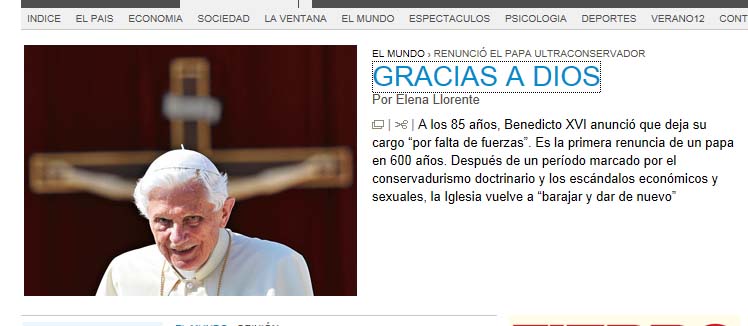

The article itself is by Elena Llorente, Benedicto XVI renuncia a su pontificado y sorprende a todos.

There is already a lot of speculation about what role the sex abuse scandal plays in Ratzinger's departure. We'll probably learn more about that, especially if the next Pope does what he needs to do and really do a clean-up, making sure that the practice of covering for abusive priests ends and notifying the secular authorities to take action.

Joseph Ratzinger, Pope Benedict XVI, aka, "Papa Ratzi"
As unusual as it is for a Pope to resign, it could be that Ratzinger is just tired and wants to spend his remaining years handling such a demanding position. His resignation is probably one of his best acts, and hopefully will open the way for his successors to retire when the job becomes too physically demanding rather than linger in the position semi-incapacitated, as his predecessor John Paul II seems to have done.

Llorente mentions that Ratzinger said several years ago in an interview that he would consider resignation as a possibility someday, though qualifying his statement by saying that he would not do so in a moment of crisis. She also reports that his brother Georg Ratzinger, also a German priest, knew of his decision beforehand.

Of course, speculation over his successor is part of the media chatter. So far, I've seen the following mentioned as possible candidates:

  • Cardinal Angelo Amato of Italy, Prefect of the Congregation for the Causes of Saints, age 74
  • Cardinal Francis Arinze of Nigeria, who is already 80
  • Cardinal Angelo Bagnasco, Archbishop of Genoa, age 70
  • Cardinal Jorge Mario Bergoglio of Argentina, Archbishop of Buenos Aires, age 76
  • Cardinal Tarsicio Bertone of Italy, Vatican Secretary of State, age 78
  • Cardinal João Braz de Aviz of Brazil, Prefect of the Congregation for Institutes of Consecrated Life and Societies of Apostolic Life, age 65
  • Cardinal Norberto Rivera Carrera of Mexico, Archbishop of Mexico City, Age 71
  • Cardinal Timothy Dolan, Archbishop of New York, age 63, a youngster in Papal age
  • Cardinal Antonio Cañizares Llovera of Italy, Prefect of the Congregation for Divine Worship and the Discipline of the Sacraments, age 67, and possessor of perhaps the oddest official title of the lot
  • Honduran Cardinal Oscar Andres Rodriguez Maradiaga of Honduras, age 69
  • Diarmuid Martin of Irelanhd, Archbishop of Dublin, age 67
  • Cardinal Marc Ouellet of Canada, Prefect of the Congregation for Bishops, age 68
  • Cardinal George Pell of Australia, Archbishop of Sydney, age 70
  • Cardinal Mauro Piacenza of Italy, Prefect of the Congregation for the Clergy, age 68
  • Cardinal Albert Malcolm Ranjith of Sri Lanka, Archbishop of Colombo, age 65
  • Cardinal Gianfranco Ravasi of Italy, President of the Pontifical Council for Culture, age 70
  • Cardinal Leonardo Sandri of Argentina, President of the Congregation for the Oriental Churches, age 69
  • Cardinal Odilo Pedro Scherer of Brazil, Archbishop of São Paulo, age 62, also a youngster in this context
  • Angelo Scola, Archbishop of Milan, age 71
  • Cardinal Christoph Schönborn, Archbishop of Vienna, who replaced an archbishop who had to step down because of his mishandling of sexual abuse cases, age 68
  • Cardinal Crescenzio Sepe, Archbishop of Naples, age 69
  • Cardinal Luis Antonio Tagle of the Philippines, Archbishop of Manila, age 55, a child in Papal age
  • Cardinal Peter Kodwo Appiah Turkson of Ghana, President of the Pontifical Council for Justice and Peace, age 64

Commonweal has a page collecting various links related to The Resignation of Benedict XVI

The National Catholic Reporter is a good source, e.g., John L. Allen Jr., Pope Benedict leaves behind legacy full of ups and downs 02/11/2013.

So is Catholic News Service, e.g., Francis X. Rocca, In hindsight, Pope Benedict's resignation seems almost predictable 02/11/2013.

The Jesuit magazine America, which has many of its articles behind subscription, has posted links to a number of them on The Papacy of Benedict XVI.

Other stories:

Pope Benedict's resignation will set in motion period of transition Catholic News Service 02/11/2013, on how the conclave of the Cardinal of Cardinals that will select the next Pope functions:

Only those cardinals under age 80 will be eligible to vote in the coming conclave. Cardinals who are age 80 or over by the time the conclave starts are excluded from the closed-door proceedings. There will be 117 cardinal-electors when the "sede vacante" begins Feb. 28; by March 5, that number will be 116. ...

The word conclave comes from Latin, meaning literally "with key," and reflects the previous tradition of locking the cardinals in an area where they would spend day and night until the new pope's election.

On the day set for entry into the conclave, the cardinal-electors assemble in St. Peter's Basilica to attend morning Mass. In the afternoon, they walk in procession to the Sistine Chapel, located just to the north of St. Peter's.

The voting may begin that afternoon with one ballot; on following days, normally two ballots are held in the morning and two in the afternoon.

A pope is elected when he obtains a two-thirds majority, reflecting a change Pope Benedict established in 2007 that effectively undid a more flexible procedure introduced by Blessed John Paul.
Michael Brendan Dougherty, One Of These Men Will Be The New Pope Business Insider 02/11/2013

David Gibson And Alessandro Speciale, Who's in the running? 12 names to watch to become the next pope Washington Post 02/11/2013

Heribert Prantl, Stellvertreter Gottes a. D. Süddeutsche Zeitung 11.02.2013

Wie die Wahl des Benedikt-Nachfolgers funktioniert Die Welt 11.02.2013

Rätselraten um Papst-Nachfolge hat begonnen SWR 12.02.2013

Tags: ,

Wednesday, May 06, 2009

Obama and the Vatican


John L Allen, Jr. in Vatican's moderate line on Obama has deep roots National Catholic Reporter 05/04/09 observes that the Vatican has been much friendlier in its treatment of President Obama than some American Catholic fundamentalists have been, like those trying to get him banned from speaking at Notre Dame University.

Allen sees a couple of basic reasons for this:

First, abortion has never been the overriding focus for conservative Catholic intellectuals and activists in Europe that it is in the United States. In Europe, the dominant issue tends to be the continent's Christian identity, which is often expressed in anti-EU activism or concern about the social impact of immigration. As a result, it does not come naturally for many European Catholics, including many in the Vatican, to evaluate leaders primarily through the lens of their policies on life issues.

Second, the Holy See is a sovereign state with its own diplomatic corps and a wide range of international interests. On several matters of global concern -- including the reconstruction of Iraq, the Israeli/Palestinian problem, multilateralism in foreign policy, and nuclear disarmament -- Vatican diplomats generally believe the early signals from the Obama administration are encouraging. For that reason, some Vatican officials are reluctant to take a hard anti-Obama line, particularly on the eve of Pope Benedict XVI's much-anticipated trip to the Holy Land, which the Vatican hopes will lend momentum to the peace process. [my emphasis]
While the Vatican has generally opposed anti-immigrant extremism, it has promoted the "Europe's Christian identity" business.

There are other distinctions between the Vatican and the Catholic Church in Europe, on the one hand, and the American Christian Right on the other. Don't get me wrong: Ratzinger (Benedict XVI) is a reactionary in terms of his theology. And there is a tradition of Christian Democratic parties in Europe that gives the Vatican close allies among conservative politicians.

But Christian Democrats in Europe are not like American Republicans. The leader of the Partido Popular (PP) in Spain, a party closely aligned with the very conservative Church hierarchy there, said after the US election last November that the PP was a less conservative party than Obama. I haven't looked hard to see in what ways that might be true. But the point is that the conservative parties close to the Catholic hierarchies in their respective countries don't understand their politics in the way the US Republican Party understands theirs.

And the hardline rightwingers, those who would be impressed with European versions of Rush Limbaugh or Glenn Beck, don't tend to be aligned with overtly religious activists like US Republicans are. On the contrary, the European far right tends to be anti-clerical. Some of them promote kitschy "pagan" religions, something in America that people tend to associate more with tree-hugging New Agers.

Tags: ,

Friday, January 30, 2009

Another Ratzinger special

Schismatic, reactionary Archbishop Marcel Lefebvre (1905-1991)

Pope Ratzinger I (formally Benedict XVI) just lifted the excommunication of four schismatic hard-right bishops, one of whom is an overt Holocaust denier.

Dave Neiwert gives a great account in Pope Benedict reaches out to anti-Semitic Catholics, but liberals still talk to the hand (video fixed) Crooks and Liars by David Neiwert 01/25/09. I have to admit that "talk to the hand" is a figure of speech I only recently learned what it means, i.e., talk to the hand because the ears ain't listening to you.

Lefebvre movement: long, troubled history with Judaism by John Allen, Jr. National Catholic Reporter 01/26/09. The four bishops that Ratzinger just accepted back into the Catholic Church were ordained by the late schismatic Catholic archbishop Marcel Lefebvre. Allen reports:

A troubled history with Judaism has long been part of the Catholic traditionalist movement associated with the late French Archbishop Marcel Lefebvre — beginning with Lefebvre himself, who spoke approvingly of both the World War II-era Vichy Regime in France and the far-right National Front, and who identified the contemporary enemies of the faith as “Jews, Communists and Freemasons” in an Aug. 31, 1985, letter to Pope John Paul II.

Reacting to the furor over [Bishop Richard] Williamson [the reinstated Holocaust denier], the Vatican has stressed that lifting the excommunication is not an endorsement of his views on the Holocaust, and has repeated its firm commitment to Catholic-Jewish dialogue and to combating anti-Semitism. The pope’s outreach to traditionalists should instead be seen, spokespersons said, as an "act of peace" intended to end the only formal schism in the wake of the Second Vatican Council (1962-65).
The PBS Newshour reported on the issue in Pope Draws Criticism for Pardoning Bishop 01/28/09. Their report shows Williamson declaring:

I believe that the historical evidence is hugely against 6 million Jews having been deliberately gassed in gas chambers as a deliberate policy of Adolf Hitler. I believe there were no gas chambers.
Holcaust denial is a variety of pseudohistory. But it's main purpose is sneering at Jews and victims of the Nazi dictatorship. It's also an attempt to rehabilitate the image of Hitler and Nazism, but I see that as a distinctly secondary function. Holocausts deniers' approach is so full of far-right, crackpot features that I find it hard to take seriously that most of them actually believe their own line.

Williamson's brief statement is typical. Denying that there were gas chambers in the extermination camps is straightforward denial of historical facts. But the rest of his statement is full of the kind of double-talk rightwing kooks love.

"I believe that the historical evidence is hugely against 6 million Jews having been deliberately gassed in gas chambers as a deliberate policy of Adolf Hitler, he said.

No one claims that six million Jews were killed in gas chambers. Large numbers were shot, starved or beaten to death, and so on. The "deliberately" is a nice weasel word.

The six million number originated with Adolf Eichmann, who was in a better position than most to know. I believe that most historians of the Holocaust would put the number of clearly documented deaths at between 5.2 million and 5.8 million. But they also don't challenge six million as a likely number. Leading Holocaust historians did react against a claim several years ago that newly-released files from the Soviet Union showed that the number was significantly higher than six million. The higher estimate was a serious misreading of the material.

But Holocaust deniers and Hitler apologists love to comma-dance over numbers. They insist on minimizing the number of Jews and others killed in the Holocaust. But exaggerating the number of Germans killed in the Dresden bombing in particular has been a favorite obsession of the same crowd.

Also, Williamson specifies a "deliberate policy of Adolf Hitler". A variation on Holocaust denial is to deny that Hitler himself ordered it or even knew about it. In response to David Irving's work in particular, historians have looked closely at both issues. And, despite the extreme efforts to shield Hitler from documentable responsibility, there is no serious doubt that he both ordered the killing and knew what was going on.

This is part of the problem of responding in a careful way to bald-faced liars. I say "no serious doubt" because despite overwhelming circumstantial and other evidence, we don't have a handwritten order from Hitler saying "Kill.All.The.Jews." Someone looking at the question carelessly or superficially might have some doubt. But not anyone who actually is aware of the evidence. Christopher Browning deals with this particular question in The Path to Genocide: Essays on Launching the Final Solution (1995).

Additional sources on the controversy over Ratzinger's action:

Replacing dialogue with deafness by Jonathan Romain Guardian 01/26/09

Pope’s Embrace of Renegade Bishops Dooms Jewish-Catholic Summit by Nathaniel Popper The Forward 01/27/09:

The most significant impending meeting between Jewish leaders and Pope Benedict XVI is being called off due to the Catholic Church’s recent decision to reconcile with four renegade ultra-conservative Catholics, including one who has a history of denying the Holocaust.

Israel’s chief rabbinate sent a letter to the Vatican indefinitely postponing a March summit in Rome that was to include the pope. The letter came a few days after the Vatican revoked the excommunication of four bishops from the Society of Saint Pius X, a group that opposed modernizing reforms adopted by the church during the 1960s, including efforts to reconcile with Jews. One of the four bishops in question, Richard Williamson, has said that no Jews were killed in Nazi gas chambers and has accused Jews of striving for “world dominion.”
Pope decision to rehabilitate Holocaust-denying bishop sparks Jewish-Catholic row Haaretz 01/25/09:

The Yad Vashem Holocaust Museum and Memorial in Jerusalem decried as
"scandalous" Benedict's decision to lift excommunications on British-born bishop, Richard Williamson, who has said there were no gas chambers and only 300,000 Jews perished in Nazi concentration camps in World War Two. Foreign Ministry spokesman Yigal Palmor, said, however, the pontiff's planned visit in May to Israel was not in doubt. "This has nothing to do with relations between states," he said.
Tags: , , ,

Wednesday, April 11, 2007

Things that make you go, "Huh?"

Some days the news is exceptionally weird. Today, we've got the neoconservative theologian Michael Novak saying that Joseph Ratzinger, aka, Pope Benedict XVI, is a leftwinger. Ratzinger a leftwinger. We're into Bizarro World with that one. (See Benedict vs. the War Party by Justin Raimondo, Antiwar.com 04/11/07, and, no, I'm still not comfortable with the way Raimondo uses "War Party".)

Then we have a Page 1 story by Robert Fisk, Divide and rule - America's plan for Baghdad Independent 04/11/07, reporting that the Pentagon has a spiffy new plan for the new strategy (The Surge, aka, the McCain escalation). They're going to wall off several section of Baghdad and not let anyone in without proper ID. Hey, building that wall in the West Bank has brought permanent peace between Israel and the Palestinians, hasn't it? It's bound to work in Baghdad. And, as a special bonus benefit of this grand idea, that will free up 40,000 troops to be stationed near the Iranian border to be positioned "in the event of a US or Israeli military strike against its nuclear facilities later this year". Well, all rightie, then! Victory is just around the corner, no doubt.

Wierdest of all, Peter Baker and Tom Ricks report that three four-star generals have turned down a position that apparently still exists only somewhere in a dark recess of Dick Cheney's brain, "a high-powered czar to oversee the wars in Iraq and Afghanistan with authority to issue directions to the Pentagon, the State Department and other agencies" (3 Generals Spurn the Position of War 'Czar' Washington Post 04/11/07)). Presumably this new General Czar of War would only be directing the State Department on matters related to those two wars. But who knows? There are several possible ways to understand this story. If I were to use a political-science version of Occam's Razor - the least malign explaination that accounts for the known facts is probably the best - I would guess that this would be a position formally reporting to the President but really to Dick Cheney, and which would let Cheney basically run all of Middle East policy directly.

What in the name of Pallas Athena are these people thinking?

Update: Not surprisingly, a number of bloggers have been commenting on this War Czar report. Josh Marshall at TPM 04/11/07 compares it to a previous Onion spoof, illustrating once again how hard it is to actually make satire about an administration as off the tracks of this one. He takes it as a sign that Bush is feeling overwhelmed, and says it shows "why the Republic is genuinely in peril as long as this pitiful goof remains in office".

Kevin Drum at the Washington Monthly sees it as an attempt to fix problems by juggling boxes on an org chart, though he also says, "the fact that Bush apparently thinks that a bit of org chart shuffling will make a significant difference in Iraq is just one more sign of how deeply out of touch with reality he is." (Out of Gas 04/11/07)

Tim Grieve at Salon's War Room focuses on the Post's quote from Gen. Jack Sheehan, one of those who turned down the job emphasizing Cheney's stranglehold over foreign policy. Grieve quips about the War Czar position, "The catch? Dick Cheney already has the job, and he's not letting go." (Cheney in charge 04/11/07)

Steve Soto at The Left Coaster writes, "Yet as the story indicates, a czar won’t do any good if the fundamental policy is wrong and is being pushed by a delusional VP with too much power." (Bush Has No Takers For "War Czar" 04/10/07).

Robert Farley at TAPPED thinks it's another sign of Republican incompetence at government and asks, "Right; we don't have one guy, we just have several guys, including the commander of CENTCOM and the Secretary of Defense, who should have this kind of authority" to coordinate the Iraq and Afghanistan Wars.

Matt Iglesias comments on the fact that nobody will so far take the job, "The Bush family's one-way understanding of loyalty also has to make this a relatively unappealing post."

The Armchair Generalist says (Failure of Leadership 04/11/07):

What the hell is wrong with these people? Maybe I'm naive, but I thought there was a guy in charge of coordinating the execution of national strategy in the region. He's called a National Security Advisor, but then again, if Condi set the bar, maybe that's not working. And of course, there's always the SecDef, Chairman of the Joint Chiefs, and the CENTCOM combatant commander who have responsibilities there. I think all those retired generals understand that implicitly and really don't want the headache of playing butt-boy between the White House, State, DOD, and CENTCOM. As the article suggests, the obstacle here is more that there is already a civilian micromanaging the details of the wars - that would be Vice President Dick Cheney.
The most substantial blog comment on this I've seen is from Marcy (emptywheel) at The Next Hurrah (A Failure of Management 04/11/07):

We taxpayers pay a National Security Advisor to make sure that someone mediates the opinions and agendas of the many strong-willed people running our foreign policy. We pay that person to make sure that our foreign policy is managed well. But once again, the person in the position is not up to the task.

At some point, we need to face the overriding management issue. Is the problem that Condi and Hadley are incompetent (yes, partly)? But this constant shuffling, this search to find someone who can put unity to our foreign policy approach, suggests another problem. It's not just that Condi and Hadley are incompetent. It's that Bush himself can't see the issue with the requisite clarity to empower his National Security Advisor to do the job well.
Marcy is right in seeing this, as she explains in her post, as a continuation of management flubs on both wars.

But management flubs are a given in this administration, especially on the most critical foreign policy issues. I'm concerned that there's more to this, and that it's disturbing beyond the desperation and confusion it seems to show.

Marcy and the Armchair Generalist both remind us that the National Security Adviser, currently Stephen Hadley, is supposed to provide management and information coordination for overall foreign policy. But the NSA is a statutory position, and it was set up for good reasons as a formal position.

This War Czar as described in the Post article sounds like an Executive Branch creation that could be given the authority, or in practice exercise the authority, to overrule both the Secretaries of Defense and State on matters relating to the two wars.

But I'm wondering what the statutory position of a position like that would be. And since Dick Cheney apparently never does anything without thinking how it might provide an excuse to keep even more of the public's business secret from the public, Congress should start asking questions sooner rather than later. Is this a way to make an end-run around legal restraints of some kind?

One possibility relates to the covert operations that Rummy had started running out of the Pentagon. That gave him and Cheney the ability to do secret operations not subject to the requirements for authorization and reporting that are mandated for the CIA. Rummy's replacement Robert Gates has been reported to want to give the black-ops portfolio completely back to the CIA. I wouldn't be surprised to find out that the War Czar idea is a play to keep a secret-war capability in Dick Cheney's hands, one not subject to the CIA's reporting requirements.

At a minimum, I hope that Congress will look more into this. The press, too, if our "press corps" can tear themselves away from montoring the fashion statements they think the Democratic candidates are making with their attire and from defending their good buddy Don Imus.

Tags: , , , , , ,

Wednesday, March 14, 2007

Vatican criticizes work of Jesuit liberation thologian Jon Sobrino

Vatican bogeyman Jon Sobrino (Photo: El Mundo/EFE)

The Vatican's Holy Office (Congregation for the Doctrine of the Faith, known previously as the Inquisition) has issued a condemnation of two works by the liberation theologian Jon Sobrino, a Spainard who has spent most of his career as a Jesuit priest in El Salvador: Vatican criticizes Jesuit liberation theologian, issues no sanctions by John Thavis, Catholic News Service 03/14/07; Vaticano reitera obra jesuita muestra discrepancias con Fe Diario de Hoy (El Salvador) 14.03.07.

Ironically, Pope Benedict XVI when he was Archbishop Ratzinger of Munich had Sobrino's doctoral thesis translated into German.

The official criticism was directed toward two of Sobrino's works in particular: Jesucristo liberador: Lectura históricoteológica de Jesús de Nazaret and La fe en Jesucristo. Ensayo desde las víctimas. Normally when a theologian's works are denounced this explicitly, a sanction is imposed forbidding the theologian to teach as an official Catholic theologian. I call it "yanking the Vatican franchise". Sometimes the person is "silenced", meaning they are forbidden to give public presentations of their ideas at all. Such sanctions do not mean that the criticized theologian is excommunicated from the Church.

In this case, the initial reports stress that there is no news of sanctions being imposed on Sobrino. But reporters may have fallen for Vatican spin on that one. The opinion piece by Elilio de Benito linked below quotes the Archbishop of San Salvador, Fernando Sáenz, as saying that if Sobrino doesn't renounce the parts of his work criticized in the Holy Office's report, he would be banned from teaching as a Catholic. You could say his Catholic "franchise" has been suspended, with removal an immediate option.

Sobrino's best-known early work was Christology at the Crossroads, which is one of the basic texts of "liberation theology". This was a viewpoint on Christian theology that stemmed from the experience of Latin American Christians who suffered from both economic deprivation and bad government, often a dictatorial kind. It grew out of an official position of the Latin American Church that emphasized a "preferential option for the poor".

It's essentially impossible to summarize a serious theological movement in a few words. But if I had to do so, I would say that it was an attempt to elaborate the social doctrines of Christianity in a way relevant to the conditions of the late 20th century, with heavy emphasis on the prophetic tradition.

One of the institutions associated with liberation theology was known as "base communities". These were associations of local people who tried to cooperatively address very practical problems in their local villages, such as digging wells. Priests working with those communities encouraged discussion of Scriptural texts in light of the social experience of the local communities.

It's not surprising that this led to a perspective on Christianity that was not comforting to the comfortable.

A favorite text of those active in the base communities and liberation theology was the passage from Luke known as the Magnificat of Mary, which includes these lines (RSV):

He has shown strength with His arm:
He has scattered the proud in the imagination of their hearts.
He has put down the mighty from their thrones,
and exalted those of low degree.
He has filled the hungry with good things;
and the rich He has sent empty away.

Sobrino teaches at the University of Central America. Fortunately for him, he was out of the country on a teaching assignment on November 16, 1989, when Salvadoran soldiers murdered six priests on the campus, including the rector of the university. An event worth remembering when we hear references to a possible "Salvador option" in Iraq.

The news articles are also fairly vague about the nature of the Holy Office's criticisms. They accused the criticized works for being in error in both methodology and content. The essential argument seems to be that Sobrino's emphasizes the humanity of Jesus too much in comparison to his divine nature. According to the Christian doctrine of the Trinity (which is so hard to understand that even theological-minded Christians wind up calling it "a mystery"), Jesus of Nazareth was both fully human and fully divine.

Though liberation theology as a movement or intellectual trend has been largely suppressed by the Church for the moment, I continue to think that approach offers some real insight into how the Christian religion can conceptualize the challenges of the Church in today's conditions. I don't think it's going away.

Other news reports:

El Vaticano hace una advertencia contra las tesis del teólogo español Jon Sobrino El Mundo 14.03.07

Jon Sobrino espera ser sancionado por el Vaticano por 'falsear la figura del Jesús histórico' El Mundo 13.03.07

La primera condena del papa Benedicto XVI El País 13.03.2007

El Vaticano sanciona a Jon Sobrino, el principal teólogo de la liberación de Emilio de Benito El País 13/03/2007

Vaticano condena la obra de Jon Sobrino, importante teólogo de la liberación El Comercio (Ecuador) 03/14/07

On the mixed performance of the current Pope Benedict XVI: The Puzzling Pope: Who Is Benedict XVI? by Andrew Greeley Commonweal 11/03/06

Tags: , , ,