Showing posts with label deutsche politik. Show all posts

Friday, July 01, 2011

Political anti-Semitism in Germany, 1871-1914 (5 of 5): the SPD and anti-Semitism

Paul Massing, Rehearsal for Destruction: A Study of Political Anti-Semitism in Imperial Germany (1949)
SPD leader Wilhelm Liebknecht (1826-1900)
The combination of the SPD's view of contemporary anti-Semitism as an ugly side-product of capitalism, their notion that it would fade away with the growth of working-class solidarity and the eventual achievement of socialism, and the receding of anti-Semitic politics and activism after 1895 made them misjudge the potential political power of anti-Semitism. Massing notes that after the 1905 Revolution in Russia, pogroms against Jews took place there:

The brutality with which the government put down the revolution, and the white terror and pogroms that followed in its wake, were not taken as an object lesson by the German Socialists. They felt, like most Western Europeans, that terroristic anti-Semitism was inconceivable anywhere but in the barbarous world of Czarist reaction. Pogroms belonged to the dark Middle Ages which in Russia extended into the present but which had definitely become past history in Germany. The Social Democrats shared this conviction with the Liberals and with most Conservatives. In Germany, not even a professional anti-Semite would have dared any longer to instigate physical violence against Jews. The worst mob demonstrations in the eighties and nineties had not approximated anything like a Russian pogrom. Meanwhile ten years had passed which had extinguished even these memories. The use of physical violence against the Jews was only possible among "backward," "uncivilized," "ignorant" masses, spurred on by ruthless tyrants. (p. 196)
"Racial" anti-Semite Max Liebermann von Sonnenberg (1848-1911)
He quotes the Party's leader, August Bebel from 1906 condemning anti-Semitic outbreaks in Russia and affirming the view that such a problem was not to be expected in Germany:

The Russian government favors anti-Semitism because it is anxious to divert the hatred of the masses from its own foul and corrupt system of government and from the representatives of this system, the corrupt civil service. ... And since the Jews in Russia, intellectuals and proletarians, participated in extraordinary number in the revolutionary movement, the Russian government had an additional reason for having hatred of Jews incited by its agents and for provoking massacres and butcheries the like of which have happened so far only under oriental despotisms. Anti-Semitism which by its very nature can appeal only to the basest drives and instincts of a backward stratum of society, expresses the moral depravity of the groups that accept it. It is comforting [to know] that in Germany it will never have a chance to exert a decisive influence upon the life of state and society. [p. 197; Massing’s emphasis]
Massing then observes that even though that final sentence sounds "preposterous" after the experience of the Third Reich, at the time it "expressed the conviction of the German people at large."

In response to the pogroms in Russia and the generally unfavorable condition of Jews in eastern Europe, especially compared to their situation in Germany and Austria, the Zionist movement began to win adherents. Its popularity was greatest among eastern European Jews. But some Jews in the SPD’s reform wing expressed active sympathy for Zionism, doubting the Party’s official position that the development of capitalism would make class considerations override religious or pseudo-racial prejudices against Jews as Jews. The SPD’s official position was opposed to Zionism, regarding it as an unrealistic response to a problem they believed was fundamentally rooted in the social processes affecting peasants and the lower middle class under capitalist condition, and one that would disappear as a matter of course under socialism.
"Racial" anti-Semite Wilhelm Marr (1819-1904)
This approach meant that the SPD tended to downplay the manifestations of anti-Semitism in Germany during the 1895-1914 period. But he also argues that not only Party leades but rank-and-file supporters understood anti-Semitism as being an ideology hostile to the needs of the working class. And he notes:

Indeed, quite a number of Jews were attracted to the party despite the economic and cultural barrier of class. The Jewish Social Democrats were mostly intellectuals, businessmen, and salaried employees, with hardly any manual workers among them. The reasons that prompted middle-class Jews to expose themselves to additional hostility by joining the Social Democrats must have been strong. Material considerations, as a rule, cannot have entered into their decision. To be known as a voter, member, or even active supporter of the Social Democratic Party was in imperial Germany no boon to anyone's career, and less so to a Jew's. Besides, Jewish intellectuals who joined and worked for the revolutionary party often jeopardized their social relations and damaged their standing in the Jewish community, particularly in small towns. Apparently in the world of socialist labor individual Jews could experience the equality which German society denied to the Jewish group. (p. 202)

He sums up the strengths and the weaknesses in the SPD's approach to anti-Semitism this way:

In theory and practice socialist labor was opposed to anti-Semitism. The Socialists never wavered in their stand against all attempts to deprive Jews of their civil rights. They treated with contempt the anti-Semitic agitators and the groups behind them. They never gave in to the temptation - considerable at times - to gain followers by making concessions to anti-Jewish prejudice. From the rise of the socialist labor movement in the 1860's to the time of its defeat by National Socialism, the statements of the labor leaders, the resolutions carried in party conventions, the methods of coping with the situations created by political anti-Semitism, testify to its unswerving opposition to any kind of discrimination against Jews.

On the other hand, socialist labor was indifferent, if not actually hostile, toward all efforts to preserve and revitalize autonomous Jewish religious, cultural, or national traditions. Marxism, its guiding philosophy, had as little use for the Jewish religion as it did for the Christian. Eager to have the processes of industrial society do their work of obliterating cultural differences, socialist labor could see no more than an obsolete religious heritage in the beliefs of orthodox Jewry and had even less sympathy for conscious attempts to revive the Jewish nation.

Little attention has been paid in nonsocialist literature to the work of enlightenment and education which German socialism carried on among its followers. The Socialists, on the other hand, have done little in the way of critically reevaluating this work. [As of 1949.] (p. 151)
Massing's book doesn’t trace the historical threads of these anti-Semitic trends into the First World War and beyond. He occasionally makes reference to some similar development in the time of the Nazi movement. But he mostly concentrates on describing the events in the political context as the major players understood them at the time. His analysis does throw light on some of the psychological and sociological factors at work in anti-Semitic appeals. But its main value is in giving a clear definition of the most notable political anti-Semitism movements from the time of German unification in 1871 to the First World War and how they were situated in the social and political conflicts of the time.

Tags: , , , , , ,

Thursday, June 30, 2011

Political anti-Semitism in Germany, 1871-1914 (4 of 5): the SPD and anti-Semitism

Paul Massing, Rehearsal for Destruction: A Study of Political Anti-Semitism in Imperial Germany (1949)

Massing devotes several separate chapters to the Social Democratic Party (SPD), the labor movement and anti-Semitism. The SPD's outlook was secular. Socialist labor was deeply skeptical of both the Catholic and Protestant hierarchies, and the feeling was returned and more. Massing frames the basic position of the SPD on anti-Semitism this way:

The Social Democrats saw no reason for singling out the Jewish group, either for attack or protection. Jews would share the fate of the socioeconomic classes to which they happened to belong. The revolutionary workers would abolish capital regardless of its religious denomination. In matters of human relations they would be guided by the declaration of the First International which had stated that "this International Association and all societies and individuals adhering to it will acknowledge truth, justice, and morality as the bases of their conduct towards each other and towards all men without regard to color, creed or nationality." The class theory also governed the Social Democrats' appraisal of anti-Semitism. They were certain that the economic and psychological conditions necessary for anti-Semitism to flourish were to be found mainly in those intermediary classes which modem capitalism had thrown into a "prolonged but hopeless agony." (p. 160)

Social Democratic Party (SPD) leader August Bebel  (1840-1913)
As a practical matter, the "racial" anti-Semites were of more concern to the SPD than the Stoecker variety. Because, as Stoecker soon realized after launching his political activities, he was attracting support from independent tradespeople and shopkeepers, virtually none from the industrial working class which was his original target constituency. The "racial" anti-Semites did attempt to compete directly with the SPD for working-class votes, and their programs were tailored to appeal to not only urban middle-class voters who felt their positions endangered by economic developments, but also to peasants and to workers. By contrast, Stoecker for most of his political career focused more on pulling voters from the liberal (capitalist) parties to the Conservatives and allied forces. The SPD saw the "racial" anti-Semites as the more direct political threat, because they also denounced feudal reaction and struck a radical and even revolutionary tone against the existing authorities. The SPD prior to the First World War didn’t make much effort to win rural votes from the peasants.
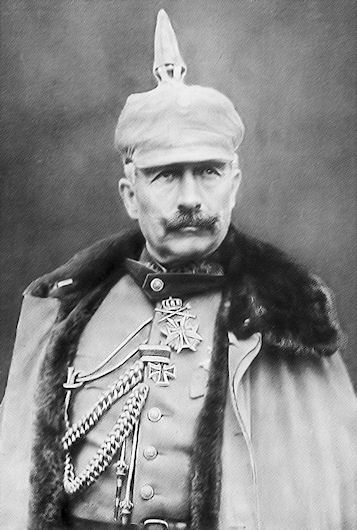
Kaiser Bill, Wilhem II (1859-1941), who "improvised from one blunder to the next"
Massing credits the SPD, whose leaders mostly applied a Marxist outlook to their understanding of social and class dynamics, with recognizing the dangerous potential popularity of anti-Semitism in German politics:

The Marxists [SPD] were the first to emphasize the socioeconomic roots of modem anti-Semitism. They warned their followers not to belittle it as a mere product of demagogic agitation, not to ignore the social reality behind the manipulative aspects of anti-Semitic movements. "One cannot pass over phenomena which find a response among the masses," Bebel told the delegates to the Social Democratic Party convention in 1893, admonishing them not to repeat the stupidity of their own opponents who for a long time had regarded the socialist movement as nothing but an artificial bubble. "It is necessary to analyze the causes and, having found these causes, one must look out for the means with which to remedy the ills that have produced these phenomena." [my emphasis] (p. 161)
Massing doesn't go into detailed analyses of electoral results but rather describes the fortunes and influence of those groups that promoted anti-Semitism most actively and effectively. He has a good sense of the complexity of motivation on politics and the difficulties for an historian to make exact judgments about them. He also appreciates the role of plain old folly in politics; he writes of Kaiser Wilhelm II's general approach to forming foreign policy, "It was all-important to have the ear of the Kaiser who, unable to master the situation, relied on his 'intuition' and improvised from one blunder to the next."
"Racial" anti-Semite Ernst Henrici (1854-1915) strikes a colonial pose
He gives one of the best brief descriptions I’ve seen of how the reform and revolutionary wings of the SPD co-existed in the same Party from the mid-1890s to the First World War brought a split between supporters and opponents of the war, largely corresponding to the reform and revolutionary trends, respectively:
Intensive industrialization not only favored the growth of the Social Democratic organization but facilitated a compromise between the party's left and right wings. So long as such objective criteria as electoral victories, membership increases, and the rapid concentration of industrial and financial wealth supported the theory of a quasi-automatic evolution toward the day when labor would "take over," it did not matter too much how the party acted, as long as it remained "revolutionary." The Social Democratic leaders seemed justified in the belief that the revolutionary prospects would not suffer if the party confined itself to those legal methods of agitation which the government could not deny it. The radicals' desire for legality was, of course, wholeheartedly shared by the moderates who saw in the party's growing stature proof of the progress which Social Democracy could make under the constitutional government. In the early nineties, on the occasion of Bismarck's dismissal, and again at the time of the Kaiser's conflict with [Chancellor] Caprivi when the air was thick with rumors of an impending coup d'etat, the leaders of Social Democracy had agreed that the conditions of constitutional legality were preferable to a hazardous existence under a military dictatorship. (p, 191)
Concludes in Part 5

Tags: , , , , , ,

Wednesday, June 29, 2011

Political anti-Semitism in Germany, 1871-1914 (3 of 5): "racial" anti-Semitism

Otto Boeckel, the "peasant king of Hesse"

Paul Massing, Rehearsal for Destruction: A Study of Political Anti-Semitism in Imperial Germany (1949)

Political and racial anti-Semitism were real phenomena in late 19th-century Germany and had a significant impact on politics. But they were largely a side-show to the Conservative Party of Prussian Junkers, other big landlords and the conservative Protestant hierarchy. The political anti-Semites had some success in making "the Jews" a bogeyman for an array of social problems, especially during periods of harder economic times. In periods when the Conservatives were outside the government coalitions, they found it convenient to make use of the anti-Semites, not so convenient when they were in the government coalitions. Especially among the leaders of "racial" anti-Semitism, there was genuine fanaticism and a keen desire to suppress or even expel Jews from Germany. But these elements never had the political clout to force significant governmental measures against Jews:


Theodor Fritsch and his Anti-Semites' Catechism; Fritsch eventually wound up in prison for blackmail

Neither the anti-Semitic movement of the eighties nor of the nineties succeeded in bringing about any changes whatsover in the legal status of the Jewish group. Not a single law was passed that infringed upon the emancipation act of 1869. This in a country in which there was at the time considerable discrimination against Catholics, Socialists, and Poles. The demands of the racial anti-Semites that the Jewish group be put under legal restrictions never had the slightest chance. When, at the first "International Congress of Anti-Semites" at Dresden (1882), Ernst Henrici moved that all Jews be expelled from Germany, no other than Adolf Stoecker assured him that, in a contest as to who should be expelled from Germany, the Jews or the anti-Semites, the decision would most certainly go against the anti-Semites.' Stoecker's biographer, Nazi professor Walter Frank, agrees that "the whole anti-Semitic movement which, between 1876 and 1900, had such a wide appeal, did not noticeably change the nature of the Jewish problem one way or the other. The situation in the Prussian-German state continued to be such that by and large Jewry's economic, social and cultural power was left untouched, whereas Jews were, on the whole, excluded from the administrative apparatus."' [my emphasis] (p. 107)
Political anti-Semitism faded considerably in importance during the period 1895-1914, as a strong recovery from the international economic Crisis of 1893 took hold. The anti-Semitic voting base in rural areas dropped off as agricultural prosperity returned. Massing quotes Willi Buch saying, "By 1911, anti-Semitism with a political party organization had actually ceased to exist." And Massing summarizes the passing from the scene of the old guard anti-Semitic leaders like this:

Among the apostles of "pure," "radical" anti-Semitism Ernst Henrici gave up early and withdrew so completely from the political scene that his name was soon all but forgotten. Even standard works on the history of anti-Semitism contain no reference to his further fate. Buch mentions that its erstwhile hero had turned out to be an embarrassment for the anti-Semitic movement. Henrici had gone to the United States from which he returned with a spouse of "mixed blood." Bernhard Förster and his wife Elizabeth Förster-Nietzsche, Friedrich Nietzsche's sister, left Germany in 1886 and founded a judenreine colony, Neu-Germania, in Paraguay. In 1889 Förster, despairing of the success of his project, committed suicide. Karl Paasch, pamphleteer and contemporary of Henrici and Förster, went to Switzerland where he died, a victim of persecution mania. Otto Boeckel, "peasant king of Hesse," lost his Reichstag seat in 1903, withdrew from political life "completely impoverished, bitter and withdrawn," and died forgotten in 1923. Hermann Ahllwardt, "Rektor of all Germans," fared even worse. Although reelected to the Reichstag in 1898, he found himself in complete isolation and stopped attending parliamentary sessions. By the turn of the century he had practically disappeared from the political scene. After an unsuccessful trip to the United States where he tried to organize the fight against "the Jewish rabble that does not want to work," he opened a cigar store in Berlin which he soon gave up again. For a while he sold mining stock in the German-speaking parts of Bohemia. In 1907, "having completely turned his back on anti-Semitism," he approached Theodor Fritsch with a suggestion to take up the fight against the Jesuits and Free-Masons. In 1909 he was sentenced for blackmail. His family was impoverished and sunk to the level of the Lumpenproletariat; Ahlwardt himself died in 1914 from injuries he suffered in a traffic accident in Leipzig. (pp. 113-114)
During the two decades leading up to the First World War, organized anti-Semitism faded in importance, although it didn’t disappear. But its political position was in practice subordinated to the Conservatives:

During the years of prosperity the two occupational organizations, the Agrarian League and the Federation of Commercial Employees, well managed, solidly financed, and going about their business in a rational way, proved to be far superior to the parties which had nothing to sell but anti-Semitism. The anti-Semitic parties became financially dependent on them and were accordingly treated. (p. 139)
But this was also the era in which Germany started playing the imperialist game in a major way, competing with Britain and France for colonial acquisition and influence. And along with that mission came racist ideas. The Pan-German League (Alldeutsche Verband) was the major private organization devotedly specifically to promoting German colonialism. (See pp. 142ff)

Massing's book is especially helpful in showing how anti-Semitism was more typically linked to conservative politics, but not always. Some of the anti-Semitic groups favored social reforms that would benefit labor and small farmers. But it was generally clear that the anti-Semites hated organized labor, whether in the form of unions or the Social Democratic Party. Stoecker's Christian Social Party had a significant wing of Protestant unions.

Continued in Part 4

Tags: , , , , , ,

Tuesday, June 28, 2011

Political anti-Semitism in Germany, 1871-1914 (2 of 5): Adolf Stoecker and religious anti-Semitism

Adolf Stoecker (1835-1909)

Paul Massing, Rehearsal for Destruction: A Study of Political Anti-Semitism in Imperial Germany (1949)

Adolf Stoecker (1835-1909)
Organized anti-Semitism as it manifested itself in German politics in the second half of the 19th century up to 1895 revolve around two movements: the Berlin Movement led by Adolf Stoecker (1835-1909) and the pseudo-scientific racial agitation, led by characters like Hermann Ahlwardt (1846-1914), Otto Böckel (1859-1923), Theodor Fritsch (1852-1933), Ernst Henrici (1854-1915), Wilhelm Marr (1819-1904) and Max Liebermann von Sonnenberg (1848-1911). Eugen Dühring (1833-1921), who is mainly remembered today as the target of fierce polemics by Nietzsche and Engels, was also a significant promoter of racial anti-Semitism.

Stoecker was a Protestant minister who was recognized as a "court minister," which was an official position within the Imperial court. It was unusual for someone in that position to actively engage in politics, but Stoecker did. He founded the Christian Social Workers Party (Christlich-Soziale Arbeiterpartei) in 1878, which became the Christian Social Party (Christlich-Soziale Partei) in 1881, after it became clear to him that his notions of conservative reform had little resonance among urban industrial workers, which had been a large part of his intent in founding the Party.

Though Stoecker advocated reforms aimed at ameliorating the social conditions of workers, his politics were very much on the conservative side. The Christian Social Party worked closely with the Conservatives, and Stoecker himself served in the German Parliament (Reichstag) as a Conservative from 1880-1893 and then again from 1898-1908. His original political strategy, encouraged and tolerated to greater and lesser degrees over time by Bismarck and Kaiser Wilhelm I, was to use anti-Semitism to draw votes away from the SPD in order to strengthen the clout of the Conservatives. Massing writes that "as long as Stoecker wooed the industrial population, anti-Semitism was not in the foreground of his agitation though it certainly was inherent in the orthodox Protestant concept of the Christian state" which he advocated. After a notable lack of success in drawing working-class voters in Berlin elections of 1878, Stoecker accepted that his constituency was largely middle class and began to emphasize anti-Semitic appeals. Massing includes in an appendix an 1879 speech of Stoecker's, "What We Demand of Modern Jewry" which elaborated his anti-Semitic themes.

Stoecker's influence rise and fell depending on whether Bismarck needed an alliance with the liberals in the Reichstag; the liberals opposed Stoecker’s anti-Semitism. Although he served in the Reichstag until 1908, the year before his death, his influence on the Conservative Party after 1895 had become negligible.

Stoecker relied on traditional Christian anti-Semitic themes, which included not only religion but accusations of various conspiracies and bad acts in business and social life. But Stoecker rejected the pseudoscientific racial anti-Semitism promoted by the likes of Hermann Ahlwardt.

Or rather, sometimes he did. The distinction between the more traditional-religious and pseudoscientific-racial anti-Semites is not one of relative benevolence, and not much so of ideological framing. Both drew on anti-Semitic traditions of the past, and both used similar characterizations of the alleged threat presented by the Jews. For instance, in "What We Demand of Modern Jewry" Stoecker said this:

The Jews are and remain a people within a people, a state within a state, a separate tribe within a foreign race. All immigrants are eventually absorbed by the people among whom they live - all save the Jews. They pit their Unbroken Semitic character against Teutonic nature, their rigid cult of law or their hatred of Christians against Christianity. We cannot condemn them for this; as long as they are Jews, they are bound to act in this way. But we must, in all candor, state the necessity of protecting ourselves against the dangers of such an intermingling. There are 45,000 Jews in Berlin alone, as many as there are in all of France, in all of England. That is too many. If they had a real bond with us, there would be nothing wrong with this figure. But this half of a hundred thousand lives by itself, in easy circumstances, with increasing power, equipped with a very profitable mind, and without any concern for our Christian-German interests. Therein lies the real danger. [my emphasis] (pp. 285-6)
The more practical distinction between the Stoecker anti-Semites and the "racial" kind was one of party allegiances, political programs and target constituencies. And as Massing points out, whereas for Stoecker and the Conservatives, anti-Semitism was a useful tool of political agitation in seeking votes, the racial anti-Semites tended toward the fanatical:

In every mass movement two types of agitators may be distinguished, the missionary and the racketeer. The preponderance of the one or the other type is relevant for evaluating the movement's dynamic power. In German racism the anti-Semitic fanatics far outweighed the racketeers to whom Jew-baiting was one way of making a living. There was a high proportion of elementary and high school teachers among its leaders (Henrici, Bernhard and Paul Förster, Jungfer, Bruhn, Schwarzschulz, Dühring, Ahlwardt, Holtz, Hentig, etc.) some of whom paid with the loss of their positions for the tenacity of their opinions. As a political career racial anti-Semitism in the Kaiserreich had little to offer in terms of spoil. Unlike Stoecker, whose movement was generously subsidized by Conservative friends, the racists were always short of funds and income. Prior to 1906, Reichstag members were not paid either a salary or a per diem allowance. There was little if any remuneration in lecturing. Anti-Semitic mass meetings were usually free of charge and organizers passed the hat around to get reimbursed for their expenses. A semblance of a paying anti-Semitic show was once staged in Berlin. An anti-Semitic schoolteacher, Wilhelm Bruhn, got hold of a mentally deranged aristocrat, one Count Pückler, whom he exhibited in popular meetings for a small admittance fee. The Count threatened to drive all the Jews out of Germany as he had driven them out of his Junker domain at the head of a "flail-guard" of peasant boys, and his performance attracted big crowds of entertainment-seekers who enjoyed the megalomaniac's antics. Eventually Pückler was institutionalized. This one celebrated exception where anti-Semitism was offered as commercial divertissement only serves to underscore the general rule that German anti-Semitism was taken with deadly seriousness by its partisans. [my emphasis in bold] (p. 100-1)
But those partisans tended to be educated urban men. Their voting strength, to the extent it existed, was primarily among peasants. Massing argues that for them, "the Jews" didn’t represent so much a racial or religious characteristic so much as an image of everything they found oppressive and frustrating about existing society. Of course, the fact that they responded to "the Jews" as a bogeyman for those conditions had to do with a much longer history of Christian anti-Semitism. Massing writes:

One thing is certain. The peasants who voted for Boeckel and Ahlwardt were not enraptured by notions of race superiority. They were concerned with more sober matters, such as cheaper industrial goods, cheaper government, cheaper credit, feed, and Schnaps. Their anti-Semitism telescoped many elements of discontent, and they lumped together as "Jews" a host of foes whom they thus could abuse in violent language without fear of punishment. Disgruntled peasants saw "Jews" everywhere - in Berlin, in the government, in the legislature, in subversive Social Democracy; at the stock exchange, in the press, in the Conservative Party, and even at the Royal and Imperial Courts. The racial agitators' success with the rural population was due in part to the aggressiveness with which they put forth demands for economic remedies, but perhaps even more to the fury and bluster that distinguished their oratory, to the emotional gratifications which their violent invective provided for the rural audience. The most noticeable gains of radical anti-Semitism among peasants and farm hands were made when the agrarian depression was at its worst. They were largely lost again when "the Jews" gave less cause for discontent, an indication that the reactions of the peasants depended on other factors than a permanent body of racial doctrine. (p. 101)
The advocacy of racial anti-Semitism, though, had promoted a prejudice that later and more successful advocates of peusdoscientific racial anti-Semitism would effectively exploit.

Continued in Part 3

Tags: , , , , , ,

Monday, June 27, 2011

Political anti-Semitism in Germany, 1871-1914 (1 of 5): politics in the Kaiserreich

Paul Massing's Rehearsal for Destruction: A Study of Political Anti-Semitism in Imperial Germany (1949) was one of five volumes in the Studies in Prejudice series sponsored by the American Jewish Committee and conducted under the direction of Max Horkheimer, one of the leading figures in the Institute for Social Research, aka, the Frankfurt School.

More than half of Massing's book emphasizes on the last quarter of the 19th century:

The years 1875-1895 were the formative period of all German political anti-Semitism. In the economic transformations and political conflicts of these twenty years anti-Semitism was established as a quasi-automatic group reaction as well as a consciously used instrument of power. The conditions of its growth and its inherent explosive forces had become discernible a generation prior to the Nazi ascent to power. [my emphasis] (p. 109)
Otto von Bismarck, the dominant figure in German politics in the 2nd half of the 19th century
Massing focuses separately on two different varieties of organized anti-Semitism, which he distinguishes as "political anti-Semitism" as distinct from "racial anti-Semitism." It’s not an entirely sharp distinction, because the "racial" anti-Semites were also active in politics and had political goals. Perhaps a more helpful way of framing the two groups would be between conservative-Christian anti-Semitism and racist anti-Semitism. The former wound up functioning largely as a cynical tactics used by Conservatives – and by the Iron Chancellor Bismarck – to gather voting support for their parties and programs.

Here a word is in order about the nature of German politics. The average American news consumer may well have the impression that democracy first appeared in Germany in 1945, sprung full grown out of the brows of Allied generals. Those with more familiarity with 20-century history will recognize that there was a German democracy from 1918-33 known as the Weimar Republic.

The nature of German politics in the 19th century up through the First World War is even more confusing for American readers who haven’t given some special attention to German history of that period. Three basic factors that have to be kept in mind are:

  • Germany was first unified politically under a single sovereign authority with the founding of the Kaiserreich (Empire) in 1871 after Germany’s defeat of France in the Franco-Prussian War of 1870-71; prior to that “Germany” was more a general sense of identification of language and custom among many smaller political entities of kingdoms, duchies, principalities and what-not.
  • Germany, like much of western and central Continental Europe, experienced a major democratic revolution in 1848, which included the establishment of a national revolutionary Parliament in Frankfurt; the revolution failed to create a German republic, but also made it clear to the conservative rulers that more popular representation would have to be recognized.
  • During the last half of the 19th century, Germany functioned under a system largely run by a Chancellor appointed by the Kaiser (Emperor); but there was a Parliament that had some power and influence, which meant that political parties were carrying on election campaigns and the various functions that democratic parties do, even though the structural weakness of Parliament and a system of representation that gave the wealthy a representation far disproportionate to their vote made the system highly undemocratic in quality.
One of the features that historians of Germany commonly emphasize is the political weakness of the German capitalist class (bourgeoise) in comparison with its counterparts in France, England and the United States. Massing describes how that played out with the political party alignments in the mid-1800s:

When Germany began her late rise as a modem industrial nation, she retained the essential structure of a caste society. The middle classes represented the liberal forces of industrialism but ranked below the topmost level of the social hierarchy. The lowest ranking group, the workers, had at first supported the Liberals in the struggle for constitutional rights. But they had asked in return that the Liberals join them in a program of democratic reforms in which the abolition of the discriminatory class franchise figured prominently. The Liberals refused to commit themselves with regard to the workers' demand for general, equal, direct, and secret suffrage. They were lukewarm about the question of the freedom of the press, and unwilling to accept the workers' associations into their own political organization, the Nationalverein (founded in 1859). They had likewise turned down, in the name of laissez-faire philosophy, the workers' demands for social reforms. The fruitless negotiations between the nascent workers' associations and the liberal parties finally convinced the workers that the middle class could not be trusted as an ally in the fight for basic democratic rights. ...

After Prussia's victorious wars against Denmark and Austria the liberal opposition crumbled. Democracy had suffered another defeat, hardly less severe than the one inflicted on it in 1848. The antagonism between labor and the middle classes remained characteristic of their relations throughout the history of imperial Germany. The workers never forgave the parties of the bourgeoisie for their betrayal of democracy. They despised them and rarely missed an opportunity to discredit them for the equivocal role they had played and were destined to continue playing in the involved political drama of modern Germany. Before Germany's national unification in Bismarck's Kaiserreich, the Liberals were indeed in a difficult position. Their two great political aims were unity and liberty. But unity under Prussia's leadership — there was, short of a nationwide revolutionary upheaval, no other power capable of bringing it about—required the sacrifice of basic democratic rights. The middle classes preferred to make the necessary concessions rather than risk the dangers of a social revolution which might not have stopped at the destruction of a system of conservative rule. Fearing the necessary though dangerous alliance with labor, the middle classes relinquished their claims to political leadership at a time when they had become strong enough to overthrow the old powers. It was the price Germany paid for being "late" on the European scene. (pp. 151-2)
Massing describes the more prominent role that intellectuals began to play in German social struggles than in England and France:

Up to the [eighteen-]sixties, the intellectual Mittelstand [middle class] had played a part in Germany's political life similar in nature to that of the liberal middle classes in France and England. In view of the weakness of the German middle class it had devolved upon the intellectuals to liberalize the old state, to work for national unification, and to transform the subject into the citizen. Professors of history and law had been leaders in the National Assembly of 1848. "These academic and intellectual auxiliaries of the middle class" [quote from Arthur Rosenberg] turned away from a bourgeoisie that gave up its own position. (p. 140)
This meant that traditional groups rooted in more feudal, anti-republican political traditions shared power with the liberal (capitalist) groups, with the traditionalists generally having a dominant position. The long Chancellorship of Otto von Bismarck, from -1871 in Prussia and then 1871- in unified Germany brought a shifting series of political alliances as the goals of the "Iron Chancellor" varied over time. The most important parties from 1871 were the Conservative Party (dominated by landed wealth), the Free Conservative Party, the National Liberal Party, the Progress Party (left liberal), the Catholic Center Party, and the Social Democratic Party (SPD).

Without some grasp of the positions of those parties, reading a history of Germany in the 19th century can be confusing. Historians talk about what the Prussian Junkers did, or large landowners did, or the peasants or the capitalists/bourgeoisie or the urban workers or the lower middle class, they are basing it in large part on the positions and actions of the parties and other organizations representing those groups, and on the positions of leading spokespeople identified with them. Massing does an exceptionally good job of focusing on the leading anti-Semitic trends while making careful distinctions among various political factions and putting it all in a meaningful context. He divides up the political periods he is considering into a liberal era (1871-78), a era of conservative-clerical reaction (1879-86), the Caprivi era (1890-94) after Bismarck's successor as Chancellor, Leo von Caprivi, and the imperialist phase (1895-1914). The 1886-90 period he calls the period’s of "Stocker’s decline," referring to the most important leader of organized anti-Semitism in 19th century Germany.

Continued in Part 2.

Tags: , , , , , ,

Sunday, June 19, 2011

German Defence Minister Thomas de Maizière rejects German participation in Libya War

Libyen-Krieg: De Maizière wirft Nato Kurzsichtigkeit vor Spiegel Online 18.06.2011 reports more pragmatically on the Libya War than we normally see in our American press:

Die Nato war mit ihrer Intervention zuletzt kaum vorangekommen. Seit gut drei Monaten bombardieren westliche Truppen nun schon die Stützpunkte des Gaddafi-Regimes. Dennoch kommen die Rebellen, denen die Nato den Rücken stärkt, mit ihrem Versuch, den Machthaber zu stürzen, kaum voran.

Hinzu kommen heftige Streits in der Nato. Europäische Alliierte warnten zuletzt vor Munitionsknappheit. US-Verteidigungsminister Robert Gates kritisierte, dass Amerika einspringen musste. Im eigenen Land steht die US-Regierung wegen hoher Militärausgaben unter Druck.

[NATO hasn't gotten very far with its intervention so far. Western forces have been bombarding key points of the Qaddafi regime for three months now. But then the rebels that NATO is supporting are also not getting very far with their efforts.

Besides that, there are serious conflicts within NATO. European allies warned recently about a shortage of munitions. US Defense Minister Robert Gates complained that America had to step up to provide them. In its own country, the US government is under pressure because of high military outlays.]
The article is mainly about an interview with German Defense Minister Thomas de Maizière, in which he criticized the Libya intervention on the record. He criticizes NATO for poorly planning the intervention. He says that NATO requested additional German help in June, and Germany turned it down. He even throws cold water on speculation that Germany might provide peacekeeping forces after the war. The way he phrased that point is almost certainly a dig at the vague nature of NATO's goals and the uncertainties about the intentions of the so-called Free Libya rebels:

"Eine internationale Friedenstruppe ist doch eine hypothetische Sache, die nur nötig ist, wenn Libyen zerfällt und man Streitparteien trennen muss", sagte er. "In einem sich hoffentlich demokratisch entwickelnden Land wäre das weder nötig noch wünschenswert." Er "hoffe, dass es zu einem solchen militärischen Einsatz gar nicht kommt. Weil Libyen hoffentlich vereint bleibt und sich in Richtung Demokratie entwickelt".

["But an international peacekeeping force is just a hypothetical thing that would only be necessary if Libya falls apart and contending parties have to be separated," he said. "In a country that will hopefully develop democratically that would be neither necessary nor desirable." He hopes "that it will just not come to such a military mission. Because Libya will hopefully stay united and develop in the direction of democracy."]
Mark Shields on the PBS Newshour Political Wrap segment for 06/1/2011 also commented in a somewhat broken way, during an otherwise lazy discussion about the Libya War:

JIM LEHRER: Why do you think they made it? Why -- why -- what -- do you have any -- any idea why they didn't just go to Congress before they did this? Or was there -- was it -- it couldn't have been an oversight.

MARK SHIELDS: No, no, it wasn't an oversight.

But I do think that the administration -- I think one thing, that they thought it was going to be -- it was going to be a lot easier going in. I mean, like, I think they thought Libya was going to be an awful lot easier than it has been. They thought it would topple. I mean, this is, what -- now we're up to almost approaching three months, aren't we, on it. [my emphasis]
For good measure, De Maizière also rejected the idea of Germany participating in any military intervention in Syria.

De Maizière's statements are particularly notable because they come after President Obama's very friendly reception of Chancellor Angela Merkel in Washington, despite Washington's unhappiness over Germany's reluctance to endorse or participate in the Libya War. There was speculation Obama had gotten agreement from Merkel to provide more assistance of some kind. But it may be that Wall Street's worries about the consequences of sovereign debt defaults in the EU has the Administration mainly looking to Germany to prevent that. The current German-French-IMF policies are scarcely optimal for that purpose, but they look good to German banks and probably to Wall Street observers, as well.

Tags: , , , , , ,

Wednesday, June 08, 2011

German-American relations and Chancellor Merkel's visit to Washington

President Obama had German Chancellor Angela Merkel as a visitor in Washington this week. And they got along well so far as we saw in public, even though Washington is unhappy that Berlin hasn't been more supportive on the Libya War. (Jeff Mason and Steve Holland, Obama presses Europe, pledges help for Greek crisis Reuters 06/07/2011; Germany’s Angela Merkel and President Obama on friendly terms during state visit Washington Post 06/07/2011; Roland Nelles, Angela Merkel bei Barack Obama: Die Chemie stimmt - ein bisschen Der Spiegel Online 07/06/2011) The Washington Post story cited there is a good example of how sad much of US foreign affairs reporting has become. The fifth and sixth paragraphs of that story read:

Why the big show of friendliness?

In other words, how’d the chancellor and the president become Angela and Barack?
I was surprised to see that Obama pledged US help for bailing out Greece. The Reuters story says, "Obama, whose political prospects have suffered from persistently high unemployment and ballooning U.S. debt, has pinpointed the euro zone crisis as one foreign "headwind" hitting the U.S. economy." In general, I think the US gives way too little foreign aid. What aid we do give is far too heavily weighted toward military aid. And a huge percentage of our aid goes to just two countries, Israel and Egypt. But Germany and France certainly have the resources to bail out Greece. And the private entities most likely to be compromised by a Greek default on its sovereign debt are German banks.

Obama endorsed the current German and French play-acting that Greece, Portugal and Ireland are going to all be able to meet their debt obligations without their debtors taking a "haircut," i.e., a writeoff of part of the debt, especially from Greece:

"I'm confident that Germany's leadership, along with other key actors in Europe, will help us arrive at a path for Greece to return to growth, for this debt to become more manageable," Obama said.

"But it's going to require some patience and some time. And we have pledged to cooperate fully in working through these issues, both on a bilateral basis but also through international and financial institutions like the IMF."
Although he hedged the public message a bit:

But his main message was aimed at EU countries -- and, by default, wealthy Germany -- to step up to help Athens.

"Other countries in the euro zone are going to have to provide them a backstop and support," he said. "And frankly, people who are holding Greek debt are going to have to make some decisions, working with the European countries in the euro zone, about how that debt is managed."
Merkel, for her part, play-acted that Germany was living up to its leadership obligations as a leading country in the EU:

"We've seen that the stability of the euro as a whole will also be influenced if one country is in trouble," she said. "So we do see clearly our European responsibility and we're shouldering that responsibility, together with the IMF."
Since it doesn't make obvious sense to me from the standpoint of immediate American interests, I assume it's some kind of payoff for Germany to do something else the Obama Administration wants them to do.

Or maybe it's the price of a political alibi for his failed gamble on the economy picking up if we just bailed Wall Street out of its immediate crisis in 2009: "With U.S. unemployment at 9.1 percent, Obama has blamed outside forces for impeding the economy, including high fuel prices, the earthquake in Japan and the euro zone crisis."

Greece's reckless borrowing and the bond speculation targeting it, Ireland, Portugal and Spain are causing high US unemployment? That's quite a stretch. And as a political slogan, a very long way from "Morning in America."

Reymer Klüver in Mehr deutsches Engagement, bitte! Süddeutsche Zeitung 08.06.2011 suggest that Obama was bargaining for more German troops in what the US considers international crisis zones and more financial aid to emerging Arab democracies. Obama has talked about the latter before, although it's not clear to me why the EU would be doing that when they aren't willing yet to do what needs to be done for the weaker EU countries under pressure from the bond speculators. Maybe this whole notion of the US giving money to Greece (for the benefit of German banks) and Germany giving more money to Arab countries is somehow more politically palatable for somebody?

Tags: , , ,

Sunday, February 20, 2011

Left sweeps election in Hamburg

The city of Hamburg, which is also a state (province) on its own, had elections Sunday. As of noon PST (9:00PM Hamburg time) according to Oliver Das Gupta et al in SPD regiert allein - CDU stürzt ab Süddeutsche Zeitung 20.02.2011, the Social Democratic Party (SPD) had won 48.6%, the Greens 11.2% (the Greens campaigns in Hamburg as the GAL, the Grün-Alternative Liste), and the Left Party 6.4%, for a "left" vote of 66.2%. The two coalition parties of Angela Merkel's national government, the Christian Democratic Union (CDU) and the Free Democratic Party (FDP) won 21.9& and 6.5%, respectively.

This is a report in German from ZDF:


According to the allocation of seats in the Landtag (state parliament, which is actually called the Bürgerschaft in Hamburg), this gives the SPD an absolute majority, so they can form a government without a coalition partner. The Landtags also select the members of the upper house of the national Parliament, so the election has direct implications for the national government.

But the trend from the previous election is drawing more immediate attention. This represented a decrease in the CDU's vote of almost 22%, and an increase for the SPD of 14.5%.

In journalist-speak, the SPD and Left parties are referred to as "workers' parties" (parties if the Arbeiterschaft, the working class). The SPD stopped officially defining itself as a "workers party" in the 1950s, but it is the main party supported by organized labor. The Left Party is the "postcommunist" successor party to the former East German Communist Party. It's still stronger in the eastern German states. But they wound up in the Hamburg election with the same number of seats as the FDP.

The FDP is the "liberal" party, in the sense that most of the world uses "liberal", i.e., enthusiasts for the so-called free-market economics, but also with a strong civil-liberties tradition. Both the CDU and Green parties are called "bourgeois" parties. The CDU is traditionally the party of big capital, so the "bourgeois" label makes obvious sense for them. But "bourgeois" as it's used in German (Bürger, bürgerlich) can mean not only "capitalist" but "citizen", the latter with kind of a sense of the "respectable citizen". Which is, I suppose, why the Green Party gets the label reflecting the fact it draws a lot of urban professional voters. Because the Green Party is more "left" by almost any measure than the SPD.

The SPD in the 1990s embraced the tenets of neoliberalism. But never to the extent that we've seen with the Democratic Party in the United States, especially under the Obama Administration. More recently, the SPD as a coalition partner at the national level with the CDU supported raising the retirement age to 67.

Still, it's probably not overreaching to speculate that a 66% vote is in some part a rejection of the austerity policies of Merkel's CDU-FDP national government. If the SPD formed a coalition with the Greens and the Left Party - which they won't - they would have more than a two-thirds majority of the seats in the Hamburg Landtag.

On the other hand, Thomas Darnstädt argues in Ich oder ich Spiegel Online 20.02.2011 that the Hamburg election should not be read as reflecting some kind of national trend. He argues that not only is Hamburg SPD Party leader Olaf Scholz a fairly colorless leader. But his election themes were "nahezu wortgleich dasselbe, was bei der vorangegangenen Wahl die CDU versprochen hatte: Hafen ausbauen, Haushalt konsolidieren, Schulen verbessern, Gewaltkriminalität bekämpfen" (almost word-for-word the same that the CDU promised in the previous election: build up the ports, consolidate the budget, improve the schools, fight violent crime). Darnstädt concedes that Scholz has "a nice smile." In short, Darnstädt thinks Scholz is an empty suit.

In addition, the outgoing CDU-headed Hamburg government was a coalition of the CDU and the Greens. But the Greens gained votes, so it was pretty clearly a rejection of the CDU. Although, as Darnstädt notes, the Hamburg voters last year voted down a school reform advocated by the Greens.
Tags: , ,

Monday, August 23, 2010

Raising the retirement age: a really bad idea catches on


Frank-Walter Steinmeier, another "left" Party leader with reason to hate his own voting base

This was a bad idea when Congress did it here in 1983, and it's a bad idea in Germany now: Richtungsstreit in der SPD/SPD: Die Rente mit 67 kommt - später (Conflict Over Direction in the SPD/SPD: Retirement at 67 is coming - later" Süddeutsche Zeitung 23.08.2010. Frank-Walter Steinmeier, the current chairman of the German Social Democratic Party (SPD) is being supporter by the Party's governing body, the Parteigremien, in a proposal to phase in a retirement age of 67 for workers in Germany. A pahse-in over two decades was enacted under the previous Grand Coalition national government of 2007-9, in which the SPD was the junior partner.

This is one more sign of the stranglehold that neoliberal ideology has on the current European and American political elites, including parties like the SPD and the American Democratic Party who represent the "left" in their countries. I should also add that they represent their countries' "left" in distinctive ways. But actually, at the moment they are becoming far too much alike in that they have both embraced neoliberalism, which is making the wealthy far wealthier but killing prosperity and basic security for everyone else.

The SPD is the Party of which Karl.Freaking.Marx was a member! And they are embracing this mindless, magical-thinking focus on deficit spending. (See Paul Krugman, Appeasing the Bond Gods New York Times 08/19/2010 for a discussion in the American context of how divorced from reality that obsession has become.)

And not at all unlike the Democratic Party leadership trying to distance themselves from their own Party base as much as they can, the SPD leadership is trying to prevent the issue from even coming up for a vote at their scheduled September Party convention. As one might guess, the idea is very controversial. Hans-Jürgen Urban, the head of the powerful IG-Metall union, said of the SPD's position, "Wir brauchen keine Scheinlösungen, sondern ohne Wenn und Aber ein Nein zur Rente mit 67." (We don't need a fake solution, but rather a No to retirement at 67 without any ifs or buts.)(Rente in Rot-Rot-Grün Süddeutsche Zeitung 12.08.2010)

The Green Party and the Left Party are both demanding the elimination of this phased-in hike in the retirement age to 67. It's likely to be a good issue for both of them.

Franz Müntefering, the Minister of Labor in the Grand Coalition government who worked to help put this monstrosity through and also former Party chairman, opposes any change to the SPD's position of continued support for the phase-in of the 67 retirement age.

The role of the "left" parties in the neoliberal scheme is to convince their voting base to accept destructive changes like this increase in the retirement age. No wonder the process leads to the Party leaders hating their own base. Of course, it is likely to wreck their parties in the not-so-much-longer run. But the CEOs don't care about that, either in Germany or the US.

Tags: , ,