Showing posts with label hippies. Show all posts

Thursday, August 22, 2013

A psychedelic article by a guy who made a stir in more than one way

Given my periodically recurring interest in seeing what people were actually saying in The Sixties, I can across an article called "The Sociology of the Now" in the eleventh and final issue of Psychedelic Review (1970-71).

The piece struck me as largely superficial, the kind of thing that one would have found at the time in standard and generally superficial coverage in the mainstream press about the hippie scene and the "youth movement." Someone would describe the author later in life as "an intellectual dilettante"; more on that below.

But the one thing that struck me as something more enduring was this:

The development of the Beatles and the entire popular-music field in the past few years is reminiscent of the 1909-14 era, when an entire artistic generation rose to heights that have not since been equaled; yet there is a great difference, for Stein, Joyce, Picasso, Matisse, and Schönberg were speaking to an extremely small audience: the pop people are directing their statements to the entire world. The increasingly critical attitude of this new elite with respect to the older generation, and their ability to dramatize their feelings, are rapidly changing the consciousness of an entire generation.
Now even this sounds like advertising copy for an art exhibit. But there is something to be said for the ways in which popular music in the 1960s played a particularly important role in popularizing new ideas and other lifestyles. The Beatles' St. Pepper's Lonely Heart's Club Band album, for instance, included an old-fashioned pop song, "When I'm Sixty-Four"; "Within You Without You," musically and thematically heavily influenced by Indian music and Hindu understanding of life; and the very contemporary "Lucy in the Sky With Diamonds," which reflected a psychedelic imagination, whether or not the title actually was a play on LSD.

Other parts were much less substantial than even that. For instance:

The psychedelics are new forms of energy, whose use will depend upon the situation in which they occur - hence the careful planning of the research worker interested in investigating a few linear parameters: a deep contrast to the teenager who downs 500 ug of LSD and goes out to a rock concert. One has expectations of particular results; the other wishes to experience new structures. One activity is based on a linear model the expansion and improvement of an old form, the energy being directed to maintaining the old game; the other activity opens up the individual to manifold experiences which will allow him to create a new game.
Apart from the likelihood that the kid will take damaging doses of LSD and/or something else, it seems more plausible to assume that most teenagers doing that would mainly have been looking for entertainment, rather than "manifold experiences which will allow him to create a new game." Actually, the more serious LSD researchers would seem to have been more likely to have "a new game" in mind.

There's this notably Reagan-esque comment: "California is quickly becoming overpopulated
and over-extended financially - the paradise has a serpent lurking in the garden." Say what?!

This also jumped out at me:

We can see the same progression in the psychoanalytic world as it moved from individual therapy to group therapy to marathon (twenty-four-to-thirty-six hour sessions) to a situation similar to that of Synanon, wherein the encounter goes on continuously, twenty-four hours a day, until the individual is converted - Wagner's idea of the Gesamtkunst functioning within a totally controlled environment (Bayreuth) that allows for the experience of conversion. We live in the age of the true believer.
He seems to be confusing psychoanalysis with psychotherapy more generally.

And Synanon was a cult, a relatively nasty one even in the cult world. But the author pretty clearly sees it as the cutting edge of a desirable development. Even though even by his description, it sounds like a particularly demanding cult.

I wish I had written down by comments on the article before I did an online search to see what the author, Ira Einhorn, had been up to since 1970: Ex-Fugitive Convicted in 25-Year-Old Murder New York Times 10/18/2002:

Ira Einhorn, a former counterculture leader who preached peace and love while battering his lovers, was convicted today of first-degree murder for killing a former girlfriend in 1977 and stuffing her body into his closet.

Mr. Einhorn, who fled the country and spent nearly 17 years in Europe after being arrested in the death of Holly Maddux, was sentenced to life in prison without parole.

After the verdict, Judge William J. Mazzola called Mr. Einhorn, 62, "an intellectual dilettante who preyed on the uninitiated, uninformed, unsuspecting and inexperienced."
See also: Joseph Geringer, Ira Einhorn: The Unicorn Killer TruTV.com (n.d,, 08/25/2011?).

Rightwing shrieker Michelle Malkin tried to use the fact that Einhorn was involved in some way with the original Earth Day to slam a later version of the event.

Actually, I did read the original article before I searched for information on his later life. I didn't see anything in the 1970 article that indicated to me he was on track to become a violent criminal. But the original piece does read like hype cobbled together from then currently fashionable notions among the hippie subculture. But most people who write superficial tripe don't murder their ex-girlfriends and hide their bodies in a trunk in the closet for weeks.

Tags: , ,

Wednesday, February 24, 2010

Blame the hippies

It really a challenge to caricature rightwingers when they so often act like caracatures of themselves. I admire people like cartoonist Tom Tomorrow who consistently do it successfully.

This doesn't look like a potential left-right alliance in the making to me: Andrew Leonard reports on rightwingers literally blaming the hippies of circa 1970 for causing the financial collapse of 2008: Tune in, turn on, buy a credit swap Salon 02/24/10.

See also Dave Neiwert on the same topic: Citizens United promotes latest fantasy on Hannity: Economic crisis was a product of spoiled '60s hippies' ethos Crooks and Liars 02/24/10.

Leonard writes:

So I watched a 10-minute clip from Fox's Sean Hannity introducing the documentary.

Here's what I learned:

"The movie completely refutes the notion that massive deregulation caused the economic downturn," said Hannity.

"It's the cultural and social breakdown from the '60s, that has really taken thirty or forty years, that led up to the September 18th crisis," said the director, Stephen Bannon.

What "the Kremlin, the Nazis, and the Japanese" couldn't accomplish, the hippies did! From "within"!

"The people who were the hippies of the '60s, of Woodstock, who became the yuppies of the '80s, and really the barons of the 2000s, and really are the leaders around the country, are the ones that helped cause this."
This so disgusting and silly that it's almost sad. This is real fanaticism.

Tags: , ,

Monday, February 01, 2010

You hippies git off my lawn!

This is one of those no-it's-not-from-the-Onion items. Joe Carter at the First Thoughts blog at the Web site for the Christian neoconservative theocratic journal First Things did a post on 01/28/10 entitled The First Amendment Doesn’t Protect Libertarian Hippies Who Dance in the Jefferson Memorial.

Things like this make me wonder if the Republican worldview generally isn't in some basic ways frozen in about 1969. Carter writes:

So you can imagine my dismay when on midnight April 12, 2008, the eve of Thomas Jefferson’s birthday, a group of eighteen libertarian hippies donned iPods and danced inside the Jefferson Memorial. The Man - in the form of a National Park Service officer - told them to stop the tomfoolery (he may have also told them to wash their hair and get a real job (i.e., stop interning at Cato) but the news reports don't say). The leader of the hippies, Mary Oberwetter, refused to stop that awkward gyrating they call dancing and was arrested, though the charges were later dropped (The Man is getting squishy).

Instead of being grateful for the leniency, Oberwetter sued the Park Service last year claiming that the very reason the First Amendment was added to the Constitution was to protect libertarian hippies who like to dance a jig in front of statutes at midnight (or something like that).
Carter hangs his post nominally on the fact that the "hippies" lost their case, in what seems to be a pretty trivial matter.

But it sure gave Joe Carter an excuse to spew about "hippies".

I've never been to visit the Cato Institute, which along with the occasional isolationist paper on foreign policy mainly puts out endless justifications for standard Republican articles of faith like deregulation and the desperate need for the wealthiest people to be free of the burden of paying taxes. But knowing what they do, it's hard to imagine what kind of people it may attract that qualify to Joe Carter as "hippies".

This is a screen shot of coverage of the incident itself showing Oberwetter being arrested:


I don't see any flowers-in-her-hair or tie-dyed clothes or pot bongs in that shot, do you?

Tags:

Sunday, November 29, 2009

A surprisingly good Psych-Out from 1968


I recently saw a 1968 movie called Psych-Out about hippies in Haight-Ashbury called 1968, produced by Dick Clark. (Yes, the eternally young Dick Clark.) I think it's considered a bit of a "cult movie" and I expected it to be entertainingly hokey. But sometimes low expectations are an advantage. It's actually a pretty good film.

It stars Jack Nicholson as Stoney [groan], who has a psychedelic rock band called Mumblin' Jim that's trying to get a gig at the Fillmore, which is called the Ballroom in the flick. He meets a run-away named Jenny (Susan Strasberg) who's searching for her long-lost brother Steve (Bruce Dern) who she believes is in the Haight. Strasberg was 29 or 30 when the movie was made, though she has to look younger for the part. Since Jenny is described as a runaway, presumably she was no older than 17. Here's Jenny meeting her first flower child in San Francisco as she arrives in town on the bus:


I was a little surprised at how familiar the scenery looks. Although since I've lived in the Bay Area most of my life, I guess I shouldn't be. Shoot, I even go to the annual free bluegrass concerts that have happened in Golden Gate Park every October for the last few years. For that matter, I went to the Summer of Love 40th anniversary event in 1967 held in the same place that the bluegrass concerts take place.

Psych-Out has pretty much all of the stock features you might expect: tie-dyed clothes, hippie coffee houses, dope and more dope, paisley designs, beads and crystals, gurus and hippie-sympathizing ministers, stiff cops, group living, a psychedelic sex with Nicholson and Strasberg. And, of course, the bad trips. Pretty spectacularly bad trips, actually. And groovy music.

Stoney (Jack Nicholson) and Jenny (Susan Strasberg)

But what saves it from being hokey is that the writers evidently made some effort to understand the hippie culture as it was at the moment, and the actors play the parts in a serious way, so that it doesn't come across as either a moral instruction tale or as camp. And while it may still have the capacity to scandalize conservative cultural warriors - shoot, even Disney pablum can do that!- it's certainly not a propaganda film for the alternative hippie lifestyle, either. You do get a sense that the characters in the film are looking for more personal and collective freedom than they were finding in "straight" society. (Straight meant non-hippie at that time.) That there were looking for a life with more sense of living in the moment and a greater appreciation of joy in life.

But a character named Dave played by Dean Stockwell has the role in the movie of being a kind of devil's advocate to Stoney as well as a rival for Jenny's affections. At one point, Stoney is about to sneak off to sleep with a groupie but has to explain his absence to Jenny. Dave confronts him with the fact that he either has to stick with his "do your own thing" ethos or with his value of being honest and direct, but can't do both. Stoney winds up lying to Jenny about where he's going. But the scene is played as though this was a serious conversation between two people who were both committed to certain alternative ways of living. Dave doesn't come off as a simple hippie moralist, and Jack Nicholson's Stoney doesn't come off as a manipulative hypocrite.

The movie doesn't demonize the drug culture. But it also makes it clear that there are definite risks involved. Jenny has the mother of all bad trips with flames spurting out of the ground at her and so forth. She winds up right in the middle of Golden Gate Bridge at night in heavy traffic. You don't get the idea that it was a pleasant experience for her.

Another reason the movie doesn't come off as hokey is that it doesn't stick with stereotypes. In one scene, Stoney and two of his band members are helping Jenny search for her brother and they wind up in a junkyard surrounded by street punks. One of the hippie guys is in the middle of an LSD trip. The street punks assume that the hippies are gutless peace-and-love types and start getting aggressive with them. And then the hippies just beat the crap out of the punks. The guy tripping sits out the first part of the fight smiling and saying, "Peace, man!" But then he picks up a thick board and joins in the fight, thinking he's fighting a knight and a dragon. At the end of the fight when the punks are lying unconscious in the dirt, he hugs his club smiling and says, "It was beautiful." This is the funniest scene in the film to me just because it plays so deliberately against the stereotype.

Jenny, in line with the screen conventions of the time, had to cower in fear while the guys did the fighting. There were already some popular culture images like the TV shows The Girl from U.N.C.L.E. and The Avengers where women were allowed to kick butt themselves. But the age of Buffy the Vampire Slayer was still a ways off.

One of the first scenes is a reminder that long before Starbucks, the hippies had used coffeehouses as a social meeting place.

One of the special features on the DVD is a short about the making of the film, called "Love and Haight". [groan] It features the eternally young Dick Clark from several years ago, before his stroke, talking about making a film. In the process, he makes this comment, which is pretty psychedelic itself:

I've always been a square individual. I mean, I've attracted a very strange group of friends, from Hell's Angels to junkies and psychopaths and a lot of other people. For some reason or other, they're attracted to me, knowing that I'm not of them.
I'm still trying to get my head around the image of Dick Clark hanging out with the junkies and psychopaths.

The Web site of San Francisco's artsy-alternative Red Vic Theater quotes Michael Weldon from the Psychotronic Encyclopedia of Film calling Psych-Out the "(t)he best Haight-Ashbury drug film".

Someone has posted at least major parts of the movie on You Tube. No telling how long it will be there.

I got another period movie from NetFlix, Getting Straight (1970). I made it through about the first ten minutes and that was all I could take. The hokey stereotypes and the script were so nails-on-the-blackboard bad it was amazing. A real contrast to Psych-Out.

Tags: , , ,

Saturday, June 14, 2008

The sixties: those famous hippies


I've been quoting several of the essays from a special issue of The Annals of the American Academy of Political and Social Science (382) Mar 1969, devoted to Protest in the Sixties. John Robert Howard contributed a piece on "The Flowering of the Hippie Movement". I suppose we can't blame him for the corny title.

Howard bases his discussion of the hippies on his encounters with them in the San Francisco area. Which is appropriate, since San Francisco was a major center for the hippies and their cultural predecessors, the Beats, aka, beatniks. Howard first heard the term "hippie" at a concert in the Fillmore Auditorium in San Francisco in 1966, and notes that the term probably derived from "hipster". Elsewhere, I've seen writer Norman Mailer credited with inventing the term from that source, but sometimes these concepts are just in the air.

The hippie image is remembered with relative fondness today, it seems to me, though it still horrifies some "culture warriors". Most people could reel off a definition of what they think hippies were. Most of them would include some combination of rock music, the Beatles in the Sgt. Pepper phase, colorful clothing, long hair for men, simple straight hairstyles for women, pot and LSD, psychedelic art and, of course, promiscuous sex. Howard makes a useful distinction in defining four types of people in "the hippie scene": (1)visionaries; (2) freaks and heads; (3) midnight hippies; and, (4) plastic hippies.

The visionaries were those who had a more serious, we might even say more mature, vision of creating alternative lifestyles. They made serious and sometimes thoughtful criticisms of the prevailing materialism and waste, of social conformity in general from grade school to employment, and of hypocrisy and superficiality about everything from sex to music. In a catchy formulation, Howard writes, "The hippies, in a sense, invert traditional values. Rather than making 'good' use of their time, they 'waste' it; rather than striving for upward mobility, they live in voluntary poverty."

But this was by no means just some kind of low-budget self-indulgence. Howard points out that the first "hippies" to attract wider public attention were part of a group calling themselves Diggers, who organized free food programs for the homeless.

"Freaks and heads," as one might guess, were the dopers. They wanted to get high and often did. While marijuana was the most popular stimulant, LSD was widely used. Thanks to LSD guru Timothy Leary there was sort of a philosophy around LSD, which argued that it gave the user access to higher, hidden levels of reality and that it gave one "a certain sense of fusion with all living things" (Howard). A chemical door to mystical experience. Howard notes that speed (methamphetamines) had become widely used by 1967 in the Haight-Ashbury scene. He also notes that hippies as a group had a sense of discrimination as to which drugs were more risky than others, illustrated by the saying, "Speed kills".

Howard's categories of "midnight" and "plastic" hippies provide a way of talking about the cultural diffusion of some hippie styles, practices and attitudes. The business system always seeks ways to make money. And the hippie movement made love beads and leather shirts commodities with decent profit margins. Despite the exaggerated reactions from many of their elders, hippie styles could be adapted by people who had no ambition or desire to "tune in, turn on, drop out", as a popular saying had it. Thus, the "plastic" hippies.

The "midnight" hippies, on the other hand, are those who don't adopt hippie styles but do share some aspects of the more thoughtful hippie criticisms of the broader society.

It's always tempting with something like this to try to draw some kind of "lessons" or talk about current influences of the hippies. But because it was a diffuse movement, it's hard to make very definite judgments about that. The druggy aspects of the movement helped make marijuana into a profitable crop in various parts of the country with a congenial climate for it. There were some serious efforts to form communes and a back-to-the-land ethos among some of Howard's "visionaries". Surely we see some effect of that in Whole Earth food stores, the general popularity of organic products, and in the present-day environmental consciousness. How much? Probably impossible to say. Is the common practice of young singles in urban areas sharing housing a product of the hippie movement? Or is it more a function of real estate prices?

The hippies also helped challenge public hypocrisy about heterosexual sex and love practices. And Howard notes how the hippies may have contributed to the gay rights movement. The openly-gay libertarian-anarchist writer Paul Goodman was popular among the alternative-lifestyle hippies. Howard notes that in the Haight-Asbury neighborhood in San Francisco, Ground Zero for the Summer of Love in 1967, even before 1967 the Haight had become home to a community including blacks, white beatniks and "a small homosexual colony". And since I have a soft spot for utopian experiments like Brooks Farm in the 1800s, I have to think there was some positive and constructive effects of the hippie ethos. Writing specifically about the communes, Howard says:

There are rural communes throughout California. In at least some of them, allocation of task and responsibility is fairly specific. There is the attempt within the framework of their core values - freedom from hang-ups about property, status, sex, race, and the other furies which pursue the normal American - to establish the degree of order necessary to ensure the persistence of the system within which these values are expressed.
Tags: , , ,

Saturday, May 10, 2008

Hippie communes and false innocence


Richard Armitage: was he channelling hippie communards?

Yes, there actually were some of them once upon a time. Hippie communes, that is. Not many of them worked out. Maybe there are some still existing somewhere that didn't degenerate into outright cults. But I can't say I know of any.

Psychologist Rollo May wrote contemporaneously about the hippie communes in his book Power and Innocence: A Search for the Sources of Violence (1972):

Many members of the new generation are discovering for themselves that "impulses of the spirit" are more precious than the worldly goods they inherit from their parents. Their discovery is of tremendous value indeed, and no one would argue with it. But here, again, a kind of trading on innocence comes in to confuse the picture. To a greater or lesser extent, youths of today, like the rest of us, use and enjoy the benefits of technology, no matter how simplified their lives may be. Our culture's affluence, often to be found in the life styles of parents of the more radical young people, is what makes it possible for them to indulge in their radicalism and, many times, form communes. Here they get into such absurd contradictions, as Peter Fonda, in Easy Rider, scattering wheat on unploughed, hard, dry ground, insisting: "It will grow." All he proves is that without some knowledge of agriculture, all the good intentions in the world cannot prevent the members of the commune from starving when winter comes. The fact, of course, that many of these communes fail and all have a difficult time does not lighten their moral value as a testimony to the voice of nature; and they are a sharp reminder to all our consciences of the divisive baggage of worldly possessions.

But "high purpose" is not enough. One observer of a number of communes says that those doomed to failure are the ones with no other purpose than the self-improvement of the group, whereas those that succeed have some goal or value - a special religious commitment, for example - that transcends the members themselves. This saves them from the innocence of believing that what they want will come out of their wanting it, that nature will renounce its age-old neutrality and fit their morality (as it was in the Garden of Eden), and that somehow one escapes the tragedies and complexities of life simply by being simple.
I'm not sure it was quite accurate to say that parental affluence "is what makes it possible for [their children] to indulge in their radicalism and, many times, form communes." That's one of those fuzzy generalizations that inspires approving nods because it's broad enough to be interpreted various ways but also touches on common assumptions they may or may not be well-founded.

The budding "culture war" narrative of the time included the bogeyman of long-haired hippies who made a big show of rejecting conventional values but were actually spoiled rich kids. And if you make the language fuzzy enough, you could squeeze facts into that framework.

Were "radicals" more likely from wealthy homes, which is the implication of the sentence? It depends on how you define "radical", not a small matter. If radical meant opposing segregation - that was widely labeled "radical" in the South - then that would be a hard case to make. If you considered it "radical" to have demonstrated against the Vietnam War, an action that by almost any reasonable criteria was just plain good sense, the idea that it was mainly spoiled rich kids is ridiculous. Vietnam veterans, most of whom were not from wealthy families, had a major role in leading the antiwar movement. And even on college campuses, antiwar protests were more popular at state universities than at Ivy League schools, state universities attracting many more students from working-class backgrounds.

In fairness to May, he may have been using "affluent" in a very broad sense. John Kenneth Galbraith's The Affluent Society had popularized the notion that in comparison to most of American history, a majority of the populations could be considered "affluent". And the awareness that America was an "affluent" country in comparison to most of the world was a topic very much discussed in 1972.

And while it's always easy to extract some principle so abstract that it has little relation to the concrete reality from which it is supposedly abstracted, I see no reason not to take May seriously which he says that the communes have "moral value as a testimony to the voice of nature" - by which he presumably meant the desire to live in harmony with nature as well as the nature of young hormones - and that "they are a sharp reminder to all our consciences of the divisive baggage of worldly possessions."

His observation about the failure of most communes of that time could also be applied to other utopian communities in American history, as well. And when he comments on the mistaken belief that "somehow one escapes the tragedies and complexities of life simply by being simple", he's emphasizing a major theme of his books, the problem of false innocence.

And most of us would not dispute his later comment:

Innocence is real and lovable in the child; but as we grow we are required by the fact of growth not to close ourselves off, either in awareness or experience, to the realities that confront us.
The tragedy is that, when it comes to attempts like the communes to address real deficiencies in our society, most of us are altogether too ready to agree with a statement like that, which can be used to dismiss the challenges such attempts raise without having to bother to think about them too much.

Ironically, a type of false innocence can also come out of the brand on Christianity promoted by many of today's Christianists, especially the "prosperity gospel" of characters like McCain radical cleric John Hagee. In a twisted but real sort of way, we've seen the problem of trying to wipe the slate clean, of trying to recreate a Garden of Eden where the burdensome requirements of the rules of civilization don't apply, in the Bush Gulag and the torture policy.

Deputy Secretary of State Richard Armitage told the Pakistani Ambassador Maleeha Lodhi on 9/11/2001, "History starts today." And that's the way Cheney and Bush and Rummy approached creating a gulag system outside the rule of law. They were going to start history anew. Now they find themselves recapitulating the ABC's of justice:

  • We don't have time to bother with legal procedures and such niceties, The Terrorists are out to get us and we're peeing our pants with fear.
  • We'll stick the people we consider suspects in a gulag and figure out what to do with them later.
  • Later comes around, and we start having to think about: do we release them? What if they're guilty? And what if they're so angry about being abused and tortured for years that they go out and commit terrorist acts?
  • Why, what we need is a procedure! So lets create a new one.
  • Dang, our new procedure is presenting the same kinds of problems as the old one. It's hard to convince any judge even pretending to apply the law to admit evidence derived from torture. So we may have to let them go. But what if they're guilty? And what if ... etc.
  • Gee, we could have saved ourselves a lot of trouble and had better results in our supposed aim of targeting The Terrorists if we hadn't started all this gulag-and-torture crap to begin with. Why didn't we think about that before?
History started a long time before 9/11/2001. And trying to erase it and hoping to start over from scratch, whether it's the too-easy assumptions of a hippie commune in 1968, or the "second virginity" promoted for teenagers by fundamentalist chastity advocates, or the grim, dictatorial-minded gulag-and-torture complex of Dick Cheney is a recipe for trouble. Or disaster.

Tags: , , ,

Wednesday, October 24, 2007

Old hippies never die, they just morph into conservatives' nightmares

Paul Waldman has a good piece on how the Republicans are still Haunted by the Hippie American Prospect Online 10/24/07.

If you thought we'd get through this campaign without the people who were too square to be down with the scene in the 1960s once again venting their resentment at their cooler peers, think again. But this time around, it's even less likely to work than it has in the past.

Not that they won't be trying. Imagine the quivers of delight over at RNC headquarters when they learned last week that back in June, senators Chuck Schumer and Hillary Clinton inserted a $1 million earmark into the health and education appropriations bill for the Museum at Bethel Woods in upstate New York, commemorating the Woodstock concert that took place there in 1969.

Cue the wa-wa pedal, bust out the love beads, stay away from the brown acid, blah blah blah -- these moments call for a full-scale mobilization of clichés. The best may have come from the conservative magazine Human Events, which blared on its website, "Earmarxists Commemorate the Hippie Summer of Love." They must have been waiting a long time to use that one.
Tags: , ,

Tuesday, September 04, 2007

Summer of Love 40th anniversary in San Francisco

San Francisco is celebrating the 40th anniversary of the Summer of Love this year. On Sunday the 2nd, there was a free concert in Speedway Meadow in Golden Gate Park, the same location that the annual Hardly Strictly Bluegrass Festival uses.

Lots of people showed up. (Well, of course lots of people showed up! It was a free concert, man!)

Ice cream was available. I didn't try it. It must have been good, though, because there was a long line. Dove ice cream was also available for the less vegan and less adventurous.

A teepee greeted concert-goers at the entrance. I was never sure what it's purpose was. It looked like somebody was selling flowers. Or giving them away, maybe.

But it was a cool teepee. (Dude, who cares what it was for? It was, like, a real teepee!)

There were a (to me) surprising number of twentysomethings there, with people of ages up to the septuagenarian or so. Quite a few people wore retro-sixties clothes, like tie-dyed clothes for guys and sixties-style casual dresses for women. I didn't take any close-ups of interesting costumes, but this photo (not from the concert) gives an idea:

I'm sure that's a vegan Pepsi she's carrying.

Not all the music was played on the stage.

It wouldn't have been complete with these folks showing a presence:

The San Francisco Chronicle reporter in the article linked at the end seemed to perceive a lot of cannabis being smoked. But I hardly saw anybody smoking anything, hand-rolled or otherwise. The Chron reporter may have mistaken the incense from the Hare Krishna post at the entrance and the smoke from the barbecue stands for pot smoke.

People were playing with hula-hoops. I can't remember the last time I saw people using hula-hoops! (Hey, man, just what do you do with a hula-hoop? I mean, you know, do you, like, play with? Or dance with it? Or, oh, far out: maybe you hula-hoop with it! Wow, that's pretty far out, I've never thought of that before.)

A Mississippi connection appeared in the crowd. (Dude, how'd you, like, get all the way here from Mississippi?)

Flags were visible.

This guy is actually a well-known figure in downtown San Francisco. He has been walking around the financial district during the day for about 15 years carrying this sign or ones like it. After a few years, downtown businesses started taking out ads with him, which he displays on the back side of the sign. (I'm not making this up!) At Halloween parties downtown, people will dress up as this guy.

Someone had set up this colorful, uh, I'm not quite sure what it is. But it was definitely worth a photo. (Hey, it's a greenhouse bus, man!)

Oh, yeah, they had music and stuff on the stage, too. Geezer rockers playing old tunes, mainly. See the story by pop music critic Joel Selvin for more details, Summer of Love bands and fans jam in Golden Gate Park San Francisco Chronicle 09/03/07. The Chronicle also has twelve photos from the concert.

And food. Lots of food booths. I had fried artichoke hearts. I'm pretty sure for the first time in my life. Fried, I mean. I've eaten artichokes, just not fried ones.

But all good things must end:

So, everybody back on the bus!

Tags: , ,

Saturday, January 06, 2007

Who were the real existing hippies?

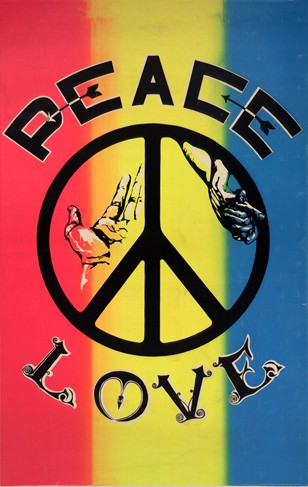
Peace and Love poster, 1968

Since the elections a few weeks ago, we've seen the Republican "culture warriors" falling back on some of their most primitive concepts derived from some Spiro Agnew version of "the 60s" filtered through the Oxycontin haze of Rush Limbaugh and the other worthies of hate radio blessed by the benedictions of the Christian dominionists in which "hippies" and antiwar protesters and, you know, rowdy minorities are the root of all social evil. And all foreign policy failures and the lost wars in Iraq and Afghanistan, of course.

It got me to thinking a bit about what there was in the social movement known as the "hippies", the real existing hippies that is, not the bizarre imaginary construct in the minds of the Christian Right "culture warriors", that may have been substantial and important.

It's not just that, though. When I was on vacation in Austria this past summer, I went to an exhibition of psychedelic art in the Museum Quartier in Vienna. It focused on art of that type from the late 1960s from four cities: San Francisco (of course!), London, Frankfurt and Hamburg. It included some short films with sounds tracks of snatches of urban sounds. I actually had a moment of revelation, not with flashing bursts of colored lights or anything, when I was watching one of those. It occurred to me that this is the sort of art that Yoko Ono was doing, and I thought, "Oh, this is what they were doing on 'Revolution #9'". That was a very unusual track on the Beatles White Album from 1968 that has tended to strike most Beatles fans then and sense as a bunch of random sounds. Authorship is credited to John Lennon and Paul McCartney. But it was Yoko Ono piece.

I haven't actually gone back and listened to "Revolution #9" since then. It's too satisfying to think I finally "get it" to risk actually listening to it and realize that maybe I still don't get it.


I was struck with the visual art in that exhibit by how so much of it emphasized harmony, flow and tranquility. Not in the propaganda sense of slogans saying "peace is good" but in the tone of the pictures themselves. The first poster I saw going into the exhibit made a good impression on me though it was one of the few scenes depicting some kind of violence. It was a psychedelic movie poster showing Klaus Kinski as a gangster holding a machine gun. The late German actor Kinski produced one of the true natural phenomena of his time, his daughter Nastassja Kinski. She looks amazingly like him, but she's gorgeous and he was ugly as sin (at least in many of his movie roles).

"Hippies" were a group that can't be defined with any great precision. You can construct a profile of, say, Chamber of Commerce memebers or of who voted for Richard Nixon in 1968. But the hippie movement or phenemenon was a diverse and informal social trend from the mid-1960s to the mid-1970s or so. It was identified with colorful, loose clothing, rock music festivals, long hair for both men and women, beards, recreational drug usage, pacifism, relaxed attitudes about sex. The idea of getting "back to the land" by living in the country and growing your own food was part of the hippie subculture. Meditation and "eastern religions" (Buddhism, Hinduism) played their part. Broadly speaking, there was a sense of wanting to create alternative lifestyles outside the available conventional options, in terms of both work and personal relationships. The hippies were predominantly people in their teens and twenties.

It's worth remembering as well what the hippies were not. While it's hard to draw rigid lines, the civil rights activists and antiwar activists were not hippies, while hippies were often apolitical, seeing politics as irrelevant to their lives or as a corrupt part of the established society. The hippies were mostly whites. And while kids from genuinely poverty-stricken families weren't so attracted to the hippies, the Republican culture-war stereotype that they were a bunch of spoiled rich kids is also not a meaningful picture. If a meaninglu demographic breakdown could be compiled on them, I would expect that white-collar workingclass and professional families would be heavily over-represented among them compared to other groups.

And because we're dealing with a vaguely-defined social trend, it's also fairly hard to say what its lasting contributions have been. The art and music, for one thing, have proven to be durable, as that exhibition reminded me. It shouldn't be difficult to trace important elements of today's popularity of organic food at least in part to the hippies. Certainly they gave a boost to environmental consciousness, though Teddy Roosevelt and John Muir came along way too early to be hippies. Certainly, the kind of respect for nature shown by writers like Muir and Henry David Thoreau resonated with many who were attracted to the hippie lifestyle(s).

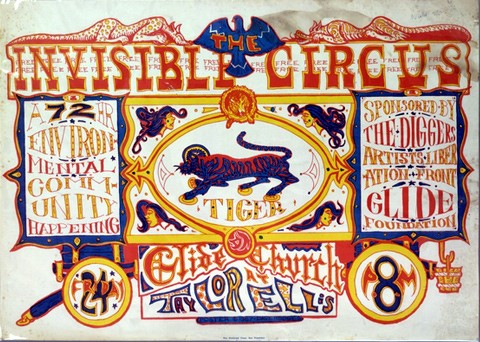
Advertisement for an environmental "happening" in San Francisco, 1967

It would be tempting see elements of feminism and multiculturalism in the hippie movement. But it's hard to see it as being a direct predecessor of major contributor to those movements. The hippies did raise questions about established family norms, especially those who built communal living arrangements. But family structures and gender roles aren't so easily challenged as a movement with a "let it be" attitude was inclined to do. And although the hippies certainly sympathized with many of the goals of the civil rights movement and were willing to borrow from African-American culture, they tended to be non-political. And most of them were white. It just seems to me that the hippie movement's contribution specifically to the multicultural consciousness was limited and indirect.

Psychedelic art and drugs were more likely to get mass-media coverage in those days than gay and lesbian issues. The hippies' willingness to challenge existing assumptions about sex and family life surely contributed to greater tolerance and awareness of homosexualtiy. But it's hard to say how much.

There were clearly some negative aspects of the hippie movement, as well. Drug abuse problems would quickly come to mind for most people. And rightly so. Marijuana for some reason that has always been hard for me to understand came to symbolize the horrors of, I'm not quite sure what - Otherness, maybe - for nice conservative white people. But some of the harder drugs that also became part of the hippie scene, including psychedelics like LSD and psyloscibin, were more dangerous, both in terms of unpredictable effects on individuals and also in the danger of overdoses, because quantities were harder to measure and the drugs were often "cut" with others, like amphetamines. On the whole, I would find it hard to identify anything terribly socially constructive about the role the hippie movement played in promoting the increased use of recreational drugs. We should also remember, though, that hippies were by no means the only people around who used recreational drugs. There were plenty of "straights" (at the time the word meant non-hippies), even more conservative ones, who shared that habit with the hippies.

And, in general, as I've often noticed with regret, some people are unconventional because they have some substantial reason to reject the conventional. Others are unconventional because they just can't hack it to meant conventional expectations, or because they are lazy, or because they are disturbed in some way. Jackson's Browne's old song "Before the Deluge" refers to the hippies of those times:

Some of them were dreamers
And some of them were fools
And for some of them
It was only the moment that mattered


Hippies and the "culture warriors"

In some ways, the vague notion of "hippies" became sort of a culture-war Rohrschact test in which the "straights" used them as a blank slate to project their own dislikes onto. And that still goes on with the Republican culture warriors. How one looks at their effect on current religious ideas and practices is a good example. The hippies helped popularize "eastern religions", a term I put in quotation marks here because that is a buzzword in the usage of many Christian evangelicals for a set of evil, deluded religions that send people to Hail. More awareness and openness to Buddhism and Hinduism may seem like a positive thing to us ecumenical Christians. I would point out the cult offshoots of that openness as a negative factor. But if you think "eastern religions" are just evil, there's nothing positive about that aspect of the hippie movement at all.

Former Los Angeles Times reporter Russell Chandler described the influence of the hippies on the later New Age/esoteric advocates and believers in his 1993 book Understanding the New Age. He actually provides a decent, informed, fair description of New Age beliefs. But he also makes it clear in this book, which was published by the Christian publishing house Zondervan, that he considers himself an evangelical Christian who, among other things, worries about people getting infected with demons. But this is a good brief summary:

Contemporary roots of the New Age can be found in the counterculture movement of recent decades. The beatniks of the 1950s were fascinated with Zen; a decade later came the hippies "with their acid dreams and Eastern gurus, their flower power and Utopian radicalism," wrote Brooks Alexander. "Next in line was the 'human potential movement' of the 1970s, spearheaded by 'humanistic' therapists of various mystical inclinations. Esalen was the touchy-feely Mecca for the upscale, post-hippie seeker. In the 1980s, all these strands and more came together, mingling in new, fanciful ways."

Gordon Melton pinpoints 1971 as the galvanization date for the movement in America. It was the year that the national periodical, East-West Journal, was first published, as well as the first representative book, Be Here Now, written by Baba Ram Dass, the Jewish-born Richard Alpert. A former psychology professor, he and colleague Timothy Leary—both were fired from Harvard—extolled "psychedelic mysticism" produced by using LSD and other hallucinogenic drugs.

Alpert, finding his personal guru in India, reemerged as Ram Dass and "preached a new, hybrid message of spiritual ecstasy and 'newness,' which he committed to print as a crazy pastiche of bold-face words strewn all over the pages in scissors-and-paste fashion," described [Carl] Raschke.

Meanwhile, Carlos Castaneda's books about his Mexico desert adventures with a bizarre Yaqui Indian sorcerer, Don Juan, "sold millions of copies and ... attracted many who followed his path of initiation through the experience of hallucinogenic mushrooms."
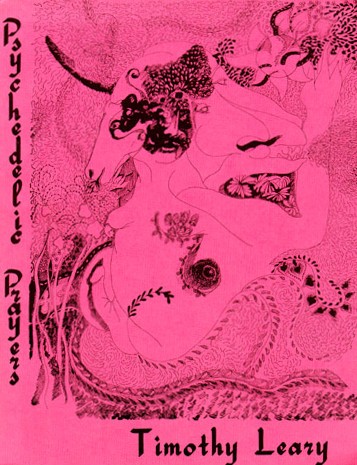
Cover to Timothy Leary, Psychedelic Prayers After The Tao Te Ching (1966)

Again, this is a non-threatening description of a process to most people. To the devout Christian culture warrior, it's the history of a sinister, even Satanic development.

It's also important that today's Christian culture-warrior image of "hippies" is merged with other images of the Other to yield the contempt they still express for what Jane Hamsher and Duncan Black ironically call "dirty [Cheney]ing hippies". Vice President Spiro Agnew was the most prominent promoter of this notion for the Nixon administration before he had to resign in disgrace over a bribery scandal. But Ronald Reagan was one of the first major politicians to see the potential of such negative images of hippies to mobilize some of the darker fears and prejudices of white voters during his successful gubernatorial campaign of 1966.

For some background, California in some ways was ahead of the curve in some of the social developments of the 1960s. Student demonstrations at Berkeley in particular shook people up. And in 1965 was the large Watts riot in Los Angeles, which was both a symptom of racial tensions and a contributor to racial fears and hatreds in the aftermath. The famous Summer of Love which was in many ways the high point of the hippie phenemenon was still to come. But hippies and the term hippies (derived from an early Norman Mailer coinage, "hipster") were well known by then.

Jules Tygiel in his contribution to the collection What's Going On? (2004), "Reagan and the Triumph of Conservatism" gives a flavor for how Reagan spun the tale. And Reagan did have a talent for creating memorable images, however regretable some of the causes in which he employed them may have been:

Vietnam and the offshoots of the antiwar agitation also had overtones in Reagan's most potent statewide issue. Even before he had announced his candidacy and before professional pollsters had detected it, Reagan had discovered that wherever he spoke "this university thing comes up" [meaning student protesters]. People repeatedly asked him about "the mess at Berkeley." In his announcement speech in January 1966 Reagan had raised this issue with rhetorical vehemence. "Will we meet [the students'] neurotic vulgarities with vacillation and weakness," he asked, "or will we tell those entrusted with administering the university we expect them to enforce a code based on decency, common sense, and dedication to the high and noble purpose of the university?"" Throughout the campaign, Reagan returned to this issue. "There is a leadership gap, and a morality and decency gap in Sacramento," he exclaimed, which had made it possible for "a small minority of beatniks, radicals and filthy speech advocates" to bring "shame to ... a great university."

As Matthew Dalleck has written, the issue of morality, as exemplified by Berkeley radicals, became "a convenient catchall, an umbrella that allowed [Reagan] to weave together an effective and articulate assault on everything that happened in the state during [encumbent Goverernor Pat] Brown's tenure." Reagan decried hippies as people who "act like Tarzan, look like Jane, and smell like Cheetah." He attacked the rise of welfare costs, asserting that working people had been "asked to carry the additional burden of a segment of society capable of caring for itself," but that preferred to make welfare "a way of life, freeloading at the expense of more conscientious citizens." (my emphasis)
As Tygiel mentions in the quote below, Reagan's 1966 campaign was very much focused on white voters. He wasn't interested in trying to identify with the wing of the Republican party who supported civil rights legislation, which included very many sitting Republican Congress members and Senators on the key civil rights legislation of 1964 and 1965. So when he talked about the Tarzan, Jane and Cheetah (Tarzan's chimpanzee companion), he expected his white audience to relate the allusions to jungle imagery and bad smell to others than young white hippies. Tygiel continues:

Reagan managed to merge the antiwar and morality issues in a May 12 speech in which he excoriated the conduct of participants at a Vietnam Day Committee dance on the Berkeley campus. He characterized the goings-on as "so bad, so contrary to our standards of decent human behavior, that I cannot recite them to you from this platform in detail." Nonetheless, he described "nude torsos ... twist[ing] and gyrat[ing] in provocative and sensual fashion," blatant sexual misconduct, and the omnipresent smell of marijuana. University and county officials dismissed Reagan's allegations as exaggerations, but the charges rang true [for many white voters], and Reagan's disgust accurately reflected the sentiments of many of his fellow Californians.

The growing volume of Black Power voices gave Reagan additional ammunition. An inflammatory appearance by militant firebrand Stokely Carmichael offered Reagan the opportunity to connect Black Power and campus activism. "We cannot have the university ... used as a base to foment riots from," retorted Reagan. The candidate pitched his appeal almost exclusively to white voters, rarely stopping in African American communities or addressing black audiences. (my emphasis)
What Reagan accomplished in 1966 was to build a coalition with the support of many white Californians who came to see themselves the way many whites in segregated Deep South states long before the hippies or the beatniks came on the scene. As Tygiel writes:, "Reagan's rhetoric encouraged a culture of victimhood among the affluent white majority, wherein unsung working people paid 'exorbitant taxes to make possible compassion for the less fortunate,' having 'to sacrifice many of their own desires and dreams and hopes' in the process".

The whiny white folks phenemenon, in other words, California version. And the "hippies" were a big symbol of what they were whining about. And since hippies were a new, diffuse movement, it was more respectable to describe them as smelly monkeys than to apply such terms to other feared groups. In this sense, "hippies" functioned a bit like George Allen intended "macaca" to function during his Senate campaign this past year.

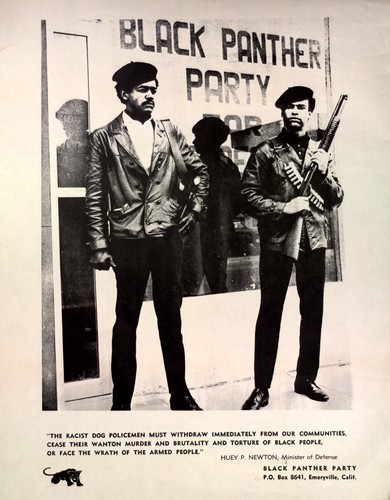
The Second Amendment in action? Black Panther Party poster, 1968; the caption says, "The racist dog policemen must withdraw immediately from our communities, cease their wanton murder and brutality and torture of black people, or face the wrath of the armed people".

Why people who think of themselves as responsible citizens so often fell the need to have people to sneer at to illustrate their own alleged superiority is still kind of a mystery to me. But those good Republican white folks who learned to sneer at "hippies" and other undesirables in the 1960s and early 1970s kept many of those attitudes alive so that they are now dominate in today's authoritarian Republican Party.

A few good words for the hippies

Herbert Marcuse, one of the more famous names among what was called the New Left in the days of the hippies, actually appreciated the phenomenon as a manifestation of more-or-less instinctive protest against a number of bad aspects of what was then often called "the affluent society" after the title of John Kenneth Galbraith's famous book. (Reagan tried unsuccessfully to get Marcuse fired from a teaching post in the University of California system.)

He addressed the hippie movement in a lecture of July 1967 called, The End of Utopia. For this quotation, unless you just happen to like pouring through Hegelian philosophical essays, just take a deep breath and go with the flow:

We already know what cybernetics and computers can contribute to the total control of human existence. The new needs, which are really the determinate negation of existing needs, first make their appearance as the negation of the needs that sustain the present system of domination and the negation of the values on which they are based: for example, the negation of the need for the struggle for existence (the latter is supposedly necessary and all the ideas or fantasies that speak of the possible abolition of the struggle for existence thereby contradict the supposedly natural and social conditions of human existence); the negation of the need to earn one's living; the negation of the performance principle, of competition; the negation of the need for wasteful, ruinous productivity, which is inseparably bound up with destruction; and the negation of the vital need for deceitful repression of the instincts. These needs would be negated in the vital biological need for peace, which today is not a vital need of the majority, the need for calm, the need to be alone, with oneself or with others whom one has chosen oneself, the need for the beautiful, the need for "undeserved" happiness - all this not simply in the form of individual needs but as a social productive force, as social needs that can be activated through the direction and disposition of productive forces.
To boil it down a bit, Marcuse, who was one of the legenary Frankfurt School, approached social criticism with a utopian Marxist perspective. So when used the term "negation", he meant it in the Hegelian sense of "preserved, cancelled and lifted up to a higher level of development". He argued that in the advanced capitalist countries, the possibilities of technology made it immediately feasible to reduce the amount of work required to support the basic needs of the people and also eliminate poverty.

Herbert Marcuse

He saw the hippies' rejection of conventional jobs and career paths as an expression of that recognition. He also saw them challenging aspects of the established society such as the arms race and destructive competition. Marcuse also argued on Freudian grounds that the level of "instinctual repression" that was required to maintain the existing pattern of social relations also built up a tremendous amount of aggression among people that was manifested in various destructive ways, not least of which was international war.

Unwind the philosophical terminology, and that's basically what he's saying there.

In response to a question after the lecture, he said:

... I am supposed to have asserted that what we in America call hippies and you [in Germany] call Gammler, beatniks, are the new revolutionary class. Far be it from me to assert such a thing. What I was trying to show was that in fact today there are tendencies in society - anarchically unorganized, spontaneous tendencies -that herald a total break with the dominant needs of repressive society. The groups you have mentioned are characteristic of a state of disintegration within the system, which as a mere phenomenon has no revolutionary force whatsoever but which perhaps at some time will be able to play it role in connection with other, much stronger objective forces.
Again unwinding the philosophical language, he is saying there that such countercultural movements as the hippies do not, contrary to the paranoia of those we today call "culture warriors", did not have the capacity to make fundamental changes in the power relationships of American or German society. They were unorganized, largely nonpolitical groups who were finding new ways to live and raising important challenges to some of the ideas and practices of the dominant society.

Marcuse was very well aware of the ability of capitalist societies to "co-opt" dissenting movements, to tame them so that they became nonthreatening. But I don't believe he meant that response just quoted to be dismissive of the hippies. On the contrary, he credited them with identifying problems in society that were actually tional-minded (including more traditionally-minded Marxists) were recognizing.

For a couple of online looks at the hippie movement, see A Most Merry and Illustrated History of The Hippies and The Psychedelic 60s