Showing posts with label rummy. Show all posts

Monday, November 16, 2015

Fixing our gaze on calamity - and hurting ourselves in the process

"The gaze fixed on calamity has an element of fascination. But therefore of secret complicity. So strong are the social bad conscience[s] of all who have a part in injustice, and the hatred of fulfilled life, that in critical situations they turn directly against self-interest as an immanent revenge."

- "Vain Terror," Max Horkheimer and Theodor Adorno, Dialectic of Enlightenment (Edmund Jephcott translation; 2002)

Horkheimer and Adorno were looking intensely in Dialectic of Enlightenment at the lessons of the Third Reich and how it represented a catastrophically bad development of the instrumental reason stemming from the Enlightenment tradition. They continue directly from the above lines to say:

There was in the French bourgeois a fatal agency which ironically resembled the heroic ideal of the fascists: they rejoiced in the triumph of their likeness, as expressed in Hitler's rise, even though it threatened them with ruin; indeed, they took their own ruin as evidence of the justice of the order they represented.
This probably strikes most American readers today as more enigmatic than it did at the time, though they use an aphoristic style in that book that at times is reminiscent of Nietzsche.

But when it was first published in 1944, the reference would have been more obvious. The conservatives who saw themselves as representing the interests of German capitalism invited Hitler to become Chancellor of Germany in January, 1933. Not because they had signed own to the National Socialist program, but because they thought they could use Hitler to create a stable authoritarian order more along conservative, Bismarckian lines. They thought they could control him, as it is sometimes said.

The previous Chancellor Franz von Papen (1879–1969) was one of the leading political players who brought Hitler into the government. Hitler's Thirty Days to Power: January 1933 (1996) by Henry Ashby Turner, Jr., gives a detailed and very readable account of those events. But Hitler made intensive use of the politics of calamity, using the Reichstag Fire as a pretext to gain emergency powers from Parliament that allowed him to rule as a dictator. After the Night of the Long Knives, aka, the Röhm Putsch, in which Hitler suppressed the followers of SA leader Ernst Röhm and killed many of them including Röhm himself, Von Papen was sidelined and the old conservatives were largely squeezed out of power.

So, Van Papen and the conservative capitalists of Germany were "fixed on calamity" in the form of their fears of Communist revolution, and they were willing to roll the dice on Hitler and the Nazis. The result within a few years was a disastrous war and the devastation of Germany.

But Horkheimer and Adorno argue that such conservatives were perversely led by the "social bad conscience" that went along with their fear of revolution, which psychologically represented to them "hatred of fulfilled life" in addition to more pragmatic concerns. Driven by irrational fears, they made a short-term choice according to instrumental rationality that was ultimately self-destructive in violation of a broader application of Reason.

It was also widely understood in 1944 that the fall of France had been facilitated by Fifth Column subversion and a spirit of less than steadfast resistance to Hitler on the part of the respectable classes of France. Even when they had been conquered and occupied, many of them were willing to go along to get along by supporting the pro-Hitler Vichy traitor regime: "they rejoiced in the triumph of their likeness, as expressed in Hitler's rise, even though it threatened them with ruin; indeed, they took their own ruin as evidence of the justice of the order they represented."

At the risk of running afoul of Godwin's Law, the psychological dynamic there struck me as having relevance to the kind of sky-is-falling warmongering that happens every time there is a dramatic terrorist attack involving Muslims ever since 9/11. The latest of course being last week's Paris attack.

As the (still) global hegemon, US politics is far, far more focused on the danger of underreacting rather than overreacting. But the US should have learned long ago, including in the period since 2001, that overreacting can also badly damage our national interest.

Paul "the Shrill One" Krugman makes a decidedly non-shrill and sensible plea for measured and considered reactions to the Paris attacks (Fearing Fear Itself New York Times 11/16/2015):

Like millions of people, I’ve been obsessively following the news from Paris, putting aside other things to focus on the horror. It’s the natural human reaction. But let’s be clear: it’s also the reaction the terrorists want. And that’s something not everyone seems to understand.

Take, for example, Jeb Bush’s declaration that “this is an organized attempt to destroy Western civilization.” No, it isn’t. It’s an organized attempt to sow panic, which isn’t at all the same thing. And remarks like that, which blur that distinction and make terrorists seem more powerful than they are, just help the jihadists’ cause.

... France is not going to be conquered by ISIS, now or ever. Destroy Western civilization? Not a chance.
How can we, the West, NATO, "turn directly against self-interest" in this situation and bring "an immanent revenge" on ourselves? Pretty much the way we did after the 9/11 attacks, especially with the invasion of Iraq. Krugman:

A much bigger risk [than "appeasement"], in practice, is that the targets of terrorism will try to achieve perfect security by eliminating every conceivable threat — a response that inevitably makes things worse, because it’s a big, complicated world, and even superpowers can’t set everything right. On 9/11 Donald Rumsfeld told his aides: “Sweep it up. Related and not,” and immediately suggested using the attack as an excuse to invade Iraq. The result was a disastrous war that actually empowered terrorists, and set the stage for the rise of ISIS.

And let’s be clear: this wasn’t just a matter of bad judgment. Yes, Virginia, people can and do exploit terrorism for political gain, including using it to justify what they imagine will be a splendid, politically beneficial little war.

Monday, March 28, 2011

How militarism looks in 2011

Sunday's edition of ABC's This Week provides a microcosm of how the national security state has corrupted and continues to corrupt American democracy. Military expenditures may represent a small percentage of US GDP. But our foreign and military policy of global dominance represents a huge, often overwhelming portion of our national political culture.

Jake Tapper subbed for Christine Amanpour as moderator, unfortunately. Tapper is better than most celebrity journalists at doing this. But he rarely strays far from Beltway Village conventional wisdom. Here's a general news report on the segment: Joshua Miller, Defense Secretary: Libya Did Not Pose Threat to U.S., Was Not 'Vital National Interest' to Intervene 03/27/2011.

The panel discussion in the second half was half-decent, thanks to presence of Joe Sestak. As of this writing, This Week's website hasn't made the transcript of the second half available.

But the first half gave us a glimpse of the postpartisan world which President Obama actually seems to want to achieve. We had the prowar Democratic Secretary of State on together with the prowar Republican Secretary of Defense, thus providing input from both parties.

Following them came Donald Rumsfeld to talk about Libya. Let's think about this. Here is a guy who's a war criminal, who has to be cautious about leaving the territory of the United States because in dozens of other countries he risks being arrested and indicted for war crimes, including torture. His brilliant leadership of the Afghanistan War and the Iraq War led to disaster after disaster. He lied repeatedly and blantantly to the American public about the war. So, here's a war criminal, who in a press with reasonable ethical standards, would not be invited onto TV to talk about anything but his own war crimes. His advice on matters relating to war has been repeatedly proven disastrous. He can't be relied upon to make a conscientious attempt to stick to the facts on anything.

So why in the name of Ares was this man on ABC Sunday morning being asked respectful question about the Libya War?

Jake Tapper in the latter part of Rummy's segment asked him softball questions about his memoirs that he's currently promoting. When Rummy failed to give the web address of the book's promotional website, Tapper helpfully supplied it, saying he was surprised that Rummy hadn't. (No, it's not rummywarcriminal.com)

But Tapper snoozed through this part. He asked Rummy about this memo dated October 15, 2002. Rummy calls it his "parade of horribles" memo, but its formal title is "Iraq: An Illustrative List of Potential Problems to be Considered and Addressed." It's basically a CYA memo that Rummy wrote on the potentially bad things that could happen. Rummy easily brushed off the lame "gotcha" question that Tapper asked. But in the process he said this:

And -- and that parade -- so called parade of horribles I made before the war started. I -- I circulated it to the National Security Council and the president. And I felt that was my responsibility.

It was to sit down and say to myself, OK, the president's decided he's going to move forward and invade Iraq and change the regime. And we've got a plan, and we know the plan changes with first contact with the enemy. And what are the things that conceivably can go differently? And so I made that list. And then I got other people to help me develop it. And then I sent it around to the president and the National Security Council.

The other day, I was on O'Reilly, and he kept saying, well, why didn't we publicize the list? Well, that would be mindless, to tell the enemy every conceivable thing we didn't want them to do, every conceivable thing they could do that could complicate the problems for the United States and the coalition.

But I felt a responsibility that we look seriously at all of those. Fortunately, a lot of those terrible things that could have happened did not happen. Some of them did, to be sure.my emphasis]

[

When I heard it on the show, it immediately struck me that on the face of it, Rummy is saying that he knew in mid-October 2002 that Bush had decided to go to war with Iraq. If Tapper had bothered to press him on the point, he probably would have weaseled his way out of it by saying, no, he was describing what at the time he wrote might be a future scenario. But Tapper didn't try.

It's an important point. We know from other evidence like the Downing Street Memo that Bush had decided to go to war with Iraq no later than the first half of 2002. But to my knowledge, none of the senior planners and decisionmakers implicated in that decision has ever admitted that Bush had made a firm decision until just before launching the invasion.

The really sad part is that if Obama had done his duty and what the law requires him to do, he - or, technically his Attorney General - would have launched a serious and independent investigation into the torture crimes and other felonies committed in the course of launching the Iraq War on false pretences and other potential war crimes committed under the Cheney-Bush Administration. And both Democratic-controlled House of Congress should have launched their own investigation. They should have done it because it was the right thing to do and in the case of torture, international and US requires them in a serious way to do so.

If that had happened, the result would certainly have been to widely discredit Rummy and other senior members of that Administration. The Republicans would have celebrated them as martyrs. But it would have diminished the ability of people like Rummy to go on TV and pretend to be an authority on anything other than their own criminal conduct.

But that's not how our political and media elite tend to think. So Rummy could go on This Week and represent the duplicitous but unsurprising Republican posture on the Libya War: approve of it in principle but trash Obama to some degree or other as a wimp and a failure in his conduct of the war. Rummy's interview gives an idea of the kind of political pressure that Republicans create in situations like this:

TAPPER: So, first of all, are we doing the right thing in Libya?

RUMSFELD: Well, the first thing one has to say is that we have U.S. military forces involved, and everyone has to be hopeful that it turns out well and that the progress proceeds.

What concerns me is -- is the questions that have been raised, and they're fair questions, questions about who the rebels are. And I think probably the most important question is whether or not Gadhafi will stay.

If you put yourself in the shoes of the rebels, they -- they wonder whether or not the coalition has an interest in Gadhafi leaving. And there's a great deal of ambiguity about that. Gadhafi's forces wonder whether or not Gadhafi will be leaving. And there's -- that same ambiguity affects their decision-making. And until that's clarified, it seems to me, we'll have a much more difficult time. I think that the goal has to be that Gadhafi leaves.

TAPPER: Well, that is not, obviously, the goal of the military campaign. The military campaign's mission is civilian protection and a no-fly zone. Do you think that the U.S. should not have entered this coalition without Gadhafi's removal being a goal?

RUMSFELD: My personal view is that, once you're involved, you have to recognize that the prestige of the United States is at stake. And if you think about the region, what's strategically important to the United States, it seems to me we'd have to say first is Iran and Syria and their close linkage and the damage they're doing us in Iraq and in Afghanistan and in Lebanon. They are sponsoring terrorism in major portions of that region, which is terribly damaging to us.

Second, in terms of strategic importance, again, is not Libya. It's Egypt, Saudi Arabia, and the gulf. Those are the anchors in that region for stability and for the United States of America. And what we do in Libya will unquestionably -- how we handle it, how it turns out -- will unquestionably have a serious impact on the more important issues of Iran, and Syria, and Egypt, and Saudi Arabia, and the gulf.

TAPPER: You seem to be suggesting, Mr. Secretary, that Libya was not high on the priority list in that region for the U.S. to be involved in. I'm wondering, if you had been secretary of defense as Gadhafi's troops stormed into Benghazi, and Gadhafi himself threatened no mercy, and there was a very real fear of a mass slaughter, what would you have recommended to the president?

RUMSFELD: Well, I wasn't there, so I can't answer that question. I will say that I think that President Obama and Secretary Clinton are both experiencing the differences from serving in a legislative branch and then serving in executive positions. The perspective is enormously different. And I think you can almost see them transition in their thinking and in their handling of this.

I listened to Secretary Gates. And I must say, I agree with a lot of what he says. He said, when someone asked, well, how many people might be killed or how long will it last or what will it cost, there's no one who can answer those questions. And he's absolutely right in that respect.

I think that you have to pick it up from where we are now. And where we are now is not where your question started, what would you do in the beginning? The fact is, we are involved. And the prestige of the United States is involved.

And think back to the gulf war, the First Gulf War in the early 1990s. Saddam Hussein, when it was over, said he had fought the mother of all battles, and President George Herbert Walker Bush was gone, Margaret Thatcher and the U.K. was gone, and he was still in office. And the implication of that was that he had defeated the United States.

And we are involved -- let there be no question we're now involved in Libya. And if Gadhafi stays on, he will feel he has fought the mother of all battles against the United States. And it will be damaging to us, just as our demeanor in Somalia was damaging, the situation in Lebanon was damaging, and that will embolden others of his ilk. [my emphasis]

How many people have died for that vague notion of "American prestige" over the decades? How many American soldiers, how many foreign soldiers, how many civilians?

There a compact Republican case: Obama took us to war when our national interests weren't at stake; but he's not escalating fast enough; he's not being tough enough; he's being wishy-washy in his leadership.

By contrast, on the Democratic side, the Democratic leaders in Congress - apparently most Democratic members of Congress - aren't willing to make any kind of stink over Obama going to war without Congressional approval. So Obama and the Democrats wind up getting all the political downsides of war. But by casting it as a social-work mission, they don't get any jingoism premium out of it either!

One side is just more aggressive and willing to play the politics of war than the other. One side plays to win, the other side gets played.

Tags: , , , ,

Sunday, August 10, 2008

Afghanistan-Pakistan War

Scott Horton interviews the Pakistani analyst Ahmed Rashid, one of the leading authorities on Al Qa'ida and the conflicts in Afghanistan and Pakistan (Inside the Pakistan-Taliban Relationship No Comment blog 07/30/08). Rashid has this to say about how Pakistan reacted to the American policy in the early months of the Afghanistan War in 2001-2:

The Pakistani military was stunned at the lackadaisical attitude of the Americans in mopping up Al Qaeda, and the U.S. failure to commit ground troops in the south and then at Tora Bora convinced the Pakistani army that the Americans were not serious, that they preferred that the Northern Alliance militias do their fighting for them. Pakistani officers told me they were amazed that Rumsfeld would not put even one thousand U.S. soldiers into battle. The ISI sent memos to Musharraf stating that the Americans would not stay long in Afghanistan and that the Taliban should be kept alive.

This lack of U.S. interest coincided with the interests of the Pakistani army: to go after Al Qaeda, but to allow the Taliban to resettle in Pakistan. Quite soon the Taliban was once again patronized by the ISI. The reason was that the Pakistani army was deeply offended by the Bonn agreement, which actually gave all power to the Northern Alliance – who were deemed the enemies of Pakistan and the Taliban because they had been backed in the civil war by India, Russia, and Iran (the regional opponents of the Taliban and Pakistan during the 1990s decade-long civil war in Afghanistan). Later, India asserted itself in Afghanistan by opening an embassy and four consulates in Afghanistan and then announced a large reconstruction program in Pakistan. Pakistan’s military told the West that Indian influence was undermining Pakistan’s interests in Afghanistan and also subverting Pakistan by funding and supporting the Baloch insurgency in Balochistan province. Today India's presumed influence in Afghanistan is the principle gripe of the military. I think the Americans knew quite early what was going on between the military and the Taliban, but were prepared to ignore it as long as Musharraf helped out with Al Qaeda and as long as the United States remained bogged down in Iraq. (my emphasis)
For Pakistan, Afghanistan has to be seen in the context of the India-Pakistan conflict over Kashmir. That dispute is well known among Muslims. But American reporting on Pakistan rarely mentions that dimension of the situation, so far as I can see.

Tags: , , , ,

Monday, May 12, 2008

The Pentagon document dump

TPM has a group research project going to encourage people to poke through the Pentagon's recent document dump to see what kind of interesting stuff may be in there.

I was curious enough to go click on an interview with my man Rummy. One problem I notice right away is that the Pentagon page has screwy dates on these things. The dates given are apparently release dates, and not all of them were released in the last few weeks. That Rummy interview is dated 11/05/07 on the DOD "Reading Room" page but was clearly from an earlier date because Rummy wasn't still Secretary of Defense then. The interview itself is labeled , but Rummy's last day as SecDef was 12/18/06. This is a press conference with Gen. Peter Pace. Rummy indicates at the top of page 1 it is a "background" briefing, meaning Rummy can't be quoted by name. I haven't been able to tell fromt he transcript if he was speaking only to military analysts, or who.

The section that particularly caught my eye on this one is on page 3, speaking of the Iraq War:

People keep talking about going after the militias as though that they exist in a form, in a location where you can attack them, destroy them, and then mat's done: they don't exist or they're captured. And of course, our guys go into militia - into that territory and these folks disappear, and they don't want to fight, and you leave and they're back.

So it is a very different circumstance and obviously they know it. They know that the center of gravity of the thing is here in the United States. It isn't out there. And mat they're designing their attacks to have maximum effect politically to weaken the will of the American people. They're doing a pretty good job. They are a hell of a lot more skillful at it than we are and have a lot greater flexibility. They can lie. (The element?) of bureaucracy. They have media committees that they operate to manipulate the media and they do it very skillfully, but let's eat our stuff. What the hell? What he was, you know, listening to me jabber when you could be eating something? (my emphasis)
Rummy saying that the Other Side has an advantage over him in propaganda because, "They can lie", is a classic. I can't help but notice what he didn't say, which would have been a logical follow-on thought, "but we can't". Maybe even Rummy couldn't say that one with a straight face.

But it's the line about the "center of gravity" that really caught my eye. Rummy is here endorsing the pernicious idea that the only true weakness that the US military has in a foreign war is the public back home. Otherwise our infallible generals would be invincible if it weren't for those gutless civilians.

I won't try to give a detailed history here. But the "center of gravity" concept used in this way is based on a bad interpretation of Prussian military theorist Carl von Clausewitz (1780-1831). And probably on a poor translation of the phrase, as well.

I discuss this "center of gravity" business in 2007 in The military, the Republican-dominated officer corps and democracy 04/03/07 and An alibi with feet of clay 04/23/07. See also Clausewitz's Center of Gravity: Changing Our Warfighting Doctrine - Again! by Antulio J. Echevarria II September 2002 (US Army War College Strategic Studies Institute) and Targeting the American Will and Other Challenges for 4th-Generation Leadership by Maj. David Harper Military Review Mar/April 2007.

Tags: , , , , , ,

Monday, April 14, 2008

Rummy, 5 years ago


Rummy 04/11/03: "Henny-Penny, the sky is falling" (note characteristic death's-head smile)

I started poking around the online archives of the PBS Newshour, and I came across some classic stuff from my man Rummy from almost exactly five years ago. Here he is in one of his finest moments, giggling like a fool about the looting that was going on in Baghdad just after US troops took the city, from the War News Roundup of 04/11/08. The audio-only feature doesn't work any more, but the video is still available. This is one that can't be fully appreciated without seeing Rummy giggling through his death's-head smile and waving his hands around. That comes at just past the halfway point in the video.

First, here's the Newshour summary of the events introducing Rummy the Great:

KWAME HOLMAN: Lawlessness also reigned in parts of Baghdad this evening. Government buildings-- including the education, industry, trade and planning ministries-- all were on fire. This is the third day of rampaging in the capital. At one government building, Iraqis took food that had been stored there. At Ba'ath Party headquarters, furniture was being hauled away. A stack of mattresses was carted off in a wheelbarrow despite hand-written signs that said in Arabic "Looting is forbidden under Islam." At the Pentagon this afternoon, Defense Secretary Donald Rumsfeld said prominent reporting of the chaos in Baghdad and other cities overstates the seriousness of the problems. (my emphasis)
Actually, vitually all accounts of the war with even remote credibility agree on one thing: the looting going on at the moment was catastrophic for the occupation, and wrecked the ability of the governmental institutions to functions. It was a looters' form of "shock and awe" that struck at Rummy's ability to run Iraq.

Mario Vargas Llosa in his articles on the occupation for El País repeatedly stressed the negative impact the looting in Baghdad had made. Patrick Cockburn wrote of the Baghdad looting in The Occupation (2006), "The failure of the US military to deal with the looters convinced many Iraqis that Washington did not care what happened to them. ... Security was never truly restored over the next few years".

But what did Rummy the Liberator of Mesopotamia think about the looting at the time?

DONALD RUMSFELD: The images you are seeing on television you are seeing over and over and over, and it's the same picture of some person walking out of some building with a vase, and you see it 20 times and you think, "my goodness, were there that many vases?" (Laughter [from the press]) Is it possible that there were that many vases in the whole country?

REPORTER: Do you think that the words "anarchy" and "lawlessness" are ill-chosen...

DONALD RUMSFELD: Absolutely. I picked up a newspaper today and I couldn't believe it. I read eight headlines that talked about chaos, violence, unrest. And it just was Henny-Penny, "the sky is falling." I've never seen anything like it. And here is a country that's being liberated, here are people e going from being repressed and held under the thumb of a vicious dictator, and they're free. And all this newspaper could do, with eight or ten headlines, they showed a man bleeding, a civilian, who they claimed we had shot... one thing after another. It's just unbelievable how people can take that away from what is happening in that country. Do I think those words are unrepresentative? Yes.
The Pentagon press corps just snickered along with Rummy about the whole thing.

But Big Pundit David Brooks was able to read Rummy's thoughts for us

DAVID BROOKS: You could read it in Rumsfeld's eyes. I just had the greatest victory maybe in military history. How about a little patting on the back -- and the next day -- there was maybe one day of patting on the back -- the next day, what about the looting and welcome to the press corps. You know. (my emphasis)
The "greatest victory maybe in military history." With perception and historical perspective like that, no wonder Brooks is still one of our leading pundits! The "greatest victory maybe in military history."

Bonus Rummy

Rummy 04/09/03 on the impossibility of the US invasion causing a humanitarian crisis:

CHARLES ALDINGER, Reuters: It seems as the shooting wanes in coming days, that the humanitarian need will grow drastically.

DONALD RUMSFELD: Why... I can't see why the humanitarian situation would grow drastically. Quite the contrary. The humanitarian problem occurred under the Saddam Hussein regime for a decade. The circumstance of those people has been terrible. They had been denied all kinds of things because he was unwilling to cooperate with the United Nations. Now, what's happening now is that humanitarian assistance is coming in. That doesn't mean the situation is worse; it means that it's better. I'll tell you what's going to happen is, the more people who go into that country and see how serious the situation is, the needs of those people-- and they're real needs-- they're going to report there's a humanitarian crisis, the implication that it just occurred. It didn't just occur.
Rummy 04/09/03 being sad about incorrect media reporting:

JOHN McWETHY, ABC News: Is it your sense, especially in the Arab-speaking world, that they have become convinced of the rightness of the cause that you are fighting this war for?

DONALD RUMSFELD: There's no question but that there are a number of, particularly television stations, as well as print, in that part of the world that have carried a message that was false. They've carried a message that tried to lead people in that part of the world to believe that we were fighting Iraq and the Iraqi people, as opposed to a vicious dictator; that we were anti a religion, which is totally untrue. Does it make me sad to see television saying things that are flat not true and people printing things in that part of the world that's flat not true, children being taught things that is flat not true, yes it bothers me but what can one do except to tell the truth, behave in a way that is consistent with the our values and this country and the coalition has done that in this case. (my emphasis)
Tags: , ,

Tuesday, December 26, 2006

Gabriel Kolko on Rummy

I always feel a bit guilty whenever I link to something at the neo-Confederate Web site LewRockwell.com. I certainly don't want to promote their group or their ideology.

But they also run some important articles by critics of the Iraq War and of American foreign policy by critics who have something substantial to say and are also not neo-Confederate.

This column by historian Gabriel Kolko counts as one of those Rumsfeld and the American Way of War 12/26/06. Kolko did some important and widely-recognized work that challenged the dominant Cold War consensus on American foreign policy.

He writes of the current American dilemma in the Iraq War:

Disjunction and irrationality become the norm in these kinds of situations, and responses that seem bizarre are fairly predictable. Rationality often disappears in this process and denial – and delay – becomes the norm. That is happening now in Washington, and probably in London and Canberra as well, because Bush's foreign policy has produced an immense disaster and there is less peace and stability in the world and security at home than anytime since 1945. Donald Rumsfeld's December 15th farewell speech as Defense Secretary should be read in this light, but also as a reflection of the much larger problem of the way American foreign and military policy has been conducted for decades. It is probably the precursor of those we have yet to hear – and will. If his speech were not so important it would simply be pathetic.
He writes that on Rummy's watch as SecDef:

... national defense spending, which had been stable in the 1990s, increased from $294 billion in 2000 to $536 billion in 2006, and as a percentage of the GNP it grew 37 percent from 2000 to 2006. All kinds of weapons, many the futuristic products of junk science concocted by well-placed manufacturers, were funded for eventual production – a dozen years being a short delivery time for many of them.
And the phenomenon Kolko describes is very real:

[Rummy] always premised his ambition, which various defense secretaries had attempted before him and failed, on the notion that the secret of military success was better and more weapons – "more bang for the buck" as an illustrious predecessor phrased it. More bucks also made the Pentagon requests that much more palatable to a pork-hungry Congress eager to increase spending in their districts.
The following is not original or unique to Gabriel Kolko. But it's well said and, unfortunately for the US, true:

Rumsfeld and his peers know the American military cannot win the war in Iraq. Just as during the Vietnam war, they have the quixotic hope that a solution for the profound and bloody turmoil that reigns there can be found politically – at first the Shiites, Sunnis, and Kurds were to have parliamentary elections and then make a political deal. They did not. Then they were to write a constitution, which they eventually managed to do but it changed nothing. Now they are hoping that the prime minister, Nouri al-Maliki, can miraculously cobble together some kind of consensus that will produce peace, but Bush's closest advisers think it is very likely he will fail. They have no one else to turn to. Politics, like military power, will not prevent the United States from losing control over events in Iraq – thereby losing the war. A "surge" in American troops in Iraq, as even the Joint Chiefs of Staff now argues, is only a recipe for greater disasters. Attacks against U.S. coalition forces, their Iraqi dependents, and civilians have now reached a peak and are over twice that two years ago. The Bush Administration today confronts disaster in Iraq, and probably the worst foreign policy failure in American history. Futility is the hallmark of all its efforts.
Kolko gives particular attention to Rummy's speech of 12/15/06. And he describes the situation, which is a key military issue that needs to be thoroughly debated in Congress, which is the overwhelming emphasis of the US military on preparing to fight conventional wars:

The fact is that the immense and costly American military today bears no relationship to politics and reality. It accounts for nearly half of the world's military expenditures but it cannot win its two wars against the most primitive enemies, enemies who exist in multiple factions who often fight each other more than Americans and who could not care less what Washington spends on weaponry and manpower. But America's leaders have always assumed convenient enemies who calculate the way the U.S. wants them to. More important, politics was never complicated; it existed as an afterthought and never interfered with fighting and winning wars the American way. But the Soviet Union and Communism no longer exist, and absolutely nothing has changed in America's behavior and thinking. The Pentagon is superb at spending money but its way of warfare in now in a profound and perhaps terminal crisis. It has lost all its wars against persistent guerillas armed with cheap, light weapons that decentralize and hide.
Tags: , , ,

Thursday, November 09, 2006

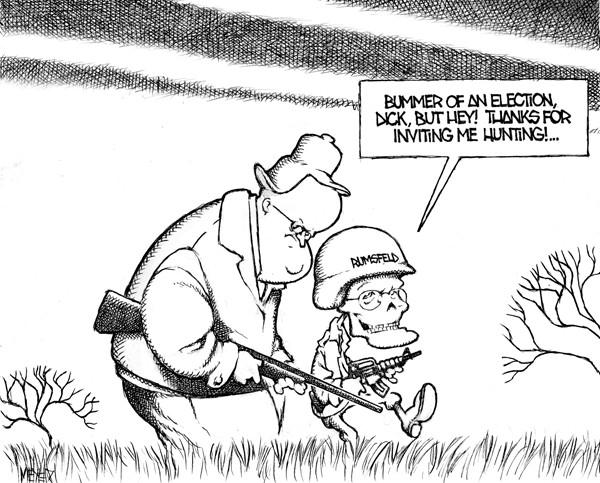
So long, Rummy, we won't miss you at all

The San Francisco Chronicle's Tom Meyer speculates on the back story behind Rummy's long-overdue departure.


Tags: ,

Saturday, November 04, 2006

Civilian-military relations


My goodness, no, I don't care what the public or the Congress or the military think, I run things around here

I wouldn't describe myself as a pessimist when it comes to political affairs, but more as a guarded optimist.

But the recent news that the Military Times newspapers (Army Times, etc.) were coming out with an editorial this Monday calling for Rumsfeld's resignation got me thinking again about the state of military-civilian relations. Those papers are not government-owned or run; they are published by a subsidiary of the Gannett Co. But the editorial bases its argument in part on the claim that "when the nation's current military leaders start to break publicly with their defense secretary, then it is clear that he is losing control of the institution he ostensibly leads." It's understandably assumed that the editorial reflects a widespread sentiment in the armed forces (Newspapers for troops call for Rumsfeld's ouster by Matthew Stannard San Francisco Chronicle 11/04/06):

The editorial will run in the 250,000 copies of Army Times, Navy Times, Marine Corps Times and Air Force Times. The newspapers are published under the umbrella Military Times Media Group by Gannett Co. Inc., not by the U.S. military, and have been popular among American forces since World War II.

"It is extremely widely read and influential for the professional military," said David Segal, director of the Center for Research on Military Organization at the University of Maryland.

The relationship goes two ways, said Segal. "I think it would be safe to say if the Army Times is saying that, it is something they are hearing from senior officers in the Army," he said.
It has been somewhat counterintuitive during the Cheney-Bush administration that it has been the civilian neocons and nationalists like Dick Cheney who have been the "hawks", while the uniformed military has tended to call for restraint and caution when it comes to adventures like the Iraq War. During the 1950s and 1960s, the situation had been the reverse.


The Democrats have been happy to seize on criticism of Rummy and the Cheney-Bush administration more generally that has come from military figures like retired generals. Party Chairman Howard Dean said on the PBS Newshour on Friday 11/03/04:

But we need to be out of Iraq, and we need a plan to get us out of Iraq. And we expect the president to listen to the military about how we can do that.
It's hard to fault the Democrats for wanting to counter the Republicans' martial and often just plain militaristic rhetoric with a defense of the allegedly pragmatic generals against the bumbling, incompetent Bush Republicans.

But it's also been obvious since early 2005 that the generals were positioning themselves to duck criticism for what was already an obvious failure in the Iraq War. The neoconservatives who were the intellectual godfathers of this disaster are also now bravely scrambling to find excuses for why their ideas put into practice turned out to have created possibly the worst failure in the history of American foreign policy with the Iraq War. And their favored excuse of the moment is that it was the incomptence of the Cheney-Bush administration in executing their preventive war that is to blame.

But our infallible generals shouldn't be allowed to skate on this one, either. They aren't entirely to blame. But they certainly share in the blame, for instance in their counterinsurgency strategy which responds to sniper fire in urban combat by calling in artillery and air strikes. Those tactics have multiplied the civilian casualties and were a major factor in turning Iraqis against the American presence. But we haven't seen a lot of retired generals denouncing those failures on the part of our unassailable generals.

We've also seen and heard throughout the war that the President and Rummy say over and over and over that they're giving our infallible generals everything they say they need to win the Iraq War. And that they're letting the military control the military operations in Iraq without any interference from the civilians. And the serving military officers back them up.

Now, we know they're lying. The military always tries to have it both ways in such situations, publicly endorsing the course of the Executive but laying the groundwork to alibi themselves for possible failure later.

But still, this all raises some important questions. By statute, the Joint Chiefs of Staff are the primary military advisers of the President and the Secretary of Defense. Their role was defined as such in the Goldwater-Nichols Act of 1986 (Part 1 and Part 2).

Paragraph 151 says the following:

... in presenting advice with respect to any matter to the President, the National Security Council, or the Secretary of Defense, the Chairman shall, as he considers appropriate, inform the President, the National Security Council, or the Secretary of Defense, as the case may be, of the range of military advice and opinion with respect to that matter. (my emphasis)
Now that "as he considers appropriate" means that the JCS Chairman would be free to ignore any part of the "range of military advice and opinion" that he chooses. But it was clearly the intent of Cogress that a broad range of options would be presented not just to the Defence Secretary but the President, as well.

The following parts of the same paragraph, though, don't include a loophole for the JCS Chairman:

A member of the Joint Chiefs of Staff (other than the Chairman) may submit to the Chairman advice or an opinion in disagreement with, or advice or an opinion in addition to, the advice presented by the Chairman to the President, the National Security Council, or the Secretary of Defense. If a member submits such advice or opinion, the Chairman shall present the advice or opinion of such member at the same time he presents his own advice to the President, the National Security Council, or the Secretary of Defense, as the case may be. ...

After first informing the Secretary of Defense, a member of the Joint Chiefs of Staff may make such recommendations to Congress relating to the Department of Defense as he considers appropriate. (my emphasis)
So this means that the other members of the JCS - Army Chief of Staff, Chief of Naval Operations, Air Force Chief of Staff, and the CommCommandant of the Marine Corps - all had the statutory option to submit dissenting opinions on military advice to the President and to Congress. And if they had good reason to know that the plans for the Iraq War were excessively risky, did they not have some kind of moral obligation to make their dissents known? If any of them come out after retirement and say they opposed the JCS Chairman's recommendations, then they should also explain why they did not exercise their option to make a dissent known to Congress.

There are a number of actions, laws and precedents that give the military a level of authority in civilian governmental affairs that are not necessarily healthy for a democracy, or other kind of civilian government. Lt. Col. Charles Dunlap, Jr., used a futuristic scenario to look at some of those in The Origins of the American Military Coup of 2012 by Lt. Col. Charles Dunlap, Jr. Parameters (US Army War College) Winter 1992-93.

In this fictional scenario, it's 2015, then 20 years in the future. A military junta has taken power by a coup in the United States. And the article is in the form of a letter from a "senior retired officer of the Unified Armed Forces, known here simply as Prisoner 222305759" who "is one of those arrested, having been convicted by court-martial for opposing the coup".

Here are some of his points, keeping in mind that anything after 1992 is imagined:

Congress became their unwitting ally. Because of the popularity of the new military programs - and the growing dependence upon them - Congress passed the Military Plenipotentiary Act of 2005. This legislation was the legacy of the Goldwater-Nichols Defense Reorganization Act of 1986. Among many revisions, Goldwater-Nichols strengthened the office of the Chairman of the Joint Chiefs of Staff and mandated numerous changes intended to increase "jointness" in the armed services. Supporters of the Military Plenipotentiary Act argued that unity of command was critical to the successful management of the numerous activities now considered "military" operations. Moreover, many Congressmen mistakenly believed that Goldwater-Nichols was one of the main reasons for the military's success in the First Gulf War. They viewed the Military Plenipotentiary Act as an enhancement of the strengths of Goldwater-Nichols.

In passing this legislation Congress added greater authority to the military's top leadership position. Lulled by favorable experiences with Chairmen like General Colin Powell, Congress saw little danger in converting the office of the Chairman of the Joint Chiefs of Staff into the even more powerful Military Plenipotentiary. No longer merely an advisor, the Military Plenipotentiary became a true commander of all US services, purportedly because that status could better ameliorate the effects of perceived interservice squabbling. Despite warnings found in the legislative history of Goldwater-Nichols and elsewhere, enormous power was concentrated in the hands of a single, unelected official.
He points to the idolization of the American military that was already well advanced under the Reagan administration and Old Man Bush's administration (though he doesn't emphasize the significant role that the Christian Right played in this process):

America's societal malaise was readily apparent in 1992. Seventy-eight percent of Americans believed the country was on the "wrong track." One researcher declared that social indicators were at their lowest level in 20 years and insisted "something [was] coming loose in the social infrastructure." The nation was frustrated and angry about its problems.

America wanted solutions and democratically elected government wasn't providing them. The country suffered from a "deep pessimism about politicians and government after years of broken promises." David Finkle observed in The Washington Post Magazine that for most Americans "the perception of government is that it has evolved from something that provides democracy's framework into something that provides obstacles, from something to celebrate into something to ignore." Likewise, politicians and their proposals seemed stale and repetitive. Millions of voters gave up hope of finding answers. The "environment of apathy" Janos characterized as a precursor to a coup had arrived.

Unlike the rest of government the military enjoyed a remarkably steady climb in popularity throughout the 1980s and early 1990s. And indeed it had earned the admiration of the public. Debilitated by the Vietnam War, the US military set about reinventing itself. As early as 1988 U.S. News & World Report heralded the result: "In contrast to the dispirited, drug-ravaged, do-your-own-thing armed services of the '70s and early '80s, the US military has been transformed into a fighting force of gung-ho attitude, spit-shined discipline, and ten-hut morale." After the US military dealt Iraq a crushing defeat in the First Gulf War, the ignominy of Vietnam evaporated.
One of the hopeful aspects of the torture scandals at Abu Ghuraib, Guantanamo and other stations in the Bush Gulag is that after seeing the photos of naked, hooded men stacked in human pyramids and various other disgusting acts of sexual sadism being performed by some of "the troops", is that it slapped the public upside the head with the reality that The Troops are human beings, not all of whom practice "spit-shined discipline" and "ten-hut morale". At Abu Ghuraib, it was more like ten-hooding morale.

Dunlap cites the following quote from Atlantic writer James Fallows in 1991:

According to our economic and political theories, most agencies of the government have no special standing to speak about the general national welfare. Each represents a certain constituency; the interest groups fight it out. The military, strangely, is the one government institution that has been assigned legitimacy to act on its notion of the collective good. "National defense" can make us do things - train engineers, build highways - that long-term good of the nation or common sense cannot.
Dunlap notes that injecting the military into the "war on drugs" was an erosion of the long-standing distinction between civilian and military realms of authority. That process has proceeded much further since then, with the warrantless, illegal spying by the Pentagon's National Security Agency (NSA) being the most dramatic recent example. At the same time, he notes various factors that create a sense of isolation between civilians and the uniformed military:

Furthermore, well-meaning attempts at improving service life led to the unintended insularity of military society, representing a return to the cloistered life of the pre-World War II armed forces. Military bases, complete with schools, churches, stores, child care centers, and recreational areas, became never-to-be-left islands of tranquillity removed from the chaotic, crime-ridden environment outside the gates. As one reporter put it in 1991: "Increasingly isolated from mainstream America, today's troops tend to view the civilian world with suspicion and sometimes hostility." Thus, a physically isolated and intellectually alienated officer corps was paired with an enlisted force likewise distanced from the society it was supposed to serve. In short, the military evolved into a force susceptible to manipulation by an authoritarian leader from its own select ranks.
This line turned out to be sadly prophetic: "What made this all the more disheartening was the wretched performance of our forces in the Second Gulf War."

Dunlap's article goes on to cite some things that he saw as threatening to erode the military's central mission of warfighting. And it's pretty clear he had in mind the conventional-war model of warfighting. Ironically, some of the things he complains about being problems in that sense actually would have helped in the Iraq War if the military had been better and more experienced at them. For instance:

Police organizations are understandably oriented toward the studied restraint necessary for the end sought: a judicial conviction. As one Drug Enforcement Administration agent noted: "The military can kill people better than we can [but] when we go to a jungle lab, we're not there to move onto the target by fire and maneuver to destroy the enemy. We're there to arrest suspects and seize evidence." If military forces are inculcated with the same spirit of restraint, combat performance is threatened.
But, in fact, the mission that the Army and the Marines were given in Iraq in the counterinsurgency war involved a big demand for just those kinds of situations that required "studied restraint". And among an Arab-speaking population for whom tribe-and-clan-based "honor systems" are a key element, i.e., you humiliate or injure one member and all his cousins want to come kill you.

And that is one of the things that the generals can be legitimately criticized for. They structured and trained their forces so that they would be prepared for conventional war, like the Gulf War of 1991, and not for a counterinsurgency war like the one in which they are now mired. Yet when they were given a mission that involved massive counterinsurgency operations, apparently none of the service Chiefs who have the statutory authority to send dissenting recommendations to the Defense Secretary, the President and Congress have chosen to do so.

I'm very happy to see Rummy get some of the criticism he deserved for his performance even during the opening months of the Afghanistan War in 2001-2. But we would also make a big mistake to let our infallible generals off the hook for the disaster known as the Iraq War.


Saturday, October 04, 2003

Iraq War: A soberting warning

Competing with Arnie's sex issues and Rush's race and drug problems, Gen. Sanchez' warning this week probably didn't get the intention it deserves. The commander of American forces in Iraq said:

This is still wartime. ... There is still some intense fighting to be done, especially out in the west. We should not be surprised if one of these mornings we wake up and ... there has been a major firefight with some casualties or a significant terrorist attack that kills significant numbers of people.
Apart from the merits of the war or the occupation policy, this is the kind of thing both civilian and military officials at the Pentagon should be saying more often.

Fans of the war are suggesting that the press is causing the Administration's credibility problems. That's way off base. The press generally is still much too little critical on the war.

But over-optimistic expectations that the Administration raised about the costs (human and financial) of the war and the occupation have not so far been met. That's the credibility problem.

But Sanchez' bosses in Washington are still at it:

Sanchez stressed that U.S. forces were improving their ability to confront the resistance, a statement echoed Thursday in Washington by Defense Secretary Donald H. Rumsfeld and Air Force Gen. Suzanne Goldenberg Richard B. Myers, chairman of the Joint Chiefs of Staff, who defended American progress in Iraq.

"While there is no question we have faced some challenges and we've got some ahead of us, we have really achieved numerous successes and expect the situation to continue to improve," Myers told reporters at a Pentagon news conference. "We're in this for the long haul and ... we'll get the job done."
And it's starting to look like the US is running a serious risk of losing even the existing level of diplomatic support from the United Nations for the occupation.

Happy talk isn't going to fix this.

Tags: , , , ,

Tuesday, September 09, 2003

Iraq War: Stab in the Back

Some hawkish types are already making up blustering excuses for the possibility of a fiasco in the Iraq War.

I know I just linked to Josh Marshall, but he's pursuing an important observation on the emergence already of a rightwing "stab-in-the-back" theory that explains failure in Iraq as a loss of nerve by weak-kneed civilian wimps back home. Donald Rumsfelds's comment in Ireland that critics of the war are helping them terrorists has gotten a lot of publicity.

But I've noticed signs of this prior to now. On the cruder side, country singer and rightwing pamphleteer CHARLIE DANIELS tried out the idea in one of his Soapbox rants last month:

If you listen to the mainstream press these days you are inundated with stories which make it sound as if our troops in Iraq are ready to mutiny to get out of there and come home.
Now, Chuckie didn't cite any sources for this. But he goes on, relying on an alleged letter from an unidentified American soldier in Iraq, to explain how our fightin' men can win this thang as long as them there media "pukes" don't give everybody the wrong impression about the war.

He concludes, "It seems that we are being told what the media wants us to know and not what is actually happening." Presumably, Chuckie isn't referring to Fox News or the Washington Times in saying that.

A more highbrow version appeared in the Los Angeles Times from Max Boot:

As long as we keep our nerve, we will prevail. As in Vietnam, so in Iraq: Only defeatism on the home front can stop our soldiers.
One thing to watch with those making this argument is what they are willing to support in actual policies. Are they willing to put 50,000 more American soldiers in Iraq? 100,000 more? Did they support Bush's proposals this summer to cut our soldiers' combat pay and death benefits? Or are they just getting pseudo-patriotic excuses ready if the war they cheered keeps going badly?

Steve Earle and the Del McCoury Band, "Dixieland"

- Bruce Miller

Tags: , , , , , ,