Showing posts with label rumsfeld. Show all posts

Monday, March 28, 2011

How militarism looks in 2011

Sunday's edition of ABC's This Week provides a microcosm of how the national security state has corrupted and continues to corrupt American democracy. Military expenditures may represent a small percentage of US GDP. But our foreign and military policy of global dominance represents a huge, often overwhelming portion of our national political culture.

Jake Tapper subbed for Christine Amanpour as moderator, unfortunately. Tapper is better than most celebrity journalists at doing this. But he rarely strays far from Beltway Village conventional wisdom. Here's a general news report on the segment: Joshua Miller, Defense Secretary: Libya Did Not Pose Threat to U.S., Was Not 'Vital National Interest' to Intervene 03/27/2011.

The panel discussion in the second half was half-decent, thanks to presence of Joe Sestak. As of this writing, This Week's website hasn't made the transcript of the second half available.

But the first half gave us a glimpse of the postpartisan world which President Obama actually seems to want to achieve. We had the prowar Democratic Secretary of State on together with the prowar Republican Secretary of Defense, thus providing input from both parties.

Following them came Donald Rumsfeld to talk about Libya. Let's think about this. Here is a guy who's a war criminal, who has to be cautious about leaving the territory of the United States because in dozens of other countries he risks being arrested and indicted for war crimes, including torture. His brilliant leadership of the Afghanistan War and the Iraq War led to disaster after disaster. He lied repeatedly and blantantly to the American public about the war. So, here's a war criminal, who in a press with reasonable ethical standards, would not be invited onto TV to talk about anything but his own war crimes. His advice on matters relating to war has been repeatedly proven disastrous. He can't be relied upon to make a conscientious attempt to stick to the facts on anything.

So why in the name of Ares was this man on ABC Sunday morning being asked respectful question about the Libya War?

Jake Tapper in the latter part of Rummy's segment asked him softball questions about his memoirs that he's currently promoting. When Rummy failed to give the web address of the book's promotional website, Tapper helpfully supplied it, saying he was surprised that Rummy hadn't. (No, it's not rummywarcriminal.com)

But Tapper snoozed through this part. He asked Rummy about this memo dated October 15, 2002. Rummy calls it his "parade of horribles" memo, but its formal title is "Iraq: An Illustrative List of Potential Problems to be Considered and Addressed." It's basically a CYA memo that Rummy wrote on the potentially bad things that could happen. Rummy easily brushed off the lame "gotcha" question that Tapper asked. But in the process he said this:

And -- and that parade -- so called parade of horribles I made before the war started. I -- I circulated it to the National Security Council and the president. And I felt that was my responsibility.

It was to sit down and say to myself, OK, the president's decided he's going to move forward and invade Iraq and change the regime. And we've got a plan, and we know the plan changes with first contact with the enemy. And what are the things that conceivably can go differently? And so I made that list. And then I got other people to help me develop it. And then I sent it around to the president and the National Security Council.

The other day, I was on O'Reilly, and he kept saying, well, why didn't we publicize the list? Well, that would be mindless, to tell the enemy every conceivable thing we didn't want them to do, every conceivable thing they could do that could complicate the problems for the United States and the coalition.

But I felt a responsibility that we look seriously at all of those. Fortunately, a lot of those terrible things that could have happened did not happen. Some of them did, to be sure.my emphasis]

[

When I heard it on the show, it immediately struck me that on the face of it, Rummy is saying that he knew in mid-October 2002 that Bush had decided to go to war with Iraq. If Tapper had bothered to press him on the point, he probably would have weaseled his way out of it by saying, no, he was describing what at the time he wrote might be a future scenario. But Tapper didn't try.

It's an important point. We know from other evidence like the Downing Street Memo that Bush had decided to go to war with Iraq no later than the first half of 2002. But to my knowledge, none of the senior planners and decisionmakers implicated in that decision has ever admitted that Bush had made a firm decision until just before launching the invasion.

The really sad part is that if Obama had done his duty and what the law requires him to do, he - or, technically his Attorney General - would have launched a serious and independent investigation into the torture crimes and other felonies committed in the course of launching the Iraq War on false pretences and other potential war crimes committed under the Cheney-Bush Administration. And both Democratic-controlled House of Congress should have launched their own investigation. They should have done it because it was the right thing to do and in the case of torture, international and US requires them in a serious way to do so.

If that had happened, the result would certainly have been to widely discredit Rummy and other senior members of that Administration. The Republicans would have celebrated them as martyrs. But it would have diminished the ability of people like Rummy to go on TV and pretend to be an authority on anything other than their own criminal conduct.

But that's not how our political and media elite tend to think. So Rummy could go on This Week and represent the duplicitous but unsurprising Republican posture on the Libya War: approve of it in principle but trash Obama to some degree or other as a wimp and a failure in his conduct of the war. Rummy's interview gives an idea of the kind of political pressure that Republicans create in situations like this:

TAPPER: So, first of all, are we doing the right thing in Libya?

RUMSFELD: Well, the first thing one has to say is that we have U.S. military forces involved, and everyone has to be hopeful that it turns out well and that the progress proceeds.

What concerns me is -- is the questions that have been raised, and they're fair questions, questions about who the rebels are. And I think probably the most important question is whether or not Gadhafi will stay.

If you put yourself in the shoes of the rebels, they -- they wonder whether or not the coalition has an interest in Gadhafi leaving. And there's a great deal of ambiguity about that. Gadhafi's forces wonder whether or not Gadhafi will be leaving. And there's -- that same ambiguity affects their decision-making. And until that's clarified, it seems to me, we'll have a much more difficult time. I think that the goal has to be that Gadhafi leaves.

TAPPER: Well, that is not, obviously, the goal of the military campaign. The military campaign's mission is civilian protection and a no-fly zone. Do you think that the U.S. should not have entered this coalition without Gadhafi's removal being a goal?

RUMSFELD: My personal view is that, once you're involved, you have to recognize that the prestige of the United States is at stake. And if you think about the region, what's strategically important to the United States, it seems to me we'd have to say first is Iran and Syria and their close linkage and the damage they're doing us in Iraq and in Afghanistan and in Lebanon. They are sponsoring terrorism in major portions of that region, which is terribly damaging to us.

Second, in terms of strategic importance, again, is not Libya. It's Egypt, Saudi Arabia, and the gulf. Those are the anchors in that region for stability and for the United States of America. And what we do in Libya will unquestionably -- how we handle it, how it turns out -- will unquestionably have a serious impact on the more important issues of Iran, and Syria, and Egypt, and Saudi Arabia, and the gulf.

TAPPER: You seem to be suggesting, Mr. Secretary, that Libya was not high on the priority list in that region for the U.S. to be involved in. I'm wondering, if you had been secretary of defense as Gadhafi's troops stormed into Benghazi, and Gadhafi himself threatened no mercy, and there was a very real fear of a mass slaughter, what would you have recommended to the president?

RUMSFELD: Well, I wasn't there, so I can't answer that question. I will say that I think that President Obama and Secretary Clinton are both experiencing the differences from serving in a legislative branch and then serving in executive positions. The perspective is enormously different. And I think you can almost see them transition in their thinking and in their handling of this.

I listened to Secretary Gates. And I must say, I agree with a lot of what he says. He said, when someone asked, well, how many people might be killed or how long will it last or what will it cost, there's no one who can answer those questions. And he's absolutely right in that respect.

I think that you have to pick it up from where we are now. And where we are now is not where your question started, what would you do in the beginning? The fact is, we are involved. And the prestige of the United States is involved.

And think back to the gulf war, the First Gulf War in the early 1990s. Saddam Hussein, when it was over, said he had fought the mother of all battles, and President George Herbert Walker Bush was gone, Margaret Thatcher and the U.K. was gone, and he was still in office. And the implication of that was that he had defeated the United States.

And we are involved -- let there be no question we're now involved in Libya. And if Gadhafi stays on, he will feel he has fought the mother of all battles against the United States. And it will be damaging to us, just as our demeanor in Somalia was damaging, the situation in Lebanon was damaging, and that will embolden others of his ilk. [my emphasis]

How many people have died for that vague notion of "American prestige" over the decades? How many American soldiers, how many foreign soldiers, how many civilians?

There a compact Republican case: Obama took us to war when our national interests weren't at stake; but he's not escalating fast enough; he's not being tough enough; he's being wishy-washy in his leadership.

By contrast, on the Democratic side, the Democratic leaders in Congress - apparently most Democratic members of Congress - aren't willing to make any kind of stink over Obama going to war without Congressional approval. So Obama and the Democrats wind up getting all the political downsides of war. But by casting it as a social-work mission, they don't get any jingoism premium out of it either!

One side is just more aggressive and willing to play the politics of war than the other. One side plays to win, the other side gets played.

Tags: , , , ,

Saturday, May 02, 2009

Notable quotes from the "war on terror"

Secretary of Defense Rummy, CNN's Hunt Novak & Shields program 12/01/01, being questioned by Robert Novak on possible war crims by our Afghan ally, the Northern Alliance:

NOVAK: Do you feel, Mr. Secretary, there is a problem, however, when apparently most of the prisoners, all of the prisoners, are in the hands of the Northern Alliance, which I don't believe signed the Geneva Convention and are not the nicest guys in the world? Does that bother you at all? [Novak's premise was wrong; the Northern Alliance was bound by the Genevan Convention.]

RUMSFELD: ... The fact that they don't happen to subscribe to some convention that we do or that other countries do is a fact. It is also a fact that we have to stop those terrorists from killing more Americans. And I don't feel even the slightest problem in working with the Northern Alliance to achieve that end. [my emphasis]
I blogged about this in one of my earliest blog posts on 10/13/03.

Rummy and Bush

From CNN (Last Cabinet Meeting of 2003 12/11/03), reporter questioning President Bush:

QUESTION: Sir, Chancellor [Gerhard] Schroeder [of Germany] says international law must apply in this case. Well, what's your understanding of the law?

BUSH: International law? I better call my lawyer.
Said, as I recall, with his sideways preppie smirk.

Tags: , ,

Sunday, August 10, 2008

Afghanistan-Pakistan War

Scott Horton interviews the Pakistani analyst Ahmed Rashid, one of the leading authorities on Al Qa'ida and the conflicts in Afghanistan and Pakistan (Inside the Pakistan-Taliban Relationship No Comment blog 07/30/08). Rashid has this to say about how Pakistan reacted to the American policy in the early months of the Afghanistan War in 2001-2:

The Pakistani military was stunned at the lackadaisical attitude of the Americans in mopping up Al Qaeda, and the U.S. failure to commit ground troops in the south and then at Tora Bora convinced the Pakistani army that the Americans were not serious, that they preferred that the Northern Alliance militias do their fighting for them. Pakistani officers told me they were amazed that Rumsfeld would not put even one thousand U.S. soldiers into battle. The ISI sent memos to Musharraf stating that the Americans would not stay long in Afghanistan and that the Taliban should be kept alive.

This lack of U.S. interest coincided with the interests of the Pakistani army: to go after Al Qaeda, but to allow the Taliban to resettle in Pakistan. Quite soon the Taliban was once again patronized by the ISI. The reason was that the Pakistani army was deeply offended by the Bonn agreement, which actually gave all power to the Northern Alliance – who were deemed the enemies of Pakistan and the Taliban because they had been backed in the civil war by India, Russia, and Iran (the regional opponents of the Taliban and Pakistan during the 1990s decade-long civil war in Afghanistan). Later, India asserted itself in Afghanistan by opening an embassy and four consulates in Afghanistan and then announced a large reconstruction program in Pakistan. Pakistan’s military told the West that Indian influence was undermining Pakistan’s interests in Afghanistan and also subverting Pakistan by funding and supporting the Baloch insurgency in Balochistan province. Today India's presumed influence in Afghanistan is the principle gripe of the military. I think the Americans knew quite early what was going on between the military and the Taliban, but were prepared to ignore it as long as Musharraf helped out with Al Qaeda and as long as the United States remained bogged down in Iraq. (my emphasis)
For Pakistan, Afghanistan has to be seen in the context of the India-Pakistan conflict over Kashmir. That dispute is well known among Muslims. But American reporting on Pakistan rarely mentions that dimension of the situation, so far as I can see.

Tags: , , , ,

Monday, May 12, 2008

The Pentagon document dump

TPM has a group research project going to encourage people to poke through the Pentagon's recent document dump to see what kind of interesting stuff may be in there.

I was curious enough to go click on an interview with my man Rummy. One problem I notice right away is that the Pentagon page has screwy dates on these things. The dates given are apparently release dates, and not all of them were released in the last few weeks. That Rummy interview is dated 11/05/07 on the DOD "Reading Room" page but was clearly from an earlier date because Rummy wasn't still Secretary of Defense then. The interview itself is labeled , but Rummy's last day as SecDef was 12/18/06. This is a press conference with Gen. Peter Pace. Rummy indicates at the top of page 1 it is a "background" briefing, meaning Rummy can't be quoted by name. I haven't been able to tell fromt he transcript if he was speaking only to military analysts, or who.

The section that particularly caught my eye on this one is on page 3, speaking of the Iraq War:

People keep talking about going after the militias as though that they exist in a form, in a location where you can attack them, destroy them, and then mat's done: they don't exist or they're captured. And of course, our guys go into militia - into that territory and these folks disappear, and they don't want to fight, and you leave and they're back.

So it is a very different circumstance and obviously they know it. They know that the center of gravity of the thing is here in the United States. It isn't out there. And mat they're designing their attacks to have maximum effect politically to weaken the will of the American people. They're doing a pretty good job. They are a hell of a lot more skillful at it than we are and have a lot greater flexibility. They can lie. (The element?) of bureaucracy. They have media committees that they operate to manipulate the media and they do it very skillfully, but let's eat our stuff. What the hell? What he was, you know, listening to me jabber when you could be eating something? (my emphasis)
Rummy saying that the Other Side has an advantage over him in propaganda because, "They can lie", is a classic. I can't help but notice what he didn't say, which would have been a logical follow-on thought, "but we can't". Maybe even Rummy couldn't say that one with a straight face.

But it's the line about the "center of gravity" that really caught my eye. Rummy is here endorsing the pernicious idea that the only true weakness that the US military has in a foreign war is the public back home. Otherwise our infallible generals would be invincible if it weren't for those gutless civilians.

I won't try to give a detailed history here. But the "center of gravity" concept used in this way is based on a bad interpretation of Prussian military theorist Carl von Clausewitz (1780-1831). And probably on a poor translation of the phrase, as well.

I discuss this "center of gravity" business in 2007 in The military, the Republican-dominated officer corps and democracy 04/03/07 and An alibi with feet of clay 04/23/07. See also Clausewitz's Center of Gravity: Changing Our Warfighting Doctrine - Again! by Antulio J. Echevarria II September 2002 (US Army War College Strategic Studies Institute) and Targeting the American Will and Other Challenges for 4th-Generation Leadership by Maj. David Harper Military Review Mar/April 2007.

Tags: , , , , , ,

Tuesday, December 11, 2007

Dems and the torture policy

The revelation that Democratic members of Congress were briefed in 2002 has raised questions about the conduct of those Democrats involved: Hill Briefed on Waterboarding in 2002 by Joby Warrick and Dan Eggen Washington Post 12/09/07.

Digby has been coming down hard on Nancy Pelosi and other Dems at her Hullabaloo blog (Accomplices 12/09/07; Cards On The Table 12/10/07), as has Glenn Greenwald at his Salon blog ("Missing" evidence is familiar Bush pattern 12/07/07; Democratic complicity in Bush's torture regimen 12/09/07).

The torture issue is way bigger than either Party. So I'm generally sympathetic to this line of criticisms of Democrats involved. Their basic point is a very sound one. If Democrats learned from classified briefings that illegal acts were being committed, they both could and should have taken more substantial steps to bring them to a halt. The whole point of having Congressional oversight of intelligence agencies is to help ensure that the agencies are acting within the law.

But I'm also painfully aware of that powerful instinct among Democrats to form circular firing squads. So I'm not quite ready to blast the Dems, Pelosi in particular, quite as much as Digby and Greenwald are.

Spencer Ackerman has an update on Pelosi's version of the story: What Pelosi Knew About Torture in 2002 TPM Muckraker 12/1007.

We don't need to know about those briefings to know that Congress had every good reason even by late 2001 to be worried about what was going on with the Cheney-Bush administration's policies on torture and the application of the Geneva Conventions. There were massacres of prisoners committed in Afghanistan by the Northern Alliance warlords that the US was backing in the early weeks of the Afghanistan War. These were widely reported at the time.

In what's still to me one of the most remarkable moments of this administration, on 12/01/07, Robert Novak asked Rummy on CNN if it bothered him that some of our allied warlords weren't observing Geneva Convention rules. The great Rummy replied:

The fact that they [the Northern Alliance] don't happen to subscribe to some convention that we do or that other countries do is a fact. It is also a fact that we have to stop those terrorists from killing more Americans. And I don't feel even the slightest problem in working with the Northern Alliance to achieve that end. (my emphasis)
That should have been a screaming signal to Democrats and Republicans in Congress that something was going badly wrong in this rogue administration. Yes, even in those immediate post-9/11 months. Actually, especially in those post-9/11 months. And just to be clear on one point, yes, the Northern Alliance was obligated to observe the Geneva Conventions, Afghanistan is a signatory to the Geneva Conventions, the Northern Alliance was recognized by the UN and the United States as the legitimate government of Afghanistan, and the applications of the basic Geneva Conventions and "customary international law" is not dependent on the country having specifically ratified the Geneva Conventions.

Even that much of his answer should have been cause for his immediate dismissal, let along the rest of it, especially his sneering contempt for the laws of war. And if the President didn't fire him, Congress should have impeached and removed him immediately.

We've come a long way since then. It seems downright "quaint" - as this administration considers the laws of war - to even suggest in the abstract that Dick Cheney and George Bush would have entertained the thought of firing Rummy over that for a moment. When typing the previous sentences, I also had to think whether it wasn't totally silly to suggest that Democrats and Republicans should have been concerned about it, in light of how faithfully we've seen the Republicans support the torture policy in the years since. Vapid commentators in those post-9/11 days talked about how America had lost its innocence for the umpteenth time. What we were really losing was our Constitutional government.

And in the conventional wisdom of the punditocracy, it must be that, "Liberals and conservatives are equally guilty." But it's not the case. However remiss Democrats may have been and are now about putting a stop to these criminal activities, it was the Cheney-Bush administration who made torture an official policy of the United States.

Even Glenn Greenwald qualifies his harshing on the Dems by saying, "I'm not pointing any of this out in order to try to persuade anyone that there are no meaningful differences between the parties or that it's irrelevant who wins in 2008." As illustrations, he links to tabulations of the key votes on the Military Commissions Act (Senate votes) and on warrantless eavesdropping (in the House). In both cases, the Republicans overwhelmingly supported them, the Democrats overwhelmingly opposed them.

One other thing from Afghanistan that was in the public record in 2001 was the serious question about how carefully US forces were following the law in the treatment of captured "American Taliban" John Walker Lindh. I've always been convinced that the main reason John Ashcroft's Justice Department was willing to allow Lindh to cop a plea - for a guy that was caught in a foreign army fighting against the United States - is that the administration feared that too much of what Cheney calls "the dark side" of the administration's handling would come to light if they proceeded with the trial.

So Democrats can legitimately be criticized for failing to do more even then to stop the excesses and criminal behavior that were already coming to light. Sure, the Republicans would have called them unpatriotic for doing so. So what else is new? Not doing more hasn't prevented a steady but growing stream of such accusations from the Reps.

But on the specific issue of those classified briefings to members of Congressional intelligence committees, I'm more reserved about jamming the Dems over those, because of the cynical way this administration has used government secrecy. We don't know what was in those briefings. Unless the administration agrees to declassify records of those meetings, or a court or the Congress forces them to, we can't tell how precise the information was. In Ackerman's article, a Pelosi spokesperson claims that the information she got in 2002 about torture techniques was presented as something that might be considered in the future, not as acts being committed at the time.

We don't know what we don't know. But that description in Ackerman's article is at least not implausible on the face of it. Democrats involved were in a tricky spot. Holding the briefings gave the administration a fallback to say, in effect, "The Democrats are to blame, too." That's how the Reps have used the October 2002 war resolution on Iraq to this day. (It's still astounding to me that Democrats aren't making the point constantly that Cheney and Bush violated that resolution when they invaded Iraq. But that's another story ...)

But if the Dems weren't told specifics that indicated laws were being violated, that placed them in an very awkward position. If they pursued specific investigations based on that information, the Reps could have accused them of undermining national defense. Although, again, what else is new? I'm just not clear at this point from what's in the public record, especially in Pelosi's case, that the Dems were quite so remiss in this particular instance as Digby and Greenwald seem to think.

So I don't want to volunteer for the circular firing squad just yet.

But I do want the Democrats to stop making excuses and pursue Congressional investigations into the torture program and other criminal activities that have come partially to light by now.

Tags: , , , , ,

Sunday, November 04, 2007

The torture issue

Here are a couple of worthwhile posts on the torture issue: Tortured Editorials Scott Horton Harper's No Comment blog 11/04/07; Now Why Didn't I Think of That? Washington Post Proposes That Senate Ban Torture! by Marty Lederman, Balkinization blog 11/02/07. Both talk about the specifics of the ways torture is illegal in the US, and how scandalously pitiful the national debate on the subject has been.

Digby also has a well-meaning post on the ugly topic, Too Much Fun Hallabaloo blog 11/03/07. She's right critical of the irresponsibility of CNN reporter Jeanne Moos. But she doesn't question the essentially anecdotal evidence she apparently used as the basis of her report. Staged YouTube videos of water-boarding? Let's get real. People who went through torture survival training that included water-boarding have testified about its effects. Since that particular torture technique has been around since at least the days of the Spanish Inquisition, which was founded in 1488, it's not as though there isn't evidence about what the practice actually does. YouTube videos are her evidence? Our TV media is a train wreck.

Digby also has this to say:

Every time they normalize state sanctioned sadism, from tasering to waterboarding, we are one step closer to fully accepting a police state. That's how they do it. It never happens over night. It happens one taboo at a time.
But I don't this is exactly what's happened on torture. Cheney and Bush used the 9/11 attacks to stoke fear and hatred, and the Geneva Conventions went out the window fairly quickly. Tasering, whatever its merits or lack thereof, is normally used in making arrests. Tasering a prisoner strapped down to a table would be torture, and there's no general acceptance (legal or otherwise) of such a practice.

The leap into the torture practice was sudden, not gradual. If we had a real press corps instead of the corporate Potemkin version with which we are currently blessed, they would have made torture and execution of prisoners-of-war a major news story in late 2001 as soon as such crimes started emerging in the early weeks of the Afghanistan War. What's been gradual is Congress and the media reacting against torture.

Still one of the most remarkable moments of the Cheney-Bush administration to me was back on 12/01/01, when Rummy was being interviewed on TV by Novakula (Robert Novak) about war crimes being committed by the Northern Alliance, the America-backed guerrilla group, which was still recognized by most countries as the legitimate government of Afghanistan. Rummy replied:

The fact that they don't happen to subscribe to some convention that we do or that other countries do is a fact. It is also a fact that we have to stop those terrorists from killing more Americans. And I don't feel even the slightest problem in working with the Northern Alliance to achieve that end.
There was Rummy on national television sneering at the Geneva Conventions as "some convention" for which he had total contempt. Certainly in the European Union, any defense minister who had made such a comment in public would have been required to resign the following day, if not the same day.

But there he was, announcing it to the world. And our "press corps" and Congress snoozed right through it.

Tags: , , , ,

Thursday, February 15, 2007

Life and times of Rummy

Rummy: too ruthless for Kissinger, not idealistic enough for Nixon

Roger Morris of the Green Institute has done a fascinating historical portrait of Rummy and his dubious accomplishments. In particular, he draws attention to Rummy's malign role in first (1975-6) tour of duty as Defense Secretary. Tom Engelhardt is publishing it in two parts at TomDispatch.com. The first part is called The Undertaker's Tally (Part 1): Sharp Elbows 02/013/07.

I was particularly struck by Morris' description of how Rummy played a critical role in the military's post-Vietnam response to their defeat in the Vietnam War, which largely consisted of deciding to avoid ever having to fight a counterinsurgency war against and also finding scapegoats. Morris writes:

By any measure, Rumsfeld arrived [as SecDef in 1975] at a rare, and exceedingly fleeting moment when the enormous U.S. war machine might have come to terms with its past, and so the future. The failure to do so - hardly Rumsfeld's alone, but his role was decisive - would haunt America and the world into the twenty-first century. ...

Officially, the crumbling of discipline and performance in Vietnam would be blamed not on the military's long-festering venality and incompetence, but on the ready scapegoats of antiwar agitation and the larger social turbulence of the 1960s, a perfect fit with Rumsfeld-Cheney demonology. To the relief of the Joint Chiefs, the Secretary of Defense scoffed at, or swiftly suppressed, any institutional self-examination; yet the counterattack on critics was vicious. (my emphasis)
Rummy encouraged the stab-in-the-back thinking about the loss of the Vietnam War. The same kind of thinking we hear all the time now in its mutation for the Iraq War, as Republicans routinely and brazenly accuse critics of the Iraq War of treason and of endagering American troops.

Morris' description of the post-Vietnam War stab-in-the-back excuse in its early incarnation, which Rummy had such an important role in promoting, very well:

In the siege mentality of Rumsfeld's post-Vietnam Pentagon, the besieging force was never a blindly misjudged nationalism, an intrepid insurgency, corrupt, untenable clients, or persistent myopia, folly, self-delusion, and ultimate self-betrayal of U.S. policy. It was the curse of wavering civilian masters at home - craven Washington politicians and the old foreign policy establishment, especially Democrats - and a public too easily swayed by the treachery of a mythological "liberal media." Humiliation in Vietnam had come not from colossal blunder, but from homefront perfidy, from the hoary stab in the back. "Do we get to win this time?" [the fictional movie character] Rambo famously asks about his return to Vietnam, echoing in popular lore that denial of debacle.
In other words, Rummy has done far more than most individuals to poison the American political culture. But then, you could hardly avoid knowing that from just living through the last five years.

Morris gives us a useful glimpse, though, at the kind of self-assessment that could have taken place, that should have taken place, had the government been run by people of a less dark and cynical turn of mind that Don Rumsfeld, Dick Cheney, Henry Kissinger and their boss Gerald Ford:

Within the system, there were predictable if vain attempts to hide the approaching disgrace. When, in 1970, a war-college study of "professionalism" in Vietnam was done with implications (as a pair of reviewing experts described it) "devastating to the officer corps," the Joint Chiefs of Staff quickly classified and suppressed the findings. Yet none of the inner withering was a secret, or even arcane knowledge, in government. Before, during, and after Rumsfeld's first regime at the Pentagon, Congressional hearings, journalism and memoirs exposed the reality for what it was; while nationally noted, amply documented books, often written by veteran officers or based on their testimony, appeared under titles that spoke eloquently of the disaster still to come: Crisis in Command: Mismanagement in the Army, Defeated: Inside America's Military Machine, Self-Destruction: The Disintegration and Decay of the United States Military, The Death of the Army.
How bad a person is Rummy really? The following three sentences give the best brief answer to that I could imagine:

At the time, privately at least, his grasping shallowness led to withering - now long-forgotten - verdicts from knowing witnesses. Even a jaded Nixon would eventually deplore him as "a man without idealism." His extensive experience with despots giving the judgment added weight, Henry Kissinger came to think Rumsfeld the "most ruthless" official he had ever known.
Yes, you read that correctly. Richard Nixon thought Rummy was lacking in idealism. Henry Kissinger thought he was the most ruthless official he'd ever encountered. Yikes!

Morris also looks back at a much-neglected even in 1964, when Rummy as a young Congressman led a revolt against the Republican House leadership, successfully placing a conservative Midwestern Congressman named Jerry Ford as the Republican House leader:

It seems hard now to exaggerate the endless sequels to this small but decisive act. The lifting of the honest but mediocre Ford higher into line for appointment as vice president amid the ruin of President Richard Nixon and his Vice President, Spiro Agnew; Ford's lackluster, if relatively harmless, interval in the Oval Office and later as Party leader with the abject passing of the GOP to Ronald Reagan in 1980; [Kansas Congressman Robert] Ellsworth's boosting of Rumsfeld into prominent but scandal-immune posts under Nixon; and then, during Ford's presidency, Rumsfeld's reward, his elevation to White House Chief of Staff, and with him the rise of one of his aides from the Nixon era, a previously unnoticed young Wyoming reactionary named Dick Cheney; next, in 1975-1976, the first Rumsfeld tenure at a Vietnam-disgraced but impenitent Pentagon that would shape his fateful second term after 2001; and eventually, of course, the Rumsfeld-Cheney monopoly of power in a George W. Bush White House followed by their catastrophic policies after 9/11 - all derived from making decent, diffident Gerry [sic] Ford Minority Leader that forgotten winter of 1964. (my emphasis)
Morris' article really illustrates how the Cheney-Bush Presidency and the Iraq War are the horrible but "legitimate" spawn of the Nixon administration and the Vietnam War.

Tags: , , , , ,

Tuesday, December 26, 2006

Gabriel Kolko on Rummy

I always feel a bit guilty whenever I link to something at the neo-Confederate Web site LewRockwell.com. I certainly don't want to promote their group or their ideology.

But they also run some important articles by critics of the Iraq War and of American foreign policy by critics who have something substantial to say and are also not neo-Confederate.

This column by historian Gabriel Kolko counts as one of those Rumsfeld and the American Way of War 12/26/06. Kolko did some important and widely-recognized work that challenged the dominant Cold War consensus on American foreign policy.

He writes of the current American dilemma in the Iraq War:

Disjunction and irrationality become the norm in these kinds of situations, and responses that seem bizarre are fairly predictable. Rationality often disappears in this process and denial – and delay – becomes the norm. That is happening now in Washington, and probably in London and Canberra as well, because Bush's foreign policy has produced an immense disaster and there is less peace and stability in the world and security at home than anytime since 1945. Donald Rumsfeld's December 15th farewell speech as Defense Secretary should be read in this light, but also as a reflection of the much larger problem of the way American foreign and military policy has been conducted for decades. It is probably the precursor of those we have yet to hear – and will. If his speech were not so important it would simply be pathetic.
He writes that on Rummy's watch as SecDef:

... national defense spending, which had been stable in the 1990s, increased from $294 billion in 2000 to $536 billion in 2006, and as a percentage of the GNP it grew 37 percent from 2000 to 2006. All kinds of weapons, many the futuristic products of junk science concocted by well-placed manufacturers, were funded for eventual production – a dozen years being a short delivery time for many of them.
And the phenomenon Kolko describes is very real:

[Rummy] always premised his ambition, which various defense secretaries had attempted before him and failed, on the notion that the secret of military success was better and more weapons – "more bang for the buck" as an illustrious predecessor phrased it. More bucks also made the Pentagon requests that much more palatable to a pork-hungry Congress eager to increase spending in their districts.
The following is not original or unique to Gabriel Kolko. But it's well said and, unfortunately for the US, true:

Rumsfeld and his peers know the American military cannot win the war in Iraq. Just as during the Vietnam war, they have the quixotic hope that a solution for the profound and bloody turmoil that reigns there can be found politically – at first the Shiites, Sunnis, and Kurds were to have parliamentary elections and then make a political deal. They did not. Then they were to write a constitution, which they eventually managed to do but it changed nothing. Now they are hoping that the prime minister, Nouri al-Maliki, can miraculously cobble together some kind of consensus that will produce peace, but Bush's closest advisers think it is very likely he will fail. They have no one else to turn to. Politics, like military power, will not prevent the United States from losing control over events in Iraq – thereby losing the war. A "surge" in American troops in Iraq, as even the Joint Chiefs of Staff now argues, is only a recipe for greater disasters. Attacks against U.S. coalition forces, their Iraqi dependents, and civilians have now reached a peak and are over twice that two years ago. The Bush Administration today confronts disaster in Iraq, and probably the worst foreign policy failure in American history. Futility is the hallmark of all its efforts.
Kolko gives particular attention to Rummy's speech of 12/15/06. And he describes the situation, which is a key military issue that needs to be thoroughly debated in Congress, which is the overwhelming emphasis of the US military on preparing to fight conventional wars:

The fact is that the immense and costly American military today bears no relationship to politics and reality. It accounts for nearly half of the world's military expenditures but it cannot win its two wars against the most primitive enemies, enemies who exist in multiple factions who often fight each other more than Americans and who could not care less what Washington spends on weaponry and manpower. But America's leaders have always assumed convenient enemies who calculate the way the U.S. wants them to. More important, politics was never complicated; it existed as an afterthought and never interfered with fighting and winning wars the American way. But the Soviet Union and Communism no longer exist, and absolutely nothing has changed in America's behavior and thinking. The Pentagon is superb at spending money but its way of warfare in now in a profound and perhaps terminal crisis. It has lost all its wars against persistent guerillas armed with cheap, light weapons that decentralize and hide.
Tags: , , ,

Saturday, November 11, 2006

No rest for Rummy

As I wrote the other day after hearing about Rummy's much-belated resignation as Defense Secretary, "We hope to see you again in the news very soon. Testifying before Congressional committees, for example. Or defending yourself in front of the International Criminal Court."

Or maybe in front of a German court: Charges Sought Against Rumsfeld Over Prison Abuse by Adam Zagorin Time Online 11/10/06. This is a story about how several former residents of the Bush Gulag are suing in the German court system to require a prosecution of Rummy and several others for crimes in relation to torture and illegal confinements. Zagorin explains how German law allows such an action for crimes not committed within German jurisdiction. He also relates a bit of recent history that got close to zero attention in the American press:

Germany was chosen for the court filing because German law provides "universal jurisdiction" allowing for the prosecution of war crimes and related offenses that take place anywhere in the world. Indeed, a similar, but narrower, legal action was brought in Germany in 2004, which also sought the prosecution of Rumsfeld. The case provoked an angry response from Pentagon, and Rumsfeld himself was reportedly upset. Rumsfeld's spokesman at the time, Lawrence DiRita, called the case a "a big, big problem." U.S. officials made clear the case could adversely impact U.S.-Germany relations, and Rumsfeld indicated he would not attend a major security conference in Munich, where he was scheduled to be the keynote speaker, unless Germany disposed of the case. The day before the conference, a German prosecutor announced he would not pursue the matter, saying there was no indication that U.S. authorities and courts would not deal with allegations in the complaint.
This was not under the current German "Grand Coalition" government but under the previous "red-green" coalition. This was a sign of things to come, though our own press corps snoozed through it. Rummy took the problem seriously enough that he wasn't going to come to Germany for fear he might be arrested. German officials waited until one day before the defense ministers' conference to reject the call to prosecute him. A quiet but serious gesture that should have stood as a reminder to the Cheney-Bush administration that anyone who had anything to do with promoting or administering torture, as well as anyone involved in planning the Iraq War policies and fabricating intelligence to justify it, had probably better think carefully before planning any European vacations.


For Republicans, the following part of Zagorin's piece will just merit a snort of contempt, at most. But it's a grim commentary on how drastically the Cheney-Bush administration has skirted the law, so far with legal impunity for the senior officials:

In bringing the new case, however, the plaintiffs argue that circumstances have changed in two important ways. Rumsfeld's resignation, they say, means that the former Defense Secretary will lose the legal immunity usually accorded high government officials. Moreover, the plaintiffs argue that the German prosecutor's reasoning for rejecting the previous case — that U.S. authorities were dealing with the issue — has been proven wrong.
I know a lot of people think that references to war crimes prosecutions for the principals of the Cheney-Bush administrations is just some partisan polemics. But it's not for me. And it's not simply an American decision. The rest of the world sees the reckless nuclear proliferations policies of this administration, the Bush Doctrine of preventive war and its brutal application in Iraq and looking at ways they can reinforce a world order of international law that can constrain the behavior of an American administration pursuing the policies of a rogue state.

We shouldn't underestimate the pressure that senior officials in this administration feel from knowing they might be held accountable for serious violations of the law. The scope of the current legal action in Germany gives a hint of how far-reaching this fear could be. Along with Attorney General Abu Gonzales and former CIA director George Tenet, the action includes others:

Along with Rumsfeld, Gonzales and Tenet, the other defendants in the case are Undersecretary of Defense for Intelligence Stephen Cambone; former assistant attorney general Jay Bybee; former deputy assisant attorney general John Yoo; General Counsel for the Department of Defense William James Haynes II; and David S. Addington, Vice President Dick Cheney's chief of staff. Senior military officers named in the filing are General Ricardo Sanchez, the former top Army official in Iraq; Gen. Geoffrey Miller, the former commander of Guantanamo; senior Iraq commander, Major General Walter Wojdakowski; and Col. Thomas Pappas, the one-time head of military intelligence at Abu Ghraib. (my emphasis)
Expect these names and more to pop up when the new House and Senate begin their investigations of the Iraq War and torture in the Bush Gulag.

Music I'm listening to: Shakira Mebarak, "Moscas en la Casa"


Thursday, November 09, 2006

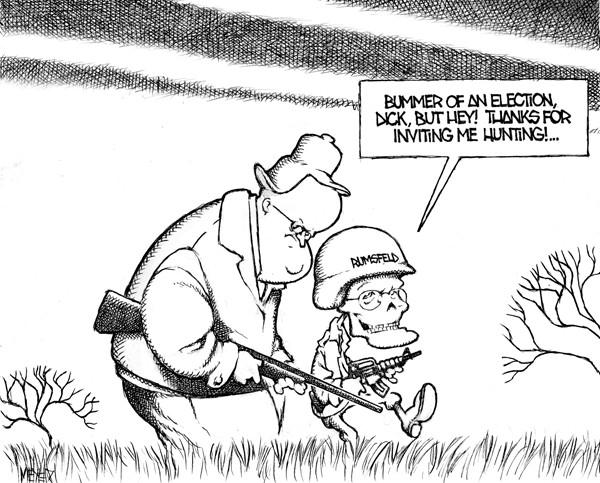
So long, Rummy, we won't miss you at all

The San Francisco Chronicle's Tom Meyer speculates on the back story behind Rummy's long-overdue departure.


Tags: ,

Wednesday, November 08, 2006

So long, Rummy: no one in their right mind will miss you

Tuesday is shaping up to have been one those events that Jerry Brown describes as a "democratic moment", when the people intervene in politics as usual in a decisive way. Whether it becomes a "Jacksonian moment" will depend on how the Dems do over the next two years.

Bob Dreyfuss gets uncharacteristically enthusiastic about the meaning of Tuesday's elections in The Iraq Mandate TomPaine.com 11/08/06:

For the first time in American history, Americans have gone to the polls in wartime and rejected that war. Not only that, but they’ve done so overwhelmingly. Just as the election of 1932 was a seismic repudiation of the failed economic policies of the Hoover Republicans, the election of 2006 was a landslide against the Bush Republicans and their criminally misguided war against Iraq.

Amid pre-election polls showing that voters oppose “staying the course” by margins of as much as three to one, the American people have issued a sweeping mandate to the U.S. government: Get out of Iraq.
Ivo Daalder in A Vote of No Confidence TPM Cafe 11/08/06 writes about what we should look for in terms of possible changes in the Cheney-Bush war policies in the wake of this election. He writes:

The first sign of whether such change is forthcoming will be whether Bush accepts the resignation of Donald Rumsfeld — or demands it if Rumsfeld fails to offer it. Of course, Bush pledged to keep his secretary of defense before the election. But that was then, this is now. Remember, Bush also said that FEMA Director Michael Brown was doing "a heckova job" in responding to Hurricane Katrina - and Brown was gone days later.
That one is now taken care of: Bush Says Rumsfeld Is Stepping Down by David Espo and Liz Sidoti AP 11/08/06.

The timing of Rummy's departure may relate less to being responsive to the electorate than with a desire to push through a confirmation of the new Defense Secretary before the Democrats (presumably) take control of the Senate in January. Confirmation hearings are going to focus a magnifying glass on the Iraq War. But if the Reps still control the Senate, they can severely restrict the scope and depth of the investigations around the confirmation hearings.

Whatever the thinking behind Rummy's departure, it should have happened at least five years ago. This is one of the most disgraceful men who ever held a high office in the US Government. In a more just world than the one we live in, he would have been shipped off to the Hague and already tried before the International Criminal Court (ICC). Alarm bells should have gone off for both parties in Congress back in December 2001 when Novakula (Robert Novak) asked Rummy on CNN about the reports of our Northern Alliance partners in Afghanistan murdering prisoners in violation of the Geneva Conventions, and Rummy replied:

The fact that they [the Northern Alliance] don't happen to subscribe to some convention that we do or that other countries do is a fact. It is also a fact that we have to stop those terrorists from killing more Americans. And I don't feel even the slightest problem in working with the Northern Alliance to achieve that end.
The Secretary of Defense sneering at the international laws and customs of war as "some convention" should have resulted in his ouster within a day or two just by itself. Rummy proceeded to show us in the years since just how little he cared about international and domestic law.

Daalder's second sign to watch for is:

The next sign of change must come in Bush’s Iraq policy. ... Today, America’s goal cannot be victory; it must be to minimize the damage of its defeat.

That requires a clear and unambiguous commitment to disengage from the conflict. American troops should immediately move from the streets of Baghdad and Iraq’s other cities and into the safety of their barracks and bases. And then they should begin the steady process of withdrawing.
When Bush family fixer James Baker releases the Iraq Study Group (ISG) report soon, we'll see if Dubya can or will manage to use that as a vehicle for any substantial changes in policy. My guess is that Cheney and Bush intend to plow ahead to go for an undefinable and unattainable "victory" in Iraq.

Daalder then describes a number of actions that the administration should take that seem even less likely for Cheney and Bush to embrace: recognizing basic human rights and international standards of justice for "terrorism" suspects; start taking other key concerns of the world community like global warming seriously; engage in active Middle East diplomacy; and, change their attitude to work better with other countries.

Yes, these actions would all be good. Rummy's going, thank God. But Cheney and Bush are extremely unlikely to change their Iraq War policies in essential ways unless Congress forces them to do so. And recognizing prisoners' rights, fighting global warming, working more cooperatively with allies? Ain't gonna happen. Relationships with some countries might, repeat might, improve. But the rest, no way.

Saturday, November 04, 2006

Civilian-military relations


My goodness, no, I don't care what the public or the Congress or the military think, I run things around here

I wouldn't describe myself as a pessimist when it comes to political affairs, but more as a guarded optimist.

But the recent news that the Military Times newspapers (Army Times, etc.) were coming out with an editorial this Monday calling for Rumsfeld's resignation got me thinking again about the state of military-civilian relations. Those papers are not government-owned or run; they are published by a subsidiary of the Gannett Co. But the editorial bases its argument in part on the claim that "when the nation's current military leaders start to break publicly with their defense secretary, then it is clear that he is losing control of the institution he ostensibly leads." It's understandably assumed that the editorial reflects a widespread sentiment in the armed forces (Newspapers for troops call for Rumsfeld's ouster by Matthew Stannard San Francisco Chronicle 11/04/06):

The editorial will run in the 250,000 copies of Army Times, Navy Times, Marine Corps Times and Air Force Times. The newspapers are published under the umbrella Military Times Media Group by Gannett Co. Inc., not by the U.S. military, and have been popular among American forces since World War II.

"It is extremely widely read and influential for the professional military," said David Segal, director of the Center for Research on Military Organization at the University of Maryland.

The relationship goes two ways, said Segal. "I think it would be safe to say if the Army Times is saying that, it is something they are hearing from senior officers in the Army," he said.
It has been somewhat counterintuitive during the Cheney-Bush administration that it has been the civilian neocons and nationalists like Dick Cheney who have been the "hawks", while the uniformed military has tended to call for restraint and caution when it comes to adventures like the Iraq War. During the 1950s and 1960s, the situation had been the reverse.


The Democrats have been happy to seize on criticism of Rummy and the Cheney-Bush administration more generally that has come from military figures like retired generals. Party Chairman Howard Dean said on the PBS Newshour on Friday 11/03/04:

But we need to be out of Iraq, and we need a plan to get us out of Iraq. And we expect the president to listen to the military about how we can do that.
It's hard to fault the Democrats for wanting to counter the Republicans' martial and often just plain militaristic rhetoric with a defense of the allegedly pragmatic generals against the bumbling, incompetent Bush Republicans.

But it's also been obvious since early 2005 that the generals were positioning themselves to duck criticism for what was already an obvious failure in the Iraq War. The neoconservatives who were the intellectual godfathers of this disaster are also now bravely scrambling to find excuses for why their ideas put into practice turned out to have created possibly the worst failure in the history of American foreign policy with the Iraq War. And their favored excuse of the moment is that it was the incomptence of the Cheney-Bush administration in executing their preventive war that is to blame.

But our infallible generals shouldn't be allowed to skate on this one, either. They aren't entirely to blame. But they certainly share in the blame, for instance in their counterinsurgency strategy which responds to sniper fire in urban combat by calling in artillery and air strikes. Those tactics have multiplied the civilian casualties and were a major factor in turning Iraqis against the American presence. But we haven't seen a lot of retired generals denouncing those failures on the part of our unassailable generals.

We've also seen and heard throughout the war that the President and Rummy say over and over and over that they're giving our infallible generals everything they say they need to win the Iraq War. And that they're letting the military control the military operations in Iraq without any interference from the civilians. And the serving military officers back them up.

Now, we know they're lying. The military always tries to have it both ways in such situations, publicly endorsing the course of the Executive but laying the groundwork to alibi themselves for possible failure later.

But still, this all raises some important questions. By statute, the Joint Chiefs of Staff are the primary military advisers of the President and the Secretary of Defense. Their role was defined as such in the Goldwater-Nichols Act of 1986 (Part 1 and Part 2).

Paragraph 151 says the following:

... in presenting advice with respect to any matter to the President, the National Security Council, or the Secretary of Defense, the Chairman shall, as he considers appropriate, inform the President, the National Security Council, or the Secretary of Defense, as the case may be, of the range of military advice and opinion with respect to that matter. (my emphasis)
Now that "as he considers appropriate" means that the JCS Chairman would be free to ignore any part of the "range of military advice and opinion" that he chooses. But it was clearly the intent of Cogress that a broad range of options would be presented not just to the Defence Secretary but the President, as well.

The following parts of the same paragraph, though, don't include a loophole for the JCS Chairman:

A member of the Joint Chiefs of Staff (other than the Chairman) may submit to the Chairman advice or an opinion in disagreement with, or advice or an opinion in addition to, the advice presented by the Chairman to the President, the National Security Council, or the Secretary of Defense. If a member submits such advice or opinion, the Chairman shall present the advice or opinion of such member at the same time he presents his own advice to the President, the National Security Council, or the Secretary of Defense, as the case may be. ...

After first informing the Secretary of Defense, a member of the Joint Chiefs of Staff may make such recommendations to Congress relating to the Department of Defense as he considers appropriate. (my emphasis)
So this means that the other members of the JCS - Army Chief of Staff, Chief of Naval Operations, Air Force Chief of Staff, and the CommCommandant of the Marine Corps - all had the statutory option to submit dissenting opinions on military advice to the President and to Congress. And if they had good reason to know that the plans for the Iraq War were excessively risky, did they not have some kind of moral obligation to make their dissents known? If any of them come out after retirement and say they opposed the JCS Chairman's recommendations, then they should also explain why they did not exercise their option to make a dissent known to Congress.

There are a number of actions, laws and precedents that give the military a level of authority in civilian governmental affairs that are not necessarily healthy for a democracy, or other kind of civilian government. Lt. Col. Charles Dunlap, Jr., used a futuristic scenario to look at some of those in The Origins of the American Military Coup of 2012 by Lt. Col. Charles Dunlap, Jr. Parameters (US Army War College) Winter 1992-93.

In this fictional scenario, it's 2015, then 20 years in the future. A military junta has taken power by a coup in the United States. And the article is in the form of a letter from a "senior retired officer of the Unified Armed Forces, known here simply as Prisoner 222305759" who "is one of those arrested, having been convicted by court-martial for opposing the coup".

Here are some of his points, keeping in mind that anything after 1992 is imagined:

Congress became their unwitting ally. Because of the popularity of the new military programs - and the growing dependence upon them - Congress passed the Military Plenipotentiary Act of 2005. This legislation was the legacy of the Goldwater-Nichols Defense Reorganization Act of 1986. Among many revisions, Goldwater-Nichols strengthened the office of the Chairman of the Joint Chiefs of Staff and mandated numerous changes intended to increase "jointness" in the armed services. Supporters of the Military Plenipotentiary Act argued that unity of command was critical to the successful management of the numerous activities now considered "military" operations. Moreover, many Congressmen mistakenly believed that Goldwater-Nichols was one of the main reasons for the military's success in the First Gulf War. They viewed the Military Plenipotentiary Act as an enhancement of the strengths of Goldwater-Nichols.

In passing this legislation Congress added greater authority to the military's top leadership position. Lulled by favorable experiences with Chairmen like General Colin Powell, Congress saw little danger in converting the office of the Chairman of the Joint Chiefs of Staff into the even more powerful Military Plenipotentiary. No longer merely an advisor, the Military Plenipotentiary became a true commander of all US services, purportedly because that status could better ameliorate the effects of perceived interservice squabbling. Despite warnings found in the legislative history of Goldwater-Nichols and elsewhere, enormous power was concentrated in the hands of a single, unelected official.
He points to the idolization of the American military that was already well advanced under the Reagan administration and Old Man Bush's administration (though he doesn't emphasize the significant role that the Christian Right played in this process):

America's societal malaise was readily apparent in 1992. Seventy-eight percent of Americans believed the country was on the "wrong track." One researcher declared that social indicators were at their lowest level in 20 years and insisted "something [was] coming loose in the social infrastructure." The nation was frustrated and angry about its problems.

America wanted solutions and democratically elected government wasn't providing them. The country suffered from a "deep pessimism about politicians and government after years of broken promises." David Finkle observed in The Washington Post Magazine that for most Americans "the perception of government is that it has evolved from something that provides democracy's framework into something that provides obstacles, from something to celebrate into something to ignore." Likewise, politicians and their proposals seemed stale and repetitive. Millions of voters gave up hope of finding answers. The "environment of apathy" Janos characterized as a precursor to a coup had arrived.

Unlike the rest of government the military enjoyed a remarkably steady climb in popularity throughout the 1980s and early 1990s. And indeed it had earned the admiration of the public. Debilitated by the Vietnam War, the US military set about reinventing itself. As early as 1988 U.S. News & World Report heralded the result: "In contrast to the dispirited, drug-ravaged, do-your-own-thing armed services of the '70s and early '80s, the US military has been transformed into a fighting force of gung-ho attitude, spit-shined discipline, and ten-hut morale." After the US military dealt Iraq a crushing defeat in the First Gulf War, the ignominy of Vietnam evaporated.
One of the hopeful aspects of the torture scandals at Abu Ghuraib, Guantanamo and other stations in the Bush Gulag is that after seeing the photos of naked, hooded men stacked in human pyramids and various other disgusting acts of sexual sadism being performed by some of "the troops", is that it slapped the public upside the head with the reality that The Troops are human beings, not all of whom practice "spit-shined discipline" and "ten-hut morale". At Abu Ghuraib, it was more like ten-hooding morale.

Dunlap cites the following quote from Atlantic writer James Fallows in 1991:

According to our economic and political theories, most agencies of the government have no special standing to speak about the general national welfare. Each represents a certain constituency; the interest groups fight it out. The military, strangely, is the one government institution that has been assigned legitimacy to act on its notion of the collective good. "National defense" can make us do things - train engineers, build highways - that long-term good of the nation or common sense cannot.
Dunlap notes that injecting the military into the "war on drugs" was an erosion of the long-standing distinction between civilian and military realms of authority. That process has proceeded much further since then, with the warrantless, illegal spying by the Pentagon's National Security Agency (NSA) being the most dramatic recent example. At the same time, he notes various factors that create a sense of isolation between civilians and the uniformed military:

Furthermore, well-meaning attempts at improving service life led to the unintended insularity of military society, representing a return to the cloistered life of the pre-World War II armed forces. Military bases, complete with schools, churches, stores, child care centers, and recreational areas, became never-to-be-left islands of tranquillity removed from the chaotic, crime-ridden environment outside the gates. As one reporter put it in 1991: "Increasingly isolated from mainstream America, today's troops tend to view the civilian world with suspicion and sometimes hostility." Thus, a physically isolated and intellectually alienated officer corps was paired with an enlisted force likewise distanced from the society it was supposed to serve. In short, the military evolved into a force susceptible to manipulation by an authoritarian leader from its own select ranks.
This line turned out to be sadly prophetic: "What made this all the more disheartening was the wretched performance of our forces in the Second Gulf War."

Dunlap's article goes on to cite some things that he saw as threatening to erode the military's central mission of warfighting. And it's pretty clear he had in mind the conventional-war model of warfighting. Ironically, some of the things he complains about being problems in that sense actually would have helped in the Iraq War if the military had been better and more experienced at them. For instance:

Police organizations are understandably oriented toward the studied restraint necessary for the end sought: a judicial conviction. As one Drug Enforcement Administration agent noted: "The military can kill people better than we can [but] when we go to a jungle lab, we're not there to move onto the target by fire and maneuver to destroy the enemy. We're there to arrest suspects and seize evidence." If military forces are inculcated with the same spirit of restraint, combat performance is threatened.
But, in fact, the mission that the Army and the Marines were given in Iraq in the counterinsurgency war involved a big demand for just those kinds of situations that required "studied restraint". And among an Arab-speaking population for whom tribe-and-clan-based "honor systems" are a key element, i.e., you humiliate or injure one member and all his cousins want to come kill you.

And that is one of the things that the generals can be legitimately criticized for. They structured and trained their forces so that they would be prepared for conventional war, like the Gulf War of 1991, and not for a counterinsurgency war like the one in which they are now mired. Yet when they were given a mission that involved massive counterinsurgency operations, apparently none of the service Chiefs who have the statutory authority to send dissenting recommendations to the Defense Secretary, the President and Congress have chosen to do so.

I'm very happy to see Rummy get some of the criticism he deserved for his performance even during the opening months of the Afghanistan War in 2001-2. But we would also make a big mistake to let our infallible generals off the hook for the disaster known as the Iraq War.


Monday, October 13, 2003

Iraq War: War and Atrocities

Rummy don't care about no convention, in Geneva or anywhere else

One of the most disturbing things any high American official has ever said in public was Defense Secretary Donald Rumsfeld's comment on CNN's Hunt Novak & Shields program on 12/01/01. Robert Novak - the same Novak who's so much in the news over the Wilson/Plame scandal - asked Rummy about reports of killings of prisoners-of-war by the Afghan Northern Alliance troops who the US was supporting:

Do you feel, Mr. Secretary, there is a problem, however, when apparently most of the prisoners, all of the prisoners, are in the hands of the Northern Alliance, which I don't believe signed the Geneva Convention and are not the nicest guys in the world? Does that bother you at all?
The premise of Novak's question was flawed from the start. The body of international law which is often referred to by the shorthand "Geneva Convention" applies to all belligerents in a war, whether they have formally agreed to them or not. But Afghanistan is a formal signatory to the Geneva Convention. And the Northern Alliance at that time was recognized by the US, the UN and almost all countries of the world as the legitimate government of Afghanistan.

Rummy replied first by referring to the deaths in the 9/11 attacks. And he continued:

The fact that they [the Northern Alliance] don't happen to subscribe to some convention that we do or that other countries do is a fact. It is also a fact that we have to stop those terrorists from killing more Americans. And I don't feel even the slightest problem in working with the Northern Alliance to achieve that end.
Any defense minister in any other country in the democratic world who had publicly sneered at the Geneva Convention laws as "some convention" and brushed off well-sourced press reports of deliberate murder of POWs by their allies would likely have been forced to resign within 24 hours or less.

We now know that US Special Forces were fighting very closely together with Northern Alliance troops, often giving them very detailed tactical direction in battles. So that makes Rummy's cavalier attitude toward atrocities and violations of international law all the more disturbing.

As reports mount of questionable shootings of civilians in Iraq, I've often thought of Rummy's comment then and the kind of signal it sent to US commanders and soldiers and to our allies.

Tags: , , , , , ,

Saturday, October 04, 2003

Iraq War: A soberting warning

Competing with Arnie's sex issues and Rush's race and drug problems, Gen. Sanchez' warning this week probably didn't get the intention it deserves. The commander of American forces in Iraq said:

This is still wartime. ... There is still some intense fighting to be done, especially out in the west. We should not be surprised if one of these mornings we wake up and ... there has been a major firefight with some casualties or a significant terrorist attack that kills significant numbers of people.
Apart from the merits of the war or the occupation policy, this is the kind of thing both civilian and military officials at the Pentagon should be saying more often.

Fans of the war are suggesting that the press is causing the Administration's credibility problems. That's way off base. The press generally is still much too little critical on the war.

But over-optimistic expectations that the Administration raised about the costs (human and financial) of the war and the occupation have not so far been met. That's the credibility problem.

But Sanchez' bosses in Washington are still at it:

Sanchez stressed that U.S. forces were improving their ability to confront the resistance, a statement echoed Thursday in Washington by Defense Secretary Donald H. Rumsfeld and Air Force Gen. Suzanne Goldenberg Richard B. Myers, chairman of the Joint Chiefs of Staff, who defended American progress in Iraq.

"While there is no question we have faced some challenges and we've got some ahead of us, we have really achieved numerous successes and expect the situation to continue to improve," Myers told reporters at a Pentagon news conference. "We're in this for the long haul and ... we'll get the job done."
And it's starting to look like the US is running a serious risk of losing even the existing level of diplomatic support from the United Nations for the occupation.

Happy talk isn't going to fix this.

Tags: , , , ,

Wednesday, September 10, 2003

Stop the Presses! Rummy Interviewed by Real Live Journalist

I'm sitting here stunned. I've had an unprecedented experience. Donald Rumsfeld sat for an extended interview with Jim Lehrer of the PBS Newshour tonight. It's the first time I've actually enjoyed seeing Rummy on TV.

Because Lehrer took him apart. Chewed him up and spit him out. Rummy resorted to the same posturing that turns on the Rush Limbaugh dittohead crowd when he sneers and swaggers in front of the Pentagon press corps, who normally cower like children afraid to upset daddy when he's come home drunk.

Rummy blustered and bullied and sneered. He tossed questions back in Lehrer's face. He tried to change the subject. He made arguments a 12-year-old could see through. He lived up to Doonesbury's lampooning of him by asking his own questions and then answering them. (He got on a manic roll on that toward the end.) He smiled his creepy death's-head smile.

Lehrer maintained a polite, professional demeanor. But he asked tough questions. He asked follow-up questions. He asked for clarifications when Rummy contradicted himself. He asked him for details on silly claims. In other words, he acted like normal journalists did not so very long ago. The fact that it was a novel event shows how craven the mainstream press has become.

At one point while Lehrer is asking a pointed question, Rummy gets an expression on his face like he's just been punched in the stomach. Having to answer real questions from a real reporter is clearly an unfamiliar experience for Deputy Rummy.

The video is a must-see (search for Rumsfeld). Because this is one you can't appreciate by just reading the transcript. At least listen to the audio. When you hear the entire exchange, it's hard to miss what a blustering, dissembling, arrogant twit Rummy really is. Don't miss the part where Rummy approvingly quotes someone saying the 9/11 attacks were "a blessing in disguise."

I respected Jim Lehrer before. Now I'm ready to nominate him for the Andrew Jackson Award for Taking on Scoundrels. Speaking of which, I'd love to see Rummy go head-to-head in an argument with Old Hickory. He would reduce Rummy to tears in about 10 minutes time.

Hearing: Louvin Brothers, "Satan is Real"

Tags: ,

Tuesday, September 09, 2003

Iraq War: Stab in the Back

Some hawkish types are already making up blustering excuses for the possibility of a fiasco in the Iraq War.

I know I just linked to Josh Marshall, but he's pursuing an important observation on the emergence already of a rightwing "stab-in-the-back" theory that explains failure in Iraq as a loss of nerve by weak-kneed civilian wimps back home. Donald Rumsfelds's comment in Ireland that critics of the war are helping them terrorists has gotten a lot of publicity.

But I've noticed signs of this prior to now. On the cruder side, country singer and rightwing pamphleteer CHARLIE DANIELS tried out the idea in one of his Soapbox rants last month:

If you listen to the mainstream press these days you are inundated with stories which make it sound as if our troops in Iraq are ready to mutiny to get out of there and come home.
Now, Chuckie didn't cite any sources for this. But he goes on, relying on an alleged letter from an unidentified American soldier in Iraq, to explain how our fightin' men can win this thang as long as them there media "pukes" don't give everybody the wrong impression about the war.

He concludes, "It seems that we are being told what the media wants us to know and not what is actually happening." Presumably, Chuckie isn't referring to Fox News or the Washington Times in saying that.

A more highbrow version appeared in the Los Angeles Times from Max Boot:

As long as we keep our nerve, we will prevail. As in Vietnam, so in Iraq: Only defeatism on the home front can stop our soldiers.
One thing to watch with those making this argument is what they are willing to support in actual policies. Are they willing to put 50,000 more American soldiers in Iraq? 100,000 more? Did they support Bush's proposals this summer to cut our soldiers' combat pay and death benefits? Or are they just getting pseudo-patriotic excuses ready if the war they cheered keeps going badly?

Steve Earle and the Del McCoury Band, "Dixieland"

- Bruce Miller

Tags: , , , , , ,