Showing posts with label sigmund freud. Show all posts

Friday, January 05, 2018

"Black Book of Communism" and Holocaust Denial

Ben Norton tweeted over a month ago about a Holocaust-denier exercise, which first came to my attention this morning:

Norton's citation is to his article Why Are the Trump White House and Media Citing an Antisemitic Book's Claims to Demonize Communism? AlterNet 11/22/2017. The book in question is The Black Book of Communism, first published in French as Le Livre noir du communisme: Crimes, terreur, répression in 1997. Norton explains:
The Black Book of Communism is a collection of right-wing essays published in France in 1997, and subsequently translated into English and published by Harvard University Press in 1999. Some of its contributors have admitted that the book’s figures are fabricated or exaggerated. Contributors Jean-Louis Margolin and Nicolas Werth distanced themselves from the text, criticizing the editor Stéphane Courtois and his “obsession to arrive to the 100 million deaths.” When he could not round out the figure to 100 million, Courtois apparently just added numbers.

Perhaps more troubling than The Black Book of Communism’s many egregious errors is the fact that it counts Nazi-collaborating fascists, anti-Semitic White Army fighters and czarist officers who oversaw genocidal pogroms against Jews in its list of “victims of communism.”

The International Commission on the Holocaust in Romania — known popularly as the Wiesel Commission, after Holocaust survivor Elie Wiesel, who led it — condemned the editor Courtois for “comparative trivialization” of the Nazi Holocaust. In order to portray communism as more evil and murderous than fascism and demonize scholars who refuse to do the same, Courtois fell back on anti-Semitism, “inserting an incriminating insinuation directed at the Jews,” the Wiesel Commission wrote. The commission noted that the editor’s tactics inspired “prestigious intellectuals” to rehash anti-Semitic stereotypes and talking points like “Red Holocaust,” “monopoly on suffering” and “Judeocentrism,” which it noted “are widely popular in radical-right circles.”
These "body-count" controversies are always grim. I find it helpful to keep in mind as an ethical guideline when looking at them that 100 wrongful deaths in one country or under a particular regime doesn't justify even one wrongful death in another country or another regime.

At the same time, invidious comparisons between countries is a standard feature of international relations, including these body-count disputes.

Anti-Communism was always a key part of Nazi ideology. And Holocaust-deniers to this day try to justify the Holocaust and even the German invasion of Russia by saying it was all the Commies' fault.

One of the best analyses and debunking of Holocaust denial I've come across is the 2000 decision written by Mr. Justice Gray in Irving v. Penguin Books Limited, Deborah E. Lipstat [sic[, the case depicted in the movie Denial (2016). The decisions deals with the historical issues at length, and in language accessible to non-attorneys. Because the notorious David Irving was suing Lipstadt in a British court for portraying him in a book as a Holocaust denier, the decision goes into some detail about the nature of the available documentation and what reality-based uses of it requires.

Section 11 is about the Allied bombing of the German city of Dresden in 1945. The section is a case study in how Holocaust deniers take a real historical event, exaggerate facts in the favor of the case they want to make, and make a tendentious historical interpretation that tends to minimize or justify the mass murder of Jews and others in the Holocaust. In this case, it is the Western Allies, not the Communist Soviet Union, whose actions are exaggerated and used to cast the Holocaust in a more favorable light.

There is a website, Holocaust Denial on Trial from Emory University's Tam Institute for Jewish Studies, with historical resources on the Holocaust and Holocaust denial, including transcripts of expert witnesses at the Irving v. Lipstadt trial.

The current (Jan/Feb) issue of Foreign Affairs journal has a set of stories on "The Undead Past: how Nations Confront the Evils of History," with articles focusing on the US, Germany, Russia China, South Africa and Rwanda. In his essay "China's Cover-Up: When Communists Rewrite History," he describes the perspective of Karl Jaspers on how Germans needed to come to grips with the crimes of the Nazi regime:
The man who devised the road map for the expiation of German guilt was the philosopher and psychoanalyst Karl Jaspers, who in 1945 gave a series of influential lectures at the University of Heidelberg that were later collected in a book titled The Question of German Guilt. Even though what happened under Adolf Hitler precipitated something "like a transmutation of our being," said Jaspers, Germans were still "collectively liable." All of those "who knew, or could know" - including those "conveniently closing their eyes to events or permitting themselves to be intoxicated, seduced, or bought with personal advantage, or obeying from fear" - shared responsibility. The "eagerness to obey" and the "unconditionality of blind nationalism," he declared, constituted "moral guilt." Human beings are, said Jaspers, responsible "for every delusion to which we succumb." He put his faith in healing through "the cultivation of truth" and "making amends," a process he believed had to be completely free from any state-sponsored propaganda or manipulation.

"There can be no questions that might not be raised," he declared, "nothing to be fondly taken for granted, no sentimental and no practical lie that would have to be guarded or that would be untouchable." In Jaspers' view, only through historical awareness could Germans ever come to terms with their past and restore themselves to a semblance of moral and societal health.

Jaspers' approach owed a great deal to psychoanalytic theory and the work of Sigmund Freud. For Freud, understanding a patient's past was like "excavating a buried city," as he wrote in 1895. Indeed, he was fond of quoting the Latin expression saxa loquuntur: "The stones speak." Such mental archaeology was important to Freud because he believed that a repressed past inevitably infected the present and the future with neuroses unless given a conscious voice to help fill in what he called "the gaps in memory." In this sense, history and memory were Freud's allies and forgetting was his enemy. [my emphasis in bold]

Sunday, April 03, 2016

Confederate "Heritage" Month 2016, April 3: Slave patrols and ... "false consciousness"?

I've always been kind of fascinated about the notion of plagiarizing from oneself. I understand that there are some sensible reasons for such a thing to be regulated by law, such as when an author gives up the commercial rights to a written or musical composition. Others can be more of a gray area. Did a writer provide a "unique product"? Does a songwriter's song sound too much like an earlier song of hers to which someone else has the rights?

I notice Digby Parton is careful to cite her earlier posts as quotations, rather than just using the text in a new post.

I'm kind of split on it, myself, for this blog.

The reason I mention it is that one of the things I've discussed here in various posts is "slave patrols" in the slave states. And I want to write about it some more without completely repeating myself.

One post devoted completely to the slave patrols is Confederate "Heritage" Month 2012, April 15: Slave patrols, the Ku Klux Klan and present-day white racism 04/15/2012. Another is Confederate "Heritage" Month 2012, April 16: More on slave patrols 04/16/2012.

In Confederate "Heritage" Month, April 28: Convincing non-slaveowning whites to fight for the Slave Power 04/28/2013, I wrote about how the planter class used slave patrols as one key institution in a broader political strategy of giving whites generally a sense of having a stake in the slave system. That is an aspect of the slave patrols that is not only historically important but relates to the actual functioning of white racism in the US today.

Debates over gun proliferation in recent years have focused at times on the motivating impulse for the Second Amendment, the second half of which is currently idolized by the Republican Party. The first part about a "well regulted militia"? Not so much. And here I'm going to plagiarize myself a bit from things I've written earlier on this blog, not just in the posts linked above.

The Second Amendment to the US Constitution was placed there primarily at the insistence of Southern states that required white male citizens to participate in slave patrols, whose purpose was to catch runaway slaves and generally to terrorize the black population, both slave and free, to discourage revolts. And more generally to promote fear and subservience among African-Americans.

The slave patrols were posses in which non-slaveowning whites were compelled to participate that searched for blacks who were not on plantations. Plantations had their own plantation patrols, as well. The slave patrols were often vehicles of arbitrary abuse. They were also a key social institution by which the slaveowners won the support of non-slaveholders for the Peculiar Institution. The slave patrols gave free whites who might be inclined to political and/or violent anger against wealthy slaveowners the opportunity to vent their anger on vulnerable blacks, slave and free. And that's a key reason that participation was mandatory.

The fear of slave revolts was widespread and ingrained into daily life in the South prior to the Civil War. It was accompanied by periodic panics over them, most of which existed only the in the fevered, guilty imaginations of white people. Though slave resistance and the occasional slave revolt really did occur, too. John Brown fanned those fears with his plan to set up a guerrilla army in the South to free slaves in the years immediately before the Civil War.

The slave patrols were instruments of state terror against slaves and any whites who might attempt to assist escaping slaves. They were also a direct precursor of Reconstruction-era terrorist organizations of which the Ku Klux Klan is the most infamous. (There is also an argument that the slave patrols were the direct predecessors of present-day police departments; I haven't looked at that argument carefully enough to have an informed opinion on it.)

The existence of the slave patrols also means that it's not the case that non-slaveowning Southern whites had no direct prewar connection to enforcing slavery, claim that neo-Confederates routinely make. The patrols had unchallenged authority to stop and abuse any black person free or slave they saw out in public, whether or not the victim was authorized to be there. And they often did so. It was an effective way to create an emotional bond to the slave system even among non-slaveowners. Betram Wyatt-Brown has a good description of the slave patrols in his Southern Honor: Ethics and Behavior in the Old South (1982).

Conservative intellectuals like to sneer at Mean Libruls for supposedly talked down to Real Americans by accusing them of suffering from "false consciousness." White slaveowners in the antebellum South and the white non-slaveowners did make money off their black slaves. But whether we use the anathematized phrase or not, most white Southerners who supported the slave system were demonstratbly acting against their own interests. Because as Hinton Helper famously detailed at the time in ..., the slave system worked very much to the disadvantage of the Southern white common people, the big majority of whites. But the white non-slaveowners who were required to serve on slave patrols did get the sadistic satisfaction of pushing around unarmed blacks and the psychological satisfaction of feeling themselves part of a master race for doing so.

That attitude may have been self-defeatign. But it would be a mistake to dismiss it as entirely false. The psychological advantage they felt from white racism was real, then as it is today. Sigmund Freud's argument in The Future of An Illusion (1927) is very relevant to the psychological and social function of the slave patrols:

The narcissistic satisfaction provided by the cultural ideal is also among the forces which are successful in combating the hostility to culture within the cultural unit. This satisfaction can be shared in not only by the favoured classes, which enjoy the benefits of the culture, but also by the suppressed ones, since the right to despise the people outside it compensates them for the wrongs they suffer within their own unit. No doubt one is a wretched plebeian, harassed by debts and military service; but, to make up for it, one is a Roman citizen, one has one's share in the task of ruling other nations and dictating their laws. This identification of the suppressed classes with the class who rules and exploits them is, however, only part of a larger whole. For, on the other hand, the suppressed classes can be emotionally attached to their masters; in spite of their hostility to them they may see in them their ideals; unless such relations of a fundamentally satisfying kind subsisted, it would be impossible to understand how a number of civilizations have survived so long in spite of the justifiable hostility of large human masses. [my emphasis]

Historically, the purpose of the Second Amendment was to guarantee that critics of slavery would be unable to block the use of "slave patrols" in which white citizens were required to patrol for slaves who were somehow breaking the rules. It was a key institution in the slave South for gaining political and psychological commitment among nonslaveholders for the Peculiar Institution.

Thom Hartmann writes in The Second Amendment was Ratified to Preserve Slavery 01/16/2013:

In the beginning, there were the militias. In the South, they were also called the "slave patrols," and they were regulated by the states.

In Georgia, for example, a generation before the American Revolution, laws were passed in 1755 and 1757 that required all plantation owners or their male white employees to be members of the Georgia Militia, and for those armed militia members to make monthly inspections of the quarters of all slaves in the state. The law defined which counties had which armed militias and even required armed militia members to keep a keen eye out for slaves who may be planning uprisings.

As Dr. Carl T. Bogus wrote for the University of California Law Review in 1998, "The Georgia statutes required patrols, under the direction of commissioned militia officers, to examine every plantation each month and authorized them to search 'all Negro Houses for offensive Weapons and Ammunition' and to apprehend and give twenty lashes to any slave found outside plantation grounds."

It's the answer to the question raised by the character played by Leonardo DiCaprio in Django Unchained when he asks, "Why don't they just rise up and kill the whites?" If the movie were real, it would have been a purely rhetorical question, because every southerner of the era knew the simple answer: Well regulated militias kept the slaves in chains.
The slave patrols and their historical function shows us a way that the institution of slavery affects US politics and society in visible ways still.

See also:

Robert Bateman, Hey Oregon "Militia": Here's the History Lesson You Missed Esquire Politics Blog 01/17/2016

Digby Parton, What were the founders really afraid of? Hullabaloo 01/17/2013

Thursday, January 01, 2015

José Pablo Feinmann on Nietzsche's continuing influence, Philosophy Here and Now (Temporada 1-13) (Spanish-language video)

This is Chapter 13 and the final installment of the first season of Argentine philosopher José Pablo Feinmann's public TV series Filosofía aquí y ahora, "T1 CAP 13: Derivaciones de Nietzsche” Encuentro n/d Filosofía y Praxis YouTube 02/05/2013:


In this installment, Feinmann further discusses the continuing influence of the philosophy of Friedrich Nietzsche (1844–1900). Including Hannah Arendt (1906–1975), Freud, Thomas Hobbes (1588–1679) and the critical theory of the Frankfurt School, in particular that of Theodor Adorno (1903-1969), Walter Benjamin (1892-1940) and Max Horkheimer (1895–1973).

Saturday, January 25, 2014

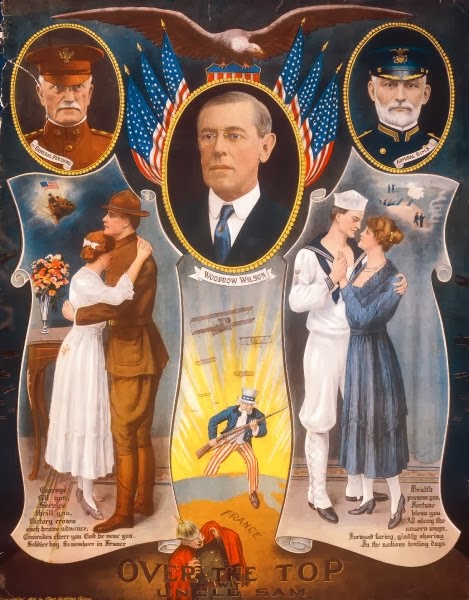
Woodrow Wilson in the Great War and the sorry peace that followed it

I'm already losing track of the number of bad 1914 analogies I'm seeing this year. Anne-Marie Slaughter thinks that the South China Sea is shaping up as "Sarajevo, 21st-century version"? Please.

That's what we learn in the opening paragraph of Hans Hoyng's 'We Saved the World': WWI and America's Rise as a Superpower Spiegel International 01/24/2014.

My first rule on 1914 analogies: if it doesn't involve the eurozone, it's almost certainly a bad one.

It's also generally a bad sign if a writer quotes a Kagan in the second paragraph with approval, as Hoyng does, Robert in this case.

Third paragraph: "leaders in Beijing have responded to such attempts to encircle their country with a similar sense of outrage as that displayed by the German Reich." This is truly going to be the Year Of Bad Analogies.

But once the nails-on-the-chalkboard introductory paragraphs are done, Hoyng gives a pretty decent sketch of Woodrow Wilson's foreign policy. Including how the power brokers of Britain and France completely punked him on the Treaty of Versailles that made a new war all but inevitable.

I have a grudging respect for the internationalist and rule-of-law elements in Wilson's foreign policy outlook. Wilson himself I find a really unsympathetic character. That's based in significant part on the book co-authored by Sigmund Freud and the famous and colorful William Bullitt, Thomas Woodrow Wilson: A Psychological Study, first published in 1967. The nature of Freud's co-authorship has been the cause of some consternation. Freud's daughter Anna found it hard to believe that Freud was satisfied with the text that Bullitt presented to him based on their joint work, but assumed he was willing to approve it without further revisions because his priorities were elsewhere at the time. Freud and Bullitt co-signed the chapters of the manuscript, and Freud did his own introduction to it, in which he writes, "For the analytic part we are both equally responsible; it has been written by us working together."


Freud's biographer, the historian Peter Gay, in Freud: A Life for Our Time (1988) calls the Wilson book "an embarrassing production." Gay writes, "Freud had solemnly proclaimed that psychoanalysis, his creation, must not be employed as a weapon of aggression. But at his advanced age, with his infirm health, in his embittered mood, Freud was prepared to make an exception with Woodrow Wilson." And the harshly judgmental tone, unusual for Freud's work, comes across even in the introduction, for which his authorship is uncontroversial. Gay's judgment strikes me as correct when he writes of the supposedly jointly authored text, "Throughout, the tone is scornful, as though Wilson's neuroses were somehow a moral failing." He also notes, the style and tone are notably different in the short introduction, though Freud says there in the opening paragraph that "the figure of the American President, as it rose above the horizon of Europeans, was from the beginning unsympathetic to me, and ... this aversion increased in the course of years the more I learned about him and the more severely we suffered from the consequences of his intrusion into our destiny." Freud proceeds to say, "With increasing acquaintance it was not difficult to find goo reasons to support this antipathy." He suggests that Bullitt could even have made changes to the text after Freud signed off on it.

Freud had patriotic and political motives for his judgments on Wilson's politics. The Austro-Hungarian Empire was a wobbly construction in 1914. In retrospect, even aside from the not inconsiderable possibility of a social revolution, the Empire's increasing involvement in the fanaticism-drenched mire of the Balkans had sealed its doom even before Gavrilo Princip assassinated his target in Sarajevo. By the end of 1916, Austria-Hungary's losses in the war and dire economic straits had made it practically the appendage of Germany. And in the remaining years of the war, Erich Ludendorff's military dictatorship was not primarily interested in preserving the postwar status of the Habsburg Empire.

Germans and Austrians of democratic orientation, of which Freud was one, hoped that the United States would act on Wilson's proclaimed goals of a fair peace, had legitimate reason to be bitterly disappointed in the vultures' peace that Wilson eventually agreed to in the Versailles Treaty. John Maynard Keynes, who had been part of the British delegation to the peace conference, wrote an early warning about the disastrous nature of the peace that was shaping up in his book, The Economic Consequences of the Peace.

John Kenneth Galbraith refers to Keynes' verdict on the Versailles Conference in The Age of Uncertainty (1977):

The mood in Paris in the early months of 1919 was vengeful, myopic, indifferent to economic realities, and it horrified Keynes. So did his fellow civil servants. So did the politicians. In June he resigned and came home, and, in the next two months, he composed the greatest polemical document of modern times. It was against the reparations clauses of the Treaty and, as he saw it, the Carthaginian peace.

Europe would only punish itself by exacting, or seeking to exact, more from the Germans than they had the practical capacity to pay. Restraint by the
victors was not a matter of compassion but of elementary self-interest. The case was documented with figures and written with passion. In memorable
passages Keynes gave his impressions of the men who were writing the peace. Woodrow Wilson he called " this blind and deaf Don Quixote." Of [French President] Clemenceau he said: "He had one illusion - France; and one disillusion, mankind ... " On [British Prime Minister] Lloyd George he was rather severe:

How can I convey to the reader, who does not know him, any just impression of this extraordinary figure of our time, this syren, this goat-footed bard, this half-human visitor to our age from the hag-ridden magic and enchanted woods of Celtic antiquity.
Alas, no man is of perfect courage. Keynes deleted this passage on Lloyd George at the last moment.
Galbraith relates that Keynes' basically accurate but highly unwelcome view of the Versailles Treaty earned him the defensive scorn of the British Establishment. Galbraith judges that this rejection was valuable to Keynes intellectual development:

It was not that the great men of the Treaty and the Establishment were suffering under the onslaught [of Keynes' criticism], although that, of course, was the real point. Rather, the criticism was [said by them to be] causing rejoicing to the nation's enemies. It's a device to which highly respectable men regularly resort. "Even if you are right, it is only the Communists who will be pleased."
Those familiar with Galbraith's own career will recognize that he spoke from experience and undoubtedly identified with Keynes position in that regard.

And it is when they are wrong that great men most resent the breaking of ranks. So they greatly resented Keynes. For the next twenty years he headed an insurance company and speculated in shares, commodities and foreign exchange, sometimes losing, more often winning. He also taught economics, wrote extensively and applied himself to the arts, old books and his Bloomsbury friends. But on public matters he was kept outside. He had broken the rules. We saw earlier that, as often as not, the intelligent man is not sought out. Rather, he is excluded as a threat.
This is the phenomenon that Paul Krugman calls that of the Very Serious People. It is far more acceptable in the view of the VSPs to be conventionally wrong than to be unconventionally right. What Jesus told Judas in the Bible about the poor is apparently also true of the VSPs: we seem to have them with us always, as well. (I know I used a similar reference in the previous post. So I like the Biblical references, so what?)

"Keynes's exclusion," writes Galbraith, "was his good fortune. The curse of the public man is that he first accommodates his tongue and. eventually his thoughts to his public position. Presently saying nothing but saying it nicely becomes a habit. On the outside one can at least have the pleasure of inflicting the truth." Freud's friend and presumed co-author Bullitt was also known for ruffling the feathers of the VSPs of the day over his public criticism of the Versailles Treaty.

Freud, of course, also had his lifelong experience of exclusion, even as he became one of the most celebrated scientists of his day. And he could see some of the same sense of unjust exclusion in that fate of Austria after the Versailles Conference. Though Vienna still conveys a sense of the onetime glory of the great Habsburg Empire, postwar Austria was a tiny rump remnant of what the Empire was in 1914 when Archduke Franz Ferdinand made his ill-fated visit to Sarajevo. One of Wilson's perhaps less idealistic premises that was incorporated into the peace was the notion that major ethnic groups should have their own nations, an embrace of the European ethnic concept of nationalism whose application after the First World War had decidedly ambiguous results. And, as Gay writes, Wilson's own "conduct during the tortuous peace negotiations was erratic and counterproductive."

Austria in the ethnic scheme was predominantly German in language and culture. And, not inconsequentially, in the view and aspirations of the majority of Austrians, including the Social Democrats who headed the postwar government. Austria's official name in the postwar constitution was "German Austria," and they wanted to merge with Germany. But the Allies did not considered it advantageous to allow ethnic unity to prevail in the case of Austria and Germany, and under the terms of the peace treaty, such a merger could not take place without Allied permission, which was never forthcoming. For those who know of Austrian merger with Germany in the context of the forcible Anschluss (annexation) of 1938, this can appear to be a strange concept that Austrians aspired to merge with Germany.

Hoyng is more generous to Wilson on this score than I'm inclined to be:

Wilson vehemently advocated the creation of the League of Nations. He noted with irritation that the British and the French were more intent on what they could demand from Germany. Wilson would even have been prepared to postpone the negotiations over new borders and reparations -- but not the talks on the League of Nations -- by a year until emotions had cooled down. "Our greatest error would be to give (Germany) powerful reasons for one day wishing to take revenge," Wilson warned. But he was unable to prevail, and the Germans soon felt betrayed by Wilson.
But he also notes, "Wilson signed the Treaty of Versailles, despite his own reservations and external warnings that the pact contained the germ of the next war."

It's one of the great mistakes of postwar Allied foreign policy that they did not allow the merger of Germany and Austria. The Weimar Republic was considered the model democracy in Central and Eastern Europe in the 1920s, and a merger into it would have both placed Austrian democracy on a more solid basis and removed a major nationalist grievance from the German rightwing parties. It would be too much of a stretch to say that it would have prevented the Nazis' rise to power. Hitler was very much an Austrian, after all, and his National Socialist ideology came out of the dysfunctional brand of multiculturalism he experienced in Vienna and the toxic soup of political anti-Semitism in which he immersed himself there prior to the First World War. On the other hand, it's hard to see how an annexation of Austria to Germany circa 1920 could have made Weimar democracy less stable and durable, and the opposite is more likely the case.

Freud may have identified with Moses. But he was also suspicious and skeptical about people with messianic pretensions. As Gay puts it, Freud "saw in Wilson a melodramatic specimen of" the particular type of "infliction on humanity" that Freud saw embodied in "prophets and religious fanatics." Freud, in Gay's formulation, "encountered in Wilson what the American historian Richard Hofstadter has felicitously called 'the ruthlessness of the pure in heart.' Worse: Wilson's vain attempt to make the map of Europe conform to his exalted ideals, and to purify European politics, proved his ruthlessness to be empty bluster - the most hateful of combinations."

God was on Woodrow Wilson's side in the First World, because God always supports America. He also sided with Kaiser Bill:


God also included Austro-Hungarian Franz Joseph (r) in his support (Kaiser Bill on the left), though I'm not sure this "God is with us" postcard was entirely meant to celebrate that joint blessing:


Freud found Wilson to suffer from the kind of rejection of reality that we see today in the American Christian Right:

Wilson ... repeatedly declared that mere facts had no significance for him, that he esteemed highly nothing but human motives and opinions. As a result of this attitude it was natural for him in his thinking to ignore the facts of the real outer world, even to deny they existed if they conflicted with his hopes and wishes. He, therefore, lacked motive to reduce his ignorance by learning facts. Nothing mattered except noble intentions. As a result, when he crossed the ocean to bring to war-torn Europe a just and lasting peace, he put himself in the deplorable position of the benefactor who wishes to restore the eyesight of a patient but does not know the construction of the eye and has neglected to learn the necessary methods of operation.

This same habit of thought is probably responsible for the insincerity, unreliability and tendency to deny the truth which appear in Wilson's contacts with other men and are always so shocking in an idealist. The compulsion to speak the truth must indeed be solidified by ethics but it is founded upon respect for fact.

I must also express the belief that there was an intimate connection between Wilson's alienation from the world of reality and his religious convictions. Many bits of his public activity almost produce the impression of the method of Christian Science applied to politics. God is good, illness is evil. Illness contradicts the nature of God. Therefore, since God exists, illness does not exist. There is no illness. Who would expect a healer of this school to take an interest in symptomatology and diagnosis? [my emphasis]
Freud, himself a non-believer - who nevertheless took religion as a social and psychological phenomenon very seriously and was well-versed in the Hebrew and Christian Bibles - was struck by how God managed to back different sides in the same war, not unlike the divisions in the Court of Olympus during the Trojan War or the catholic willingness of arms manufacturers to sell their wares to different sides in the same conflict:

It was reported that Wilson, as President-elect, shook off one of the politicians who called attention to his services during the presidential campaign with the words: "God ordained that I should be the next President of the United States. Neither you nor any other mortal or mortals could have prevented it." The politician was William F. McCombs, Chairman of the Democratic National Committee. I do not know how to avoid the conclusion that a man who is capable of taking the illusions of religion so literally and is so sure of a special personal intimacy with the Almighty is unfitted for relations with ordinary children of men. As everyone knows, the hostile camp during the war also sheltered a chosen darling of Providence: the German Kaiser. It was most regrettable that later on the other side a second appeared. No one gained thereby: respect for God was not increased. [my emphasis]
Tags: ,
, , , , ,