Showing posts with label munich agreement. Show all posts

Thursday, May 15, 2008

"Munich", "Munich", go away!


The "Munich analogy" is itself becoming an analogy of history degraded to slogans and then degraded to even more mindless slogans, producing an all-too-real threat inflation that causes all-too-real problems.

Our Dear Leader Bush was addressing the Israeli Knesset (Parliament) on Thursday and he used the Munich analogy to criticize Obama; he didn't mention Obama by name, but the White House made it clear that he was one of the appeasers referenced. But I want to note before getting to more specifics that Dear Leader was so off-base on this one that it actually drove Chris Matthews, yes, that Chris Matthews, into acting like a real journalist for several consecutive minutes! It was that bad.

Dear Leader said:

"Some seem to believe that we should negotiate with the terrorists and radicals, as if some ingenious argument will persuade them they have been wrong all along."

"We have heard this foolish delusion before," Bush said. "As Nazi tanks crossed into Poland in 1939, an American senator declared: 'Lord, if I could only have talked to Hitler, all this might have been avoided.' We have an obligation to call this what it is - the false comfort of appeasement, which has been repeatedly discredited by history."
Obama fired back immediately. Joe Lieberman agreed with Dear Leader. And that bold, independent Maverick McCain ... agreed with Bush 100%. (See quotes below.)

The Munich analogy as it has become embedded in the American political vocabulary over the decades has usually been used to refer to backing down unwisely in the face of a military aggressor. Bush's usage today is a neocon version that takes it into a further step of deterioration: "appeasement" in his Knesset speech means even negotiating with a potential enemy.

Wasn't it the neocons political god Winston Churchill who said on that topic the "jaw, jaw" is better than "war, war"? John Kennedy's famous line - "Let us never negotiate out of fear. But let us never fear to negotiate." - doesn't sound like cowardly shirking of duty to me. It sounds more like plain common sense.

But in CheneyWorld, we've gone from "Munich" being a bad deal (the more-or-less reality-based version) to a cowardly backing down from a dangerous aggressor (the threat-inflation version) to the problem having been the whole idea of even attempting to use diplomacy to avoid war. If it keeps going down this path, "Munich" will eventually mean the cowardly failure to invade and occupy Germany in 1921 or so when Hitler's political career was just getting started. Even with Bush's version, any attempt to seriously apply historical lessons from the "Munich" experience of 1938 has evaporated into the air.

Sen. Joe Biden, Chair of the Senate Foreign Relations Committee, called Bush's comment "bulls**t". A perfectly sober analysis, I would say.

Chris Matthews is the walking embodiment of what is wrong with our sad excuse for a press corps these days. But credit where credit is due. He at least pinned down some fool rightwing radio ranter named Kevin James on what he knew about "Munich". And the guy didn't know squat. Enjoy the show in text and video at Chris Matthews Stumps Right-Wing Radio Host: ‘Tell Me What Chamberlain Did?’ ‘I Don’t Know’ ThinkProgress.org 05/15/08.

Let's not go overboard. Since this Kevin James guy has a head so empty that even OxyContin probably isn't in there, Matthews looked like a well-informed guy by contrast. But even in those unaccustomed moments of committing an act of journalism, he was a little shaky on some details. He didn't seem to know much about William Borah (rightwing isolationist Senator who actually admired Hitler), who Dear Leader referenced in his Knesset speech. And he was kind of shaky on whether the Munich Conference was in 1938 or 1939. (It was 1938.)

See: 'Appeasement' remark by Bush sets off political fray by Johanna Neuman Los Angeles Times Online 05/15/08

McCain: Bush ‘Exactly Right’ On ‘Appeasement’ Remark, Praises Reagan’s Handling Of Iran Hostage Crisis ThinkProgress.org 05/15/08. The bold Maverick even had the gall to say:

Yes, there have been appeasers in the past, and the president is exactly right, and one of them is Neville Chamberlain. I believe that it’s not an accident that our hostages came home from Iran when President Reagan was president of the United States. He didn’t sit down in a negotiation with the religious extremists in Iran, he made it very clear that those hostages were coming home.
What a shameless bunch of hooey! Leave aside for the moment Reagan's arms-for-hostages deal that Ollie North and his boys ran for him that became infamous as the Iran-Contra scandal.

There's a substantial body of mostly circumstantial evidence, circumstantial but very persuasive in an historical sense, that the Reagan campaign did negotiate with Iran behind the backs of the Carter administration in 1980 to delay the release of the hostages until after the 1980 election. Yes, I know that conventional wisdom considers this "October surprise" story to be a silly conspiracy theory.

But I'm one of maybe ten people in the US who believes that it was Oswald in the book depository with the rifle in 1963. Single assassin. And I'm probably the only person alive who doesn't believe Jack Kennedy and Marilyn Monroe had an affair (though I'm willing to concede there's evidence for a one-night stand that could convince a reasonable person). Which is not evidence of any kind for the October surprise. But I'm just saying.

Gary Sick laid out the evidence in his 1991 book October Surprise: America's Hostages in Iran and the Election of Ronald Reagan. Robert Perry reported on his own two-year investigation of the story in Trick or Treason: The October Surprise Mystery (1993). Sick's book provoked the Democratic-controlled Congress into a desultory investigation, which concluded with no thorough digging into the story. But the investigations did produce some additional information, as Perry reports in his account.

It's too bad the investigation wasn't pressed much more seriously. One of the key players in the October Surprise story, for instance, was Laurence Silverman, who went on to become a federal judge who played a disreputable role in the Whitewater witch-hunt against the Clintons in the 1990s.

The Congressional investigations drug on into 1992. But this was the year the Establishment press went off the cliff with the Whitewater story. We were entering a new era of press malfunction. The Republicans in Congress belligerently opposed the investigation. The press poo-poohed the evidence. And the Dems finally gave it up.

Now, the Maverick can say, "He didn’t sit down in a negotiation with the religious extremists in Iran, he made it very clear that those hostages were coming home."

Will any of the Great American's Hannah Montana fan-boys and -girls in the press dig into what a ditzy statement that is? Hell could freeze over tomorrow, too. Life is full of surprises.

Joe Lieberman has really become a sad case, as we see in Lieberman On Bush Comparing Democrats To Nazi-Appeasers: 'The President Got It Exactly Right' ThinkProgress.org 05/15/08:

President Bush got it exactly right today when he warned about the threat of Iran and its terrorist proxies like Hamas and Hezbollah. It is imperative that we reject the flawed and naïve thinking that denies or dismisses the words of extremists and terrorists when they shout "Death to America" and “Death to Israel,” and that holds that — if only we were to sit down and negotiate with these killers — they would cease to threaten us. It is critical to our national security that our commander-in-chief is able to distinguish between America’s friends and America’s enemies, and not confuse the two.
This viewpoint doesn't see diplomacy as even part of foreign policy in dealing with potentially hostile states or groups. Foreign policy without diplomacy is not really foreign policy, it's just straight-up militarism. War and the threat of war are the only tools in that toolbox.

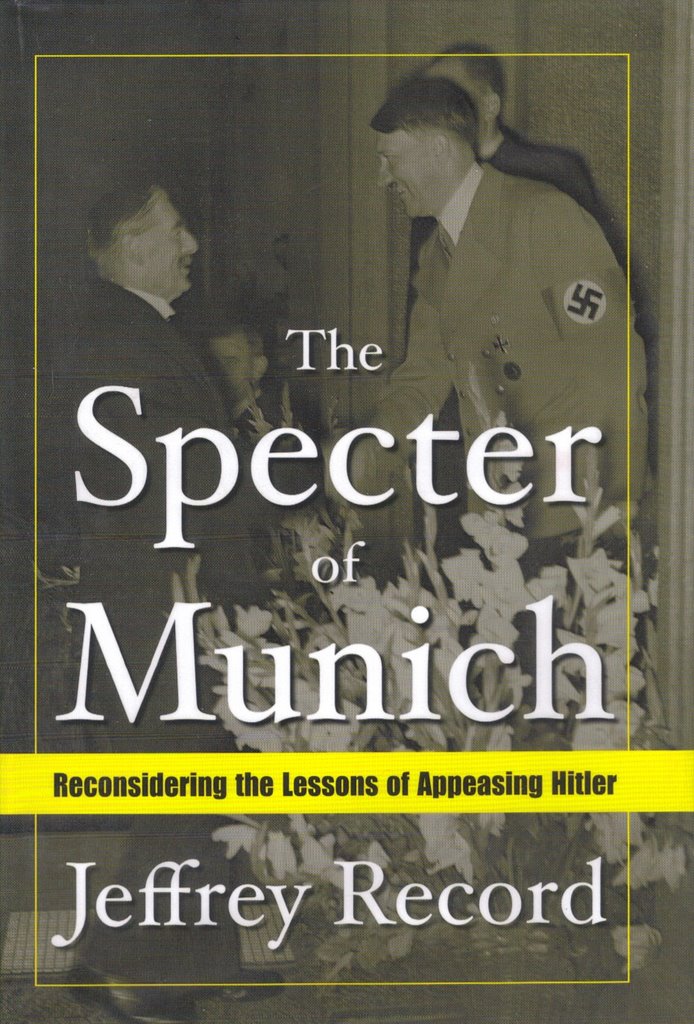
And for anyone who actually cares about the history of the Munich Conference and what real lessons sane people might learn from it, I can't recommend highly enough Jeffrey Record's The Specter of Munich: Reconsidering the Lessons of Appeasing Hitler (2007), which I reviewed on 01/02/07. It's a serious book but it's not that long and it's very accessible.

Most of the book's text is available online from the US Army's Strategic Studies Institute (SSI), Appeasement Reconsidered: Investigating the Mythology of the 1930s (Aug 2005).

The scary thing is, people like Dick Cheney and Rummy and the rest of Bush's crew actually make policies and invade countries based on thinking that's this disconnected from the actual experience of the past. Used in this way, the "lessons of Munich" just become a magic talisman to use against anyone who disagrees with your foreign policy of the moment.

Tags: , , , ,

Sunday, December 02, 2007

Far-right isolationism

Congressman Hamilton Fish, bitter opponent of Franklin Roosevelt's war-preparedness program and active enabler of far-right propagandists

Let me start this by saying as I've said in a number of posts before that most warnings about "isolationism" are fake, straw-man arguments. At least outside of Ron Paul's political corner, there are no actual isolationists in American politics. Categorizing these things by "schools" is tricky. But there are basically three broad categories of thinking on foreign policy which are dominant in actual policymaking: liberal internationalism (aka, Wilsonianism), realism, and neoconservatism/unilateralist nationalism.

I've linked some of my earlier posts on the whole appeasement issue in the 1930s at the end of this post. But I agree with Jeffrey Record of the Air War College that the appeasement/"Munich" analogy has been so overused and so overlaid with various flaky meanings that we're probably better off not using it any more. It leads to mindless threat inflation and false parallels.

The great Maverick McCain, who of course is a Very Serious Person, said during the Republican Presidential debate this past week, "We allowed Hitler to come to power with that kind of attitude of isolationism and appeasement." Invoking "appeasement" and "isolationism" as bogeymen has become so mindlessly routine that hardly anyone stops to notice how blatantly boneheaded such warnings often are. We allowed Hitler to come to power? The appeasement policy - it was actually called that, "appeasement" then being a synonym for concessions rather than a cuss word - was the policy pursued by France and England toward Germany when Hitler began his expansion beyond the limits allowed by Versailles Treaty, starting with the remilitarization of the Rhineland in 1936. The 1934 coup attempt in Austria was so badly bungled it didn't really count, although they did manage to murder the Austrian dictator Dollfuss.

But some of our press corps might want to ask the great Maverick how he would suggest the United States might have gone about preventing Hitler from coming to power in 1933. I took on the notion of preventive pre-regime change in More daffy history from Bush 11/01/07, including the difficulty of foreseeing Hitler coming to power at the time.

I came across a good description of Old Right isolationism that defines the strange conceptual world in which their "antiwar" stance is articulated. This goes back a ways. But Harry and Bonaro Overstreet in their 1964 book The Strange Tactics of Extremism described the weird worldview of the John Birch Society and others in their political niche in this way:

Here, we discover the key to the Birch Society's - and, more broadly, the Radical Right's - brand of anti-Communism. It is a brand that presents as unnecessary, or downright harmful, most of America's around-the-world activities and involvements. It is an anti-Communism which contends that, if it were not for treason and conspiracy in high places, we could, on our own - without the high costs of entangling alliances and big defense systems - make things happen as they ought to happen, all around the world. We could do so by pulling back out of the world, as it were, and simply cleaning up the mess in Washington. What we might need to do abroad, in military terms, could be done by a well-placed bomb or a regiment of Marines.

Communism's advance would be stopped in its tracks - so the argument runs - and Communist regimes would be toppled by the uprisings of suppressed peoples, if our government, direct by "Communist bosses," could be forced to stop underwriting Lenin's grand strategy with our tremendous resources of materials and know-how. (my emphasis)
If you listen carefully to what Ron Paul and similar isolationist rightwingers are saying, their brand of nationalism is coming from a very similar place. They want to discard normal diplomacy, foreign aid, even the threat of economic and trade sanctions from the set of foreign policy tools available to the United States. They are not far from the neocons in that essential focus. As the Overstreets described the perspective 43 years ago, "What we might need to do abroad, in military terms, could be done by a well-placed bomb or a regiment of Marines."

Is that so different from Ron Paul's response to Maria Bartiromo's question on how he would deal with a challenge to the United States from Iran if Iran should "turn hostile"? "I'd treat them something like what we did with the Soviets" during the Cuban Missile Crisis, he told her.

Here's an interview with isolationist author Jim Powell with Scott Horton of Antiwar.com Radio. (This is not the Scott Horton with with an Atlantic Harper's Online blog.) For those of us who actually pay attention to history and think it may have some importance, claims like Powell's are fingernails-on-the-blackboard difficult to listen to. He chirps away with the bonehead rightwing claim that the postwar inflation through 1923 was what brought Hitler to power in 1933. Hitler's NSDAP (Nazi Party) was competing in free elections during that time. It wasn't until the Great Depression of 1929 that their electoral strength became anything but minor. It's a stretch to argue that inflation had any direct effect on Hitler's rise to power. But lots of people just make this stuff up to suit their own ideology of the moment. It did crack me up to hear him talk about Hitler's "Beer Hall Pooch"; I think he meant "Beer Hall Putsch", the "put" part being pronounced like the English word "put". This is a clean-shaven version of Old Right isolationism, and so some individual points sound perfectly sensible. But it uses their standard alternative history. And the core of Old Right isolationism is radical unilateralism.

Fritz Kuhn, center, leader of the German-American Bund (1939)

Justin Raimondo gives an Old Right isolationist response to McCain's criticism of Ron Paul in McCain's Mangled Metaphor Antiwar.com 11/30/07. Although it might not be instantly apparent to the casual reader, he uses the same fingernails-on-blackboard version of German history that Jim Powell uses:

Hitler came to power not due to any "appeasement" by the Western powers, but because of World War I. He was elected by the German people ... due to resentment of the Treaty of Versailles, and the heavy burden of reparations which unleashed inflation such as the world had never seen on the German economy. This created the conditions under which German national socialism flourished – and when Hitler was installed in the German Chancellory, it was long past the time when anyone in Europe's capitals or in Washington could do anything about it.
Short version of response: Hitler came to power in January 1933through a backroom political deal with conservatives; the NSDAP had actually lost representation in the last parliamentary election before that. And while the NSDAP used legal and democratic methods, they also had effective goon squads that busted heads. The violent methods were particularly effective against the Center Party. So you can't say that the NSDAP came to power through purely democratic means.

The "inflation caused Nazism" is just such a beloved argument for conservatives I'm not sure actual history can ever dislodge it.

Yes, the punitive elements of the Versailles Treaty are generally recognized as a major element in the rise of rightwing parties like the NSDAP in the 1920s. But it's also true that the democratic Weimar governments (I would say semi-democratic from 1931-33) had already negotiated modifications in the most onerous provisions.

Some of my earlier posts touching on the appeasement policy of the 1930s:

The Munich Agreement 10/02/03 (one of my earliest blog posts)

Jeffrey Record on appeasement 10/16/06

Review of The Specter of Munich by Jeffrey Record 01/02/07

Historical analogies and the people who analogize them 05/01/07

Tags: , , , , , ,

Tuesday, January 02, 2007

Review of The Specter of Munich by Jeffrey Record


Jeffrey Record's The Specter of Munich: Reconsidering the Lessons of Appeasing Hitler (2007) is an expansion of his August 2005 paper for the US Army's Strategic Studies Institute (SSI), Appeasement Reconsidered: Investigating the Mythology of the 1930s. I reviewed that paper in October 2006. The Specter of Munich contains much the same material in the historical analysis of the appeasement policy of Britain and France. So I'll focus here more on the additional material in the book which applies some observations from his analysis to the current US situation, especially in the Iraq War.

As I described in more detail in the earlier review, Record makes clear that the appeasement policy was a disastrous strategic mistake. But that mistake is popularly understood today as a failure by Neville Chamberlain in a mano a mano testosterone face-off with Adolf Hitler at the Munich Conference in 1938. The popular understanding seems to have been shared by many senior policymakers in the decades since the Second World War. But, in fact, the mistakes in the appeasement policy were not primarily personality failings on the part of Chamberlain or of French Prime Minister Edouard Daladier.

For instance, France's foreign policy was based on a series of forward alliances with Czechoslovakia and Russia against Germany; but their military policy was a defensive one not suited to supporting allied nations in the east by attacking Germany if they came under German attack. Britain assumed that airpower would be decisive in the war but also had mistaken assumptions about the effectiveness of air power and also poor intelligence on actual German air power capabilities. Britain's policy was based on a widespread British belief that the Versailles Treaty that had ended the Great War (First World War) was excessively harsh on Germany, while France insisted on enforcement of the Versailles Treaty but doing so with a military strategy not suited to enforcing it. And this is only part of the list.

The main additions in the book compared to the paper have to do with how the lessons of appeasement from the 1930s have been applied to influence policy, and what more constructive lessons might be. For instance, in an expansion on the material at the end of p. 43 in the SSI paper, he writes of Richard "Prince of Darkness" Perle, generally referred to as the "leading" neoconservative:

Given the horrors of that war, initiation of a preventive war seems retrospectively imperative, and when neoconservatives such as Richard Perle speak about how Hitler could and should have been stopped before 1939, they mean via forcible regime change of precisely the kind the United States launched against Iraq in 2003. But it is here that the neoconservatives enter the fantasy realm of historical counterfactualism. For Britain and France in the 1930s, a decisive preventive war against Germany was morally unacceptable, politically impossible, and militarily infeasible. Rewriting history is always easier than writing it. If Chamberlain horribly misread Hitler, the neoconservative indictment of Chamberlain conveniently assumes that the option of preventive war against Germany was as available to London and Paris in 1938 as it was to the United States against Iraq in 2003.

The American experience in Iraq testifies to the perils inherent in forcible regime change, especially forcible regime change undertaken on the basis of rosy neoconservative assumptions about the degree of difficulty involved and without adequate preparation for the possibility of postregime violence and the challenges of national political and economic reconstruction. Yet one can speculate that the magnitude of the task of forcible regime change in Germany in, say, 1938 would have dwarfed that in Iraq today. Hitler was a genuinely popular leader within Germany, whereas Saddam Hussein was detested by all but the minority Sunni Arab population. Germany in 1938 had a burgeoning economy and a rapidly expanding and highly competitive military establishment, which could have been counted upon to offer much more formidable resistance than Saddam's sanction-crippled forces. An effective occupation and reconstruction of Germany would in any event have required far more manpower, resources, and time than the United States has been prepared to invest in Iraq. (my emphasis)
Record emphasizes repeatedly throughout the book that in evaluating the decisions made by British and French officials, we have to keep in mind that they didn't know they were making pre-Second World War decisions. They were trying to avoid a war.

The bulk of the additional material in the book come in the last two chapters, where he looks in particular at the lessons he would draw for the United States today from the appeasement experience of the 1930s. He formulates the major lessons he sees as follows:

* "Don't propitiate an insatiable great power dictator if you are in a position to pursue and alternative policy" - but rely on reality-based evaluations of when the opponent is "insatiable".

* "[T]hreat miscalculation can have severe penalties". The popular version of the "lessons of Munich" recognizes that underestimating threats can be dangerous. But part of the Anglo-French miscalculation in the 1930s was overestimating German air power - even neocon idol Winston Churchill did that.

* "[D]emocratic governments are constrained by public opinion", both in a policy of initating war and in sustaining public support in a protracted war. He expands on this as follows:

Leaders of democratic states must necessarily consider public opinion in making decisions to use (or not use) force. They can and do attempt to mobilize public opinion for war, but in the end they cannot readily march off to major war - or continue to sustain a policy of war - in the face of a hostile electorate. This is especially the case in wars of choice as opposed to wars of necessity. (my emphasis)
* Take account of "the risks inherent in discordance between foreign policy aims and military force posture".

* Be aware of the "dangers of strategic overextension". This can be done either by boosting the resources devoted to the strategic goals, or by scaling back on those goals (or of course some combination of the two). Clarity in the way a nation defines threats is an important component of this.

* It is important to maintain "a proper offensive-defensive balance".

* Maintain as much as possible "consistency in threatening and using force".

Record discusses these lessons extensively in the context of the Iraq War and the current assumptions of military "transformation", which has focused on developing more high-tech capabilities relying even more on air power. It could be argued that Record's usage of his "lessons of Munich" to frame his own criticisms of the Iraq War can lead to the same kind of reading current experiences back into one's evaluation of historical events.

It's certainly easy to fall into that. I would argue that Record does not do so in this case because he uses those broad lesson categories to examine aspects of our current situation in terms of realistic analysis of the current situation. Where American statecraft (which seems an awfully highfalutin word to apply to the cynical operations of the Cheney-Bush administration, I know) has so often gone wrong is to try to make every enemy we face be the new Adolf Hitler and every war as critical to American security as the confrontation over Czechoslovakia in 1938 proved to be for the world.

This is a rich chapter, almost any paragraph of which could be the basis of extensive discussion and debate. Here, I'll mention just a few. On the subject of threat miscalculation he writes:

War is the province of miscalculation. History is littered with wars arising from misperceived enemy intentions, capabilities, or both, and this reality seems endemic in the practice of statecraft. Just as Chamberlain misread Hitler's intentions in 1938, Hitler misread British intentions in 1939. In Korea in 1950, the Soviets misread the intentions of the Americans, who in turn misread the intentions (and capabilities) of the Chinese. In Vietnam, the United States overestimated its own capabilities and underestimated those of the Communists. And Saddam Hussein misread George H. W. Bush's intentions in the Persian Gulf in 1990-91, while the George W. Bush administration misread Saddam Hussein's capabilities as it approached America's second war against Iraq in 2003. Saddam certainly wanted deliverable weapons of mass destruction (WMD), but wanting is not the same thing as having.
On the mismatch between foreign and military policies:

The fatal misfit between France's foreign and defense policies finds no analog with the United States today. ...

That said, however, there is a discernible and growing disjoint between the kind of war the United States prepares to fight and the kinds of wars it has actually fought. To put it another way, U.S. military force posture is increasingly at odds with the emerging strategic environment. The United States remains focused on preparation for high-technology conventional warfare against other potential military peer competitors (most notably China), whereas the predominant threats to its security interests are rogue states, failed states, and nonstate unconventional adversaries practicing asymmetrical war. This new threat environment places a premium on preparation for operations other than war (OOTW)- that is, operations other than the big conventional force-on-force mission for which the U.S. military is optimized. Such operations include peace enforcement, counterinsurgency, stability, and state-building operations. Success in performing these operations is certainly essential to a foreign policy that embraces forcible regime change in places like Iraq and the muscular promotion of democracy in the Arab world and other regions of political autocracy and economic stagnation. (my emphasis)
He believes that the institutional resistance to shifting the focus of the US military from conventional war preparation to OOTW is extremely strong, especially in the Army: "Unfortunately, whatever the strength of the arguments for establishment of OOTW-dedicated ground forces (and there are serious arguments against), such forces stand little bureacratic chance of ever seeing the light of day."

But he doesn't use this as a shrug of the shoulders to say there's no point in worrying about changing it:

None of this is to argue that the Defense Department is hopelessly unadaptable to the deconventionalized global strategic environment — only that its force structural bias toward conventional combat is long standing and well entrenched and that overcoming that bias will entail fundamental changes in how U.S. military forces are organized, equipped, trained, and manned. For example, personnel policies that constantly rotate individuals from one assignment to another and promotion polices prejudiced against development of specialized area knowledge and linguistic skills are antithetical to the requirements of successful counterinsurgency. For another example, retention of division-level organizations makes little sense against decentralized, irregular adversaries. And what does the F/A-22 program [one of the Pentagon's most controversial] bring to the table in the fight against al Qaeda? (my emphasis)
Yes, Jeffrey Record, a professor at the US Air Force Air War College, is questioning the current policies of our infallible generals. Fortunately, these kinds of issues are discussed within the military, often more freely it seems than among our punditocracy. But maybe our punditocracy is a poor comparison to any kind of serious discussion of such matters.

And, on the question of realistic threat definition, he writes:

The argument that the war in Iraq serves as a magnet for terrorists that otherwise would be conducting attacks in the United States is not persuasive. The war certainly did not prevent the Madrid and London attacks. Iraqis are notable for their scarcity among the ranks of Islamic terrorists, and 90 to 95 percent of insurgents in Iraq are Iraqis radicalized by the dispossession of the Baathist regime and/or the U.S. invasion and occupation of their country. True, most suicide bombings in Iraq have been conducted by outsiders — mostly Saudis, Syrians, and Kuwaitis — but studies of suicide bombers in Iraq by the Saudi government and an Israeli think tank reveal that the great majority of them had never taken part in any terrorist activity before their arrival in Iraq but rather were radicalized by the Iraq War itself. They are part of a new generation of terrorists responding to calls by Osama bin Laden and radical Islamic clerics to defend their fellow Muslims from the "infidel crusaders" in Iraq. Notes terrorism expert Peter Bergen, "The president is right that Iraq is a main front in the war on terrorism, but this is a front we created." (my emphasis)
The final chapter includes a more extensive set of "observations and recommendations" than his SSI paper. He gives 11 of these, and here are his one-sentence summaries of them:

1. Nazi Germany remains without equal as a state threat.

2. American presidents should cease invocation of the Munich analogy to justiy threatened or actual uses of force.

3. Today's strategic environment bears little analogy to that of the 1930s.

4. Osama bin Laden and Adolf Hitler share key traits.

5. British and French security choices in the 1930s were neither simple nor obvious.

6. Hindsight is not 20/20 vision; it distorts.

7. The United States is poorly served by reliance on preventive war as a means of dealing with states it fears or simply does not like.

8. Political-military coordination is essential to effective statecraft, particularly in overseas state building.

9. The prevalence of operations other than warfare (OOTW) over conventional military operations in the post-Soviet world argues strongly for the creation of OOTW-dedicated U.S. military forces.

10. A significant increase in the size of U.S. ground forces is in order.

11. A new and comprehensive assessment of the state of U.S. homeland security is also in order.
While I'm generally in agreement with Record's analysis, I would oppose any increase in US ground forces until Congress conducts a real review of US foreign policy. If we don't have enough ground forces to enable a policy of preventive war to be implemented like Cheney and Bush did in Iraq, that is a good thing. If a shortage of soldiers prevents them from attacking Iran this year - which it should, though that's scarcely the only reason not to attack Iran - that is also a good thing. Force composition can never stop a reckless or criminal Executive from making bad decisions on use of force. But the current official foreign policy of the United States under the Bush Doctrine is one of preventive war. I'm opposed to adding any more ground forces as long as such a destructive and wrong strategic doctrine is official US policy.

I'll close with this quote from Record's elaboration of his second point in the concluding chapter, that Presidents should just stop using the Munich analogy to justify wars:

Robert Merry properly observes that the word "appeasement" carries "a lot of historical freight, given that for decades it has described the soft and accommodative policies of Britain's Neville Chamberlain toward Adolf Hitler in the 1930s. Thus it suggests that if we don't get tough with any particular regional power, we are going to have another Hitler on our hands." Merry also rightly warns, however, that "not every regional power with national ambitions constitutes a threat to world peace (although it might to American hegemony), and in fact policies based on that assumption are likely to be more destabilizing to peace than such countries themselves." As a strategic threat, Saddam Hussein was hardly Adolf Hitler. Indeed, if anything good can be said about Saddam Hussein, perhaps it is that he did not permit Iraq to degenerate into the world's primary recruiting and training ground for Islamic terrorism. (my emphasis)
Altogether, Record's book is a very worthwhile analysis of a major political and diplomatic turning point leading to the Second World War, and it contains some refreshing and sensible analysis about the Iraq War. It goes without saying that the current administration will ignore the latter. But Congress should pay attention to these kinds of criticisms.

Thursday, October 02, 2003

The Munich Agreement

Charlie Eklund at the The Other Shoe posted a brief note on the 1938 Munich Agreement. He suggests that the recent impasses in the Security Council over Iraq was comparable, and asks if France's Jacques Chirac was comparable to Daladier of that time.

Historical analogies are probably more often misleading than helpful. So I think it's important to try to understand these events on their own terms. Hitler had begun a major rearmament program essentially from his first day in office. In 1934, he backed a coup attempt in Austria by the Austrian Nazis. The Austrians resisted, but Mussolini's Italy also pledged to support Austria in a conflict with Germany. At the time, those things enough threat to induce Hitler to back off. In 1935, he had illegally moved the German army into the Rhineland in violation of his treaty obligations, and the French chose not to resist. In early 1938, he marched into Austria, whose internationally isolated, clerical-fascist regime chose not to resist.

Then Hitler began using his ethnic-German Fifth Column in Czechoslovakia to agitate against the alleged oppressions of the Czechoslovak government (not all of which were inventions of German propaganda). Hitler intended to seize the western area of Czechoslovakia, which among other things would give him a crucial boost in weapons-production capacity. At this point, the combined armies of the later anti-Hitler alliance in Europe were clearly stronger than Germany's. Czechoslovakia was a democracy and the government was ready to resist.

Stalin's Soviet Union offered to defend Czechoslovakia militarily if Britain and France would also agree to do so. Britain and France were not only concerned that the Soviets might have other motives than defending the territorial integrity of the Czechoslovak democracy, and their suspicions were probably well founded. But Chamberlain and Daladier also hoped that Germany and the USSR would balance off each other, or even go to war with each other and thereby weaken the two powers that most threatened to destabilize the established order in Europe.

Winston Churchill, no admirer of the Soviet regime, was a dissenter in Parliament on this whole issue. He correctly judged that Nazi Germany was a far greater threat to England at this time than the Soviets were and advocated cooperation with the Soviets to contain Germany.

Czechoslovakia was in no military position to resist alone. So they allowed the German army to enter their country and seize the territory Britain and France had agreed for them to give up. At this point, the USSR was left facing a Germany with a vastly expanded armaments industry that also had an improved geographical position to attack the USSR.

So Stalin made a deal to carve up Poland, not the first time in history Germany and Russia had done so. That brutal deal gave the USSR badly-needed time to build up its military and prepare for the German attack they knew would eventually come.

No easy or indisputable lessons for the present can be drawn from this. But one thing that strikes me is that the leaders of Britain and Germany let hope and ideology override a practical evaluation of the risks. Among other things, believing that the extreme ideological hostility of the Nazis and the Communists would prevent an alliance, the Western leaders put the USSR in an isolated position where they were at immediate risk of attack and defeat, forcing them into a radical course change in foreign policy.

It's also important to remember that Hitler's invasions of Austria, Czechoslovakia and Poland, the three major events that produced the Second World War, were wars of aggression. Germany attacked them without provocation and seized their countries. That experience very much shapes not only the theoretical thinking of European leaders, but their practical policies and their attitude toward international law.

Some may think that EU countries like France and Germany made the wrong judgment in the case of Iraq. But their understanding of the dangers of "aggressive war", as the crime of unprovoked invasion was called at the Nuremberg War Crimes Trials, very much shaped their response to Bush's Iraq War. And they continue to influence European concern about the risks - and legality - of the Bush Doctrine of preventive war.

Tags: , , ,