Showing posts with label second world war. Show all posts

Friday, October 09, 2015

The Great Patriotic War, still mostly the "unknown war" in the US

Robert Farley writes about the German-Soviet front of the Second World War in The Most Horrific War of All Time: Russia vs. Germany The National Interest 10/08/2015.

It is known in Russia as the Great Patriotic War. A jointly-made US-Soviet documentary during the detente years was called The Unknown War (1978) in its US release, The Great Patriotic War in the Soviet release. Burt Lancaster narrated the American version:


New York Times correspondent Harrison Salisbury did the English-language companion volume, The Unknown War (1978). The American title refers to the fact that the German's "eastern front," the war with the USSR, was little known in the US compared to the war in western Europe and the Pacific. That is still true today.

The script for the American version of the documentary reflects a sentimental view of the war. Salisbury's book conveys a more jaded Cold War version.

I'm not fond of sentimental histories. But understanding the sentiment and the propaganda are also part of understanding wars. And historical accounts also have to be read with a mind to the current and previous propaganda spins that might be reflected in them.

Farley sets the stage this way:

On June 22, 1941, the German Wehrmacht and Luftwaffe struck Soviet forces across a wide front along the German-Soviet frontier. Romanian forces attacked into Soviet-occupied Bessarabia on the same day. The Finnish armed forces joined the fight later that week, with Hungarian troops and aircraft entering combat at the beginning of July. By that time, a significant contribution of Italian troops was on its way to the Eastern Front. A Spanish volunteer division would eventually join the fight, along with large formations recruited from Soviet prisoners of war and from the local civilian population of occupied Soviet territories.

The course of the war is far too complicated to detail in this article. Suffice to say that the German enjoyed overwhelming success for the first five months of the war, before weather and stiffening Red Army resistance led to a Soviet victory in the Battle of Moscow. Germany resumed the offensive in 1942, only to suffer a major defeat at Stalingrad. The Battle of Kursk, in 1943, ended the Wehrmacht’s offensive ambitions. 1943, 1944, and 1945 saw the pace of Soviet conquest gradually accelerate, with the monumental offensives of late 1944 shattering the German armed forces. The war turned the Wehrmacht and the Red Army into finely honed fighting machines, while also draining both of equipment and manpower. The Soviets enjoyed the support of Western industry, while the Germans relied on the resources of occupied Europe.
That Battle of Kursk, by the way, was the largest tank battle in history. It took place in July and August, 1943. It was a massive German counterattack. The 2012 Encyclopædia Britannica Ultimate Reference Suite article on the battle describes it this way: "The Battle of Kursk was the largest tank battle in history, involving some 6,000 tanks, 2,000,000 troops, and 4,000 aircraft. It marked the decisive end of the German offensive capability on the Eastern Front and cleared the way for the great Soviet offensives of 1944–45."

It noteworthy that this was a summer battle. Something to keep in mind the next time you hear that it was the Russian winter that defeated the Germans on their eastern front.

The German invasion and occupation were gruesome business. The mass killing in the Holocaust began just after the invasion of the USSR. One of the horrifying aspects of the situation was that many Russian Jewish communities had regarded the treatment they had received from the Germans in occupied areas during the First World War as better than what they received from the Russians. So there were many cases in the Second World War of Russian Jews in contested areas fleeing to get behind German lines.

Salisbury wrote:

Hitler had incorporated into his Nazi ideology an old Neitszchian concept of the "superman." The superman in his definition was a German "aryan," blond, clean-cut, healthy, obedient. Hitler was waging war, he insisted, to provide lebensraum, living space, for this new breed of super-German. He proposed to clear the eastern spaces of untermenschen, that is, all subhuman species such as Russians, Ukranians, Poles, Jews, "Asiatics," etc., etc.

The German armies moved eastward with special orders, such as the "commissar" order under which every Communist official who was captured would automatically be shot. There was also the "kugel" order, a bullet in the head for any prisoner who attempted to escape or was believed to be thinking of escaping.

Under this philosophy millions of Russians, Jews and Poles died. There were six million Jewish victims in Europe including possibly two million in Russia. The Germans did not always bother with bullets or concentration camp furnaces. They simply starved their victims to death. The Germans captured about 5,754,000 Russian soldiers in the war. The number who survived' as prisoners of war was a little more than 1,000,000. That is, only one in five or six of the men and women who fell into German hands survived to the end of the war. (And, shameful to say, most survivors were sent straight from German prisoner camps to Soviet labor camps by Stalin.) Several million Russians were driven into Germany as forced labor. Probably half this total died of starvation and disease.

No one knows how many persons in Russia were killed by the Germans out of hand ... But there was no doubt that the number ran to millions.
It was very ugly stuff.

Farley gives this summary:

Towards the end of the war, the Soviets did their best to return the favor. Soviet depredations against the German civilian population of East and Central Europe do not generally received the same degree of attention as German actions, in no small part because of an enduring (if problematic) sense that the German deserved what they got. Other Eastern European populations were caught in the crossfire, suffering starvation and other depredations from both sides. Nevertheless, there is no question that the Soviets (and the peoples of Eastern Europe) suffered far more deeply from the war than the Germans.

The raw statistics of the war are nothing short of stunning. On the Soviet side, some seven million soldiers died in action, with another 3.6 million dying in German POW camps. The Germans lost four million soldiers in action, and another 370000 to the Soviet camp system. Some 600000 soldiers from other participants (mostly Eastern European) died as well. These numbers do not include soldiers lost on either side of the German-Polish War, or the Russo-Finnish War.

The civilian population of the territory in conflict suffered terribly from the war, in part because of the horrific occupation policies of the German (and the Soviets), and in part because of a lack of food and other necessities of life. Around 15 million Soviet civilians are thought to have been killed. Some three million ethnic Poles died (some before the German invasion of the Soviet Union, but many after) along with around three million Jews of Polish and another two million of Soviet citizenship (included in the Soviet statistics). Somewhere between 500000 and 2 million German civilians died in the expulsions that followed the war.

Thursday, April 16, 2015

Confederate "Heritage" Month 2015, April 16: Civil rights and the Second World War (2)

John Hope Franklin and Alfred Moss, Jr. in From Slavery to Freedom: A History of African Americans (8th edition; 2003) devote a chapter to African-Americans and the Second World War. They note that black Americans had taken a concerned interest in developments in Italy and Germany well before the war began.

African Americans watched events in other parts of the world with growing concern. When Italy invaded Ethiopia, they protested with all the means at their command. Almost overnight even the most provincial among black Americans became international-minded. Ethiopia was a black nation, and its destruction would symbolize the final victory of whites over blacks. In manyvcommunities funds were raised for the defense of the African kingdom, while in larger cities elaborate organizations were set up. In New York the International Council of Friends of Ethiopia was organized, with Willis N. Huggins as executive secretary. In 1935 Ethiopia Huggins pleaded for Ethiopia before the League of Nations. Other organizations, such as the United Aid to Ethiopia (later the Ethiopian World Federation), raised funds for the beleaguered African country. The Pittsburgh Courier sent its historian-news analyst, J. A. Rogers, to cover the war. Upon his return he issued a booklet, "The Real Facts about Ethiopia," and lectured to many black and white groups. (p. 476)

Henry Louis Gates, Jr. wrote about Joel Augustus Rogers in J. A. Rogers’ 100 Amazing Facts About the Negro The Root 10/15/2012. The article's title is taken from another of Rogers' books. Gates writes:

Rogers was soon launched on a path that would make him one of the leading black journalists of his generation. Rogers wrote regularly for the Pittsburgh Courier, the New York Amsterdam News, and the Chicago Defender, and he contributed several important essays to A. Philip Randolph's radical-socialist Messenger Magazine during the Harlem Renaissance. (He also wrote the only essay on that emerging art form called "jazz" in Alain Locke's seminal 1925 anthology The New Negro.) But the triumph of his career as a journalist, without a doubt, was his coverage of events in Ethiopia. The Courier sent Rogers -- the only African-American journalist on the ground -- there to cover the Italian occupation of Ethiopia (1935-1936), including an interview with Emperor Haile Selassie, whose coronation Rogers had also attended in 1930.
Haile Selassie, 1942:


Franklin and Moss expand on this prewar background:

African Americans were among the earliest and most energetic Americans to condemn the fascism that was rising in Europe. They quickly learned to hate Nazism and its Aryan doctrines. Some had read Hitler's Mein Kampf and had resented its unfavorable comments about blacks. It had been claimed, moreover, that in 1936 Hitler had refused to treat the African-American Olympic stars Jess Owens and Ralph Metcalfe with civility in Berlin. When Max Schmeling knocked out the black idol, Joe Louis, in 1936, African Americans had little to say for Hitlerism. Not until Louis gained complete revenge in 1938 could the average black speak of Nazis without a feeling of personal antagonism. By that time, however, public opinion in America was generally censuring Hitler's tactics in overthrowing Austria and dismembering Czechoslovakia, and African Americans joined in the loud condemnation. (p. 476)
Louis and Schmeling, 1936:

Wednesday, April 15, 2015

Confederate "Heritage" Month 2015: Civil rights and the Second World War (1)

DECEMBER 7, 1941:

When Dorie Miller took gun in hand-
Jim Crow started his last stand.
Our battle yet is far from won
But when it is, Jim Crow'll be done.
We gonna bury that son-of-a-gun!

- from "Jim Crow's Last Stand" (1943) by Langston Hughes
Doris (Dorie) Miller was a black Navy cook who received the Navy Cross for his bravery at Pearl Harbor. This recuiting poster featured him:


The experience of both blacks and white in the Second World War in the United States was a decisive moment in the fight for recognition of African-American civil rights.

Dennis Mitchell in his A New History of Mississippi (2014) writes about the effects of the war in my native state:

The infusion of federal funds revolutionized the state. The military buildup began with the New Deal alphabet agencies still in place, and for a brief period funds continued to flow from those agencies and the military. During the war, Mississippians doubled their per capita incomes ...

Relative economic prosperity mattered, but perhaps more important, Mississippians met new people, traveled the world, and encountered an infinite variety of cultures. More Yankees came to train at the state's thirty-six military bases than invaded the state during the Civil War. Many of them took Mississippi wives home with them, forging new ties of kinship across the country. Hundreds of thousands of Mississippians served in the armed forces dispersed to every conceivable corner of the globe, where they encountered cultures very different from their own. Japanese American soldiers trained in the state, befuddling the caste system, which usually recognized only black and white. Northern, city-raised black troops also trained in Mississippi, generating conflict and confusion. Mississippi women worked in factories building ships and manufacturing ammunition. They learned auto mechanics when the men got drafted. They acquired new skills, such as shopping. Traditionally, farm men went to the general store and brought home the family's few store-bought goods, often including the material the wife asked for to make a new dress. The war emancipated women and provided a new independence as well as loneliness at times. (p. 350) [my emphasis]
American Imago recently published the presentations of four psychoanalysts recalling their experiences in the Second World War at a 1995 conference ("Future Psychoanalysts and Memories of the Second World War" Vol. 72/1 Spring 2015).One of them, M. Donald Coleman, talked briefly about his encounters with racial and other kinds of diversity in the Army:

While exact figures are not available, much of the act of fighting — certainly by enlisted men — was done by those aged eighteen, nineteen, and twenty. In many units a man of twenty-six or twenty-eight was likely to find himself called “Dad.” Those few enlisted men thirty to thirty-four [years] were of an age that defied comprehension by most of us, and their preoccupation with writing long letters to wives and family was observed but barely understood emotionally.
The youth of the soldiers presumably made them relatively open to new experiences, although they may also have brought more simplistic stereotypes than some of those more senior thirtysomethings.

But before bonding could take place each unit had to sort itself out and test the true value of each member against stereotypes of rank, education, and ethnic, regional, or religious groupings. In this process there were often conflicts, sometimes physical fights, but once the true worth of an individual was established, good or bad, the old stereotypes were of little use. Intelligence, honor, capability or the lack of it were discovered to reside in individuals not the group. It was an eye opener for many big-city-bred soldiers to discover that high native intelligence could reside with a southern backwards farmer or for that farmer to be disabused of some of his big-city stereotypes. Others found that some highly educated men from socially elevated backgrounds didn’t seem as smart or dependable as poorly educated, ethnic Americans.
And he gives this example:

To give a concrete example: for the surgery department of a great Boston teaching hospital to tell those who had worked beside Captain Howard Schlossman and others like him in the field that we don’t want Jewish surgical residents because they are not team players became unacceptable to the experiences of the generations who had returned, and after several postwar years such contentions were heard no more.
Of course, this doesn't mean that whites who made an adjustment to a light-skinned Jewish surgeon would easily extend the same level of acceptance to working-class blacks. But it does mean that many whites North and South were forced to deal with a wider variety of people on more equal basis than they would have at home. Coleman says: "Millions of such discoveries were made, so many that those twelve million servicemen who returned to civilian life after the war shaped a very different America, where previous exclusions in professions and workplace were no longer tenable."

And he recognized the bitter irony of African-Americans fighting for a country that deprived many of them of the basic rights of citizens:

A significant group in every company were Americans whose ethnic or religious background had made them subject to a degree of discrimination and contempt now almost erased from our social memory. Black Americans served in segregated units - and for a nation which enforced their segregation. Yet, when faced with the danger to a way of life that was for so many a dream still unfolding, this generation chose the dream as something worthy of all they had — even their lives.
And a lot of those black soldiers came back expecting to see that "dream" unfold much faster than it had.

Tuesday, June 10, 2014

Shields and Bobo on Bergdahl and D-Day

As much grief as I give Bobo and Mark Shields for their weekly recitation of Very Serious Pundit wisdom on the PBS Newshour Political Wrap, Mark sometimes rouses himself from his normal state of semi-slumber to say something worth hearing. Especially when the topic is war.

He didn't manage it last Friday, though: Shields and Brooks on Bergdahl criticism, Mississippi primary politics 06/06/2014. He and Bobo agreed that though they could wait to pass judgment on Bowe Bergdahl and that President Obama deserved to be criticized because, well, because the Republicans were criticizing him. Apparently Obama should have realized the the Republicans were going to trash him for whatever he did or didn't do about Bergdahl and therefore should have done something different, even though the Reps would attack him no matter what he did. So it's his fault. Or something.


Jack Shafer has a good piece on what the public can reasonably assume from what's in the public record, Bowe Bergdahl's court-martial by the press Reuters 06/03/2014, and the situation doesn't seem to have changed much in the last few days. Bobo and Sleepy Mark should keep their snarky judgments over Bergdahl and their silly justification of the Republican clown show around it to themselves, unless they actually can come up with something useful to say.

After their nonsense on the Bergdahl case, I wasn't favorably inclined toward Sleepy Mark's boy's comic-book description of the D-Day landing and the Second World War generally:

On D-Day, it was reaching? It was. It was an incredible — it was an incredible act.

And I think what — it’s not simply the war. The war was remarkable, Judy, in that there was an equality of sacrifice. It was universal. We absolutely all were engaged, whether it was the rationing of meat or gasoline or cigarettes or alcohol or whatever.

One-third of all the vegetables and fruit in the United States were raised in victory gardens, 20 million victory gardens. The four president sons, all four served in combat in World War II. It’s back to Lyndon Johnson and Chuck Robb, his son-in-law, before we have even seen anybody in the president’s family in battle.

So that — that was part of it. The other thing was, we usually acknowledge individual acts of great bravery, the Medal of Honor, Navy Cross, Silver Star. This was thousands upon thousands of American — all an act of just incredible collective and individual courage, I mean, going and landing on that Normandy beach, 80 miles of open water, the armaments, Pointe du Hoc, all of it.

It was remarkable. And the unity of the country at the time is something that we can just treasure and just covet.
Our Pod Pundits still practice a kind of glorification of war that was outdated and destructive even before the First World War.

The unity of war that Sleepy Mark wants us to "just treasure and just covet" was a unity of anger, fear and hatred. And that unity and the deference to authority that came with it led the country to do and tolerate things it shouldn't have. Like the massive civilian casualties in the "strategic bombing" whose actual results in terms of measurable military advantage was far more meager that air force boosts claim even today. Like interning Japanese-Americans in concentration camps.

A unity based on anger, fear and hatred, and unity in war based on the goal of killing millions of foreigners, is not something to glorify or blab sentimental nonsense about. It's just not.

Yes, wars bring out some of the best and most inspiring aspects of people: courage, self-sacrifice, inventiveness. With the right kind of leadership, they can open up opportunities for a better peace, which is ultimately the only legitimate goal of war.

William James' famous 1910 essay, "The Moral Equivalent of War" focuses on this paradox, or contradiction if you prefer. It came out four years before the First World War broke out in Europe, the greatest carnage that humanity had so far managed to stage. It took another couple of decades to surpass it. But the later carnage created that sweet national unity that Sleepy Mark wants us to "just treasure and just covet."

James' essay is short but full of provocative observations. A critic of American imperialism during the Philippine War, James expresses the hope that humanity can one day do away with war, though it does note repeatedly describe it as a Utopian aspiration in that essay:

It would be simply preposterous if the only force that could work ideals of honour and standards of efficiency into English or American natures should be the fear of being killed by the Germans or the Japanese. Great indeed is Fear; but it is not, as our military enthusiasts believe and try to make us believe, the only stimulus known for awakening the higher ranges of men's spiritual energy.
President Carter invoked James' notion of a moral equivalent of war in support of his energy programs. In which hope he was soon disappointed, unfortunately.

Here is part of how James describes the virtues he wants to channel from military to constructive peaceful pursuits:

We must make new energies and hardihoods continue the manliness to which the military mind so faithfully clings. Martial virtues must be the enduring cement; intrepidity, contempt of softness, surrender of private interest, obedience to command, must still remain the rock upon which states arc built-unless, indeed, we wish for dangerous reactions against commonwealths fit only for contempt, and liable to invite attack whenever a centre of crystallization for military-minded enterprise gets formed anywhere in their neighborhood.

The war-party is assuredly right in affirming and reaffirming that the martial virtues, although originally gained by the race through war, are absolute and permanent human goods. Patriotic pride and ambition in their military form are, after all, only specifications of a more general competitive passion. They are its first form, but that is no reason for supposing them to be its last form. Men now are proud of belonging to a conquering nation, and without a murmur they lay down their persons and their wealth, if by so doing they may fend off subjection. But who can be sure that other aspects of one's country may not, with time and education and suggestion enough, come to be regarded with similarly effective feelings of pride and shame? Why should men not some day feel that it is worth a blood-tax to belong to a collectivity superior in any ideal respect? Why should they not blush with indignant shame if the community that owns them is vile in any way whatsoever?
James showed considerably more insight into the horrors of war and the problem of glorifying it that Sleepy Mark did last Friday when he wrote in his essay:

There is something highly paradoxical in the modern man's relation to war. Ask all our millions [in America], north and south, whether they would vote now (were such a thing possible) to have our war for the Union expunged from history, and the record of a peaceful transition to the present time substituted for that of its marches and battles, and probably hardly a handful of eccentrics would say yes. Those ancestors, those efforts, those memories and legends, are the most ideal part of what we now own together, a sacred spiritual possession worth more than all the blood poured out. Yet ask those same people whether they would be willing in cold blood to start another civil war now to gain another similar possession, and not one man or woman would vote for the proposition.
Tags: , ,

Saturday, September 07, 2013

Threat inflation with Syria

The problem with making the leader of every country we want to go to war with into "Hitler" is that it has produced threat inflation again and again, exaggerating the danger of country after country, none of which were "Hitler."

Robert Fisk does a memorable takedown of the "Hitler" meme in a column mocking the shallow clichés being used to drum up support for a US attack on Syria, a country that has not attacked the United States (This bombardment of Syria with clichés shows no sign of stopping Independent 09/05/2013):

And then yet once more – how tired can you get of this mulch? – Kerry also felt he could compare Assad to Hitler. This is preposterous. Over a hundred thousand Syrians may well have died in this terrible war. But Hitler started a war that may have killed 70 million. Does Kerry maybe think that Hitler is still alive? The late Israeli prime minister Menachem Begin thought that when he fantasized in a letter to Ronnie Reagan when he was invading Lebanon in 1982 that he felt he was advancing on Berlin (Arafat was the man in the bunker). And not long ago the now Israeli Prime Minister Benjamin Netanyahu told us all that the crackpot president of Iran (Mahmoud Ahmedinejad at the time) was "worse than Hitler". So let’s have it just one more time: HITLER IS DEAD.
Tags: , , , , , , , ,

Monday, September 02, 2013

Finally, Bashar al-Assad is officially our new "Hitler"

Secretary of State John Kerry said Sunday that Syrian President Bashar Assad has taken a dubious place in history, noting the regime's alleged use of chemical weapons against civilians outside Damascus on Aug. 21.

"Bashar al-Assad now joins the list of Adolf Hitler and Saddam Hussein who have used these weapons in time of war," Kerry said on NBC's "Meet the Press."
- from Nick Gass, Kerry: Case against Assad the same Politico 09/01/2013

Of course! The US never goes to war against anybody but "Hitler."

Never mind that the thing that made Hitler "Hitler" was that he was an enemy that couldn't be appeased or deterred in his aims for external aggression, and was in command of the world's most powerful military (after Germany took over the Skoda arms works in Czechoslovakia that were ceded at the Munich Conference).

Syria's government is none of those things. So, other than everything that made Hitler "Hitler", I guess we could say that Bashar al-Assad is "Hitler" too.

One of my most popular posts here has been Jeffrey Record on appeasement 10/16/2013. It discusses a paper by Jeffrey Record in which he warns about the dangers of making every potential opponent into Hitler:

The problem with seeing Hitler in Stalin, Mao Zedong, Ho Chi Minh, and Saddam Hussein is that it reinforces the presidential tendency since 1945 to overstate threats for the purpose of rallying public and congressional opinion, and overstated threats in turn encourage resort to force in circumstances where deterrence, containment, even negotiation (from strength) might better serve long-term U.S. security interests. Threats that are, in fact, limited tend to be portrayed in Manichaean terms, thus skewing the policy choice toward military action, a policy choice hardly constrained by possession of global conventional military primacy and an inadequate understanding of the limits of that primacy.

If the 1930s reveal the danger of underestimating a security threat, the post-World War II decades contain examples of the danger of overestimating a security threat.
See also my posts, Review of The Specter of Munich by Jeffrey Record:


"Munich", "Munich", go away! 05/15/2008

Review of Making War, Thinking History by Jeffrey Record 11/18/2006:


No more "appeasement" 07/23/2008, which looks at Record's article, Retiring Hitler and "Appeasement" from the National Security Debate Parameters (Summer 2008), in which he says:

It is high time to retire Adolf Hitler and "appeasement" from the national security debate. The repeated analogizing of current threats to the menace of Hitler in the 1930s, and comparing diplomatic efforts to Anglo-French placating of the Nazi dictator, has spoiled the true meaning of appeasement, distorted sound thinking regarding national security challenges and responses, and falsified history. For the past six decades every President except Jimmy Carter has routinely invoked the Munich analogy as a means of inflating national security threats and demonizing dictators. Presidents and their spokespersons have not only believed the analogy but also used it to mobilize public opinion for war. After all, if the enemy really is another Hitler, then force becomes mandatory, and the sooner it is used the better. More recently, neoconservatives and their allies in government have branded as appeasers any and all proponents of using nonviolent conflict resolution to negotiate with hostile dictatorships. For neoconservatives, to appease is to be naïve, cowardly, and soft on the threat du jour, be it terrorism, a rogue state, or a rising great power. To appease is to be a Chamberlain rather than a Churchill, to comprise with evil rather than slay it. ...

If the 1930s reveal the danger of underestimating a security threat, the post-World War II decades and post-9/11 years contain examples of the danger of overestimating such threats. [my emphasis]
Tags: , , , , , , ,

Monday, July 22, 2013

FDR, the Second World War and the Holocaust (Updated)

Laurence Zuckerman looks at US policy during the Second World War on the Holocaust in FDR's Jewish Problem The Nation 07/172013. He describes the problem he's addressing as follows:

No matter the evidence to the contrary, it has become received wisdom among many American Jews that Roosevelt deliberately and coldly abandoned Europe’s Jews in their hour of need.

This marks a dramatic reversal in the image of a president who won more than 80 percent of the Jewish vote in all four of his successful campaigns, who surrounded himself with Jewish advisers and was portrayed by Hitler's propagandists as Jewish (and not in a good way). Roosevelt brought thousands of Jewish professionals into government, prevented Hitler from overrunning Britain and Palestine (thus saving their large Jewish populations), chose to fight Germany first after the United States was attacked by Japan, and paved the way for New York’s first Jewish governor and senator.

Presidential scholars have consistently ranked Roosevelt as the best chief executive in the nation’s history for his handling of the Great Depression and World War II. But even among liberal Jews who still hold him in high regard for those achievements, his reputation has been tarnished as he has been viewed increasingly through the prism of the Holocaust. What started out in the late 1960s as legitimate historical revisionism — looking critically at what the Roosevelt administration and American Jewry did during the Holocaust — has morphed into caricature, with FDR often depicted as an unfeeling anti-Semite.

This is a complex topic with many aspects. But the basic reality of the situation was that once Germany occupied Poland and then eastern Russia, the only thing that could have stopped his systematic killing of Europe's Jews was the defeat of Germany by the UN Allies (the US, Britain, the USSR). And that's the reality around which US policy rotated.

The notion that the Roosevelt Administration and the US cynically abandoned the Jews of Europe to destruction or that they were indifferent to their fate is, for the most part, bad revisionist history. Even the more careful versions I've seen are unconvincing.

As Zuckerman explains, the historian Rafael Medoff is the current contemporary exponent of this particular brand of revisionism. And he explains that the current controversy goes back to a faction of the Zionist movement led by Peter Bergson and its criticism of mainstream Zionist leaders in the US:

In reality, Bergson is a minor figure in the history of the Holocaust. The accomplishments claimed by his champions are disputed by reputable historians, and the lessons of his actions are unclear. Born Hillel Kook, Bergson came to New York from Palestine in 1940 at the age of 25 as the representative of right-wing Revisionist Zionism, the bitter rival of the more mainstream leftist Labor Zionism and the antecedent to Israel's ruling Likud party of today. After news of the Holocaust was officially made public in November 1942, Bergson and his colleagues took out full-page ads in The New York Times assailing Roosevelt and demanding that he do more to save the Jews. They put on a pageant featuring Hollywood stars called "We Will Never Die." And they organized a 1943 march on the White House by 400 Orthodox rabbis.

Bergson clashed with mainstream American Jewish leaders, most notably Rabbi Stephen Wise, a dedicated liberal social activist and pillar of American Jewry, whose many posts included leader of the US Zionist movement. Wise was close to FDR and regarded Bergson’s attacks on the president as politically reckless. Like many American Jews at the time, Wise saw Roosevelt as an ally—an implacable foe of Hitler and a bulwark against American anti-Semitism, which was not insignificant in the 1930s and ’40s. Republican alternatives to FDR were not anywhere near as attractive. Wise was also active behind the scenes, lobbying the president to allow more refugees into the United States and to pressure the British to allow more into Palestine. (Wise’s disagreement with Bergson was magnified by the fact that they represented competing Zionist factions, a bitter rivalry that has for decades fueled attacks on mainstream Zionism both in Israel and the United States for its handling of the Holocaust.)
And just as superficial history of the Munich Agreement has become a stock slogan for war, so the myth of American collaboration in the Holocaust is being put to work as a contemporary slogan for war:

The stakes of this historical debate are high, because the myths that have been propagated about the actions of the United States during the Holocaust are being put to specific political uses today. In a speech to the American Israel Public Affairs Committee last year, Israeli Prime Minister Benjamin Netanyahu cited the failure of the Roosevelt administration to bomb Auschwitz to support the case for an attack on Iran. "They say that a military confrontation with Iran would undermine the efforts already under way, that it would be ineffective, and that it would provoke even more vindictive action by Iran," Netanyahu said. "I've heard these arguments before. In fact, I've read them before." He then quoted from an exchange of letters in which the US War Department said that bombing Auschwitz "would be of such doubtful efficacy that it would not warrant the use of our resources."
Zuckerman himself gives an example of an action that in retrospect might have saved more Jewish lives if it had been taken earlier, the creation of the War Refugee Board (WRB):

... when Henry Morgenthau Jr., the president's good friend and treasury secretary, confronted him with evidence that the State Department was blocking rescue efforts, the president immediately signed off on the idea of the WRB and issued an executive order creating it.

In other words, the Bergson Group's biggest feat [in the claims of some of its admirers] is something that President Roosevelt created. He should have done it earlier and it could have been more effective, but doesn't he deserve some of the credit for the 200,000 Jewish lives the WRB saved? [my emphasis]
But to give an idea of the complexity of these arguments, William J. vanden Heuvel in a 1996 speech, America, Franklin D. Roosevelt and the Holocaust, talked about the WRB:

The War Refugee Board was created in January, 1944, by President Roosevelt immediately upon presentation of the case for doing so by Henry Morgenthau. There were thousands of refugees stranded on the outer peripheries of Nazi Europe. With the invasion of Italy in 1943, thousands more sought safety in camps in the south. Tito's success in Yugoslavia enabled many to escape from Croat fascism and Serb hatred. But these were refugees who were already saved. These were not escapees from the Death Camps. Under pressure from Roosevelt and Churchill, Spain kept open its frontiers, stating as its policy that "all refugees without exception would be allowed to enter and remain." Probably more than 40,000 refugees, many of them Jewish, found safe sanctuary in Spain. Makeshift transit camps in Spain, Portugal, Italy, and North Africa housed them in abysmal conditions. Those who fought for these refugees to come to America were right to do so. I have been part of the International Rescue Committee all of my adult life and have worked with refugees in Berlin, Hungary, Angola, Hong Kong, Vietnam, Cuba and Cambodia. Refugees are generally powerless and voiceless. Governments have to be reminded constantly of our humanitarian responsibilities. But perhaps the allied nations can be forgiven in the midst of a war for survival for not doing more for refugees whose lives had already been saved. Perhaps not. In remembering what we did not do, perhaps we can measure our response to today's tragedies and ask whether we--now the richest, most powerful nation in history--have responded adequately to the "ethnic cleansing" of Bosnia, to the genocide in Rwanda, to the Killing Field of Cambodia. [my emphasis]
In other words, Vanden Heuvel's presentation, which makes basically the same argument that Laurence Zuckerman against the position of historians like historian David Wyman have taken, blaming FDR for "the abandonment of the Jews," in the title of Wyman's famous work, points out that the WRB's work can scarcely be credited with saving Jews from the Holocaust. But he doesn't present that as cynicism or sinful inaction on FDR's part. Rather, he's looking at the factual record of which refugees it was with whom the WRB dealt. Getting history right can be complicated. And trying to ram it into easy slogans is usually done at the expense of history, rather than at the expense of the slogan.

Tom Segev's book The Seventh Million: The Israelis and the Holocaust (1993) deals at some length with some of the potential rescue options. William Rubinstein also lookos at the rescue claims in The Myth of Rescue: Why the Democracies Could Not Have Saved More Jews from the Nazis (1997), whose title reflects his skeptical conclusion.

The Wilson Quarterly (21/4-Autumn 1997) in an unsigned review of Rubinstein's book writes:

Before World War II, Nazi policy was to expel as many Jews as possible, not to kill them. The claim by Wyman and other critics that the West erected "almost insuperable barriers" to their emigration while "'there was still time,'" Rubinstein says, is belied by the facts: 72 percent of Germany's Jews, and an even higher percentage of Jewish children, "managed to flee before this became impossible [in late 1940], one of the greatest rescues of any beleaguered group in history." After Kristallnacht in November 1938 made it obvious that Jews had no future in Adolf Hitler's Germany, no new Western barriers .to Jewish immigration were raised, he notes. "On the contrary, more Jews left Germany in 1939 than in any other year." Britain radically liberalized its immigration policies for their benefit. ...

Wyman and others have indicted the Allies for failing to bomb the gas chambers and crematoriums at Auschwitz. That possibility was widely discussed by Jewish leaders and British and American officials in the summer of 1944, notes [Richard] Levy, a retired aeronautical engineer, in an extensive analysis of the controversy ["The Bombing of Auschwitz Revisited: A Critical Analysis," Holocaust and Genocide Studies Winter 1996]. Only the heavy bombers of the U.S. 15th Air Force, based in Italy, were capable of striking at Auschwitz, and the targets, including underground gas chambers, would have required very heavy bombing. The raids could well have failed to destroy all the gas chambers, would have impinged on the war effort, and probably would have killed or wounded thousands of the Jewish inmates. That would have given the Germans a pretext for blaming the deaths at Auschwitz on Allied bombing. For these reasons, Leon Kubowitzki of the World Jewish Congress in New York and David Ben-Gurion of the Israeli "government-in-embryo" in Palestine opposed the idea at the time. Writes Rubinstein: "Only. by winning the war as quickly as possible, and destroying the Nazi scourge, could the surviving Jews of Europe be liberated."
Tags: ,

Thursday, March 14, 2013

Britain and the post-Second World War plans for Europe

I think watching The Americans has given me a real case of Cold War nostalgia.


Fraser Harbutt in his diplomatic history of Second World War diplomacy among the US, Britain and the USSR, Yalta 1945: Europe and America at the Crossroads (2010) examines the wartime diplomacy that ultimately issued into the Cold War, whatever the intentions of the participants. Harbutt emphasizes the intra-European dimension of wartime negotiations over the shape of the postwar Europe, of which the British-Soviet relationship was the most important. As he describes it, he traces "the basic distinction ... between an autonomous European political arena (where Stalin could rely for practical cooperation upon his preferred association with Britain) and the very different American polity, with its introspective and effusively moralistic political culture." (p. 134)

He points out that Churchill's own accounts of wartime diplomacy and those of his admirerers have "done much to give it an East/West cast," at the expense of recognizing the often ruthlessly pragmatic approach to postwar questions in which the Soviet Union and Britain both indulged. He writes:

All this needs some radical qualification. It is of course true that Churchill was the dominating figure in Britain's wartime affairs. But he was decidedly more "European" than "Anglo-American" in his approach to the war's international politics. It is also true that he made a great show throughout the war of fidelity to the ideal of Anglo-American fraternity. It is not at all clear, however, how deeply felt or sincere this was. It is often overlooked that Churchill had throughout his long public life exhibited a lively apprehension of American hegemonial ambitions. And, as we have just seen, he saw Europe as his "primary concern." It seems likely, on the whole, that the taproot of his wartime commitment to the Anglo-American alliance was British necessity and self-interest rather than the transatlantic romanticism that often bubbles effervescently in World War ll's memoir literature. The fact is that British necessity during the war required the United States for survival and then for the maintenance of its war effort. It also needed the Soviet Union for victory and postwar political tranquility. Churchill behaved accordingly. [my emphasis]
Tags: ,

Thursday, June 07, 2012

Germany and Greece, not always a happy interaction: Second World War edition

New York Times reporter A. C. (Alexander Cameron) Sedgwick in "The Plot Against Greece" Foreign Affairs 3/1948 (Apr) reported on the costs imposed by Germany on Greece during the Second World War, when there imposition was considerably worse than that of Germany Chancellor Angela Merkel currently:

On October 28, 1940, Italy attacked Greece and was defeated in the mountains of Albania. The following April, Germany invaded, with Bulgaria as an accomplice. Greece resisted, and paid for valor. The price list follows, in part, as officially given: war losses, 30,000 killed; dead through famine, 360,000; executed by Germans and Italians, 43,000; executed by Bulgarians, 25,000; hostages, 45,000; homeless, 1,200,000; towns, villages ruined, 3,700. By the end of the war the Greek population was reduced by 7 percent. All that was left of the Greek Army that had beaten Italy were a few battalions mustered in the Middle East. The navy was destroyed, but sailors fought on in ships provided by the British. The air force was also destroyed, but airmen likewise fought in British planes.

On the economic side, inflation scientifically planned by the Germans ruined the monetary system. In 1939 the national wealth and national income were reckoned to be $3.4 billion and $510,400,000 respectively. In 1944 they were estimated at $1,456,000,000 and $217,600,000. The damage to the industrial plant is estimated at $40,000,000. The Greek merchant marine, which ranked ninth in the world with a total of 1,697,986 tons and was the main source of the nation's foreign exchange, was almost completely wiped out; over a million tons were sent to the bottom. Rolling stock, too, was almost totally destroyed; and 60 percent of the railroad tracks, 60 percent of the telephones, 75 percent of the telegraph wires and installations were wrecked. All big bridges and tunnels, which can be replaced only at tremendous cost, were utterly demolished, and 60 percent of the roads were rendered impassable by demolition. Harbor installations were destroyed in toto. [my emphasis in bold]
So when some Greeks have grumped that the Germans owed them reparations for the damage of the Second World War, some of them probably aren't kidding.

Tags: ,

Friday, July 15, 2011

John Steinbeck on war and the Second World War (3 of 3)

John Steinbeck's Introduction to his Second World War articles collected in Once There Was A War (1958) has a number of comments about vain and pompous officers, thieving soldiers, and carousing war correspondents. And one of the refreshing things about it is that Steinbeck holds up some of the standard clicheés of the time about the military and asks the reader to see them for what they were.

This is a great one, from his discussion of the habits that came to dominate war reporting:

Meanwhile strange conventional stories were born and duly reported. One of the oddest concerned the colonel or general in the Air Force whose duty required that he stay in reluctant comfort on the ground and who ate his heart out to be with his "boys" out on mission over Germany among the red flak. It was hard, stern duty that kept him grounded, and much harder than flying missions. I don't know where this one started, but it doesn't sound as though it came from enlisted personnel. I never met a bomber crew which wouldn't have taken on this sterner duty at the drop of a hat. They may have been a little wild, but they weren't that crazy.
He lists some of the standard conventions they followed:

There were no cowards in the American Army, and of all the brave men the private in the infantry was the braavest and noblest. The reaon for this in terms of the War Effort is obvious. The infantry private had the dirtiest, weariest, least rewarding job in the whole war. In addition to being dangerous and dirty, a great many of the things he had to do were stupid. He must therefore be reassured that these things he knew to be stupid were actually necessary and wise, and that he was a hero for doing them.
A second convention was that we had no cruel or ambitious or ignorant commanders.
A third sternly held rule was that five million perfectly normal, young, energetic, and concupiscient men and boys had for the period of the War Effort put aside their habitual preoccupation with girls.
On the latter point, he add mischievously:

When Army Supply ordered X millions of rubber contraceptive and disease-preventing items, it had to be explained that they were used to keep moisture out of machine-gun barrels - and perhaps they did.
And he summarizes the gloomy result of obsession with secrecy combined with unrealistic images of the military and the realities of war:

Since our Army and Navy, like all armies and navies, were composed of the good, the bad, the beautiful, the ugly, the cruel, the gentle, the brutal, the kindly, the strong, and the weak, this convention of general nobility might seem to have been a little hard to maintain, but it was not. We were all a part of the War Effort. We went along with it, and not only that, we abetted it. Gradually it became a part of all of us that the truth about anything was automatically secret and that to trifle with it was to interfere with the War Effort. By this I don't mean that the correspondents were liars. They were not. In the pieces in this book everything set down happened. It is in the things not mentioned that the untruth lies.
And it was this unreal quality in the reporting that for Steinbeck gave them a fairy-tale, once-upon-a-time quality re-reading them years later. Or, as he puts it, "Once upon a time there was a war, but so long ago and so shouldered out of the way by other wars and other kinds of wars that even people who were there are apt to forget."

And unlike our Keyboard Commandos today, Steinbeck hasn't forgotten that if war is sometimes a necessary evil, it is still an evil:

Perhaps it is right or even necessary to forget accidents, and wars are surely accidents to which our species seems prone. If we could learn from our accidents it might be well to keep the memories alive, but we do not learn. In ancient Greece it was said that there had to be a war at least every twenty years because every generation of men had to know what it was like. With us, we must forget, or we could never indulge in the murderous nonsense again.
Tags: , ,

John Steinbeck on war and the Second World War (2 of 3)

John Steinbeck's Introduction to his Second World War articles collected in Once There Was A War (1958) has a number of worthwhile observations about the idiocies of war, not least of which are the effects of censorship. He tells this anecdote:

Navy censors were particularly sensitive to names of places, whether they had any military importance or not. It was the safest way. Once when I felt a little bruised by censorship I sent through Herodotus's account of the the battle of Salamis fought between the Greeks and Persians in 480 B.C., and since there were place names involved, albeit classical ones, the Navy censors killed the whole story.
Steinbeck talks about how official censorship interacted with self-censorship on the part of reporters themselves:

We edited ourselves much more than we were edited. We felt responsible to what was called the home front. There was a general feeling that unless the home front was carefully protected from the whole account of what war was like, it might panic. Also we felt we had to protect the armed services from criticism, or they might retire to their tents to sulk like Achilles.
And he describes the larger environment of which this attitude was part, resulting in various things not being reported:

That they were not reported was partly a matter of orders, partly traditional, and largely because there was a huge and gassy thing called the War Effort. Anything which interfered with or ran counter to the War Effort was automatically bad. To a large extent judgment about this was in the hands of the correspondent himself, but if he forgot himself and broke any of the rules, there were the Censors, the Military Command, the Newspapers, and finally, most strong of all in discipline, there were the war-minded civilians, the Noncombatant Commandos of the Stork Club, of Time Magazine and The New Yorker, to jerk a correspondent into line or suggest that he be removed from the area as a danger to the War Effort. There were citizens' groups helping with tactics and logistics; there were organizations of mothers to oversee morals, and by morals I mean not only sexual morals but also such things as gambling and helling around in general.
The Noncombatant Commandos of the last decade were better known as the Keyboard Commandos. That, at least, changed since the Good War. And The New Yorker in recent years has been running pieces by Seymour Hersh, providing some of the best critical reporting we've had. That has changed for the better since seven decades ago.

What he has to say about secrecy is unfortunately very current:

Secrecy was a whole field in itself. Perhaps our whole miasmic hysteria about secrecy for the last twenty years had its birth during this period. Our obsession with secrecy had a perfectly legitimate beginning in a fear that knowledge of troop-ship sailings would and often did attract the wolf packs of submarines. But from there it got out of hand until finally facts available in any library in the world came to be carefully guarded secrets, and the most carefully guarded secrets were known by everyone.
He gives a couple of examples of how dysfunctional the secrecy could get:

When General Patton slapped a sick soldier in a hospital and when our Navy at Gela shot down fifty-nine of our own troop carriers, General Eisenhower personally asked the war correspondents not to send the stories because they would be bad for morale at home. And the correspondents did not file the stories. Of course the War Department leaked to a local newsman and the stories got printed anyway, but no one in the field contributed to that bit of treason to the War Effort.
It's worth noting that these two public revelations did no damage to the war effort of the time. If anything, the public revelation of the Navy's deadly "friendly fire" mistake surely created pressure on them to be sure to shoot at the enemy and not at American troops.

Tags: , ,

Thursday, July 14, 2011

John Steinbeck on war and the Second World War (1 of 3)

John Steinbeck published a collection of his newspaper articles as a war correspondent during the Second World War under the title Once There Was a War (1958). The title reflects the position he takes in the Introduction, in which he looks back on the war as though it were a kind of fairy tale or dream.

But not a dream of the Good War, as it is now revered in the general American culture. Steinbeck understood the war and its purposes. He wasn't taking some isolationist position that the US should not have been part of the war. Nor was he arguing that the war aims weren't good or that the defeat of Hitler Germany and militarist Japan were unworthy results.

What he means is more like the following. I first read this Introduction years ago. And re-reading it now, I was surprised at how I found something on almost every page that I remembered and that made a particular impression on me. But this portion, which gives a sense of the title, is what stuck with me the most:

For what they are worth, or for what they may recapture, here they are, period pieces, fairy tales, half-meaningless memories of a time and of attitudes which have gone forever from the world, a sad and jocular recording of a little part of a war I saw and do not believe, unreal with trumped-up pageantry, so that it stand in the mind like the battle pictures of Crécy and Bunker Hill and Gettysburg. And, although all war is a symptom of man's failure as a thinking animal, still there was in these memory-wars some gallantry, some bravery, some kindliness. A man got killed, surely, or maimed, but, living, he did not carry crippled seed as a gift to his children.

Now for many years we have suckled on fear and fear alone, and there is no good product of fear. Its children are cruelty and deceit and suspicion germinating in our darkness. And just as surely as we are poisoning the air with our test bombs, so are we poisoned in our souls by fear, faceless, stupid sarcomic terror. [my emphasis]
Biologists and anthropologists would quarrel with a literal assertion that fear produces "no good product." After all, the famous fight-or-flight reaction presumably offered humanity some comparative advantage over millennia of natural selection. (By "sarcomic," Steinbeck apparently meant "cancerous."

But the kind of generalized, sometimes hysterical fear of the early Cold War period about which he was commenting in 1958 does yield the kinds of results Steinbeck describes, "Its children are cruelty and deceit and suspicion germinating in our darkness."

And Steinbeck was writing in 1958, ten years into the Cold War if we count the Communist coup in Czechoslovakia and the Berlin blockade in 1948 as the beginning of the Cold War. The Cold War continued for over three more decades. And for the last decade, the United States has largely "suckled on fear" during the War on Terror. Only this time the bogeyman that justified multiple "small wars" and Cold War levels of military spending was not the nuclear-armed Soviet superpower but small band of Islamic terrorists known as Al Qa'ida. Our new Secretary of Defense, Leon Panetta, says there are only 20 or so of them left. But the security establishment and its wars continue to function as if they were every bit the menace that many Americans imagined the Communist world to be in 1958.

This kind of generalized fear is corrosive to democracy. Fortunately, not everyone has been afraid all the time during the Long War that encompassed the the Cold War and the War on Terror. Which is why democracy in some ways has also thrived and expanded during that period. But the long-term trend isn't encouraging. And in recent years the corrosion of democracy and the rule of law has been severe. From Bush v. Gore to Guantánamo to a Democratic President opposing Social Security and Medicare and embracing plutocratic economics, the trend has been bad.

Tags: , ,

Tuesday, December 07, 2010

The Pearl Harbor attack


Franklin Rossevelt 12/08/1941:


The text of FDR's Pearl Harbor Speech to Congress 12/08/1941.

James Tate, The Lost Pilot presented by Robert Pinsky PBS Newshour 12/07/1998, a poem commemorating the attack.

Judith Greer, Dive-bombing FDR Salon 06/14/2001 debunks the endless Roosevelt-planned-it revisionism, which became a founding mythology for the conservative movement.

Tags: ,

Sunday, September 06, 2009

Beginning of the Second World War, 70 years ago


Hitler arrives in Warsaw after the city falls

Zach Roth of TPM Muckraker reports, MSNBC Promoting Buchanan's Hitler-Sympathizing Column 09/03/09. The column in question was posted at Did Hitler want war? 09/01/09 but MSNBC subsequently removed it. It's also published on the WorldNutDaily site and at the rightwing isolationist-run Antiwar.com.

It's no news that Pat Buchanan is something of an admirer of Hitler Germany. He just recently published a book blaming Winston Churchill for the war. It's more interesting to me that he's a reflection of the far-right isolationist viewpoint that is, at bottom, another face of the more common manifestations of Republican unilateralism in foreign policy and xenophobia in immigration policy. For a comment specifically on that column of Buchanan's, see Just how crazy is Pat Buchanan? by Ethan Porter True/Slant 09/02/09. Here are some reality-based alternatives to Pat Buchanan's Second World War revisionism.

The more common Republican narrative of the Second World War is an American triumphalist one. We beat the bad buys, liberated Germany and Japan and a bunch of other countries, and that shows we're The Greatest Country In The World. The Democrats to a large extent embrace that narrative of the war as well, though subsequent smaller wars have tempered the enthusiasm of many Democrats for triumphalist rhetoric about war. Despite a mountain of books and films pitched especially to aging baby-boomers about the Second World War, I have to wonder how many Americans could make a good stab at explaining why Buchanan's fanciful version of the beginning of the Second World War is so frivolous, beyond just dismissing it (accurately) as pro-Nazi-Germany.

The Munich Süddeutsche Zeitung, less editorially friendly to pro-Hitler falsifications of history than WorldNutDaily or MSNBC, featured several article around the 70th anniversary of the German invasion of Poland on September 1, 1939 including: Täter und Opfer: Kriegsbeginn vor 70 Jahren 02.09.2009 von Sonja Zekri; Putin verurteilt Hitler-Stalin-Pakt: Streit um Kriegsschuld 31.08.2009; Es hat gefunkt: Zweiter Weltkrieg von Oliver Storz 30.08.2009; Eine schmerzhafte Wunde: 70 Jahre Hitler-Stalin-Pakt 23.08.2009 - Interview mit Stefan Troebst; Der Weg in den Krieg: 70 Jahre Hitler-Stalin-Pakt 27.08.2009.

Lots of people seem to have the notion that Adolf Hitler layed out his exact plans in his prison memoirs, Mein Kampf. Actually, Hitler was very flexible about goals and tactics except for two things. Throughout his political career, he kept twoo goals firmly in mind: invading Russia, and killing off the Jews. Everything else was flexible. Even when Germany was clearly losing the war and the German armies were being pushed back across Eastern Europe, Hitler diverted military supplies to keep the death camps like Auschwitz in operation. Killing as many Jews as possible was more a priority to him that saving his supposed precious fatherland (he normally called it motherland) from the barbaric Eastern hordes the Soviet armies were said to be. (Factual note: real instances of Soviet barbarism were not completely absent.)

Hitler's territorial aggressions up through 1938 in the Rheinland, Austria and the Czech areas with large ethnic German populations (Bohemia and Moravia) were aimed at uniting what Hitler saw as legitimate parts of the German Empire (Reich). The seizure of the remaining rump of Czechoslovakia in early 1939 didn't fit that category, though. In any case, Hitler's main territorial goal was the conquest of Russia, under the pretence of needed "living space" (Lebensraum) for the German people. The seizure of Poland - and not just the former German territories of Poland - was a necessary step along that path. He also planned for the Poles to be reduced to the status of a servant race, to be displaced at will by German colonization. Seizing Poland also gave him access to Polish Jews, who far outnumbered German Jews, most of whom had emigrated by 1939.

The infamous Munich Agreement of 1938, which has been reduced to the crudest brand of the "lessons of Munich" in American political speech, was a key turning point for more reasons than one. (For the neocons, the only meaningful "lesson of Munich" is that negotiating with a potential enemy is in itself a sign of insufficient testosterone.) It gave Germany control of the enormous Skoda arms works in Czechoslovakia, which enabled Germany to quickly expand its own already fast-growing armaments at a more rapid rate. It convinced the Soviets that the Western powers were aiming to promote a war between Germany and Russia from which the West would stand aloof. And it led Hitler to assume that Britain and France would not be willing to go to war over their ally Poland.

Signing of the German-Soviet Nonaggression Pact, August 24, 1939: Stalin in the rear middle, German Foreign Minister Von Ribbentrop rear left, Soviet Foreign Minister Molotov in front signing document

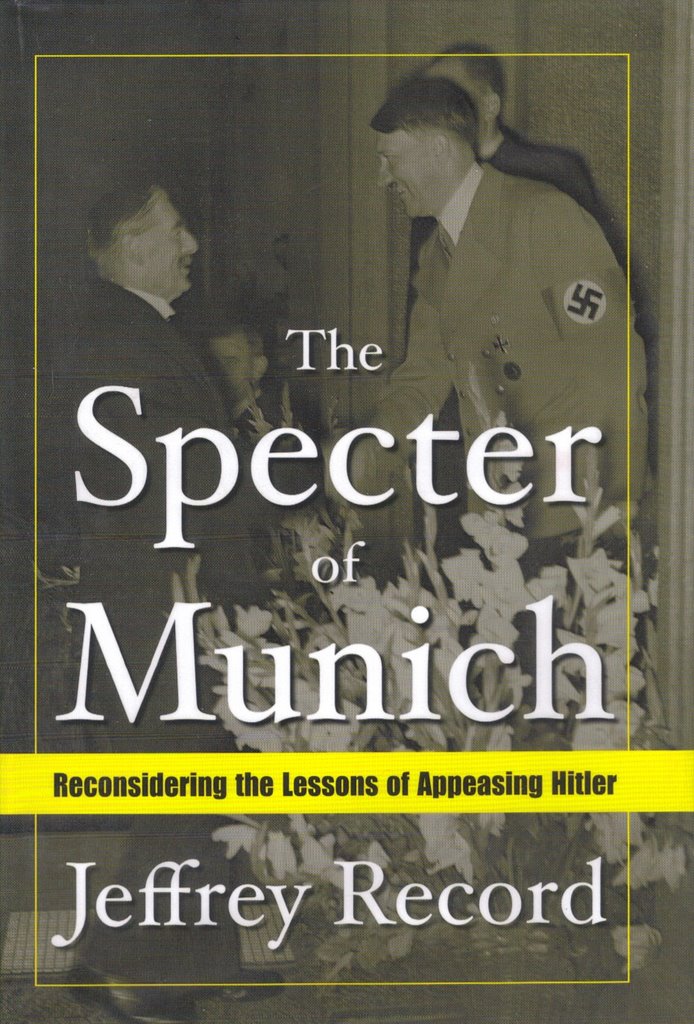
The Soviet Union had sought an alliance with the Western powers to contain Germany. When Britain and France refused to go to war together with the USSR over Czechoslovakia, the Soviet leadership concluded that the Western powers were encouraging Germany to attack the USSR. They weren't entirely wrong in that assumption. But, as Jeffrey Record of the US Army Air War College details in his The Specter of Munich: Reconsidering the Lessons of Appeasing Hitler (2007), there were many reasons that Britain and France pursued the policy that made "appeasement" into a diplomatic dirty word; at the time "appeasement" simply meant "concession." At the moment of the Munich Agreement, Britain and France had a strictly defensive military policy that did not match their policy of alliances with Czechoslovakia and Poland to restrict German expansion. That situation was a result of the broader diplomatic strategy of appeasement, for which Record - who argues that the appeasement itself was a disaster - gives the following reasons:

  1. The exceptionally traumatic experience of the Great War of 1914-18, now known as the First World War.
  2. A major misjudgment of "the nature of the Nazi regime and Hitler's strategic ambitions".
  3. France's inflexibility in military policy, more particularly its rigid conviction that in no circumstances should it initiate an attack on a major power and its lack of military capacity to do so (it was scarcely so scrupulous with colonies) - in this regard France's allowing Germany to re-ccupy the Rhineland in 1936 was "an irreperable blow to French prestige".
  4. British strategic overreach with its worldwide empire, which among other things created incentives for Britain to avoid European war - "Britain's mainfest strategic overstretch was a major factor in Hitelr's judgment of British willingness to use force against him."
  5. France's strategic dependence on Britain.
  6. Misgivings especially in Britain over the mistakes of the Versailles Treaty that ended the Great War, among them being rejection of the principle of self-determination for Germans in Austria and the Sudentenland (in Czechoslovakia); as noted above, up until the seizure of rump Czechoslovakia in early 1939, Hitler Germany's military conquests could be seen as efforts to reunite the core German lands and population.
  7. Overestimation of the power of strategic bombing and overestimation of Germany's air force capacity (thanks in no small part to the reports of Hitler's admirer Charles Lindberg); such threat inflation is scarcely unknown today, and not just in the Iraq War - it was a chronic feature of American Cold War policies.
  8. Public opinion in Britain and France was opposed to war; neither the publics nor the governments were looking for excuses to go to war, they were trying to avoid another European war, in itself an healthy instinct.
  9. American isolationism, which minimized American involvement in European power politics.
  10. Fear of Communism and the USSR.
Record's description of the military logic of an alliance between the Western powers and Soviet Russia against Hitler prior to the Munich Agreement provides important background to the German-Soviet Nonagreession Pact signed August 24, 1939, aka, the Hitler-Stalin Pact, the Molotov-Ribbentrop Pact after the foreign ministers, the Nazi-Soviet Nonaggression Pact. Record writes:

The last but by no means least factor contributing to appeasement was distrust of the Soviet Union and fear of Communism. The alternative to appeasement of Hitler in the 1930s was the formation of the kind of grand alliance that crushed Nazi Germany 1945. This alternative, however, was never more than theoretical until Hitler invaded the Soviet Union in June 1941 and declared war on the United States the following December. Domestic politics precluded war or military alliance with threatened states in Europe as voluntary policy choices for the United States. But this was not the case for the Soviet Union, which Hitler both reviled and targeted for German racial expansion. Stalin clearly understood Nazi Germany for the deadly foe it was, and in 1934 the Soviet Union entered an alliance with France as a means of checking German expansionism. Russia and France had been close allies against Imperial Germany, and the Soviet Union in the 1930s constituted the only great power east of Germany. It fielded the largest standing army in Europe and possessed war production potential second only to that of the United States. The same logic that underlay the Anglo-French-Russian alliance of World War I against Imperial Germany applied to stopping Hitler from plunging Europe into another world war, and this logic should have been glaringly apparent after Hitler removed any doubt over his trustworthiness and territorial intentions by invading what remained of Czechoslovakia after Munich.
With the possibility of an alliance with the Western powers against Germany removed, Stalin decided to cut his own deal with Hitler in order to buy time and acquire additional territory. It was a ruthlessly pragmatic deal. George Kennan once commented that the Nazi Germany and Soviet Russia had for years been pursuing foreign policies much in the spirit of Chicago gangsters. (For a stalwart of the Realist school of foreign policy thought like Kennan, that wasn't necessarily a criticism!)

The Nonaggression Pact had a secret protocol that essentially carved up Poland between Germany and the USSR, along with other German concessions to the Soviets in the Baltics and other parts of eastern Europe. Strenthened substantially by access to the massive Skoda arms works and free of immediate worry of a Soviet-Western alliance against Germany, Hitler invaded Poland on September 1, nine days after the Nonaggression Pact was signed.

Germany did go through the motions of claiming that Poland attacked them first. They took some Polish prisoners in German jails, dressed them up in Polish army uniforms and shot them. They left their bodies on the ground near a border radio station to "document" their claim that Polish troops had attacked the radio station on German soil. No one fooled. Germany had been carrying on a campaign over access to the city of Danzig, a German port city that lay within Poland, and over the alleged horrible persecution of ethnic Germans in Poland. In an interesting footnote, the Polish uniforms for the staged attack at the radio station had been provided by a Sudeten German businessman who sometimes did task for German intelligence named Oskar Schindler. Schindler would later develop a very different relationship to the goals of the Nazi regime.

Today, as Sonja Zekri writes, "Im Osten Europas ... ist die Geschichte virulent wie kaum anderswo." (In eastern Europe, history is virulent as hardly anywhere else.) Russian President Vladimir Putin took part in ceremonies in Danzig, Poland, this past week commemorating the beginning of the war and explicitly denounced the Hitler-Stalin Pact. But that followed a period of polemics between the present-day Russian government and the Poland over the question of who's guilty for the beginning of the war. The Russian government in recent years has put renewed emphasis in its role in the Great Patriotic War (their name for the Second World War) as a matter of historic pride and national legitimation.

Putin's statement on the Molotov-Ribbentrop Pact explicitly recalled an official statement from 1989 under the Soviet government of Michael Gorbachov condemning the "immoral character" of the treaty, so this position is not new. But Putin's latest affirmation of it was responding to current diplomatic pressures, as well.

But along with his condemnation of his own country's role, he also repeated the reproach against Western governments over the Munich Agreement for trying to turn Hitler's aggression eastward.

Putin also acknowledged the Polish outrage over the Katyn Massacre of 1940, in which the Russians murdered around 15,000 Polish officers and for decades blamed it on the Germans.

Tags: , , ,

Saturday, August 02, 2008

Rightwing revisionism on the Second World War

Pat Buchanan did an interview on 07/23/08 with Scott Horton of Antiwar Radio, in which he gives a pro-Hitler-Germany "revisionist" version of the beginning of the Second World War.

I won't try to refute his points here. But I will mention four books that address the history that Buchanan blatantly distorts and provide reality-based versions of events. Jeffrey Record's The Specter of Munich: Reconsidering the Lessons of Appeasing Hitler (2007) discusses the European political situation in 1938 and the outlooks of the various international players. This gives a non-Goebbels version that contrasts dramatically with Buchanan's. I keep citing that Jeffrey Record book because it's just plain good on several levels.

Much of the material is available online in Record's August 2005 paper for the US Army's Strategic Studies Institute (SSI), Appeasement Reconsidered: Investigating the Mythology of the 1930s. He also deals with a subject in the current Summer 2008 issue of Parameters, Retiring Hitler and "Appeasement" from the National Security Debate.

Starting around 26:00 in the interview, Buchanan offers his own version of Holocaust revisionism, which turns on a pure propagandistic discussion of the initial phase of the mass killing in 1941 and makes the Wannsee Conference into a key turning point in initiating the Final Solution, as distinct from organizing and implementing it. Christopher Browning's The Path to Genocide: Essays on Launching the Final Solution (1992) addresses the origins of that event. On the timing of the decision-making, the chapter, "Beyond 'Intentionalism' and 'Functionalism': The Decision for the Final Solution Reconsidered", is particularly useful on dating the decision-making process. (More recent documentation has further strengthened the base timeline he lays out.)

Gaming the timing of the original decision on initiating the Holocaust is a favorite trick of Holocaust deniers. In fact, I heard Browning say in a public lecture a number of years ago that it was David Irving's frivolous claim that Hitler didn't know about the Holocaust that spurred real scholars to pinpoint more precisely what they could definitively say about that decision point.

Any good history of the Holocaust would also show how Buchanan's characterization of German policies in the conquered territories (including Austria) is ludicrously benign. Raul Hilberg's The Destruction of the European Jews, originally published in 1961 and revised in a 1985 edition, is one of many such good histories.

On the question of Hitler's long-range intentions on both the killing of the Jews and on the need for Lebensraum (living space), Hitlers Weltanschauung by Eberhard Jäckel, originally published in German in 1969, has become a classic. Those two goals, gaining Lebensraum in "the east" (Russia) and removing the Jews from Europe, were the two key goals to which Hitler held throughout his political career. Buchanan denies that the Lebensraum concept was important to Hitler's foreign policy, and at least calls into question the intensity of Hitler's hostility toward Jews. His arguments on both are ridiculous.

Two essays by Jäckel in English addressing those topics are available online: Refutation of the absurd thesis that "Hitler Is innocent in the murder of Europe's Jews" and Once More: Irving, Hitler and the Murder of the Jews. The copyright date shown at the Table of Contents page is 1993.

(The display of those essays at the cited links is a bit confusing; you have to select "Next" after the end of the text to go to the next page. The first essays has six pages, the second only one, which immediately follows the first essay.)

Tags: ,

Thursday, May 15, 2008

"Munich", "Munich", go away!


The "Munich analogy" is itself becoming an analogy of history degraded to slogans and then degraded to even more mindless slogans, producing an all-too-real threat inflation that causes all-too-real problems.

Our Dear Leader Bush was addressing the Israeli Knesset (Parliament) on Thursday and he used the Munich analogy to criticize Obama; he didn't mention Obama by name, but the White House made it clear that he was one of the appeasers referenced. But I want to note before getting to more specifics that Dear Leader was so off-base on this one that it actually drove Chris Matthews, yes, that Chris Matthews, into acting like a real journalist for several consecutive minutes! It was that bad.

Dear Leader said:

"Some seem to believe that we should negotiate with the terrorists and radicals, as if some ingenious argument will persuade them they have been wrong all along."

"We have heard this foolish delusion before," Bush said. "As Nazi tanks crossed into Poland in 1939, an American senator declared: 'Lord, if I could only have talked to Hitler, all this might have been avoided.' We have an obligation to call this what it is - the false comfort of appeasement, which has been repeatedly discredited by history."
Obama fired back immediately. Joe Lieberman agreed with Dear Leader. And that bold, independent Maverick McCain ... agreed with Bush 100%. (See quotes below.)

The Munich analogy as it has become embedded in the American political vocabulary over the decades has usually been used to refer to backing down unwisely in the face of a military aggressor. Bush's usage today is a neocon version that takes it into a further step of deterioration: "appeasement" in his Knesset speech means even negotiating with a potential enemy.

Wasn't it the neocons political god Winston Churchill who said on that topic the "jaw, jaw" is better than "war, war"? John Kennedy's famous line - "Let us never negotiate out of fear. But let us never fear to negotiate." - doesn't sound like cowardly shirking of duty to me. It sounds more like plain common sense.

But in CheneyWorld, we've gone from "Munich" being a bad deal (the more-or-less reality-based version) to a cowardly backing down from a dangerous aggressor (the threat-inflation version) to the problem having been the whole idea of even attempting to use diplomacy to avoid war. If it keeps going down this path, "Munich" will eventually mean the cowardly failure to invade and occupy Germany in 1921 or so when Hitler's political career was just getting started. Even with Bush's version, any attempt to seriously apply historical lessons from the "Munich" experience of 1938 has evaporated into the air.

Sen. Joe Biden, Chair of the Senate Foreign Relations Committee, called Bush's comment "bulls**t". A perfectly sober analysis, I would say.

Chris Matthews is the walking embodiment of what is wrong with our sad excuse for a press corps these days. But credit where credit is due. He at least pinned down some fool rightwing radio ranter named Kevin James on what he knew about "Munich". And the guy didn't know squat. Enjoy the show in text and video at Chris Matthews Stumps Right-Wing Radio Host: ‘Tell Me What Chamberlain Did?’ ‘I Don’t Know’ ThinkProgress.org 05/15/08.

Let's not go overboard. Since this Kevin James guy has a head so empty that even OxyContin probably isn't in there, Matthews looked like a well-informed guy by contrast. But even in those unaccustomed moments of committing an act of journalism, he was a little shaky on some details. He didn't seem to know much about William Borah (rightwing isolationist Senator who actually admired Hitler), who Dear Leader referenced in his Knesset speech. And he was kind of shaky on whether the Munich Conference was in 1938 or 1939. (It was 1938.)

See: 'Appeasement' remark by Bush sets off political fray by Johanna Neuman Los Angeles Times Online 05/15/08

McCain: Bush ‘Exactly Right’ On ‘Appeasement’ Remark, Praises Reagan’s Handling Of Iran Hostage Crisis ThinkProgress.org 05/15/08. The bold Maverick even had the gall to say:

Yes, there have been appeasers in the past, and the president is exactly right, and one of them is Neville Chamberlain. I believe that it’s not an accident that our hostages came home from Iran when President Reagan was president of the United States. He didn’t sit down in a negotiation with the religious extremists in Iran, he made it very clear that those hostages were coming home.
What a shameless bunch of hooey! Leave aside for the moment Reagan's arms-for-hostages deal that Ollie North and his boys ran for him that became infamous as the Iran-Contra scandal.

There's a substantial body of mostly circumstantial evidence, circumstantial but very persuasive in an historical sense, that the Reagan campaign did negotiate with Iran behind the backs of the Carter administration in 1980 to delay the release of the hostages until after the 1980 election. Yes, I know that conventional wisdom considers this "October surprise" story to be a silly conspiracy theory.

But I'm one of maybe ten people in the US who believes that it was Oswald in the book depository with the rifle in 1963. Single assassin. And I'm probably the only person alive who doesn't believe Jack Kennedy and Marilyn Monroe had an affair (though I'm willing to concede there's evidence for a one-night stand that could convince a reasonable person). Which is not evidence of any kind for the October surprise. But I'm just saying.

Gary Sick laid out the evidence in his 1991 book October Surprise: America's Hostages in Iran and the Election of Ronald Reagan. Robert Perry reported on his own two-year investigation of the story in Trick or Treason: The October Surprise Mystery (1993). Sick's book provoked the Democratic-controlled Congress into a desultory investigation, which concluded with no thorough digging into the story. But the investigations did produce some additional information, as Perry reports in his account.

It's too bad the investigation wasn't pressed much more seriously. One of the key players in the October Surprise story, for instance, was Laurence Silverman, who went on to become a federal judge who played a disreputable role in the Whitewater witch-hunt against the Clintons in the 1990s.

The Congressional investigations drug on into 1992. But this was the year the Establishment press went off the cliff with the Whitewater story. We were entering a new era of press malfunction. The Republicans in Congress belligerently opposed the investigation. The press poo-poohed the evidence. And the Dems finally gave it up.

Now, the Maverick can say, "He didn’t sit down in a negotiation with the religious extremists in Iran, he made it very clear that those hostages were coming home."

Will any of the Great American's Hannah Montana fan-boys and -girls in the press dig into what a ditzy statement that is? Hell could freeze over tomorrow, too. Life is full of surprises.

Joe Lieberman has really become a sad case, as we see in Lieberman On Bush Comparing Democrats To Nazi-Appeasers: 'The President Got It Exactly Right' ThinkProgress.org 05/15/08:

President Bush got it exactly right today when he warned about the threat of Iran and its terrorist proxies like Hamas and Hezbollah. It is imperative that we reject the flawed and naïve thinking that denies or dismisses the words of extremists and terrorists when they shout "Death to America" and “Death to Israel,” and that holds that — if only we were to sit down and negotiate with these killers — they would cease to threaten us. It is critical to our national security that our commander-in-chief is able to distinguish between America’s friends and America’s enemies, and not confuse the two.
This viewpoint doesn't see diplomacy as even part of foreign policy in dealing with potentially hostile states or groups. Foreign policy without diplomacy is not really foreign policy, it's just straight-up militarism. War and the threat of war are the only tools in that toolbox.

And for anyone who actually cares about the history of the Munich Conference and what real lessons sane people might learn from it, I can't recommend highly enough Jeffrey Record's The Specter of Munich: Reconsidering the Lessons of Appeasing Hitler (2007), which I reviewed on 01/02/07. It's a serious book but it's not that long and it's very accessible.

Most of the book's text is available online from the US Army's Strategic Studies Institute (SSI), Appeasement Reconsidered: Investigating the Mythology of the 1930s (Aug 2005).

The scary thing is, people like Dick Cheney and Rummy and the rest of Bush's crew actually make policies and invade countries based on thinking that's this disconnected from the actual experience of the past. Used in this way, the "lessons of Munich" just become a magic talisman to use against anyone who disagrees with your foreign policy of the moment.

Tags: , , , ,