Showing posts with label world war two. Show all posts

Thursday, May 15, 2008

"Munich", "Munich", go away!


The "Munich analogy" is itself becoming an analogy of history degraded to slogans and then degraded to even more mindless slogans, producing an all-too-real threat inflation that causes all-too-real problems.

Our Dear Leader Bush was addressing the Israeli Knesset (Parliament) on Thursday and he used the Munich analogy to criticize Obama; he didn't mention Obama by name, but the White House made it clear that he was one of the appeasers referenced. But I want to note before getting to more specifics that Dear Leader was so off-base on this one that it actually drove Chris Matthews, yes, that Chris Matthews, into acting like a real journalist for several consecutive minutes! It was that bad.

Dear Leader said:

"Some seem to believe that we should negotiate with the terrorists and radicals, as if some ingenious argument will persuade them they have been wrong all along."

"We have heard this foolish delusion before," Bush said. "As Nazi tanks crossed into Poland in 1939, an American senator declared: 'Lord, if I could only have talked to Hitler, all this might have been avoided.' We have an obligation to call this what it is - the false comfort of appeasement, which has been repeatedly discredited by history."
Obama fired back immediately. Joe Lieberman agreed with Dear Leader. And that bold, independent Maverick McCain ... agreed with Bush 100%. (See quotes below.)

The Munich analogy as it has become embedded in the American political vocabulary over the decades has usually been used to refer to backing down unwisely in the face of a military aggressor. Bush's usage today is a neocon version that takes it into a further step of deterioration: "appeasement" in his Knesset speech means even negotiating with a potential enemy.

Wasn't it the neocons political god Winston Churchill who said on that topic the "jaw, jaw" is better than "war, war"? John Kennedy's famous line - "Let us never negotiate out of fear. But let us never fear to negotiate." - doesn't sound like cowardly shirking of duty to me. It sounds more like plain common sense.

But in CheneyWorld, we've gone from "Munich" being a bad deal (the more-or-less reality-based version) to a cowardly backing down from a dangerous aggressor (the threat-inflation version) to the problem having been the whole idea of even attempting to use diplomacy to avoid war. If it keeps going down this path, "Munich" will eventually mean the cowardly failure to invade and occupy Germany in 1921 or so when Hitler's political career was just getting started. Even with Bush's version, any attempt to seriously apply historical lessons from the "Munich" experience of 1938 has evaporated into the air.

Sen. Joe Biden, Chair of the Senate Foreign Relations Committee, called Bush's comment "bulls**t". A perfectly sober analysis, I would say.

Chris Matthews is the walking embodiment of what is wrong with our sad excuse for a press corps these days. But credit where credit is due. He at least pinned down some fool rightwing radio ranter named Kevin James on what he knew about "Munich". And the guy didn't know squat. Enjoy the show in text and video at Chris Matthews Stumps Right-Wing Radio Host: ‘Tell Me What Chamberlain Did?’ ‘I Don’t Know’ ThinkProgress.org 05/15/08.

Let's not go overboard. Since this Kevin James guy has a head so empty that even OxyContin probably isn't in there, Matthews looked like a well-informed guy by contrast. But even in those unaccustomed moments of committing an act of journalism, he was a little shaky on some details. He didn't seem to know much about William Borah (rightwing isolationist Senator who actually admired Hitler), who Dear Leader referenced in his Knesset speech. And he was kind of shaky on whether the Munich Conference was in 1938 or 1939. (It was 1938.)

See: 'Appeasement' remark by Bush sets off political fray by Johanna Neuman Los Angeles Times Online 05/15/08

McCain: Bush ‘Exactly Right’ On ‘Appeasement’ Remark, Praises Reagan’s Handling Of Iran Hostage Crisis ThinkProgress.org 05/15/08. The bold Maverick even had the gall to say:

Yes, there have been appeasers in the past, and the president is exactly right, and one of them is Neville Chamberlain. I believe that it’s not an accident that our hostages came home from Iran when President Reagan was president of the United States. He didn’t sit down in a negotiation with the religious extremists in Iran, he made it very clear that those hostages were coming home.
What a shameless bunch of hooey! Leave aside for the moment Reagan's arms-for-hostages deal that Ollie North and his boys ran for him that became infamous as the Iran-Contra scandal.

There's a substantial body of mostly circumstantial evidence, circumstantial but very persuasive in an historical sense, that the Reagan campaign did negotiate with Iran behind the backs of the Carter administration in 1980 to delay the release of the hostages until after the 1980 election. Yes, I know that conventional wisdom considers this "October surprise" story to be a silly conspiracy theory.

But I'm one of maybe ten people in the US who believes that it was Oswald in the book depository with the rifle in 1963. Single assassin. And I'm probably the only person alive who doesn't believe Jack Kennedy and Marilyn Monroe had an affair (though I'm willing to concede there's evidence for a one-night stand that could convince a reasonable person). Which is not evidence of any kind for the October surprise. But I'm just saying.

Gary Sick laid out the evidence in his 1991 book October Surprise: America's Hostages in Iran and the Election of Ronald Reagan. Robert Perry reported on his own two-year investigation of the story in Trick or Treason: The October Surprise Mystery (1993). Sick's book provoked the Democratic-controlled Congress into a desultory investigation, which concluded with no thorough digging into the story. But the investigations did produce some additional information, as Perry reports in his account.

It's too bad the investigation wasn't pressed much more seriously. One of the key players in the October Surprise story, for instance, was Laurence Silverman, who went on to become a federal judge who played a disreputable role in the Whitewater witch-hunt against the Clintons in the 1990s.

The Congressional investigations drug on into 1992. But this was the year the Establishment press went off the cliff with the Whitewater story. We were entering a new era of press malfunction. The Republicans in Congress belligerently opposed the investigation. The press poo-poohed the evidence. And the Dems finally gave it up.

Now, the Maverick can say, "He didn’t sit down in a negotiation with the religious extremists in Iran, he made it very clear that those hostages were coming home."

Will any of the Great American's Hannah Montana fan-boys and -girls in the press dig into what a ditzy statement that is? Hell could freeze over tomorrow, too. Life is full of surprises.

Joe Lieberman has really become a sad case, as we see in Lieberman On Bush Comparing Democrats To Nazi-Appeasers: 'The President Got It Exactly Right' ThinkProgress.org 05/15/08:

President Bush got it exactly right today when he warned about the threat of Iran and its terrorist proxies like Hamas and Hezbollah. It is imperative that we reject the flawed and naïve thinking that denies or dismisses the words of extremists and terrorists when they shout "Death to America" and “Death to Israel,” and that holds that — if only we were to sit down and negotiate with these killers — they would cease to threaten us. It is critical to our national security that our commander-in-chief is able to distinguish between America’s friends and America’s enemies, and not confuse the two.
This viewpoint doesn't see diplomacy as even part of foreign policy in dealing with potentially hostile states or groups. Foreign policy without diplomacy is not really foreign policy, it's just straight-up militarism. War and the threat of war are the only tools in that toolbox.

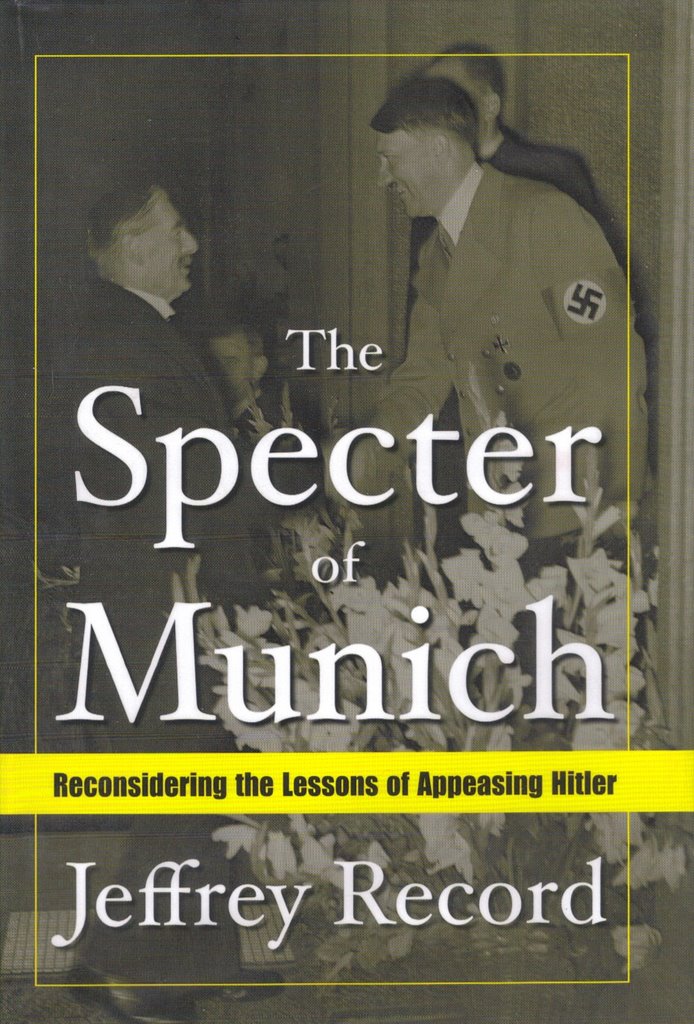
And for anyone who actually cares about the history of the Munich Conference and what real lessons sane people might learn from it, I can't recommend highly enough Jeffrey Record's The Specter of Munich: Reconsidering the Lessons of Appeasing Hitler (2007), which I reviewed on 01/02/07. It's a serious book but it's not that long and it's very accessible.

Most of the book's text is available online from the US Army's Strategic Studies Institute (SSI), Appeasement Reconsidered: Investigating the Mythology of the 1930s (Aug 2005).

The scary thing is, people like Dick Cheney and Rummy and the rest of Bush's crew actually make policies and invade countries based on thinking that's this disconnected from the actual experience of the past. Used in this way, the "lessons of Munich" just become a magic talisman to use against anyone who disagrees with your foreign policy of the moment.

Tags: , , , ,

Tuesday, October 02, 2007

The War: Episode 6

Ruins in Dresden 1945 (Photo: Gerhard Gronefeld)

The historical bloopers were coming fast and furious in Episode 6. It was sort of like one of those games that people play on long drives to combat boredom (or at least did in the days before SUV DVD players): counting hawks or pickups or whatever. It was so much a matter of blatant mistakes as of a number of places where I found myself thinking, "Wha...?" Maybe "groaners" would be a better word that "bloopers".

In the opening segment, one of the interviewees from Connecticut, Joseph Vaghi, tells about talking to a German prisoner in his mid-20s who asked him where he was from. As they talked, the German knew geographical details of the area that surprised the American. As they were talking, I thought about how my father as a young man worked in Connecticut in the summers during the late 1930s tapping maple trees to collect syrup. He said that there were some Germans working there who had to go back to Germany at some point to enter the service. (All young German men were subject to the draft.) So I thought, oh, maybe this guy was working in Connecticut before the war.

Oh, no, the German told the American that he knew all that because he had been trained in a school for administrators of future American "territories". Say what?!?

Now, there is an awful lot about the Third Reich I don't know. And I would be curious if anyone has some more specific reference about such a thing. But I have read a fair amount about German policies toward administering conquered territories and also about their Fifth Column (espionage) efforts in the United States. And it just seems unlikely in the extreme that there was any program to train "administrators" for future American "territories".

This is where a little bit of analytical commentary would have been useful if they were going to use stories like that, because many viewers hearing that will assume it's a fact. I'm tempted to quote Rummy on "unknowns" here, but I would be astonished to find out that any such thing existed in any form. Hitler envisioned making America a subordinate power, at the least, in a future world run by the Axis. But he was far to fixated on conquering Russia and killing Jews in Europe to worry about designing territorial administrations for North America.

There are several possibilities for that tale, which I would list in order of descending probability as follows: the German soldier had actually been in Connecticut (the American said he spoke "accent-free" English); the German had been trained in intelligence operations for possible infiltration to the US; the American had mixed his memory of the conversation with reports about the "geopolitical" studies in Germany, featured in one of Frank Capra's wartime "Why We Fight" films; the German had studied geography in college; and, he was actually being trained as an "administrator" for conquered Connecticut.

Certainly this kind of obscure claim is something that requires further explanation than just to be tossed out there into the stream of war folklore.

Some other historical bits that bothered me in Episode 6:

The narration says that in late 1944, Americans were "growing weary" of the war. Exactly what does that mean? I posted back in July about polling data from the US during the war. In that post, I quoted Josh Marshall:

The key point is that many polls were taken during the war. And approval of the president's conduct of the war, understanding and belief in the goals of the war and other similar measurements all remained constant at very high levels or in some cases actually went up. One key data point you can see on the chart is the number of Americans will to make peace with Hitler - that is, an negotiated end to the war rather than the unconditional surrender which was a key allied war demand. The number was under 10% for most of 1942 and 1943. Then it briefly surged up to just over 20% in early 1944 (roughly the time of the invasion of Italy) before falling back down to about 15% for duration of the war in Europe. (my emphasis)
As I recall, the documentary's narration just said "1944" for when people were getting weary of the war. But the context and the comment by interviewee Katherine Phillips accompanying it definitely made it sound like late 1944. Did anyone bother to check this stuff before they broadcast it?

Ray Leopold, a Jewish medic fighting in Europe, heard a rumor that he took seriously that if the Germans captured an American and found out he was Jewish, he would be killed. That he heard such a rumor is entirely plausible. And Lord knows that the Germans, including the Wehrmacht, were willing to kill Jews. But I've never heard of any systematic practice of Germans executing American POW's because they were Jewish.

On the subject of prisoners-of-war more generally, this documentary like most war documentaries does a very superficial job on treating the subject. It's understandable, because in general it's just a much more dull subject than battles and the shooting war and the high politics. You can go in most any bookstore and find all sorts of books about the Second World War. Try looking for one dealing with POW issues in that war the next time you walk by the war section in a large bookstore.

This documentary mentioned the Malmedy massacre, in which German soldiers murdered several dozen American prisoners. This was a significant event and caused great resentment among Americans. I don't believe they mentioned that it was Waffen-SS troops that committed the massacre, but that one incident created an especially negative image of the Waffen-SS in the United States. Joe McCarthy, the notorious alcoholic demagogue from Wisconsin, made his first national stir in the Senate by expressing his passionate outrage over the fact that the US Army had prosecuted the Waffen-SS perpetrators who had massacred those American prisoners at Malmedy for war crimes. Yes, you read that right. He was outraged that the Army took action against them. McCarthy is still a hero to many Republican rightwingers. No wonder Rush Limbaugh in trashing our soldiers today with his "unpatriotic" insults, to quote the world Senate Majority Leader Harry Reid used in a Senate speech Monday. Old Joe would have related to that just fine.

But in general, both Germans and Americans did a reasonably good job of following the Geneva conventions with each others prisoners. The practice on both sides on the Eastern Front were radically different. Millions of prisoners died on the Soviet and German sides. Telford Taylor, who was a chief counsel for the US at the Nuremberg War Crimes Trials wrote about that in his 1970 book Nuremberg and Vietnam: An American Tragedy as an example of why international law on treatment of captives is so necessary:

It is only necessary to consider the rules on taking prisoners in the setting of the Second World War to realize the enormous saving of life for which they have been responsible. Millions of French, British, German and Italian soldiers captured in Western Europe and Africa were treated in general compliance with The Hague and Geneva requirements, and returned home at the end of the war. German and Russian prisoners taken on the eastern front did not fare nearly so well and died in captivity by the millions, but many survived. Today there is surely much to criticize about the handling of prisoners on both sides of the Vietnam war, but at least many of them are alive, and that is because the belligerents are reluctant to flout the laws of war too openly.
Given the Cheney-Bush administration's policy of treating the Geneva Conventions as toilet paper, a little more decent background on the treatment of prisoners in the Second World War would have been very appropriate and timely. But then Burns might not have had time for the anecdotes from the guy who was a newspaper delivery boy in Sacramento all during the war.

The one story about an officer ordering the murder of German prisoners was an intense one. The interviewee claimed to have have objected to the officer that this was an illegal act and indicated that a number of soldiers wouldn't participate in the shooting. Here again, some effort at verification or some background on this practice would have been helpful. Some such shootings no doubt occurred; I'm not sure what kind of formal actions were taken against Americans involved by the services. The narration also mentioned that some officers gave a "take no prisoners" order during the Battle of the Bulge. To quote Taylor again:

Perhaps the most important of all the laws of war is the rule that an enemy soldier who surrenders is to be spared further attack and, upon being taken prisoner, is to be conducted, as soon as possible, to safety in the rear of the capturing force. It is "especially forbidden" under the 1907 Hague Convention "to kill or wound an enemy who, having laid down his arms, or having no longer means of self-defence, has surrendered at discretion." It is equally forbidden "to declare that no quarter will be given." And under the 1949 Geneva Convention on prisoners of war, they "shall be evacuated, as soon as possible after their capture, to camps situated far enough from the combat zone for them to be out of danger." (my emphasis)
I realize that for today's Republicans, such considerations are "quaint" and even downright contemptible. But they still are law in the United States and the world. In the Second World War, the highest officials of the US government still respected those laws. After the war, German and Japanese officers who violated them were tried and convicted of war crimes, some of them sentenced to death as a result. But war crimes trials and all they involved don't lend themselves easily to homey stories about how much fun it was to be a paper delivery boy back in the good old days.

I've posted more than once on issues relating to air warfare. So I won't go into much detail here. But the reporting on the air war was superficial to the point of being bad. I've paid particular attention to the story of the Dresden bombing. I went to Dresden on my honeymoon trip, so I do have some fond memories of the place. But that's not why I've focused attention on the Dresden bombing. It's because the Dresden bombing plays a particular role in the Holocaust-denial narrative. For more on that angle, see my post The bombing of Dresden 02/07/05.

The documentary makes it sound like the bombing of Dresden was Stalin's idea. It's true that Soviet pressure for greater Allied pressure on Germany was part of the calculation. There is certainly a legitimate case to be made that bombing Dresden was a case of bad judgment. But the city was a legitimate military target under the theory of "strategic bombing" being used in Europe. Again, it's not that The War says something wrong. But on a topic with continuing strong symbolic resonance, it didn't help the viewers to understand much about it. I noticed that they used the conservative figure of 35,000 deaths for the Dresden bombing. That's the high range of the realistic estimate. (Thirty-five thousand deaths is horrible by any measure; but the Holocaust-deniers obsess over that number for reasons discussed more at the link above.)

One of the bits of contemporary documentation they mention called even more for explanation. The narration cited a pamphlet issued by the 5th Air Force that said of Japan that "the entire population is a legitimate target ... For us, there are no civilians." To put it mildly, that was not national policy. Again, there is a lot to criticize about the morality and the effectiveness of the strategic bombing in both Europe and Asia in that war. But it was not official American policy to deliberately kill civilian noncombatants. That needed more explanation, definitely.

Particularly given the iconic role the Second World War plays in American national mythology, the bombing issues needed to be treated in more depth. A lot of viewers will take away from that episode a "lesson" that goes something like this: "Americans deliberately killed large numbers of civilians in the Second World War and there's no problem with that. They should have overthrown their own dang governments and surrendered if they didn't want civilians slaughtered."

A couple of other moments in Episode 6 also grated on me a bit. A minor one was a typical good-ole-boy story about Gen. George Patton stopping in the middle of a bridge crossing the Rhine river and saying that he had always wanted to piss in the Rhine, and proceed to unzip and do so in front of his soldiers. Now, I know Patton committed far more consequential indiscretions. His friend and admirer, Gen. Omar Bradley, wrote that if Patton hadn't been killed in an auto accident, he would have wound up badly damaging his own reputation by his own lapses in judgment. But I do wonder exactly what the regulations were about generals exposing their ding-dongs in public in front of their officers and men at that time.

Finally, Katherine Phillips of Mobile tells a story about she and two of her friends going to the train station one evening with sandwiches, donuts and coffee for soldiers on the train. She told it as a funny story and a fond memory. But what she described was having been terrified. A bunch of Marines jumped off the train whooping and started toward them. She and one of her friends tossed their sandwiches and donuts away, ran into the canteen at the station, locked the door, and hid under the counter in fear. That's what she described, even though she was laughing at it. The third girl was surrounded by Marines who kissed her repeatedly and left dirty hand prints all over her coat. There was a weird disconnect between what she described and the upbeat affect she displayed in telling it.

Episode 6 presented some good moments showing the grim side of war. But the defects and gaping omissions are so significant that it makes it difficult to trust the narrative. Some of the historical commentary is just sloppy.

Tags: , , , , ,

Sunday, September 30, 2007

The War: Episode 5

Yes, we had allies during the Second World War

The fifth installment of Ken Burns' The War strikes me as the most interesting yet. That's partially because my expectations have been considerably lowered by the first four episodes.

But still, this episode provided more engaging stories of people in extreme situations of combat in the Pacific, in the Battle of the Bulge in Europe and the Weisheimer family in their continuing imprisonment in the Philippines. It also had the advantage of relying fairly heavily on contemporary documents, not just 60-year-old memories.

Yet the accounts of the course of the war doesn't get much beyond the conventional, with lots of the same kinds of battle footage we've all seen many times before. This episode also continued to convey the impression that Americans were virtually ignorant of the world outside North America before the war began for the United States. While there's a lot of truth in that perspective, it's also misleading. I hope to expand on this a bit in a later post.

The bias of the documentary toward the stories of those who were quite young during the war continues to have an effect. For one thing, people who were not yet voting age at the time of Pearl Harbor really did first learn about the world outside North America during the war itself. Part of the contemporary material this episode uses is Sascha Weimzheimer's diary from her time in prison, written while she was a child. One Sacramento interviewee who apparently wasn't old enough to join the service during the war at all talked about how he used to play war as a kid. We needed a Ken Burns documentary to tell us that little boys play war?

The larger historical account remains a cipher. We learn that Roosevelt spent Thanksgiving of 1944 at a hospital for children with polio in Warm Springs, Georgia. What Roosevelt was doing in relations with allies or postwar planning seems to be out of the scope of this documentary. Speaking of allies, we hear in this episode that we had to deal with some annoying British general. Also we see a map that shows the Soviets apparently creeping at a slow pace across Europe, unlike the triumphant Americans who are already at the borders of Germany. It's nice to know that allies played some minor role in helping America save the world.

Tags: , , ,

War, The War, national purpose and death

The War series resumes tonight: six more hours to go. I still intend to watch it. So I'm hoping that the last six hours will at least be less unpleasant than watching someone scratch their fingernails on a chalkboard.

One of the things of which this series has reminded me is the different kinds of historical documentation there are. I guess that sounds banal. But it's important to remember that interviews in the 2000s of people recalling events of the early 1940s have their own validity and value even as types of historical evidence. But they are a different kind of evidence than contemporary documentation. One of the biggest reasons that most crimes short of murder have statutes of limitation is that eyewitness testimony has its problems even for recent events, but memories fade, shift and alter more significantly over time. Most statutes of limitation are seven years. Burns' interviews concern events around 60 years earlier.

Tom "Greatest Generation" Brokaw followed up his successful volume on that topic with An Album of Memories: Personal Histories From the Greatest Generation (2001). It actually does contain the text of contemporary letters and even copies of documents in some cases. One of the wartime letters he includes is from a man named Robert White to his wife. White was killed in an accident in October of 1945, the month after the war in the Pacific officially ended. In the letter dated April 5, apparently in 1945, he wrote about his thoughts about the risk of death:

I just finished reading the letter you wrote Friday. Yes I know Richard Wolff. I also know Virginia. See, that is an example of one of the things every one of us faces. We can imagine how bad she feels, but no one who has never gone through that can realize the full extent of her sorrow.
That strikes me as an honest expression of compassion, with no fluff or false comfort about it. This man died. His wife feels incredible grief. It's a bad thing. Period.

In the body of the letter he talks about his own personal struggle to keep going under the demands being put on him in the Navy. Unfortunately, Brokaw doesn't provide us his birthdate, so we can't say exactly how old he was. But his letter strikes me as a mature take on things. He was old enough to have a wife and a son.

That's one of the things that also bugs me about Ken Burns' series. The interviewees keep talking about "the boys", meaning the soldiers. I realize that's a conventional usage, sort of like "the guys". But even if you use 21 as the age for adulthood as it was recognized in those days, by no means all of the soldiers in that war were "boys". Someone could enlist as early as age 17. But the draft age back then was 20, and men in their early 30s was also drafted.

I don't have any statistic on the age breakdown in front of me. But it seems to me that stories in Burns' The War skew fairly heavily toward younger soldiers. This would be an understandable result of his focus on stories of people with strong memories of the time who were still alive in the early 2000s. And there's nothing wrong with that in itself. But it does seem to me that a little more information about that particular topic would have provided a better historical perspective for the audience.

White's letter reflects his practical perception that whatever he was contributing, he also risked leaving his family without him:

Things like this worry me at times, darling. Not that I am afraid, far from it. But God, we take chances every day, any one of which could put us on the "slab." It isn't the fact that a guy is afraid, but he gets to thinking of his responsibilities to his wife and family and it takes the guts out of him. Of course a married man may have more to fight for, but he still feels guilty about taking the daredevil chances.
And the way he understood his own personal situation in the larger context of the national cause is also intriguing to me:

You are right, darling, I cuss this whole thing at times too, we all do, but God we have to think of what kind of a future we will have if we don't give everything now and win this war. Right now I know of 15 fellows that I knew back home in school, etc., that are dead right now. Not one of them had a chance to live their rightful time. There is no doubt about it, "war is hell." We get that pounded into us every day. They don't mince words either. They never figure out our mathematical chances of living after we start fighting at the front. Even before we finish training, a number of us are going to "get it." But getting it in the Navy Air Corps is no worse than any other outfit. It is just that chance we have to take. Don't worry, though, darling, it is just that chance we'll have to take. We'll make it OK. All we need is faith, and we have that. No matter what happens, just keep up your faith. Don't ever let this thing whip you.
This letter strikes me as a real antidote the violin-heavy sentimentalism of the first four episodes of The War. He's saying, I know this war is necessary. But war is still a really f*****d up thing.

And his remarks about his 15 schoolmates that have died don't have any phony romanticism about how one of them might have gone on to be a Homer or an Einstein. He says, they were killed. And they died too soon.

Tags: , , , , ,

Wednesday, September 26, 2007

The War takes pride in America

Episode 4 of Ken Burns' The War presented us with the Anglo-British-American invasion of France in June 1944, apparently the grandest and most decisive military event in all of human history. All that had come before, our war interpreter tells us, were "mere preliminaries". Stalingrad, Kursk, Midway: small stuff, practically inconsequential. It had to be the Americans who achieved the Turning Point of All History. And in a battle, of course. Not in writing a Constitution or curing polio or some wimp sissy stuff like that. The invasion of France in 1944 was "the greatest invasion in history," we learn. Well, I guess if you don't count the massive attack that Germany and its allies threw at the Soviet Union almost exactly three years earlier. But who cares what happens in a backwater of history like Russia and eastern Europe?

A way occurred to me to describe the dissonance I have watching The War. Jackson Browne did a haunting song about the bloody civil conflicts in Africa over blood diamonds, called "Sergio Leone". It's about a filmmaker who records the brutal events. The concluding lines are:

From the Via Tusacalana to the view from Miller Drive
He shot the eyes of bad men and kept their deaths alive
With the darkness and the anguish of a Goya or Van Cleef
He rescued truth from beauty and meaning from belief


Just once in my life, I wish I could write a line as evocative as, "He rescued truth from beauty and meaning from belief."

But since I probably never will, I'll borrow Jackson Browne's lines to describe the impression Burns' documentary is making on me:

From the bombing of Pearl Harbor to the view from Utah Beach
He took long reams of war film and sandwiched it in kitsch
With the brightness and nostalgia of Norman Rockwell painting cheese
He buried truth in violins and horror in light relief


Tags: , , , ,

War stamps on 1944

Since I'm following The War and it's already into 1944, I thought I would post images of the Postal Services 1994 series of Second World War stamps. They have their own captions. And the art on stamps is usually pretty decent, and often quite good. (See, I can do Second World War kitsch, too!)


And a bonus map!

Tags: ,

Tuesday, September 25, 2007

The War: Episode 3

The Battle of Tarawa: covered in Episode 3

Watching Episode 3 of Ken Burns' The War was kind of like listening to an elderly friend or relative who's telling stories that you've heard five or ten times before. It's nice to hear the familiar tales, even the sad parts. But they don't tell you anything you didn't learn the first two or three times you heard them.

After seeing this episode, I would say that the approach of the film doesn't measure up to his declared goal of making us feel we know these families being interviewed like they are own own families. To give something like that kind of emotional intimacy to it - discounting the hyperbole of feeling like they are our own families - the film would have needed a much more narrow focus on the lives of individuals and much less combat footage. It would also need a different kind of descriptive background for the "home front" in general, e.g., how many of those romantic war marriages of which we hear about two in this episode really worked out?

The problem is that telling the story of the impact of war on an individual or a particular family is a very different undertaking than telling the story of a big, long, complicated undertaking like the Second World War. Burns tries to do both and also frame it all so that it wouldn't feel much more challenging or upsetting than a Hallmark card. Okaly, a Hallmark bereavement card, but still...

The effect is much like seeing a succesion of Norman Rockwell paintings alternating with stock battle footage with dubbed-in explosions and gun sounds.

Take Earle Burke from the second episode. He talked about how he not only came to feel his own mortality as a gunner in a bomber, but also came to realize what it did to his parents when he joined the servcie in such a high-risk branch after his older brother had just been killed in the war.

How did that experience affect his realtionship with his parents? Did he feel guilty enough about it that it affected important life decision? Did they ever express anger or resentment over it?

War bond drives, letters to and from home, joyful homecomings, the telegrams notifying families of a loss. These are all real and important parts of the history of that war. But, as Joe Stalin or somebody is reported to have said, "One death is a tragedy; ten thousand deaths is a statistic."

So far, between the schmaltzy incidental music and the ever-recurring footage of artillery going off, the film hasn't made me feel the tragedy or have any better understanding of the statistics. On Monday, I posted a paragraph from Studs Terkel's "The Good War" that made the tragedy of individual loss feel like a tragedy. It was an Iowa farmer, remembering the excitement in the community about how wartime production would produce better economic times. He ended by saying:

This neighbor told me what we needed was a damn good war, and we'd solve our agricultural problems. And I said, 'Yes, but I'd hate to pay with the price of my son.' Which we did." He weeps. "It's too much of a price to pay."
None of the stories in this documentary haved moved me like that brief story did. It's not that we can't see that the pain is real in the interview subjects in The War. It's that those segments are sandwiched in between a basic romantic, mythic treatment of the war that the losses seem like those mythical great sacrifices for the Noble Cause. That war was a noble cause. But so far, those segments come off in the documentary more like a war placard than tragedies that happened to real people.

This segment took us all the way into 1944 already. That means we've got more than half the series to go to cover the last year and a half of the war. Maybe he'll connect us a little more to the individuals on which he's trying to focus in the remaining episodes.

Tags: , , ,

The War goes on

I haven't seen any ratings figures from the first night. But after watching Episode 2 of Ken Burns' The War, I really wonder if its going to come close to the viewership of Burns' famous Civil War series.

After the first episode, I was grouching that a lot of it was standard History Channel fare. The History Channel does some good stuff, it's just that they became famous for running so many Second World War programs of one battle after another that it was popularly known as the "Hitler Channel" for years.

You would think Ken Burns would turn out something special. But by the last half-hour of the second episode, I was finding it downright boring. In his interviews, he's said that he hopes the viewers will become so familiar with the interview subjects that they would seem like family. Does this mean I'm going to have struggle not to nod off at Thanksgiving Dinner with these people?

I see several problems with the film so far. One is that I haven't seen anything that seems to add anything new in either facts or perspective to the story of the American experience in the Second World War. And it deals with the overall framework of the war so superficially that it does a poor job of retelling what we already know.

And the film steps on some of the parts that are the most engaging. Earle Burke from Luverne, Minnesota, has a lot of face-time in the second segment. And the film actually makes his life story come alive more than most. He tells about being a 19-year-old kid when his older brother was killed in the war. So he joins up himself, on reflection he thinks because of his brother's loss, but at the time it seemed like "fun", and he was 19 and indestructible. Flying bombing missions over Germany where the death rate among pilots and their crews was very high, he describes how he came to recognize his mortality fairly quickly, eventually ending his career on the bombing missions after two serious wounds which almost cost him his arm.

But the way the film tries to dramatize this is to show footage of American bombers being attacked by German fighters and anti-aircraft fire, complete with dubbed-in machine-gun sounds, while Burke is narrating his story about being on a bombing run over Schweinfurt, Germany,. We never see or hear the interviewer, but between the interviewer and Burke and the film editor, he was doing a darn good job of telling the story. But the fake machine-gun noise was almost drowning him out. I found myself wishing they would stop with the dubbed combat sounds and just let him tell the story.

The segment on the Japanese-American detention camps was disturbing to me, and not in a "Boy, what happened to those people was terrible" way, either. (I know there's some kind of ideological debate about whether they should be called "concentration" camps; I agree with the film's comment in Episode 1 that they were. I use "detention" only because it seems to me to be the more conventional usage, not because I object to their being called "concentration camps".)

It's preceded by the story of a white American family in a detention center in the Philippines run by the Japanese. I was thinking, why are they spending so much time on this, because there doesn't seem to be that much to the story except the bare fact that this family was there. Then it immediately switched to the story of the California camps, where we see footage of contented family strolls and baseball games to show us that "the internees acted like the Americans they were". With happy music playing in the background.

To be fair, the narration did say that those attempting to escape from the California camps were shot at and that the detainees had been deprived of their freedom. But the immediate juxtaposition of that segment with the Philippine camp segment really came off to me as intended to be a mirror-image comparison: one camp with white American internees run by Japanese, another with Japanese internees run by white Americans. The problem is, the internees in California were Americans. They weren't foreign nationals detained in wartime, as in the Philippine camp. Those two segments together left me with a bad feeling about the production.

One of the notable things about the series so far is that there is quite a bit of color footage. But I'd actually like to hear something more about the source of the film footage in general. During Burke's story, the screen was mostly taken up with scenes of bombers seemingly in the situation Burke is describing. I assume that footage is a compilation. But why don't they tell us? Especially when it's used at length to illustrate one man's story while he is narrating it simultaneously. How much trouble could it be to put up a caption that says, "Footage taken from various sources" or something?

I hardly know what to make of some of the historical commentary. Introducing Burke's story, the narrator mentions enough about the bombing policy to indicate that there was a difference in the British and American theories of "strategic" bombing. And that a lot of civilians were killed in German cities, 40,000 by their figure in Hamburg (and I believe they said in in just one night). But none of that really had much to do with Burke's particular story they were introducing. And they said just enough to brush across such huge issues related to the air war without giving the viewers any material to real understand those issues further.

And their discussion of the Second Front issue and the eastern front in Europe was so superficial they could almost have just left off mentioning that anyone but the US and Germany were in the European war.

I suppose I've got a "halo" effect working with this film. It's doing a spotty job telling the stories of the individuals and families. But it's also doing a poor job of telling the larger story of the war. We're almost getting the worst of both: a lot of schmaltz (a car dealer stopped at the base in Alaska and took home movies of "the boys" from Luverne!) mixed in with a lot of combat footage that doesn't add much of anything but noise to the story being told. Especially when we don't know if we're seeing actual footage of the events described: I guess we have to buy the $85 DVD-book-soundtrack package to find out about that.

Still, I've got more complaints. Unless I completely missed it, better-known interviewees like former Senator Daniel Inouye and historian Paul Fussell aren't identified by their more public roles. And it matters. You listen in a somewhat different way to an experienced politician or a professional historian describing things like this than to Joe Blow who's never been on TV in his life before.

The sentimental incidental music is just too much. Even if you were trying to focus on the nitty-gritty of the stories, the atmosphere with the music makes it almost impossible not to see this as a glowing heroic nostalgia tale. It also adds to the confusion. The segment discussing ramped-up war production began with about 10 minutes of boogie-woogie music for background, while the scenes on-screen were of hot, dirty, smoky factory work. Well before the end of the episode, I was thinking, "please, no more horns or violins!"

Finally, there's the problem of interviewing eyewitnesses who were teenagers or young children at the time. One woman in Mobile (who may have been a bit older than that in 1941) talked about how everybody supported Roosevelt after Pearl Harbor on. And a guy in Minnesota who was apparently a kid during the whole war talked about his very fond feelings about the sense of unity among people when he was growing up, "that sense of oneness".

National unity isn't all it's cracked up to be. And while it's true that there was widespread and enduring support for the war itself, the results of the 1944 Presidential election were that the Electoral College went 432-99 for Roosevelt, but the popular vote was 25.6 million FDR/22.0 million Dewey. Fifty-four percent of the popular vote for Roosevelt is a very solid margin. But obviously people didn't feel a complete "sense of oneness" in politics even during that war.

So maybe it's also the case that the good old days aren't what they used to be. Maybe the Minnesota guy felt a "sense of oneness" when he was a kid because the adults always talked to him about the war in simplistic terms. Here's where a focus on the individual's experience would have been enhanced by actually going into questions like that. But if you're not going to probe things like that a bit more in the final film, just leave it out. That same guy also talked about how he thought the wartime rationing was just an artificial scheme of the government to impose some sacrifices on people to make them more supportive of the war. Say what?

A lot of people are going to take away particular impressions of the Second World War from this series, I'm sure. How many days or hours will it be before a reference to it appears in a Dick Cheney or George Bush speech? Unfortunately, so far its coming off more as light entertainment than as substantial history.

Tags: , , ,

Monday, September 24, 2007

Remembering wars: the cost of war

One of the effects of the Second World War in the United States was to bring a final end to the lingering effects of the Great Depression. That has left us a deeply ambiguous legacy. Because it created a wide impression that military spending automatically brings prosperity. It doesn't. But it did in the Second World War.

But the experience was a deeply ambiguous one from the start. In "The Good War": An Oral History of World War Two (1984), Studs Terkel quotes one of his interview subjects:

For the old Iowa farmer, it was something else. Oh yes, he remembered the Depression and what it did to the farmers: foreclosures the norm; grain burned; corn at minus three cents a bushel; rural despair. Oh yes, it changed with the war. "That's when the real boost came. The war—" There is a catch in his voice. He slumps in his rocker. His wife stares at the wallpaper. It is a long silence, save for the tick-took of the grandfather's clock. "—it does something to your country. It does something to the individual. I had a neighbor just as the war was beginning. We had a boy ready to go to service. This neighbor told me what we needed was a damn good war, and we'd solve our agricultural problems. And I said, 'Yes, but I'd hate to pay with the price of my son.' Which we did." He weeps. "It's too much of a price to pay."
Tags: , ,

Ken Burns does "the History Channel"

War poster, 1942

I watched the first 2 1/2 hour (more-or-less) segment of Ken Burns' The War. I was not especially impressed with the first segment. It struck me as heavily sentimentalized and very uneven. The idea as the promotion expressed it was to tell the story of the Second World War through the experiences of families in four American cities: Sacramento CA; Mobile, Alabama; Waterbury, Connecticut: and, Minneapolis Luverne, Minnesota.

But in the first segment, it appeared as though Burns couldn't decide whether he wanted to do that, or instead to tell the story of the war with the interviewees as supporting characters. The section on the Battle of Guadalcanal in the second half of the second hour played like a standard History Channel offering, with the interviews just adding a couple of anecdotes to a stock account of artillery and bombs exploding with sound effects added. (The combat footage from that war typically had no sound.)

Burns decided to add segments featuring Latino soldiers after Latino groups complained that their role wasn't included. The addition at the end of this first episode definitely had a tacked-on feel to it. Although it had some of the best moments of the piece.

The first half hour sets a heavily sentimental tone, introducing us to the series with people giving idyllic accounts reminiscing about the good old innocent days of their youth. The incidental (background) music was heavy on violins, piano and horns in this section.

One of the things that immediately struck me is that because he's focusing on events as long as 66 years ago (1941), his selection of interview subject of necessity skews toward people who were quite young at the time. Glenn Frazier lied about his age to join the service at 16 in 1941. Former Senator Daniel Inouye is one of the interview subjects, and he was 17 at the time of the Pearl Harbor attack. Sixteen-year-olds obviously have a limited view of political events, which is what they were describing in the first half-hour.

So, we get the memories of people as teenagers recalling Pearl Harbor. Which was a big shocking surprise to them. It's not as if we didn't know that already. I assume Burns is trying to give us the sense of going all through the war with these people. But, honestly, the fact that people were shocked at news of the bombing of Pearl Harbor doesn't add much to our knowledge or understanding of the war.

And the need for dramatic progression with the interviewees even in the first hour interferes with the effort to provide a bare-bones historical context. In the first half hour, the film gives the impression that the Pearl Harbor attack was a total surprise to most everybody in the United States. But then the second half-hour recounts some of the things that Americans already knew about the war in progress overseas, reminding anyone who wasn't snoozing that people in the US did know something about the danger of war.

Maybe partly because the period leading up to the beginning of the war is of particular interest to me, I was dissatisfied with the background given on the war's beginning. Which was also pretty much stock History Channel type stuff. We get a film montage of a grim looking Hitler, marching Nazis, the bombing of London, the bombing of Pearl Harbor, a few seconds on Japan aggression in China. That introductory segment on Germany seemed to me to be about half composed of footage from the vile Leni Riefenstahl's Triumph des Willens (Triumph of the Will), which admittedly was technically well-made. And anyone who channel-flips past the History Channel has already seen it, probably several times. Weirdly, the incidental music during the segment on Germany's aggressions in Europe was downright cheerful.

Given the emphasis on framing the personal experiences of those individuals, it seemed to me that a bit more information on just how big a political issue preparations for war had been in 1940-41 would have been necessary. It's often a cheap shot to criticize people for what they didn't say. But in this case, it leaves an erroneous impression that the entire war - not just the specific attack on Pearl Harbor - was like a sudden thunderclap on a clear day to most Americans.

And that's not the case. For instance, the USS Reuben James (the subject of a song by Woody Guthrie which borrowed much of its melody from "Wildwood Flower") was sunk by a German submarine on October 31, 1941, escorting supplies across the Atlantic. Nearly forgotten in popular accounts (like The War), it was a major event at the time. And it made people very aware of how close war could be for the United States.

I don't want to be a total Grinch about the first episode. Parts of it are quite good. Sam Hynes of Minneapolis gives a good description of the appeal of soldiering to young people. He said it was not about patriotism or who the enemy was so much as the appeal of the (perceived) romance of being a soldier.

The film did take the time to remind us that Gen. Douglas MacArthur in the Philippines, with nine hours warning after the attack on Pearl Harbor, still allowed much of his air fleet to set on the ground where a Japanese attack destroyed it.

In the Latino segment at the end, one of the soldiers gives a moving account of hearing his best friend in his unit die slowly in the course of a night while they were deployed in the woods on Bougainville.

And the film describes the internment of 110,000 Japanese-American citizens on the West Coast, including a couple of moving segments from women recalling the event as they experienced it.

But even there, the tension between following the personal drama and providing meaningful context was evident. The segment didn't mention the California white who typically bought up Japanese-Americans' land, businesses and houses for bargain-basement prices as their previous owners were shipped off to the camps: that naked greed was one of the reasons prosperous Californians pushed for the internment. Or the fact that not one single case of espionage by a Japanese-American on the West Coast was ever found. There were some cases on Hawaii, where mass detention of Japanese-Americans was not imposed. The internment was much uglier than a mistake or a tragedy that just somehow happened.

Maybe it's years of blogging that make me more aware of things like this. But a number of times I had to wonder whether the accounts were vetted for factual accuracy by the filmmakers. For instance, one Latino soldier who served with "Carlson's Raiders" in guerrilla fighting behind Japanese lines gives a matter-of-fact description of an apparently illegal execution of five Japanese prisoners-of-war. His account sounded credible. But did the filmmakers try to verify that elsewhere? Given the situation he described, that actually could have been an occasion where executing the prisoners was a military necessity and therefore a legal act. I certainly don't want to make any excuses for war crimes. But those are real factual questions that I'm curious as to whether they were vetted or just taken at face value.

The same thing occurred to me with several other segments of the interviews. Two white guys from Sacramento gave the impression that they had been opposed to the interment of the Japanese-Americans. The historical narrative did say that there was little public opposition to it at the time. But did the interviewers press their subjects on that point? Hey, I grew up in Mississippi, and to hear white folks today tell it, almost none of them actually supported segregation back in the day. Amazing that it survived so long! So I always wonder about statements like that.

I also did a double-take when the narrator said that the American oil embargo on Japan was their signal to go to war with the United States. Then immediately following, he said that the purpose of the Pearl Harbor attack was to push the US out of the Pacific area. It was just too superficial of an account to make much sense. And since this is a blog and not a magazine article, I can say that I'm not really sure, but even though the oil embargo pissed off the Japanese government, the brief way they presented it sounded an awful lot like the isolationist dogma which says That Man Roosevelt deliberately pushed Japan into war with the oil embargo and other things.

Speaking of Roosevelt, they tossed in a segment on Europe in which the viewer would hear if they were listening carefully and didn't sneeze at that moment, that the Soviet Union by mid-1942 had stopped the German army outside of Moscow - a major turning point in itself, which occurred about the same time as Pearl Harbor, overshadowing it completely in American news. And also that the Soviets had lost "millions" of civilian and military dead.

This was presented in a brief discussion of the issue of forming a Second Front in Europe with Britain and the US invading France, which didn't actually happen until 1944. It said that Churchill pushed to invade North Africa instead and that American generals opposed it. And while it was worded in a way that would let them comma-dance over it, the segment says That Man Roosevelt approved the North Africa operation just because there was an election coming up in 1942 and he wanted to show he was doing something in Europe. What the [Cheney]? Who are they using for historical consultants on this stuff? The Isolationists 'R Us Institute?

I tried to pay close attention to the incidental music, which has a huge effect but can almost escape the viewers conscious notice at times. The music was clearly aimed at creating a very sentimental aura around the whole thing. I think about the only time the sentimental music shut off was during the sections where they were showing the History Channel style segments of explosions.

And, hey, I'm a fan of 1940s music and I actually get sentimental hearing the National Anthem at the ball games and stuff. (It always reminds me of how General Andrew Jackson saved the country from British tyranny in the Battle of New Orleans.)

But in the latter part of the second hour when they played Bing Crosby singing "White Christmas", I went into eye-rolling mode. And then when it was followed by Norah Jones singing some song I'd never heard before, "American Anthem", I kinda felt like gagging. It has lyrics that would embarrass Lee Greenwood, the "Ah'm proud to be an American/Where at least I know ah'm free" guy. (At least I know I'm free? What is that about?) She was singing lines like, "American, I gave my best to you" while various battle scenes flashed across the screen.

That may be a perfectly appropriate song for, say, a veteran's funeral. But coming with the rest of the package and the endless violin music on the soundtrack, it really makes the overall effect of the first episode a nostalgic glamorizing of war. And as we've seen these past few years with Cheney and Bush, glamorizing war isn't a harmless thing.

A final note. Military censors don't mind the media carrying stories about grieving widows and about lost buddies in the field even in a war in progress. I don't mean that comment to be in any way disparaging. Those are real and inevitable parts of war. And highly meaningful to those who experience them personally.

But in a documentary film context like this one, those types of stories can easily fit into a sentimental narrative that frankly functions as entertainment to most viewers without adding much to anyone's understanding or knowledge of the war being described.

In the end, I'd have to say that this first episode gets lost in nostalgia and stock sentimentality.

Tags: , , ,

Sunday, September 23, 2007

Remembering wars: organizing the American economy

Studs Terkel in "The Good War": An Oral History of World War Two (1984) didn't just interview the non-famous partipicants in events during the war. John Kenneth Galbraith was made deputy director of the federal Office of Price Administration which administered the wartime wage and price controls. One of his employees there was a young man named Richard Nixon. In his interview with Terkel, Galbraith said:

Leon Henderson was one of the unsung heroes of World War Two. He had been the administrator of prices and civilian supply as well as a powerful figure on the War Production Board. There has been an enormous literature on Albert Speer and the way he was presumed to have organized (German production. Henderson, with a few younger colleagues, of whom I was privileged to be one, organized the United States far more effectively than Germany had ever been. The man whose organization failed [Speer] is celebrated, while the man who had in mind the successful national venture [Henderson] is lost to history. Day alter day, he came back wearily from meetings, having fought the battle for some necessary action against recalcitrant trade associations, business executive types.

The businessmen who came to Washington were generally industrial bureaucrats, public relations types, who could best be spared at home. There were many times when we nearly forgot there was a war going on. Our conflict with them was not ideological. It was over the fact that they never wanted to move. We have a public picture of the businessman as a dynamic figure, always ready for action. His wartime image was somebody who could never bring himself to action as the situation required. He would come to the conference and say, "Let us wait awhile. I think this is something we can accomplish on a voluntary basis. I'm sure business will see its responsibilities. This is not a time for radical action." We really had to fight them all the way.
Tags: , , ,

Tuesday, January 02, 2007

Review of The Specter of Munich by Jeffrey Record


Jeffrey Record's The Specter of Munich: Reconsidering the Lessons of Appeasing Hitler (2007) is an expansion of his August 2005 paper for the US Army's Strategic Studies Institute (SSI), Appeasement Reconsidered: Investigating the Mythology of the 1930s. I reviewed that paper in October 2006. The Specter of Munich contains much the same material in the historical analysis of the appeasement policy of Britain and France. So I'll focus here more on the additional material in the book which applies some observations from his analysis to the current US situation, especially in the Iraq War.

As I described in more detail in the earlier review, Record makes clear that the appeasement policy was a disastrous strategic mistake. But that mistake is popularly understood today as a failure by Neville Chamberlain in a mano a mano testosterone face-off with Adolf Hitler at the Munich Conference in 1938. The popular understanding seems to have been shared by many senior policymakers in the decades since the Second World War. But, in fact, the mistakes in the appeasement policy were not primarily personality failings on the part of Chamberlain or of French Prime Minister Edouard Daladier.

For instance, France's foreign policy was based on a series of forward alliances with Czechoslovakia and Russia against Germany; but their military policy was a defensive one not suited to supporting allied nations in the east by attacking Germany if they came under German attack. Britain assumed that airpower would be decisive in the war but also had mistaken assumptions about the effectiveness of air power and also poor intelligence on actual German air power capabilities. Britain's policy was based on a widespread British belief that the Versailles Treaty that had ended the Great War (First World War) was excessively harsh on Germany, while France insisted on enforcement of the Versailles Treaty but doing so with a military strategy not suited to enforcing it. And this is only part of the list.

The main additions in the book compared to the paper have to do with how the lessons of appeasement from the 1930s have been applied to influence policy, and what more constructive lessons might be. For instance, in an expansion on the material at the end of p. 43 in the SSI paper, he writes of Richard "Prince of Darkness" Perle, generally referred to as the "leading" neoconservative:

Given the horrors of that war, initiation of a preventive war seems retrospectively imperative, and when neoconservatives such as Richard Perle speak about how Hitler could and should have been stopped before 1939, they mean via forcible regime change of precisely the kind the United States launched against Iraq in 2003. But it is here that the neoconservatives enter the fantasy realm of historical counterfactualism. For Britain and France in the 1930s, a decisive preventive war against Germany was morally unacceptable, politically impossible, and militarily infeasible. Rewriting history is always easier than writing it. If Chamberlain horribly misread Hitler, the neoconservative indictment of Chamberlain conveniently assumes that the option of preventive war against Germany was as available to London and Paris in 1938 as it was to the United States against Iraq in 2003.

The American experience in Iraq testifies to the perils inherent in forcible regime change, especially forcible regime change undertaken on the basis of rosy neoconservative assumptions about the degree of difficulty involved and without adequate preparation for the possibility of postregime violence and the challenges of national political and economic reconstruction. Yet one can speculate that the magnitude of the task of forcible regime change in Germany in, say, 1938 would have dwarfed that in Iraq today. Hitler was a genuinely popular leader within Germany, whereas Saddam Hussein was detested by all but the minority Sunni Arab population. Germany in 1938 had a burgeoning economy and a rapidly expanding and highly competitive military establishment, which could have been counted upon to offer much more formidable resistance than Saddam's sanction-crippled forces. An effective occupation and reconstruction of Germany would in any event have required far more manpower, resources, and time than the United States has been prepared to invest in Iraq. (my emphasis)
Record emphasizes repeatedly throughout the book that in evaluating the decisions made by British and French officials, we have to keep in mind that they didn't know they were making pre-Second World War decisions. They were trying to avoid a war.

The bulk of the additional material in the book come in the last two chapters, where he looks in particular at the lessons he would draw for the United States today from the appeasement experience of the 1930s. He formulates the major lessons he sees as follows:

* "Don't propitiate an insatiable great power dictator if you are in a position to pursue and alternative policy" - but rely on reality-based evaluations of when the opponent is "insatiable".

* "[T]hreat miscalculation can have severe penalties". The popular version of the "lessons of Munich" recognizes that underestimating threats can be dangerous. But part of the Anglo-French miscalculation in the 1930s was overestimating German air power - even neocon idol Winston Churchill did that.

* "[D]emocratic governments are constrained by public opinion", both in a policy of initating war and in sustaining public support in a protracted war. He expands on this as follows:

Leaders of democratic states must necessarily consider public opinion in making decisions to use (or not use) force. They can and do attempt to mobilize public opinion for war, but in the end they cannot readily march off to major war - or continue to sustain a policy of war - in the face of a hostile electorate. This is especially the case in wars of choice as opposed to wars of necessity. (my emphasis)
* Take account of "the risks inherent in discordance between foreign policy aims and military force posture".

* Be aware of the "dangers of strategic overextension". This can be done either by boosting the resources devoted to the strategic goals, or by scaling back on those goals (or of course some combination of the two). Clarity in the way a nation defines threats is an important component of this.

* It is important to maintain "a proper offensive-defensive balance".

* Maintain as much as possible "consistency in threatening and using force".

Record discusses these lessons extensively in the context of the Iraq War and the current assumptions of military "transformation", which has focused on developing more high-tech capabilities relying even more on air power. It could be argued that Record's usage of his "lessons of Munich" to frame his own criticisms of the Iraq War can lead to the same kind of reading current experiences back into one's evaluation of historical events.

It's certainly easy to fall into that. I would argue that Record does not do so in this case because he uses those broad lesson categories to examine aspects of our current situation in terms of realistic analysis of the current situation. Where American statecraft (which seems an awfully highfalutin word to apply to the cynical operations of the Cheney-Bush administration, I know) has so often gone wrong is to try to make every enemy we face be the new Adolf Hitler and every war as critical to American security as the confrontation over Czechoslovakia in 1938 proved to be for the world.

This is a rich chapter, almost any paragraph of which could be the basis of extensive discussion and debate. Here, I'll mention just a few. On the subject of threat miscalculation he writes:

War is the province of miscalculation. History is littered with wars arising from misperceived enemy intentions, capabilities, or both, and this reality seems endemic in the practice of statecraft. Just as Chamberlain misread Hitler's intentions in 1938, Hitler misread British intentions in 1939. In Korea in 1950, the Soviets misread the intentions of the Americans, who in turn misread the intentions (and capabilities) of the Chinese. In Vietnam, the United States overestimated its own capabilities and underestimated those of the Communists. And Saddam Hussein misread George H. W. Bush's intentions in the Persian Gulf in 1990-91, while the George W. Bush administration misread Saddam Hussein's capabilities as it approached America's second war against Iraq in 2003. Saddam certainly wanted deliverable weapons of mass destruction (WMD), but wanting is not the same thing as having.
On the mismatch between foreign and military policies:

The fatal misfit between France's foreign and defense policies finds no analog with the United States today. ...

That said, however, there is a discernible and growing disjoint between the kind of war the United States prepares to fight and the kinds of wars it has actually fought. To put it another way, U.S. military force posture is increasingly at odds with the emerging strategic environment. The United States remains focused on preparation for high-technology conventional warfare against other potential military peer competitors (most notably China), whereas the predominant threats to its security interests are rogue states, failed states, and nonstate unconventional adversaries practicing asymmetrical war. This new threat environment places a premium on preparation for operations other than war (OOTW)- that is, operations other than the big conventional force-on-force mission for which the U.S. military is optimized. Such operations include peace enforcement, counterinsurgency, stability, and state-building operations. Success in performing these operations is certainly essential to a foreign policy that embraces forcible regime change in places like Iraq and the muscular promotion of democracy in the Arab world and other regions of political autocracy and economic stagnation. (my emphasis)
He believes that the institutional resistance to shifting the focus of the US military from conventional war preparation to OOTW is extremely strong, especially in the Army: "Unfortunately, whatever the strength of the arguments for establishment of OOTW-dedicated ground forces (and there are serious arguments against), such forces stand little bureacratic chance of ever seeing the light of day."

But he doesn't use this as a shrug of the shoulders to say there's no point in worrying about changing it:

None of this is to argue that the Defense Department is hopelessly unadaptable to the deconventionalized global strategic environment — only that its force structural bias toward conventional combat is long standing and well entrenched and that overcoming that bias will entail fundamental changes in how U.S. military forces are organized, equipped, trained, and manned. For example, personnel policies that constantly rotate individuals from one assignment to another and promotion polices prejudiced against development of specialized area knowledge and linguistic skills are antithetical to the requirements of successful counterinsurgency. For another example, retention of division-level organizations makes little sense against decentralized, irregular adversaries. And what does the F/A-22 program [one of the Pentagon's most controversial] bring to the table in the fight against al Qaeda? (my emphasis)
Yes, Jeffrey Record, a professor at the US Air Force Air War College, is questioning the current policies of our infallible generals. Fortunately, these kinds of issues are discussed within the military, often more freely it seems than among our punditocracy. But maybe our punditocracy is a poor comparison to any kind of serious discussion of such matters.

And, on the question of realistic threat definition, he writes:

The argument that the war in Iraq serves as a magnet for terrorists that otherwise would be conducting attacks in the United States is not persuasive. The war certainly did not prevent the Madrid and London attacks. Iraqis are notable for their scarcity among the ranks of Islamic terrorists, and 90 to 95 percent of insurgents in Iraq are Iraqis radicalized by the dispossession of the Baathist regime and/or the U.S. invasion and occupation of their country. True, most suicide bombings in Iraq have been conducted by outsiders — mostly Saudis, Syrians, and Kuwaitis — but studies of suicide bombers in Iraq by the Saudi government and an Israeli think tank reveal that the great majority of them had never taken part in any terrorist activity before their arrival in Iraq but rather were radicalized by the Iraq War itself. They are part of a new generation of terrorists responding to calls by Osama bin Laden and radical Islamic clerics to defend their fellow Muslims from the "infidel crusaders" in Iraq. Notes terrorism expert Peter Bergen, "The president is right that Iraq is a main front in the war on terrorism, but this is a front we created." (my emphasis)
The final chapter includes a more extensive set of "observations and recommendations" than his SSI paper. He gives 11 of these, and here are his one-sentence summaries of them:

1. Nazi Germany remains without equal as a state threat.

2. American presidents should cease invocation of the Munich analogy to justiy threatened or actual uses of force.

3. Today's strategic environment bears little analogy to that of the 1930s.

4. Osama bin Laden and Adolf Hitler share key traits.

5. British and French security choices in the 1930s were neither simple nor obvious.

6. Hindsight is not 20/20 vision; it distorts.

7. The United States is poorly served by reliance on preventive war as a means of dealing with states it fears or simply does not like.

8. Political-military coordination is essential to effective statecraft, particularly in overseas state building.

9. The prevalence of operations other than warfare (OOTW) over conventional military operations in the post-Soviet world argues strongly for the creation of OOTW-dedicated U.S. military forces.

10. A significant increase in the size of U.S. ground forces is in order.

11. A new and comprehensive assessment of the state of U.S. homeland security is also in order.
While I'm generally in agreement with Record's analysis, I would oppose any increase in US ground forces until Congress conducts a real review of US foreign policy. If we don't have enough ground forces to enable a policy of preventive war to be implemented like Cheney and Bush did in Iraq, that is a good thing. If a shortage of soldiers prevents them from attacking Iran this year - which it should, though that's scarcely the only reason not to attack Iran - that is also a good thing. Force composition can never stop a reckless or criminal Executive from making bad decisions on use of force. But the current official foreign policy of the United States under the Bush Doctrine is one of preventive war. I'm opposed to adding any more ground forces as long as such a destructive and wrong strategic doctrine is official US policy.

I'll close with this quote from Record's elaboration of his second point in the concluding chapter, that Presidents should just stop using the Munich analogy to justify wars:

Robert Merry properly observes that the word "appeasement" carries "a lot of historical freight, given that for decades it has described the soft and accommodative policies of Britain's Neville Chamberlain toward Adolf Hitler in the 1930s. Thus it suggests that if we don't get tough with any particular regional power, we are going to have another Hitler on our hands." Merry also rightly warns, however, that "not every regional power with national ambitions constitutes a threat to world peace (although it might to American hegemony), and in fact policies based on that assumption are likely to be more destabilizing to peace than such countries themselves." As a strategic threat, Saddam Hussein was hardly Adolf Hitler. Indeed, if anything good can be said about Saddam Hussein, perhaps it is that he did not permit Iraq to degenerate into the world's primary recruiting and training ground for Islamic terrorism. (my emphasis)
Altogether, Record's book is a very worthwhile analysis of a major political and diplomatic turning point leading to the Second World War, and it contains some refreshing and sensible analysis about the Iraq War. It goes without saying that the current administration will ignore the latter. But Congress should pay attention to these kinds of criticisms.