Showing posts with label h.c. strache. Show all posts

Friday, July 06, 2018

The Trump-Putin Helsinki summit and nationalism in Europe

The Trump-Putin summit in Helsinki scheduled for July 16 is providing a focal point for political and foreign policy analysts to understand the current state of US-Russia and EU/NATO-Russia relations.

Several parties in power in European governments see Putin and his party as some kind of model for their countries. Viktor Orbán's government in Hungary is currently the leader in EU in moving to what Orbán calls "illiberal democracy," i.e., an autoritarian government validated through elections, on something like CKarl Schmitt's notion of validation through plebiscite.
In the German literature, for example the use of plebiscites was supported by Carl Schmitt, an apologist for the NSDAP-regime, who proposed that a dictator, as a “single trusted representative”, could use plebiscites to “decide in the name of the…people”[v], and it was denounced by democratically inclined writers like Robert Michels, who dismissed the plebiscite as it would allow “a Führer to lead the people astray through unclear questions, which he himself would be solely entitled to interpret afterwards”[vi]. (Encyclopedia Princetoniensis; accessed 07/06/2018)

No, even Hungary isn't that far gone yet. But, yes, Carl Schmitt is in fashion again, it appears. Schmitt would probably approve of Putin's manner of maintaining what is in fact a dictatorship while leaving the empty forms of democracy in place.

But it's also worth noting at this point that the Manichean notion that the US so often uses of democracy (Our Side) vs. dictatorship (The Bad People) is very often more slogan and propaganda than real understanding. Elections in Hungary, for instance, still do happen. And the EU rules do require free elections, which so far has put limits on how far toward authoritarian government EU member states can go. Though the Merkelized EU has far more diligent about enforcing Herbert Hoover-Heinrich Brüning economic policies than it has been about moving against "democractic deficits" in member states' governance. Not least because the EU has its own very real democratic deficits.

The point is that there is a continuum between democracy and dictatorship. And even dictatorships have to secure the practical support of some significant portions of their populations. In the case of "Putinist" parties and groups in Europe, the danger from such groups is not that they will suddenly stage a Putsch. Even Putin didn't come to power that way. The more immediate practical reality is that they are pushing for restrictions on democratic paticipation and seeking to further weaken or undermine the EU and NATO.

In Italy, Prime Minister Giuseppe Conte heads a still-new coalition government of the left-populist Five Star Movement and the right-populist Lega. Wolfgang Münchau's Eurointelligence conveys the concerns of Alberto Nardelli, Europe editor for Buzzfeed, about the Lega and the Interior Minister of that party, Matteo Salvini (What to make of Salvini's relations with Russia? 07/05/2018))
The key issue is the partnership agreement between the Lega and United Russia, Putin's Party. It contains a clause on information-sharing relevant to bilateral and multilateral affairs. The question is whether there is a deeper level of communication happening between the two parties, or whether they are simply united in their distaste for the EU and their admiration for Donald Trump. The diplomats said that European governments were playing close attention to Italy's behaviour especially during international meetings. Nardelli notes that Giuseppe Conte did not make good on previous threats by Italy to refuse a renewal of the Russian sanctions. But Conte took time with the decision, and made the point in the discussions that the sanctions should not hit Russian civil society. The officials Nardelli spoke to expressed concern that Conte may not be his own man, but may be under the direct control of Salvini and [Deputy Prime Minister and Five Star leader] Luigi Di Maio. [my emphasis]

Austria's far-right Freedom Party (FPÖ), currently the junior partner in Chancellor Sebastian "Babyface" Kurz' government, also concluded such a partnership agreement with United Russia in 2016 (Austrian far right signs deal with Putin's party, touts Trump ties Reuters 12/19/2016):
Party leader Heinz-Christian Strache and the FPO’s recently defeated presidential candidate Norbert Hofer attended the signing ceremony in Moscow, as did officials of Putin’s United Russia party including Pyotr Tolstoy, a deputy chairman of the lower house of parliament.

The FPO has long taken a pro-Russia stance, calling for an end to European Union sanctions against Moscow imposed over the annexation of Crimea and the conflict in eastern Ukraine. It has also denied allegations that it receives funding from Moscow.
Strache is now the Vice Chancellor and Foreign Minister for Austria.

Here the questions of pragmatic foreign policy, political ideology, and subversion get mixed together in ways than can be confusing. These partnership agreements with United Russia have at least an analogous relationship to the role of the Soviet Communist Party to other Communist Parties. But historical analogies are often as misleading as they are clarifying. The USSR saw itself as the legitimate leader of the world Communist movement, with the idea that the Soviet leadership provided worldwide guidance for how Communist Parties could come to power in other countries. Not surprisingly, non-Communist governments didn't view that as an entirely friendly arrangement.

But also not surprisingly, the reality was much more complicated. As Communist Parties did come to power in other countries, they had disagreements with the Soviet leadership. Yugoslavia broke with the Soviet leadership in 1948. The split between the USSR and China would become far more significant. Having formal partnerships with parties in other countries did not guarantee the Soviet Union even consistent pro-Soviet foreign policies on their part.

Politics is politics, and countries are countries. So of course countries try to influence other parties and other international actors in their favor. Anyone who is of a mind to do so can paint those influences as subversive or espionage will find some audience for those claims. Although for most people in most circumstances, the difference in admiring a foreign party or leader and committing illegal acts of espionage or treason is a clear one.

All of which is to say that we can view Russian governmental interference in elections in violation of national laws as a legal and factual matter. And the appeal to some constituencies of the Putinist forms of government and doctrine as a political and ideological matter. And the question of a country's relations to Russia as a practical and diplomatic concern.

So, whether a "Putinist" party's position on relations with Russia is good or bad depends very heavily on how one views what national and international interests and goals should be protected. Austria, for instance, gained some definite national advantages from its role as a neutral country between East and West. It would be very much to Austria's benefit as a country if its government was able to contruct a similar arrangement that would enable it to play a genuine role of reconcilation on the lines of its Cold War practice.

But Austria's best chance to do that is to strengthen the EU. And they haven't been good at that for quite a while. Strache's FPÖ has a strong anti-EU bent. In that way, the FPÖ's nationalism and hostility to the EU are in line with Putin's goals of dividing and weakening the EU and NATO. (Austria itself is not a NATO member.) The FPÖ has been banging the drums of xenophobia and Islamophobia for years, something also in line with Russia's own nationalistic policies. But that is a sign of parallel ideological development and not manipulation by Russian "special measures," however much inspiration the FPÖ may draws from Russian-style nationalism. But a policy course that actively undermines the EU and tends toward the Union's dissolution would certainly damage Austria's real interests.

The other factor currently at work is the erratic American President, who has displayed considerable hostility to both NATO and the EU. It's one thing for Austria to act as some kind of diplomatic mediator among the US, Russia, and the EU. But joining the US and Russia in wrecking the EU is a whole different matter. That's not a mediating strategy. It's sucker diplomacy.

Sadly, Chancellor Babyface seems so focused on short-term nationalist demagoguery ("Close the borders!") that he risks squandering the chance to reposition Austria as a more significant European player. Especially since he's been recklessly intervening in internal German politics and is already drawing Angela Merkel's anger and retaliation because of it.

Stephen Walt observes (The EU and NATO and Trump — Oh My! Foreign Policy 07/02/2018):
It is no secret that U.S. President Donald Trump has an instinctive animus against the European Union and NATO. He supported the Brexit vote in the United Kingdom, reportedly advised French President Emmanuel Macron that his country should leave the union too, and last week falsely claimed that the EU was created “to take advantage of the United States.” (This last statement raises an obvious question: Does Trump know any history at all? The answer appears to be no.) He has long complained that NATO’s European members aren’t paying enough for defense and has offered only tepid support for the mutual defense clause that is at the heart of the NATO treaty.

So, it’s not surprising that both Europeans and Americans are now looking ahead to the NATO summit in July with a certain foreboding. Coming on the heels of Trump’s petulant tantrums during and after the G-7 summit in June, and taking place just before he is scheduled to meet one-on-one with Russian President Vladimir Putin, the summit could turn out to be the diplomatic equivalent of a 29-car pileup.
Correction 07/15/2018: The Foreign Minister of Austria in the Kurz government from 12/18/2017 to now has been Karein Kneissl; Heinz-Christian Strache has not been Foreign Minister. Strache is Vice Chancellor and Minister of the Civil Service and Sport.

Thursday, June 21, 2018

Chancellor Babyface among the Visograds

Austria's not-quite-32-year-old Chancellor Sebastian "Babyface" Kurz has been hard at work promoting anti-immigration events that generate free publicity and enflame nationalist hostilities without committing Austria to actually have to do much of anything to actually address the chronic refugee crisis that the EU has been facing at least since 2011.


Kurz had more experience in political office before he became Chancellor in December 2017 than, for instance, Donald Trump. But he seems to be an opportunist with no particular principles other than promoting his own political career.

I attended a live event last September during the campaign when Kurz (ÖVP) debated his now Vice Chancellor and coalition partner HC Strache (FPÖ) and the then Chancellor now opposition leader Christian Kern (SPÖ). It was obvious in that appearance that Strache was clearly more experienced and at ease with retail politics than either Kurz or Kern. I've wondered since then if Strache as the junior partner in the national coalition, even though his far-right FPÖ is smaller than the ÖVP.

Kurz was clearly showing his opportunist side during the campaign by demagoguing against foreigners, something the FPÖ has been doing for Babyface's entire life. It's not yet clear after half a year if Kurz is clearly in command of the political direction of his coalition government. It may be. But he's still enthusiastic about the foreigner-baiting. And the FPÖ seems to be getting what they want on that front for the time being.

Kurz raised a lot of diplomatic eyebrows very recently by calling for an "axis of the willing" with Italy and Germany (or at least the German state of Bavaria) against immigration.

Thursday he was in Hungary for a meeting the Visegrad Group of states, which includes Czechia, Hungary, Poland and Slovakia, three of which share a border with Austria. Hungary's President Viktor Orban is one of the main European models for what he calls "illiberal democracy," authoritarian government in nominally democratic form. Xenophobic nationalism has been one of his political themes. (Hungary PM says Visegrad countries and Austria to promote EU border defence Yahoo!/Reuters 06/21/2018; Visegrad-Gruppe und Österreich pochen auf harte Flüchtlingspolitik Salzburger Nachrichten 21.06.2018)

Quelle: https://www.sn.at/politik/weltpolitik/visegrad-gruppe-und-oesterreich-pochen-auf-harte-fluechtlingspolitik-29473321 © Salzburger Nachrichten VerlagsgesmbH & Co KG 2018)

A look at a map of the Schengen Area in Europe (this one from Wikipedia; Schengen area in dark blue) gives an idea of not only the geographic context but the political element, much of which is a PR scam.


Chancellor Babyface, Orban, and the other Visegrad states are demanding the "securing" of the EU's external borders. The diplomatic device that has been in place for years is the Schengen Agreement, which actually predates the EU though it has been expanded since . In order to abolish routine border checks for travel within the EU, the states on the outer borders of the Schengen Area enforce the commonly-agreed external entry standards. Those are shown in dark blue on the above map, with Switzerland and Liechtenstein being non-EU members that are in conformity with the Schengen standards.

Three of the Visegrad countries have external Schengen borders: Hungary with Croatia, Serbia, Romania, and Ukraine; Slovakia with Ukraine; and, Poland with Ukraine, Belarus, Lituania, and Russia. Czechia has none.

Non-Visegrad Austria also has none. So when Austria and Czechia are fretting over the "outer borders" of the EU, they are talking about other countries' enforcement of the borders.

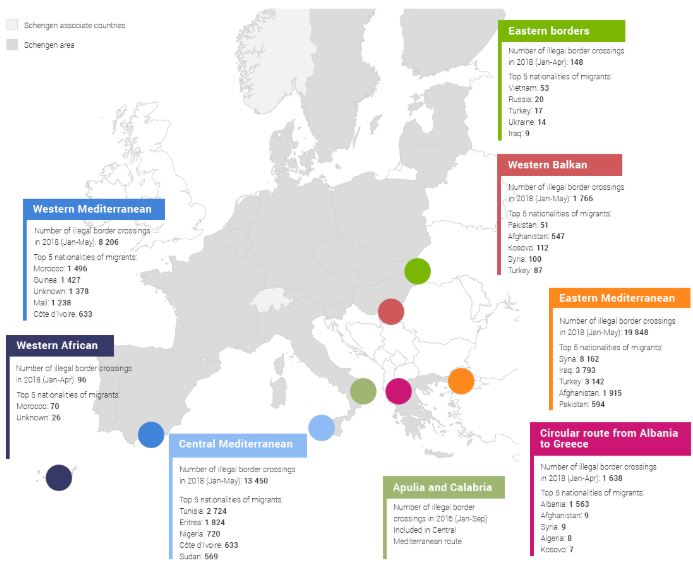
None of the Visegrad countries or Austria is currently dealing with anything that could reasonably be called a level of refugees that they can't handle. The European border and coast guard agency, Frontex, currently has figures on the January-April 2018 illegal border crossings into Europe:


This presumably doesn't include legal entrants, which include people applying for asylum that may not get it. But what this map of the significant immigration routes is that most of them involve people from the Middle East and North Africa. Those immigrants are not directly entering The Visegrad states or Austria. Italy and Greece are holding large numbers of refugees from Middle East and North Africa. And Greece especially has very legitimate complaints about inadequate solidarity on support and resettlement of immigrants from their fellow EU members.

But solidarity and support are not what the anti-immigrant policies of the Visegrad states and especially not from Austria and Czechia are about.

In Austria's case, Chancellor Babyface is trying to posture as the defender of Austria's borders by posturing over issues on which Austria has no direct control.

Starting in July, Chancellor Babyface will represent Austria, which holds the Presidency of the Council of the European Union. Which is not the same as the President of the European Council, who is currently Donald Tusk. The lack of clarity of roles in the EU is one of the various reasons for the "democratic deficit" in the EU.

But Kurz, who will be formally one of the key leaders of the EU in the second half of 2018, is actively undermining the EU with his demagogic anti-immigrant policies and posturing. To him it must look like cheap political gains. Because Austria itself doesn't have to directly implement these tougher external border policies he's promoting because Austria is not a Schengen border country.

Most importantly, Kurz and his Visegrad buddies are not promoting real solutions to the refugee problem. Politicians like Kurz and Strache aren't interested in solving the actual problems, only in exploiting them to promote authoritarian rightwing politics.

The broad outlines of a real European solution to the crisis are actually fairly obvious: stop supporting American wars in the Middle East and engage diplomatically to avoid wars in the Middle East and other external military interventions like those of Russia (and, yes, that will damage the profits of some European arms dealers and that's a good thing); a fair and comprehensive program for settling prepare adequate emergency services to handle unexpected surges in refugees like those in 2015; sufficient or more-than-sufficient support for the refugee camps in Greece, Italy, and Turkey.

There's a lot of empty talk right now about setting up asylum center in Libya and other places to process asylum claims there. This is largely a joke. First of all, if you're trying to flee a country persecuting, killing, raping, or starving you, is anyone in their right mind going to go to the government doing that apply for asylum elsewhere? Asylum applications involved preparing legal cases. Are countries like Libya going to provide those? That's really a bad joke.

Chancellor Babyface has a great chance the second half of 2018 to use his diplomatic visibility in the EU to promote some real solutions and not just PR stunts. So far, there is no indication that he intends to do so.

And for Kurz and Strache to promote the fascist anti-immigrant and anti-Roma (Gypsy) politics of the new Italian Interior Minister Matteo Salvini is about as destructive it can be for any serious effort to address the real (not imaginary) refugee problems of the EU.

Wednesday, June 20, 2018

Xenophobic theater - that does real harm to real people

Xenophobia sometimes makes good political theater for rightwing, authoritarian politicians and leaders. That's not to say that center-left and labor parties don't sometimes indulge it, as well. But it works particularly well for authoritarian parties.

We're certainly seeing that right now with Trump's policy of kidnapping children of immigrants at the Mexican border and putting them in makeshift prison camps. This report on flight attendants' reactions to serving on planes acting as the transport to the child prison camps is revealing, Anonymous Flight Attendant On Child Prison Plane Tells All The Young Turks 06/19/2018:


Trump is implementing a solution to what is in many ways a non-problem. Net immigration from Mexico has recently been negative, i.e., more Mexicans return to their country each year than those that move to the US. The American economy in many ways is currently dependent on undocumented workers, particularly agriculture but by no means only that sector. Trump's repeated claims that Mexican immigrants are rapists, murderers, and MS-13 gang members are just not true.

The children coming across the US-Mexican border are certainly not a significant threat to Americans. Even taking into account that some of them may end up in gangs, particularly if their opportunities to integrate into American society are restricted even more.

But dehumanizing immigrant children is a typical xenophobes' propaganda pitch. In Europe, the image of kindergarten kids wearing a hijab (Muslim head covering) is used by the far right and anti-immigrant politicians in Germany and Austria. It's a way of taking innocent or positive images - a headscarf can keep your head warm and dry in the winter, a kindergarten-age girl for most people is an image of someone who needs affected and be protected from harm - are transformed into a scary threat to Western white Christian civilization and a menace of terrorism in the form of a five-year-old girl in a hijab. Which is about as much of a non-problem as it can be. Because not only is a small girl no immediate threat to an adult man or woman in any remotely normal circumstance. But even devout, conservative Muslim families require their kindergarten-age children to wear hijabs.

The American term "anchor baby" serves a very similar function. Anchors keep your boat safe and stable, and babies are harmless and cute. But in the form of "anchor baby," they become a threat of undermining everything dear to white folks who understand themselves as the only Real Americans.

The Austrian Chancellor Sebastian "Babyface" Kurz (ÖVP) is currently promoting what he describes as an "axis of the willing" with Germany and Italy to promote anti-immigrant sentiment and policies in Europe. Kurz on Wednesday was meeting with Bavarian Landeshauptmann (Governor) Markus Söder (CSU) in the Upper Austrian capital city of Linz to promote the position of the German Interior Minister Horst Seehofer, head of the CSU and one of Söder's predecessors as Bavarian Governor, to turn back asylum-seekers at the German border. This is essentially a non-problem, as well. It just gives Seehofer and Söder a way to demonstrate their hostility to immigrants and promote anti-EU sentiment. Seehofer is also using it in the moment as part of a tricky political game with Chancellor Angela Merkel. (Nina Weissensteiner, Kurz und Söder machen im Asylstreit auf enge Spezln statt neutraler Nachbarn Standard 02.06.2018)

Matthew Karnitschnig reports (Angela rises from the ashes Politico EU 06/19/2018):
CSU leader Horst Seehofer, who is also interior minister, agreed to put off enforcing a new rule to turn back refugees at Germany’s borders until after the upcoming European Council summit, in order to give Merkel more time to negotiate with other EU capitals.

It’s a long shot that Merkel will actually succeed in securing a sweeping deal over the next two weeks to return refugees who show up at Germany’s border from Italy or Greece. Whether the CSU is ready for another face-off with Merkel is another matter.

Meanwhile, Kurz' far-right Vice Chancellor and Foreign Minister HC Strache was down visiting with his comrade in the (informal) Nationalist International, new Italian Vice-Premier and Italian Interior Minister Matteo Salvini of the far-right anti-immigrant League party. Salvini attracted favorable attention from xenophobes in his brief time in office by refusing to allow rescue ships carrying refugees from Africa to land in Italy, defying international law. Salvini declared himself and Strache to be "friends and allies in defending our peoples." Defending them, that is from taking refugees rescued from drowning int he Mediterranean Sea. (Vizekanzler Strache bei Vizepremier Salvini in Rom Salzburger Nachrichten 20.06.2018)

Salvini was also thereby "solving" a non-problem. Europe does face a continuing long-term crisis in emigration from the Mideast, Afghanistan, and North Africa, not incidentally places where the United States has been fighting wars for the last two decades, more-or-less. A surge in refugees in 2015 set off a political panic that has not yet ended, although immigration declined drastically the following two years and is significantly down even in Italy from 2018. "Despite recent immigration data from the Italian interior ministry showing a 76 percent drop in arrivals in the first few months of the year, the country’s new allies [Austria and Hungary] have migration [sic] as a prime-mover in common, though they differ significantly over what to do about it." (Jacopo Barigazzi, How Italy plans to blow up Brussels Politico EU 06/18/18)

But real harm to real people and real institutions can come from this kind of nationalist demagoguery. Salvini has also announced his taking moves to more closely monitor Roma (Eric J. Lyman, Italy's interior minister wants census for Roma; critics call controversy 'racist' USA TODAY 06/19/2018) in Italy and expel some of them.

Economist and former Greek Finance Minister Yanis Varoufakis tweets:


Correction 07/15/2018: The Foreign Minister of Austria in the Kurz government from 12/18/2017 to now has been Karein Kneissl; Heinz-Christian Strache has not been Foreign Minister. Strache is Vice Chancellor and Minister of the Civil Service and Sport.

Monday, June 11, 2018

Xenophobia, the Austrian right, and the rescue ship Aquarius

I'm not sure whether this is more silly than it is obnoxious, although it was presumably meant to be the latter: FPÖ will "Heimat" in Oberösterreichs Landesverfassung verankern Die Presse 08.06.2018.

The state government in the Austrian state of Upper Austria is run by a coalition of the conservative, Christian Democratic People's Party (ÖVP) and the far right, anti-immigrant "Freedom" Party (FPÖ), the same party combination currently running the national government. This proposal was announced by Vice Governor Manfred Haimbuchner (FPÖ) aund FPÖ state party leader Herwig Mahr.

The language they are proposing to be included in the state constitution reads, "Das Land OÖ bekennt sich zur Heimatpflege durch das Bewahren der landestypischen Brauchtümer und Traditionen" ("The state of Upper Austria commits itself to preserve the Heimat through guarding the customs and traditions typical to the state.") Haimbuchner suggested that handshaking would be protected by the provision. And also would prevent pork from being banned.

We aren't exactly talking high constitutional theory here.

As you might guess, protecting pork against being banned is a dumb-as-dirt Islamophobic pitch. If there is any proposal in the Austrian Parliament or the Upper Austrian Landtag to ban pork, it has somehow escaped my notice. And, I'm guessing, everyone else's, too. It a non-solution to a non-problem.

The wording cited is so vague I wonder if it would have any definable effect at all. But putting dumb and irrelevant stuff is always a bad idea. Because some judge may seize on it as a way to make an absurdly political decision that makes no sense. Like, say, ruling that a health-food grocery has to close because it doesn't sell pork there. Or whatever.

Really, it's just cheap publicity for Islamophobic hate propaganda.

This, on the other hand is considerably more serious. Austrian Vice Chancellor and head of the xenophobic FPÖ, H.C. Strache

The Strache statement says, "Under the new Italian Interior Minister Salvini, illegal migration will no longer be tolerated. Good so!" The Austrian anti-foreigner right use "migrant" to refer to desperate refugees from war zones being rescued from drowning to suggest they are just trying to come mooch off good Christian white Europeans.

He's talking about the ship Aquarius, a humanitarian rescue ship that saves people from being drowned in the Mediterranean trying to flee from the Libyan coast on often unsafe boats. The rescue ship has been stranded mid-way between Italy and Malta, with both countries refusing it permission to land. Angela Giuffrida reports in Mediterranean rescue vessel crew keep migrants calm during standoff Guardian 06/11/2018:

Onboard the vessel are 629 people, including 123 unaccompanied minors, 11 babies and seven pregnant woman. The ship is operated by the French-German charity SOS Méditerranée and has been undertaking risky year-round, search-and-rescue missions in waters north of Libya since 2015.

Victoria Russell, a spokeswoman for Doctors Without Borders (MSF), which has staff working on the boat, said the situation was under control but could change at any moment.

“None of the people on board have any idea about this whole diplomatic standoff that is unfolding around them, but they are starting to ask questions: why has the ship stopped?” she said. ...

More than 15 people onboard have serious chemical fuel burns requiring regular care, due to oil spills from the cheaply made rubber boats they travelled in from Libya. There are also a number of cases that require orthopaedic surgery.

Some of the passengers had to be resuscitated after almost drowning during a challenging overnight rescue operation on Saturday.

“They have sea water on their lungs … they’re stable right now, but it could change at any moment, and they would need assistance that we can’t provide on the boat,” said Russell.
So, seriously, do Strache and his Burschenscaften party have any actual solutions to refugee problems like this other than to bitch and moan about foreigners?

What do they suggest that Italy and/or Malta do with this boat? Just sink it? Let all the people on it drown? It's a serious question.

The new social-democratic Prime Minister of Spain has a more human response:


Demagogic anti-immigrant rhetoric leads to this eventually leads to callousness and brutality.

It always worth remembering in connection with news about the chronic refugee crisis in Europe that a major contributor, currently most likely the main cause, is the wars in the Greater Middle East the last two decades, from Afghanistan and Iraq to Yemen and Syria, mightily encouraged by the US and other NATO powers not just diplomatically but by direct intervention and massive arms sales to the belligerent parties. A war against Iran would add yet another major source of refugees.

Saturday, September 16, 2017

The Big Three in the Austrian Chancellor's race

On Friday, I had the chance to attend the "Big Three" debate between the three leading candidates for Austrian Chancellor in the election of October 15 in the Design Center in Linz. It was sponsored by the leading state/provincial newspapers, including Die Presse (Vienna) and the Oberösterreichische Nachrichten (Upper Austria). The video of the debate in German is available online at the Kleine Zeitung and at Bei Steuerplänen schieden sich die Geister, Lucian Mayringer et al, Oberösterreichische Nachrichten 15.09.2017. (The sound on both is low for the first few minutes.)

Austria has a parliamentary system, with the President elected as head of state in a separate election from the Parliament. The head of government is the Chancellor, whose function is called Prime Minister in some other countries, and is typically elected by a majority in Parliament, which often requires a formal agreement between two or more political parties. Since 1987, the government has mostly been composed of some combination of the center-left Socialdemokratisched Partei (SPÖ) and the center-right Christian-Democratic Volkspartei (ÖVP). The third-largest party is the Freiheitliche Partei (FPÖ), which we could (generously) describe as far right.

The Big Three (l to r): Sebastian Kurz, Christian Kern, HC Strache

In this campaign, the current Chancellor Christian Kern is candidate for the SPÖ, Foreign Minister Sebastian Kurz for the ÖVP, and Heinz-Christian Strache for the FPÖ. Technically, Kurz is running on the Sebastian Kurz List, but that's basically just a marketing ploy. Kurz is currently the leading candidate in the polls, and is trying to maximize the potential advantage of looking as he does 16 years old and to emphasize that he's a new and fresh leader. Actually, at 31, he's almost twice as old as he looks.

It was a relatively civilized debate, which the press commentary reflected. Here is one way in which an American has to remember that Austria is different from the US. In Austria, it's not considered normal for a candidate to, for instance, demand that their opponent be locked up. Or to complain that female reporters menstruate. But politics is inevitably about conflicts, so not everything was harmonious at the debate.

The topics included education, taxes, digitalization and employment, the budget, pensions, and immigration. But immigration and the status of non-citizens in Austria - a topic on which I don't pretend to be a disinterred party - was the main theme, thanks in particular to Kurz. Prior to 2015, xenophobia was mainly pushed by the FPÖ. For instance, in 1993 the FPÖ used an anti-foreigner referendum campaign to exploit nationalist and xenophobic sentiment. They called their campaign "Austria First." And in a fashion now all-too-familiar to Americans in our own politics, the FPÖ has consistently encouraged and maintained visible links to hardcore anti-democratic rightwing groups, some of which constantly flirt with neo-Nazi propaganda, the latter being illegal in Austria under the terms of the Independence Treaty of 1955 with the US, the then-USSR, Britain and France.

But Kurz has made the anti-immigrant theme his own. In Friday's debate, Kurz introduced an anti-Islam meme into a discussion of education ("Islamic kindergartens"). And he and Strache competed in beating the anti-foreign drums. Problems in the education system? According to Kurz and Strache, the only real problem there is that there are too many g*******d foreign children in Austria. Budget problems? Also because there are too many g*******d foreign children in Austria. Since current American levels of crassness aren't yet respectable in Austrian politics, they didn't actually use the cuss word.

Kurz claimed the low point for the day when he complained that there are too many Africans in Africa and they are still breeding more. Seriously! Maybe he was thinking that white South Africans have too high a birth rate. But I'm guessing not. It's a notable accomplishment for the leader of the ÖVP to come out of a face-to-face confrontation with Strache sounding like the more xenophobic of the two.

I was surprised that the word "terrorism" never came up in the debate, because Kurz and Strache have typically linked their hostility to foreigners with security questions. It was especially surprising because of the current report on Friday of what could have been an attempted terrorist attack in London.

But for me it was grim to hear with what a complete lack of compassion and realism the three candidate discussed the issue of refugees. All the three parties including the SPÖ have stressed the need to keep refugees out. Kern did introduce a bit of realism into Friday's discussion by talking about the real problems of war, climate change and economic crisis in the Middle East and North Africa. But it was discussed all but exclusively in terms of keeping the foreigners out of Austria.

I wouldn't want to minimize the seriousness of the ongoing refugee crisis in Europe, which is far from over. On the contrary, it's a chronic problem that the EU is currently handling with the "extend-and-pretend" approach which has been the dominant characteristic of Angela Merkel's approach to both the euro crisis and the refugee crisis. The current perception of the crisis in Austria has been heavily influenced by the refugee surge in 2015, with chaotic scenes in the city of Salzburg and the town of Traiskirchen. Ferry Maier and Julia Ortner present some of the substantive issues on the handling of refugees in Austria, including the state of the national and state emergency services, in Willkommen in Österreich? (2017).

A not-especially-diverse pundit panel discuss the discussion afterwards

But the Big Three couldn't find much time to address those substantive issues on Friday. Instead what was mainly on display were the polemical techniques the xenophobes have used to transform the image of desperate people fleeing war and severe persecution into one of coddled foreigners getting special benefits that Austrians don't get. And specifically into an image of Austrians being threatened by the presence of foreign children. It's ugly stuff.

On the bright side, there wasn't much use of favorite Islamophobe buzzwords, except for "Islamic kindergartens." (There were no similar complaints in the debate about Catholic kindergartens, of which Austria has plenty.)

On the other issues, the most substantive point was made by Chancellor Kern on tax policy, when he stressed that tax cuts, which all three are advocating, should be targeted to lower and medium income earners, not to corporations or the wealthy. And he stressed - accurately - that the Kurz and Strache proposals would most benefit the latter. None of the three wanted to be very specific about what program cuts would accompany their tax cuts. No one even mentioned the issues a large tax cut might cause for Austria under the terms of the eurozone Fiscal Suicide Pact, officially the Treaty on Stability, Coordination and Governance in the Economic and Monetary Union, better known as the Stability Pact.

Kern and Strache were agreed in opposing the increase of the retirement age, which Kurz supports.

But on other entries, all three generally took seemingly safe, stock, anodyne positions on most issues. All three are in favor of good education. They all favor increasing government efficiency. All three are committed to the TINA (There Is No Alternative) Angela Merkel/Herbert Hoover economic policies that are currently dominant in the EU. A symptom of the latter is that all three used "education" as a magic conjuring word that would solve all economic problems. And, if it doesn't, well, it's your own fault for making those infamous Bad Choices. Along with the usual fantasies about unemployed workers in their mid-50s retraining for new and better jobs.

The discussion was moderated by Wolfgang Braun of the Oberösterreichische Nachrichten and Claudia Gigler of the Kleine Zeitung. Gigler was the only female journalist with a role in the discussion. Afterwards, there was a half hour discussion of the event by six commentators, all of them white guys. There was some diversity there, though. At least one of the six on the pundit panel was probably younger than 50.

Like their American counterparts, the journalist panel was particularly interested in the horse race speculation. Who will get the biggest vote? And what kind of party coalition could then be built? On that score, it was pretty obvious that Kurz and Strache were campaigning for an ÖVP/FPÖ coalition. That probably contributed to Strache's relatively restrained conduct in the appearance, which is not always his approach.

It struck me early on that Strache was the most experienced politician of the three. He was quicker on his comebacks and easily employed humor. Kern sounds like a Chancellor, which he is. But a glad-handing politician, not so much. I would agree, though, with the commentators who noted that Kern's performance could enhance his credibility at governance. That is, for the voters for whom that's important. Kurz comes off like a well-spoken teenaged conservative twit who thinks there are too many Africans in Africa.

For an American used to the tiresome rituals of our own TV Pod Pundits, it's refreshing to see journalists actually act like journalists and pressing politicians to respond to their questions and not just letting them repeat their preferred talking points. Braun and Gigler did a good job of that during the main event. What was missing, though, was some much needed fact-checking. Strache, for instance, ranted at one point about hundreds of millions of euros being paid to support non-existent children. Which would be a suspect claim even it weren't coming from someone like Strache, who lies like breathing on topics like this. Kern then ridiculed Strache's claim with a more credible-sounding number about the entire cost of the program in question. But neither Braun nor Gigler offered any kind of fact-checking on the topic, which would have really been helpful. Especially since Strache's claim is a popular xenophobic talking point right now. In his mini-rant about there too many Africans in Africa, Kurz also used population growth rate predictions that were fantasy nonsense, which also could have used a real time fact-check from the reporters. (Not that his point had anything to do with mastering demographic forecasts.)

A final cross-cultural observation: The Chancellor's debate included no discussion about whether Austria should nuke North Korea. Or start a war with Iran. Or send more troops to ongoing conflicts in Afghanistan, Iraq and Syria. Comparatively speaking, from an American viewpoint Austria has a much preferable set of problems to wrestle with.

Press reports: