Showing posts with label sebastian kurz. Show all posts

Friday, September 21, 2018

EU summit in Salzburg kicks cans down road

The EU heads of state and government had a summit meeting Wednesday and Thursday in Salzburg. There wasn't much drama. And not much was accomplished.

A Politico EU report on the summit opens with, "That was awkward." (David Herszenhor and Jacopo Barigazzi, Rocky mountain summit 09/21/2018)

Austria's Wunderwuzzi Chancellor Sebastian "Babyface" Kurz (ÖVP) currently holds the six-month rotating Presidency of the EU Council and so had a lot to do with shaping the agenda. His signature issue is his bitter opposition to immigration and apparently he is apparently equally determined not to address the current issue in Europe in a practical and serious way. So the first day of the summit was devoted to the topic of how the EU can shut out foreigners. Kurz as Council President established that topicfor the summit.

The main solution to the challenge of refugees from the Middle East and Africa coming to Europe to ask for asylum is called Turkey. Angela Merkel came up with that extend-and-pretend solution in 2016: the EU pays Turkey, and makes various other concessions, and Turkey holds what is now around three million refugees and prevents them coming to the EU. It's not a stable solution nor is it one that gives particular attention to what the refugees can do in the future. And if (when) the Syrian government launches its expected military assault on Idlib province, it could send up to 800,000 new refugees into Turkey and quickly destabilize the current arrangement even more.

Herszenhor and Barigazzi also report that Austrian hospitality was not nearly so obsessively-complusively organized as one might expect from Austrian stereotyples:
The media center was far too small for the 1,000 journalists in attendance and, thanks to a glass roof and unseasonably warm September weather, it effectively turned the building into a sauna. Adding to the ambience, butter-fingered catering staff repeatedly dropped glasses and coffee mugs, smashing them on the tiled floor — making the event feel like a Greek wedding.

The breakdowns continued until the very end, when the audio feed failed during German Chancellor Angela Merkel’s closing news conference.
Given how Kurz and his coalition partner and Vice Chancellor Heinz-Christian Strache (FPÖ) are combining anti-EU posturing with their anti-immigrant policies, it wouldn't surprise me at all to find out the glitches they report were at least partially intentional.

Thursday was devoted to Brexit.

If anything of substance was accomplished on either issue, it was not very evident.

They all did reiterate their consensus on strenthening Frontex, the EU border control and coast guard agency agency.

Miguel Otero-Iglesias gives this summary of what a real solution might look like - a solution the EU has been unable to deliver, despite the massive freakout about the large wave of refugees arrived in 2015-6 (Europe’s two-faced migration reality Politico EU 09/21/2018):
The most persuasive idea, advocated by the World Bank, is to develop legal channels of migration based on the demand of the job market and better education and retraining systems to cover the displaced local workforce. These programs could be financed by the introduction of progressive fees on working visas. Crucially, these visas would be for time-limited periods, and only those migrants who integrate well would then acquire the nationality of the host country.

But for such a scheme to work, borders would need to be better controlled, repatriation agreements further developed and better implemented, and inspections against hiring of irregular workers would have to be more intrusive and widespread.
It would also have to specifically address the fate of the millions of refugees now retained in limbo in Turkey, Italy, and Greece. And it calls for a reorientation of EU foreign policy to mitigate conflicts in the Middle East and Northern Africa. The NATO intervention in Libya in 2010 was a major contributor to the current situation. I wouldn't venture to say that Libya under Gaddafi had a model immigration policy. But they did provide some economic opportunities for African immigrants and blocked a significant portion of immigrants from going north toward Europe. (Otero-Iglesias's boiler-plate lines about displacement and retraining could use some work, because displacement of current workers is a minor issue at best, although public perceptions may be otherwise thanks to xenophobic propaganda.)

The EU was at least able to come up with a small story on Serbia maybe-sometimes-soon will make an agreement with Frontex to enhance their border controls, but certainly not to accept more of them as immigrants. (Frontex ja - Flüchtlinge nein Wiener Zeitung 21.09.2018)

Kurz has proven himself adept in his first year as Chancellor at making a show of doing something on his pet anti-immigration issue. Coming up with substantive solution hasn't yet shown itself to be a strong point for him. The EU summit continues that pattern.

It's even less surprising that nothing of substance got accomplished on Brexit. The current deadline for Brexit is March 2019. And all sides have an interest in waiting to the last possible moment to close the deal, with the qualification that economic uncertainty will be more pressing as the months roll on. Businesses and banks are making preparations for the split, so the terms of Britain's exit are important.

The main sticking point in the Brexit negotiations now is how to manage the borders between British Northern Ireland and Ireland. (Tom McTague, UK, EU still can’t solve Irish border conundrum Politico EU 09/21/2018)

The peace agreement that finally ended decades of bitter and violent conflict in Northern Island crucially involved free movement between Northern Ireland and Ireland. Once Britain is formally outside the EU, having the current level of free border movement would mean that Britain's border would not be a normal international border between and EU and non-EU countries. Britain in understandably reluctant to establish the regular border security and enforcement at a line inside Britain, at the border to Northern Ireland. In concept, that would be analogous to Texas having an open border with Mexico and the national border controls being enforced only at the Texas borders to other US states. That is not the way inernational borders normally work.

Wolfgang Münchau's Eurointelligence describes that current status of the negotiations in The long Brexit endgame has started 09/20/2018:
What complicates the Brexit process massively is the multitude of triangular games: there are three competing positions in the House of Commons, none of which commands a majority on its own: May’s Chequers’ Plan; a eurosceptic Canada-style Brexit; and Labour’s plan for a customs union. Everybody is playing the same game: as we reported yesterday Labour does not want the spectre of a second referendum to scare eurosceptics in the Tory party into supporting Chequers. The British government is playing the converse game. A treasury minister yesterday upheld the possibility of a second referendum for precisely this reason - to scare the eurosceptics into supporting Chequers.
In another post (EU ponders Irish backstop protocol to help May Eurointelligence 09/17/2018):
The EU‘s technical solution differs in some respects from that of Theresa May, but the technical details are not the critical point at this stage. More important is the legal procedure itself. The EU is offering a protocol to the Irish backstop clause in the withdrawal treaty, which sets out possible technical solutions in case no agreement on a future trading relationship is agreed. As long-standing observers of technically complex EU-level treaty discussions, we are not surprised to witness the grand entry of the protocol, an important legal device in EU diplomacy that often succeeds in overcoming seemingly insolvable problems. Important as it may be, in historical perspective the Irish backstop is not the most difficult obstacle EU diplomats ever had to surmount. [my emphasis]
Monika Graf makes a very appropriate cautionary observative in Krisen machen die EU stark. Derzeit gibt es keine. Salzburger Nachrichten 21.09.2018 (behind subscription). She picks up on the optimistic saying that crises make the EU stronger. That can't be said of the handling of the Greek crisis in 2015, which helped set the stage for the contentious inability of the EU to agree on a Union-wide solution for the refugee inflow of that year that continued into 2016, commonly referred to as the refugee crisis of 2015.

She points out a flip side of that optimistic saying, which is that the EU can only manage to come up with good common solutions on major issues when there is a crisis. And that's not a good thing:
Rational betrachtet müssten die EU-Staaten jenes Zeitfenster nutzen, das sich durch die gut laufende Konjunktur und die Erfolge bei der Eindämmung von Defiziten und Migration geöffnet hat. In allen Staaten der Eurozone wachst die Wirtschaft, sogar um die italienischen Banken ist es wieder ruhig geworden, und an der Südküste Europas sind bis August so wenig Menschen angekommen wie nicht einmal vor 2015.

[Rationally considered, the EU states must use this time window that has been opened by the postive economic cycle and the successes with the limiting of deficits and migration {immigration}. The economy is growing in all state of the eurozone, things have even calmed down with the Italian banks, and since August there were fewer people arriving that even before 2015.]
The Herbert Hooverish conventional wisdom on both sides of the Atlantic continues to be harmful for economic policy. But the point that she's making here is that even taking view of the deficit obsessives, the EU should be making progress on major problems like immigration and presumably on reforming the eurozone before another crisis hits.

And depending on how the military situation in Idlib develops, a new surge in immigration could begin in the fourth quarter of this year.

Friday, September 14, 2018

The weirdness of immigration controversies in European politics

The immigration issue continues to be exploited by far-right radical and anti-EU groups in Europe. The situations in Germany and Austria are the ones with which I'm most familiar.

What I continue to find astonishing is how divorced from pracitcal and realistic solutions the public debate often is.

The current solution to the mass immigration problem originating from the Middle East and North Africa was established by Angela Merkel in early 2016 in negotiations with Turkey's authoritarian President Tayyip Erdoğan. The deal in simple terms was that Turkey would hold the refugees coming across the Mediterranean in exchange for the EU paying them to do so.

The EU outsourced its most difficult border control problem to Turkey, which currently holds three million or so refugees in conditions that are very likely not the best. A smaller number are also held in Italy and Greece.

In politics, a "solution" that holds for two and a half years is easy to count as a success. But this was always a delicately balanced arrangement that could fall apart at any moment if, for instance, Erdoğan's government decides it serves them better to start sending massive numbers or refugees north than to keep holding up their end of the deal. Italy's new government, in which the far-right Lega party led by Interior Minister Matteo Salvini controls immigration policy, is already posturing against EU agreements and international law to show how much his party hates foreigners.

It's a standard Angela Merkel extend-and-pretend solution.

And it can be thrown out of kilter by a Syrian military push into the Idlib province. Michael Peel reports (EU steps up planning for refugee exodus if Assad attacks Idlib Financial Times 09/14/2018):
The situation in and around Idlib, which borders Turkey, has added urgency because several million people are estimated to be gathered there.

The UN Office for the Co-ordination of Humanitarian Affairs said this week that 30,000 people had been displaced from their homes by air and ground attacks by the Syrian regime and its allies on the opposition enclave, while a full assault could drive out 800,000.

Jean-Claude Juncker, European Commission president, this week warned that the “impending humanitarian disaster” in Idlib must be a “deep and direct concern to us all”.
So it's not as though the EU governments and leaders don't know that they are facing a longterm, ongoing immigration crisis. But, as Peel also reports, the immediate goal is to clear current immigration camps in Greece by accelerating settlement of their current occupants to make way for new refugees.

But from his report, it appears that even that preparation is something ongoing for other reasons, "The proposal is primarily aimed at dealing with what 19 non-governmental groups on Thursday branded 'shameful' conditions at the island migrant centres." Greek Prime Minister Alexis Tsipras is meeting next week with the EU "migration minister" to discuss ways to free up 3,000 spots in the current camps.

Yes, with the imminent prospect of up to 800,000 refugees coming out of Syria to Turkey in the next few weeks, Greece and the EU are looking to free up 3,000 spots in current camps. The current camps that NGOs are criticizing, with good reason, for already bad conditions.

If this were a problem that appeared suddenly due to, say, an asteroid striking the Middle East, the EU's lack of preparedness might be more understandable. But the asteroid was the American invasion of Iraq in 2003 and the subsequent destablization of Iraq and Syria, along with the NATO intervention in Libya in 2011 which left Libya a failed state. That meant that Libya, which had previously absorbed large numbers of African refugees as workers, was no longer able and willing to do so. By virutally all Western news accounts, conditions in the current camps in Libya are genuinely horrific.

Since 2011 - the year of the NATO intervention in Libya - there has been a visible crisis of large numbers of refugees making their way on the very dangerous trip across the Mediterranean toward Europe. That was seven years ago. In 2018, the EU is struggling to free up 3,000 places in Greek refugee camps in face of the impending exodus of up to 800,000 refugees from Idlib.

That's what an extend-and-pretend solution looks like.

There is actually a practical, resonable, and humane way for the EU to handle this problem. Its basic elements are well known and have been discussed for years:
  • Establish individual country quotas for the reception of non-doucmented immigration flow. In the case of an Idlib situation, that could mean parceling out hundreds of thousands of refugees in a few months time. In less acute years, like most of 2016, 2017, and 2018 to date, the numbers would be radically lower.
  • Set up pro-active training programs and recruitment of immigrants for jobs which are not being filled by already-legal EU residents. In Germany and Austria, home assistance for the elderly is a job of which there is and will continue to be a growing demand. They are currently being filled mostly by immigrants, many of them from eastern EU countries. And for the same reason that agriculture in the US is completely dependent on immigrant labor, including massive numbers of undocumented workers: they can't get native workers to do it at any feasbile wage level.
  • Provide expanded development assistance to African countries in particular to provide local opportunities for people there.
Another measure that is much discussed is establishing asylum centers in Libya or other places outside of the EU borders where refugees can apply for asylum in Europe. This is known as the "Australian" solution.

But we don't need to know much about what Australia is doing to see that the latter proposal is only barely more than pure fantasy. And that's probably putting it too generously. No African country has agreed to such a scheme, and none are likely to do so. The proposal as it is being discussed runs into all sorts of problems in international and EU law. The only way the EU could insure that such camps would provide minimally humane and secure conditions in countiries like Libya would be to run the camps themselves. The PR problems of the EU setting up camps in Africa in which refugees could be, uh, concentrated, is actually the least serious problem involved.

The rightwing nationalist parties in EU countries are flatly opposed to a new system of refugee settlement and assimilation ("integration" in the official jargon in Germany and Austria). The weakened center-left parties have also been timid at best in validating this approach.

In Austria and Germany and other EU countries, the native birth rate is below the replacement rate, which means that population is expected to decline in coming decades. In order to have growing economies in the sense we currently understand economic growth, they will need significant numbers of immigrants. Several former Eastern Bloc countries are already suffering serious negative economic impacts because so many younger workers have already immigration to other EU countries.

Expanded developmental aid to African countries like Niger is certainly a worthy goal. Also a difficult one to pull off. And that talking point does nothing to address what will happen if another 800,000 refugees come into Turkey in the next few months. Politicians advocating this typically don't bother to reference the fact that the biggest development aid some African countries are currently getting comes from their citizens working in Europe who send money back to their families. And since those amounts are going to individual famililies, much of it presumably gets spent on consumption which boosts their economies. And is also, I assume, less vulnerable to massive diversion of funds than some traditional aid projects might be. In other words, African workers in Europe are a major foreign aid provider.

Much of the actual political rhetoric around immigration, though, is frivolous. The Austrian government has been taking various measure to make life for asylum-seekers in Austria more difficult, which does have the real effect of hurting real people. The rest is largely posturing. In one sense, Austria is a "free-rider" on border issues, because it doesn't have a Mediterranean coast. The current Chancellor Sebastian "Wunderwuzzi" Kurz likes to talk about boosting the presence of the border patrol Frontex, which the EU is currently doing. But if a situation like 2015 occurs again, which could happen at almost any time, and refugees are sent north to Hungary and Austria, what is Chancellor Wunmderwuzzi actually going to do? Gun them down at the border? And, if not, he's going to need a whole lot more than empty rhetoric about asylum centers in North Africa.

He rose to be Chancellor at age 31 because he skillfully exploited and fed xenophobic fears and, as Foreign Minister in 2015-16, did a lot of posturing against Germany and Angela Merkel which in the context, had no real downside for him politically. But if the current -house-them-all-in-Turkey solution doesn't work, he's like to find that chest-beating is a limited practical use in a new acute phase of the immigrantion crisis.

Meanwhile, Putin's government in Russia currently sees an advantage in weakening the US and a very useful instrument to promote it in the immigration issue. Viktor Orbán's government in Hungary is currently the main European model for the anti-EU parties from Austria to Czechia, Solovakia, Poland, Sweden, Germany, Italy, and France. Some of those parties like the FPÖ in Austria have formal friendship/cooperation agreements with Putin's United Russia party, an arrangement that seems to be a rightwing reflection of the arrangements the Soviet Communist Party had with affiliated Communist parties in Europe. Not surprisingly, the Putin-allied parties are agitating over immigration issue, which they polemically call a "migration" crisis, in ways that align with Putin's foreign policy goals.

Monday, August 20, 2018

Anti-immigrant policies in Europe

The anti-immigration agitation in Europe, as in America, is often a fact-free zone. Facts are very often more than inconveenient for the xeophobic narratives.

Still, facts do matter. Not to xenophobic politicians and agitators. But they do matter.

Christoph Reuter et al prsent a count of Syrian refugees in "Die Logik der Sieger" Der Spiegel 33: 2018 (11.08.2018):
Doch zumindest die Verlierer des Kriegs stehen fest: all jene, die sich gegen das Regime Assads erhoben. Doch letztlich hat das ganze Land verloren. Unter den 400 000 bis 500 000 Toten sind auch Zehntausende Soldaten aus Assads alawitischer Minderheit. Fünfeinhalb Millionen Syrer sind in Anrainerstaaten geflohen, dazu kommen sechseinhalb Millionen Binnenvertriebene, insgesamt etwa die Halfte der Bevölkerung von 2010.

[... at the least it is clear who the losers of the {Syrian civil} war are: all those who rose up against the Assads regime. Actually, in the end the whole country lost. Among the 400,000 to 500,000 dead there are also tens of thousands of soldiers from Assad's Alawite minority. Five and a half million Syrians have fled to neighboring countries, in addition to six and a half million internally displaced, altogether around half the population of 2010.]
War makes refugees.

Meanwhile, the Austrian government of Chancellor Sebastian "Babyface" Kurz continues to embarrass itself with it foreign policy that looks more all the time like subservience to Putin and Russia.

Here again the Russian state channel RT presentation of Putin dancing with the bride at the wedding of Austrian Foreign Minister Karin Kneissl, after which she bows and kneels to the Russian President, Putin dances, speaks German at Austrian FM’s wedding 08/18/2018):


The event called further attention to the deferential attitude Kurz' government has been taking toward Russia and pro-Russian parties in the Balkans, as Adelheid Wölfl reports in Die türkis-blaue Politik sorgt am Balkan für Irritationen 20.08.2018. Over eight months into the existence of the new government, it's pretty clear that Chancellor Babyface (ÖVP) is following the lead of his Vice Chancellor Hans-Christian Strache, whose party (FPÖ) has an Agreement on Joint Endeavors and Cooperation with Putin's United Russia party. Wölfl notes with in the FPÖ has an "ideological alliance" with hardline nationalists in Serbia and the "Republika Srpska," which is actually part of Bosnia but which Serbian nationalists regard as a legitimate part of their envisioned Greater Serbia.

Austria in the past has sought to position itself as a kind of disinterested party that could mediate between contesting countries and factions in the Balkans. But Kurz and Strache appear to be tilting to a more pro-Russia policy, which positions them more as a partisan actors there.

Kurz' government has also made it a practice to divert criticism from its other policies and missteps by posturing on the immigration issue. So it's not surprising after the humiliating performance before Putin this past weekend, Chancellor Babyface is singing the close-the-borders song again.

Michaela Kampl reports on the latest rescue ship that has picked up refugees and is looking for permission from some country to dock the Diciotti with 177 rescued people on board. (Italien fordert von EU Lösung im Streit um gerettete Migranten Standard 20.08.2018) Babyface, who is currently serving a six-month turn as President of the Council of the EU, let it be known that he would prefer that no EU country allow rescue ships to dock there. This is the immigration policy equivalent of NAMBY, i.e., we'll dump the problem on someone else and not worry about the consequences. Instead of "let them eat cake," this is more like "let them drown in the sea."

No wonder that even members of Kurz' Christian Democratic Party (ÖVP) are asking just where the "Christian" part is in this government's policies.

The opposition SPÖ is calling him out on this diversionary tactic:


Saturday, August 18, 2018

Odd diplomatic mystery in Austria today

There's a strange event that went on this weekend in the state of Graz in Austria.

Russian President came to the wedding of Austrian Foreign Minister Karin Kneissl, an independent sponsored for her post by from the far right national coalition party Freiheitliche Partei Österreichs (FPÖ) on Saturday. The FPÖ which has had a formal "working agreement" with Putin's Russia United party since 2016. (Rechtspopulisten und Putin-Partei rücken enger zusammen FAZ 19.12.2016) The FPÖ/Russia United agreement commits them to the "strenthening of friendship and raising the young generation in the spirit of patriotism and joy in labor." Yes, that does have a bit of an "Arbeit macht Frei" ring to it. [Updated 08/19/2018: Italicized portion added to clarify that Kneissl was backed by the FPÖ to be the Foreign Minister although she is formally not a member of the party.]

Sebastian Kurz' government is officially describing Putin's visit as a "working visit." (Katharina Mittelstaedt und Walter Müller, Ein russischer Chor, doch kein US-Vertreter zu Gast bei Kneissl Standard 18.08.2018) Russia expert Gerhard Mangott has described this Putin visit to a European Foreign Minister's wedding as highly unusual for Putin, maybe unique. (Katharina Mittelstaedt und André Ballin, Putin bei Kneissls Hochzeit: Liebesgrüße aus Moskau Standard 16.08.2018) "Es ist ein protokollarisch und diplomatisch völlig außergewöhnliches Ereignis." ("According to protocol and diplomatic practice, it is a completely exceptional incident.")

Mittelstaedt und Ballin also report that when Karin Neissl herself was on a trip to Moscow in April, the Russian Foreign Minister brushed off the idea that Austria could play any role in mediating in the Syrian conflict. And Putin himself turned down her request for a personal meeting then.

Othmar Karas, a member of the European Parliament for the Austrian People's Party (ÖVP), the party of Chancellor Kurz, recently framed the issue of Austrian and European relations to Russia this way:
ie können wir die großen wirtschaftlichen und sozialen Unterschiede in Europa ausgleichen, die es nach wie vor gibt? Wie können wir angesichts der Autokraten vor unserer Haustür Demokratie und Rechtsstaatlichkeit starken und unumkehrbar machen? Wie kann Europa eine globale Rolle spielen, damit wir nicht zwischen China, den USA und Russland wirtschaftlich und sicherheitspolitisch aufgerieben werden? Keine dieser Fragen kann Österreich oder ein anderer europäischer Staat alleine beantworten.

[How can we level out the large economic and social differences in Europe, which we have now as earlier? In view of the autocrats just outside our door, how can we strengthen democracy and the rule of law and make it irreversible? How can Europe play a global role so that economically and in security matters we won't be worn down between China, the US, and Russia? Neither Austria nor any other European state can answer any of these questions alone.]

But Kurz' government this year has seemed to spend little time on activities to promote common EU actions, even though he is currently serving a six-month term as the President of the Council of the EU. But his government has been doing political stunts to reinforces it reputation for being tough on immigration.

Karas goes on to explain:
Auch der österreichische Blick auf Russland wird von vielen EU-Partnern skeptisch beäugt. Ohne Zweifel ist Russland für Österreich ein traditionell enger Partner, vor allem was die Wirtschaftsbeziehungen betrifft. Doch dass die Regierungspartei FPÖ mit der Partei »Einiges Russland« von Präsident Wladimir Putin eine »Vereinbarung über Zusammenwirken und Kooperation« unterhält, ist doch mehr als ungewöhnlich. Und Österreich gehört zu einer Minderheit von EU-Staaten, die nach dem Giftgasanschlag in Salisbury die nicht aus Solidarität mit Großbritannien zumindest symbolisch einen russischen Geheimagenten mit Diplomatenpass ausgewiesen haben. Das war eine politische Entscheidung, die nichts mit den völkerrechtlichen Verpflichtungen aus dem Neutralitätsgesetz zu tun hat. Schließlich kritisieren österreichische Politiker zunehmend das an sich fast fertig verhandelte.

[... the Austrian {government's} view of Russia is seen skeptically by many EU partners. No doubt that Russia is traditionally a close partmer of Austria, especially on economic issues. That the government party FPÖ has an "Agreement on Joint Endeavors and Cooperation" with the Russia United party of Vladimir Putin, is certainly more than unusual. And Austria is among a minority of EU states, that after the poison gas attack in Salisbury on a Russia secret agent with a diplomatic passport did not at least symbolically express. That was a political decision that had nothing to do with obligations undert international law in the Neutrality Law. Eventually Austria politicians increasingly criticized it after it had almost been dealt with.]
Putin's main business in middle Europe this weekend is almost certainly the meeting he has scheduled with Germany's Angela Merkel later on Saturday.

Monday, August 06, 2018

Songwriter Wolfgang Ambros on Austrian Chancellor Sebastian Kurz

The Süddeutsche Zeiting has an interviewer with songwriter Wolfgang Ambros, a songwriter considered one of the leading figures of Austro-Pop who has also written social-critical songs for a long time. (Oliver Das Gupta, "Bin mir sicher, dass es viele braune Haufen in der FPÖ gibt" 06.08.2018) Like this one that mocks a latter-day Hitler admirer who wants to say all sorts of nasty things but can't, because every time he opens his mouth and nasty toad crawls out, Wolfgang Ambros - Alfred Hitter (Lyrics):


In the Süddeutsche, he is asked about the Austrian government of Chancellor Sebastian "Babyface" Kurz (ÖVP, Christian Democratic conservatives) and Vice Chancellor Heinz-Christian Strache (FPÖ, far-right populists):
Heinz-Christian Strache, der FPÖ-Chef und Vizekanzler, beteuert, gegen Extremismus und vor allem Antisemitismus zu sein.

Ich glaub dem kein Wort. Ich bin mir sicher, dass es viele braune Haufen in der FPÖ gibt. Weil die Regierung die ganze Zeit nur über Ausländer redet, fällt vielen Österreichern gar nicht auf, wohin die Reise geht. Die Pläne dieser Regierung bekommen nicht nur die Flüchtlinge zu spüren, sondern bald auch ärmere Österreicher. Neulich hat die FPÖ-Sozialministerin Beate Hartinger-Klein behauptet, von 150 Euro im Monat könne man leben. Das ist doch irrsinnig! Als die Regierung gebildet wurde, war abzusehen, dass die FPÖ sich auf jeder Ebene nicht staatstragend verhält. Nicht abzusehen war aber, dass unser Herr Bundeskanzler skandalöse Aussagen der FPÖ unkommentiert lässt. Der schweigt immer, wenn es unangenehm wird.

Können Sie erklären, warum Kurz trotzdem so populär ist?

Er sagt immer das Richtige, weil er inhaltlich nix sagt. Auf die Leute wirkt das angenehm.

{Heinz-Christian Strache, the FPÖ chief and the Vice Chancellor, assures us that he is against extremism and above all against anti-Semitism.

I don't believe a word of it. I myself am sure that there are many brown piles ["brown" here means Nazi-like] in the FPÖ. Because the government talks all the time about foreigners, a lot of Austrian really don't realize what the game is. Not only refugees will feel the effects of this government, but very soon poor Austrians, too. Recently, the FPÖ Social Minister Beate Hartinger-Klein claimed that someone could live on 150 euros per month [$130 per month]. But that's nuts! When the government was put together, one could see that the FPÖ on all levels would not act like a responsible government party. What wasn't obvious was that the Herr Bundeskanzler [Kurz] would not comment on the scandalous statements of the FPÖ. He's stays quiet when things get uncomfortable.

Can you explain why he is nevertheless so popular?

He always says the right thing because what he says has no content. People find that pleasant.}
The latter is a good observation. All politicians try to get away with saying things in a way that people with differing views can read their own views into what the say. But Kurz is vapid and obvious enough about it that it has inspired a hastag "AnswerLikeKurz."

The idea is that when Kurz is asked about, say, Issue X, his answer is something like, "I consider Issue X very important. And I have been engaged with Issue X for a long time. And Issue X is also something all parties need to talk about further in the future so that we can come up with acceptable solutions for Issue X."

Sunday, July 08, 2018

The politics of fakery on European immigration

Immigration makes some people crazy. And crazy, as a general rule, is a bad basis for policymaking. (Marc Brost et al, Tage des Irrsinns Die Zeit 04-05.07.2018)

With both Putin and Trump eager to weaken the European Union, the EU countries are floundering on the twin dilemma of a "the obscenity of a currency union which imposes a strict system of rules to the benefit of its strongest member states but does not in compensation provide the latitude for joint political action on the European level" (Jürgen Habermas, Die Zeit 06.07.2018) and the inability to set up an effective and fair system for handling refugees and asylum-seekers.

The EU continues to deal with the problems of the eurozone by what amounts to magic conjuring with the holy phrases of Herbert Hoover/Heinrich Brüning economics. And with the immigration crisis by staging bad theater. But since we're dealing with major government policies here, the fakery comes with real costs to real people.

In a recent lecture, Jürgen Habermas described how Angela Merkel's nationalistic posturing during the debt crisis fed nationalistic sentiments in the EU, a process that is backfiring on Germany in visible ways (Sind wir noch gute Europäer? Die Zeit 04.07.2018; English: Are We Still Good Europeans? 06.07.2018):
If you listen closely to the German chancellor, it is striking that she makes rather peculiar use of the words "loyalty" and "solidarity." During a recent appearance on a talk show hosted by Anne Will, Merkel demanded joint political action on asylum policy and in the tariff conflict with the United States, and in this context called for the "loyalty" of the EU partners. Generally, it is the boss who expects loyalty from her employees, while joint political action generally requires solidarity rather than loyalty. Depending on the constellation of interests, it is sometimes the one, sometimes the other, who must subordinate their own interests to those of the whole. When it comes to asylum policy, for example, not all countries – because of their geographical locations, for example – are equally affected by migration nor do they all have the same capacity to take people in. To take another example, tariffs on automobile imports threatened by the U.S. would hit some, Germany in this case, harder than others. In such cases, joint political action means that one party takes the interests of others into consideration and takes on its share of responsibility for the jointly approved political resolution. Germany's interest is obvious in these two examples, just as it is in the insistence on a joint European foreign policy.

The fact that the chancellor speaks of "loyalty" in such cases is likely a consequence of her having spent years using the world "solidarity" in a different, strictly economic context. "Solidarity in return for each country's own responsibility" is the euphemistic slogan that became familiar in the course of the [debt] crisis, a reference to the conditions imposed on credit recipients by those granting the credits. What I am getting at is the conditional redefinition of the term solidarity: that is the semantic breaking point where cracks are now showing in the certainty that we Germans are the best Europeans. Contrary to the raving clamor about transfer payments, which have never actually come to pass, what is slowly creeping into the public awareness is both the lack of legitimacy and the dubious effects of investment-hampering budgetary constraints, along with labor market reforms that result in entire generations being jobless. [my emphasis]
Habermas refers to the nationalistic demagogues and policies that are currently threatening the EU's existence as "the Trumpian dissolution of Europe."

There was a political confrontation the last few weeks between German Interior Minister Ernst Seehofer (CSU) over a narrow slice of the current set of immigration and asylum issue in which Austria's Chancellor Sebastian "Babyface" Kurz intervened in a reckless way that was over an issue whose substance seems almost esoteric. (Wolfgang Münchau, German refugee compromise ignores underlying issues Financial Times 07/05/2018; Andrea Böhm, Europas Flucht vor der Realität Die Zeit 07.07.2018; Max Fisher and Katrin Bennhold, Germany’s Europe-Shaking Political Crisis Over Migrants, Explained New York Times 07/03/2018)

But too much of the immigration debate - far, far too much - depends on symbolic posturing that translates into headlines the xenophobes can exploit for their own demagoguery.

I saw a small example in a local insert for the state/province of Upper Austria from the Austrian Neues Volksblatt ", Hoamatland for July 2018, which is associated with the politics of the Chancellor's conservative People's Party (ÖVP). The second half of page 6 carries three headlines: "Christliche Werte zu OÖ!" ("Christian values appertain to Upper Austria!"), "Zwei Moscheen in OÖ geschlossen" ("Two mosques in Upper Austria closed"), and "Bevölkerung für strikten Kurs" ("Population for a strict course"). Christian values, closing mosques, a strict course against "migration" - all are favorite framing constructs for Austrian xenophobes.

But if the reader bothers to look closely, something odd is happening. The first is a report about a new "integration" policy statement for immigrants by the Upper Austrian state government, featuring the leading government officials of the government coalition, Landeshauptmann (Governor) Thomas Stelzer (ÖVP) and deputy governor Manfred Haimbuchner, together with representatives of the opposition SPÖ and Greens, the same photo featured in this story at Volksblatt.at, „Kompass für das Zusammenleben“ 04.07.2018. It's about the release of a general policy statement called Integration Verbindlich Gestalten - Zusammenhalt Stärken. The "Christliche Werte" article certainly leaves the impression that all parties in the state Landtag were endorsing a policy that specified "Christian values" as government policy, which is understood in the present context as a anti-Islamic framing.

But the Hoamatland article doesn't include the quote cited in the headline. Nor does the longer Volksblatt are includes a statement supporting "Christian values and traditions," in a context which quotes the title of the Integration Verbindlich document and leaves a clear impression that it includes a Bekenntnis ("profession" or "allegiance to") "our Christian values and traditions." Here's the paragraph in German:
Unter dem Titel „Integration verbindlich gestalten — Zusammenhalt stärken“ bringe das neue Leitbild Ziel und Aufgabe der Integrationspolitik zum Ausdruck und stelle einen Handlungsrahmen für die zukünftige Integrationspolitik und Integrationsarbeit einschließlich des Förderwesens im Land auf, heißt es in einer Stellungnahme der Landesregierung. Und, so wird betont: „Wesentliche Grundlagen und Schlüsselfaktoren für ein gelungenes Zusammenleben sind unter anderem das Bekenntnis zur gemeinsamen Sprache Deutsch, das Bemühen um Selbsterhaltung und die Teilhabe am Arbeitsmarkt sowie das Bekenntnis zu unseren christlichen Werten und Traditionen.“
But the thing is, the Integration Verbindlich statement on the Upper Austria official website does not say that. A simple Cntl-F search shows 25 instances of "Werte" (values) in the 20-page document, none of which are identified as "Christian". Or "Islamic" or "Muslim" or "religious". The same combination of Windows keyboard, Adobe Acrobat, and my own eyeballs search combination finds only one reference to "Christian": "Österreich ist ein offenes, christlich geprägtes Land,
das dem Humanismus und der Aufklärung verpflichtet ist." ("Austria is an open country shaped by Christianity and which is committed to humanism and the Enlightenment.") And the document is explicit about what it assumes to be Austrian values in a section called "Central Basic Values":
  • Democracy and the rule of law ("Demokratie und Rechtsstaatlichkeit")
  • Separation of church and state/religious freedom ("Trennung von Staat und Religion/Glaubensfreiheit")
  • Integrity of body and spirit ("Körperliche und geistige Unversehrtheit")
  • The individual right to shape one's life and freedom of opinion ("Recht auf individuelle Lebensgestaltung und Meinungsfreiheit")
  • Equality of the sexes ("Gleichstellung der Geschlechter")
  • Educational opportunities and educational responsibilities ("Bildungschancen und Bildungspflicht")
In other words, like any official document passed through endless committees and designed to be acceptable to the entire ideological spectrum of the parties in a state legislature, it's a safely bland statement of general liberal democratic values of tolerance and mutual respect.

So why present the story with a headline that makes the whole thing sound like a defiant declaration of the primacy of Christianity as such in Austrian identity? Even allowing for Austrian journalistic practice of putting quotation marks in headlines around summary statements that aren't exact quotes, it's an odd presentation. I was unable to locate the quote from the Hoamatland headline in a Google search.

Briefly, the other two headlines have similar issues. Two mosques in Upper Austria were closed, it reports, a move announced in a June 8 press conference statement Chancellor Babyface, Vice Chancellor HC Strache, and Interior Minister Herbert Kickl. The article leads with a quote from Landeshauptmann Stelzer to crow about fighting "political Islam," hostile subcultures ("Gegengesellschaften"), radicalization, and violence. All associated with the closed mosques.

In reality, there was much less to the June 8 announcements that the PR hype suggested. The announcement was about withdrawing official recognition from some small Islamic associations. As Austrian specialist on rightwing extremism, Thomas Rammerstorfer, explains in Der große Schmäh mit der bösen Moschee Falter 13.06.2018, not only were the grounds for the closures practically and legally questionable. But also their practical effect on Islamic affairs and "political Islam" in Austria is to strengten the relative prestige and influence of groups friendly to Turkey's authoritarian President Tayyip Erdoğan, which were not touched by the actions. Erdoğan is a favorite bogeyman for the Austrian far right despite the similarities between his autoritarian leanings and theirs. Turks form the largest group of Austrian Muslims, all of whom are regularly trashed by rightwingers. None of that would be conveyed by the Hoamatland piece.

The third article is an uncritical paragraph saying that 83% approve of German classes for children who haven't managed German sufficiently for their grade level in school. This sounds perfectly harmless, a liberal and generous measure. But the current national government has been pushing for a particular kind of German classes in publisc schools for foreign children that would tend to segregate them in schools from their native German-speaking peers, a position means to promote stigmatization of immigrant children and make it even harder for them to integrate successfully into Austrian society. That really is just a filler article. But it fits with the other two in promoting a very superficial picture of current policies on immigration and their practical effects.

There's quite a bit of discussion in American politics right now about whether countering far-right Trumpist with facts is effective, or even counter-productive. But as these Austrian examples illustrate, the left and pro-democracy centrists have to counter these propaganda claims with facts. But they also have to be very mindful of countering the framing of the issues as well. When the right peddles with deceptive framing and appeals to fear and hatred, their opponents also have provide attractive framing and persuasive emotional appeals at the same time as countering false claims with facts. A big part of the advantage of advocates for "reality-based" understandings and advocacy for realistic policies based on facts is that reality has a persistent ability to impose itself on crackpot theories and policies.

Friday, July 06, 2018

The Trump-Putin Helsinki summit and nationalism in Europe

The Trump-Putin summit in Helsinki scheduled for July 16 is providing a focal point for political and foreign policy analysts to understand the current state of US-Russia and EU/NATO-Russia relations.

Several parties in power in European governments see Putin and his party as some kind of model for their countries. Viktor Orbán's government in Hungary is currently the leader in EU in moving to what Orbán calls "illiberal democracy," i.e., an autoritarian government validated through elections, on something like CKarl Schmitt's notion of validation through plebiscite.
In the German literature, for example the use of plebiscites was supported by Carl Schmitt, an apologist for the NSDAP-regime, who proposed that a dictator, as a “single trusted representative”, could use plebiscites to “decide in the name of the…people”[v], and it was denounced by democratically inclined writers like Robert Michels, who dismissed the plebiscite as it would allow “a Führer to lead the people astray through unclear questions, which he himself would be solely entitled to interpret afterwards”[vi]. (Encyclopedia Princetoniensis; accessed 07/06/2018)

No, even Hungary isn't that far gone yet. But, yes, Carl Schmitt is in fashion again, it appears. Schmitt would probably approve of Putin's manner of maintaining what is in fact a dictatorship while leaving the empty forms of democracy in place.

But it's also worth noting at this point that the Manichean notion that the US so often uses of democracy (Our Side) vs. dictatorship (The Bad People) is very often more slogan and propaganda than real understanding. Elections in Hungary, for instance, still do happen. And the EU rules do require free elections, which so far has put limits on how far toward authoritarian government EU member states can go. Though the Merkelized EU has far more diligent about enforcing Herbert Hoover-Heinrich Brüning economic policies than it has been about moving against "democractic deficits" in member states' governance. Not least because the EU has its own very real democratic deficits.

The point is that there is a continuum between democracy and dictatorship. And even dictatorships have to secure the practical support of some significant portions of their populations. In the case of "Putinist" parties and groups in Europe, the danger from such groups is not that they will suddenly stage a Putsch. Even Putin didn't come to power that way. The more immediate practical reality is that they are pushing for restrictions on democratic paticipation and seeking to further weaken or undermine the EU and NATO.

In Italy, Prime Minister Giuseppe Conte heads a still-new coalition government of the left-populist Five Star Movement and the right-populist Lega. Wolfgang Münchau's Eurointelligence conveys the concerns of Alberto Nardelli, Europe editor for Buzzfeed, about the Lega and the Interior Minister of that party, Matteo Salvini (What to make of Salvini's relations with Russia? 07/05/2018))
The key issue is the partnership agreement between the Lega and United Russia, Putin's Party. It contains a clause on information-sharing relevant to bilateral and multilateral affairs. The question is whether there is a deeper level of communication happening between the two parties, or whether they are simply united in their distaste for the EU and their admiration for Donald Trump. The diplomats said that European governments were playing close attention to Italy's behaviour especially during international meetings. Nardelli notes that Giuseppe Conte did not make good on previous threats by Italy to refuse a renewal of the Russian sanctions. But Conte took time with the decision, and made the point in the discussions that the sanctions should not hit Russian civil society. The officials Nardelli spoke to expressed concern that Conte may not be his own man, but may be under the direct control of Salvini and [Deputy Prime Minister and Five Star leader] Luigi Di Maio. [my emphasis]

Austria's far-right Freedom Party (FPÖ), currently the junior partner in Chancellor Sebastian "Babyface" Kurz' government, also concluded such a partnership agreement with United Russia in 2016 (Austrian far right signs deal with Putin's party, touts Trump ties Reuters 12/19/2016):
Party leader Heinz-Christian Strache and the FPO’s recently defeated presidential candidate Norbert Hofer attended the signing ceremony in Moscow, as did officials of Putin’s United Russia party including Pyotr Tolstoy, a deputy chairman of the lower house of parliament.

The FPO has long taken a pro-Russia stance, calling for an end to European Union sanctions against Moscow imposed over the annexation of Crimea and the conflict in eastern Ukraine. It has also denied allegations that it receives funding from Moscow.
Strache is now the Vice Chancellor and Foreign Minister for Austria.

Here the questions of pragmatic foreign policy, political ideology, and subversion get mixed together in ways than can be confusing. These partnership agreements with United Russia have at least an analogous relationship to the role of the Soviet Communist Party to other Communist Parties. But historical analogies are often as misleading as they are clarifying. The USSR saw itself as the legitimate leader of the world Communist movement, with the idea that the Soviet leadership provided worldwide guidance for how Communist Parties could come to power in other countries. Not surprisingly, non-Communist governments didn't view that as an entirely friendly arrangement.

But also not surprisingly, the reality was much more complicated. As Communist Parties did come to power in other countries, they had disagreements with the Soviet leadership. Yugoslavia broke with the Soviet leadership in 1948. The split between the USSR and China would become far more significant. Having formal partnerships with parties in other countries did not guarantee the Soviet Union even consistent pro-Soviet foreign policies on their part.

Politics is politics, and countries are countries. So of course countries try to influence other parties and other international actors in their favor. Anyone who is of a mind to do so can paint those influences as subversive or espionage will find some audience for those claims. Although for most people in most circumstances, the difference in admiring a foreign party or leader and committing illegal acts of espionage or treason is a clear one.

All of which is to say that we can view Russian governmental interference in elections in violation of national laws as a legal and factual matter. And the appeal to some constituencies of the Putinist forms of government and doctrine as a political and ideological matter. And the question of a country's relations to Russia as a practical and diplomatic concern.

So, whether a "Putinist" party's position on relations with Russia is good or bad depends very heavily on how one views what national and international interests and goals should be protected. Austria, for instance, gained some definite national advantages from its role as a neutral country between East and West. It would be very much to Austria's benefit as a country if its government was able to contruct a similar arrangement that would enable it to play a genuine role of reconcilation on the lines of its Cold War practice.

But Austria's best chance to do that is to strengthen the EU. And they haven't been good at that for quite a while. Strache's FPÖ has a strong anti-EU bent. In that way, the FPÖ's nationalism and hostility to the EU are in line with Putin's goals of dividing and weakening the EU and NATO. (Austria itself is not a NATO member.) The FPÖ has been banging the drums of xenophobia and Islamophobia for years, something also in line with Russia's own nationalistic policies. But that is a sign of parallel ideological development and not manipulation by Russian "special measures," however much inspiration the FPÖ may draws from Russian-style nationalism. But a policy course that actively undermines the EU and tends toward the Union's dissolution would certainly damage Austria's real interests.

The other factor currently at work is the erratic American President, who has displayed considerable hostility to both NATO and the EU. It's one thing for Austria to act as some kind of diplomatic mediator among the US, Russia, and the EU. But joining the US and Russia in wrecking the EU is a whole different matter. That's not a mediating strategy. It's sucker diplomacy.

Sadly, Chancellor Babyface seems so focused on short-term nationalist demagoguery ("Close the borders!") that he risks squandering the chance to reposition Austria as a more significant European player. Especially since he's been recklessly intervening in internal German politics and is already drawing Angela Merkel's anger and retaliation because of it.

Stephen Walt observes (The EU and NATO and Trump — Oh My! Foreign Policy 07/02/2018):
It is no secret that U.S. President Donald Trump has an instinctive animus against the European Union and NATO. He supported the Brexit vote in the United Kingdom, reportedly advised French President Emmanuel Macron that his country should leave the union too, and last week falsely claimed that the EU was created “to take advantage of the United States.” (This last statement raises an obvious question: Does Trump know any history at all? The answer appears to be no.) He has long complained that NATO’s European members aren’t paying enough for defense and has offered only tepid support for the mutual defense clause that is at the heart of the NATO treaty.

So, it’s not surprising that both Europeans and Americans are now looking ahead to the NATO summit in July with a certain foreboding. Coming on the heels of Trump’s petulant tantrums during and after the G-7 summit in June, and taking place just before he is scheduled to meet one-on-one with Russian President Vladimir Putin, the summit could turn out to be the diplomatic equivalent of a 29-car pileup.
Correction 07/15/2018: The Foreign Minister of Austria in the Kurz government from 12/18/2017 to now has been Karein Kneissl; Heinz-Christian Strache has not been Foreign Minister. Strache is Vice Chancellor and Minister of the Civil Service and Sport.

Tuesday, July 03, 2018

The Empire (Angela Merkel) strikes back at Austria's Chancellor Babyface

The EU countries are going through their own version of coming up with non-solutions to not-really-problems of immigration.

The latest round was a compromise on Tuesday between German Chancellor Angela Merkel (CDU) and her Interior Minister Horst Seehofer (CSU). Which seems to have resolved a power struggle between the two. (Angela Merkel's last-ditch migrant compromise under scrutiny Deutsche Welle 03.07.2018) At least for this week. Wolfgang Munchau suggests that Merkel's trademark extend-and-pretend solutions are having "rapidly declining half-life."

The EU's immigration crisis is real, in my view. It's a long-term problem since at least 2011 that will not go away any time soon. People fleeing war and civil violence and desperate conditions in war-torn countries like Afghanistan, Syria, and Libya. There was a crisis moment in 2015, when a big surge of refugees headed north, most of which Germany absorbed.

The current EU solution - arguably the only one in place - is that Turkey, Italy, and Greece are holding large numbers of refugees from North Africa and the Middle East in camps of varying quality. Under the "Dublin" rules governing EU immigration, the EU country of first entry is responsible for processing asylum applications. So the burdens really are unfairly distributed to Greece and Italy, and other EU countries have not been forthcoming, to put it mildly, in accepting refugees that initially enter the EU through other countries.

But for the EU as a whole, the crisis is a longer one, and 2015 was an unusual event in terms of the suddenness of the influx for much larger numbers of refugees. In countries like Germany and Austria, the influx of asylum-seekers has declined year by year since the drastic high of 2015 and can't reasonably be said to be serious problems for either of those two countries in 2018.

But rightwing demagogues have made hay with the issue through anti-immigrant agitation.

While the long-term immigration crisis is a distinct issue itself, in the EU it is intimately connected with the ongoing euro crisis, which is currently in a dormant stage but can break out against at almost any moment. Joe Stiglitz gives a good description of the interconnection in How to exit the eurozone 07/02/2018:
The resulting schisms [in the EU over the euro crisis] have also made it harder to solve other problems, most notably the migration crisis, where European rules impose an unfair burden on the frontline countries receiving migrants, such as Greece and Italy. These also just so happen to be the debtor countries, already plagued with economic difficulties. No wonder there is a rebellion.
In the current situation, Italy is in a particularly volatile moment because it's a country where the immigration and eurozone crises intersect in a particularly visible way.

Ruth Wodak of the Centre for the Analysis of the Radical Right describes several factors on which people need to focus if we want to have a realistic picture of the current immigration issue in Europe in her The Revival of Numbers and Lists in Radical Right Politics 06/30/2018.

The German compromise on Tuesday was mainly a cosmetic one for (at the moment) a non-problem. Leading up to it, Austria's 31-year-old Chancellor Sebastian "Babyface" Kurz meddled in an unusual way in German internal politics. He very publicly supported Seehofer in his power play against Merkel. The provocative nature of this is compounded by the fact that Merkel's party (CDU) and Seehofer's party (CSU) are international "sister" parties of Kurz's Christian Democratic People's Party (ÖVP). And Babyface started on July 1 as the President of the Council of Europe the European Union, a position that rotates to different EU countries every six months.

I'm very critical of Angela Merkel in many ways. But she is one of the most accomplished politicians of my lifetime. And she knows how to shove the (political) knife. So I expected retaliation on her part. And part of it has begun. The Merkel-Seehofer deal said Germany wouldn't accept new asylum-seekers entering from neighboring countries. This is to be handled by bilateral deals. And other countries like Czechia or Poland who doesn't want to accept their return will be sent to Austria under a bilateral agreement with them. An agreement that, uh, doesn't yet exist.

This is the visible beginning of Angie's payback to Babyface. It won't be the last. She's telling him, hey, you want "closed borders" to Austria, fine. We'll close the German border and any people we get we don't want, we'll dump them back onto you, you silly whining twat.

If you take a political shot like this at Angie, you'd better makes sure it hits its mark. Otherwise, there will be repercussions.

This is mostly Kabuki theater at the moment. Because there aren't hordes of scary immigrants pouring over the border into Germany. Or Austria either.

The even the Kabuki illustrates some of the limits of trying to operate in an international movement of nationalists.

Stay tuned. There will be more. It's unlikely that Babyface will fare any better in the next rounds.

[Minor updates included]

Thursday, June 21, 2018

Chancellor Babyface among the Visograds

Austria's not-quite-32-year-old Chancellor Sebastian "Babyface" Kurz has been hard at work promoting anti-immigration events that generate free publicity and enflame nationalist hostilities without committing Austria to actually have to do much of anything to actually address the chronic refugee crisis that the EU has been facing at least since 2011.


Kurz had more experience in political office before he became Chancellor in December 2017 than, for instance, Donald Trump. But he seems to be an opportunist with no particular principles other than promoting his own political career.

I attended a live event last September during the campaign when Kurz (ÖVP) debated his now Vice Chancellor and coalition partner HC Strache (FPÖ) and the then Chancellor now opposition leader Christian Kern (SPÖ). It was obvious in that appearance that Strache was clearly more experienced and at ease with retail politics than either Kurz or Kern. I've wondered since then if Strache as the junior partner in the national coalition, even though his far-right FPÖ is smaller than the ÖVP.

Kurz was clearly showing his opportunist side during the campaign by demagoguing against foreigners, something the FPÖ has been doing for Babyface's entire life. It's not yet clear after half a year if Kurz is clearly in command of the political direction of his coalition government. It may be. But he's still enthusiastic about the foreigner-baiting. And the FPÖ seems to be getting what they want on that front for the time being.

Kurz raised a lot of diplomatic eyebrows very recently by calling for an "axis of the willing" with Italy and Germany (or at least the German state of Bavaria) against immigration.

Thursday he was in Hungary for a meeting the Visegrad Group of states, which includes Czechia, Hungary, Poland and Slovakia, three of which share a border with Austria. Hungary's President Viktor Orban is one of the main European models for what he calls "illiberal democracy," authoritarian government in nominally democratic form. Xenophobic nationalism has been one of his political themes. (Hungary PM says Visegrad countries and Austria to promote EU border defence Yahoo!/Reuters 06/21/2018; Visegrad-Gruppe und Österreich pochen auf harte Flüchtlingspolitik Salzburger Nachrichten 21.06.2018)

Quelle: https://www.sn.at/politik/weltpolitik/visegrad-gruppe-und-oesterreich-pochen-auf-harte-fluechtlingspolitik-29473321 © Salzburger Nachrichten VerlagsgesmbH & Co KG 2018)

A look at a map of the Schengen Area in Europe (this one from Wikipedia; Schengen area in dark blue) gives an idea of not only the geographic context but the political element, much of which is a PR scam.


Chancellor Babyface, Orban, and the other Visegrad states are demanding the "securing" of the EU's external borders. The diplomatic device that has been in place for years is the Schengen Agreement, which actually predates the EU though it has been expanded since . In order to abolish routine border checks for travel within the EU, the states on the outer borders of the Schengen Area enforce the commonly-agreed external entry standards. Those are shown in dark blue on the above map, with Switzerland and Liechtenstein being non-EU members that are in conformity with the Schengen standards.

Three of the Visegrad countries have external Schengen borders: Hungary with Croatia, Serbia, Romania, and Ukraine; Slovakia with Ukraine; and, Poland with Ukraine, Belarus, Lituania, and Russia. Czechia has none.

Non-Visegrad Austria also has none. So when Austria and Czechia are fretting over the "outer borders" of the EU, they are talking about other countries' enforcement of the borders.

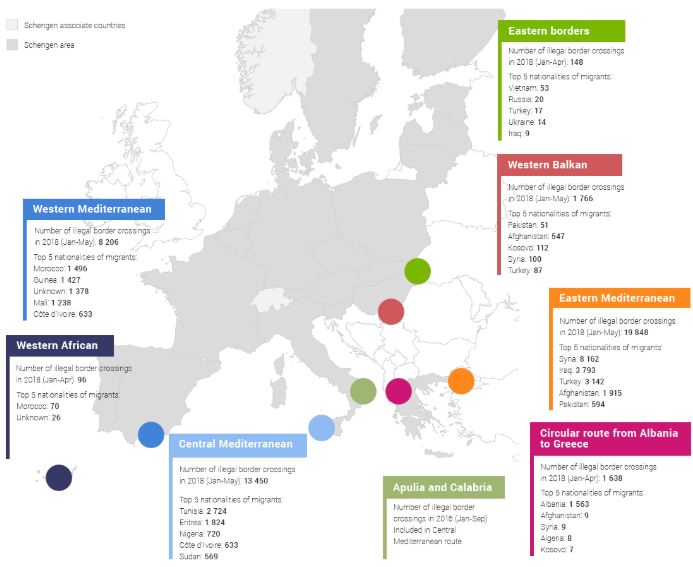
None of the Visegrad countries or Austria is currently dealing with anything that could reasonably be called a level of refugees that they can't handle. The European border and coast guard agency, Frontex, currently has figures on the January-April 2018 illegal border crossings into Europe:


This presumably doesn't include legal entrants, which include people applying for asylum that may not get it. But what this map of the significant immigration routes is that most of them involve people from the Middle East and North Africa. Those immigrants are not directly entering The Visegrad states or Austria. Italy and Greece are holding large numbers of refugees from Middle East and North Africa. And Greece especially has very legitimate complaints about inadequate solidarity on support and resettlement of immigrants from their fellow EU members.

But solidarity and support are not what the anti-immigrant policies of the Visegrad states and especially not from Austria and Czechia are about.

In Austria's case, Chancellor Babyface is trying to posture as the defender of Austria's borders by posturing over issues on which Austria has no direct control.

Starting in July, Chancellor Babyface will represent Austria, which holds the Presidency of the Council of the European Union. Which is not the same as the President of the European Council, who is currently Donald Tusk. The lack of clarity of roles in the EU is one of the various reasons for the "democratic deficit" in the EU.

But Kurz, who will be formally one of the key leaders of the EU in the second half of 2018, is actively undermining the EU with his demagogic anti-immigrant policies and posturing. To him it must look like cheap political gains. Because Austria itself doesn't have to directly implement these tougher external border policies he's promoting because Austria is not a Schengen border country.

Most importantly, Kurz and his Visegrad buddies are not promoting real solutions to the refugee problem. Politicians like Kurz and Strache aren't interested in solving the actual problems, only in exploiting them to promote authoritarian rightwing politics.

The broad outlines of a real European solution to the crisis are actually fairly obvious: stop supporting American wars in the Middle East and engage diplomatically to avoid wars in the Middle East and other external military interventions like those of Russia (and, yes, that will damage the profits of some European arms dealers and that's a good thing); a fair and comprehensive program for settling prepare adequate emergency services to handle unexpected surges in refugees like those in 2015; sufficient or more-than-sufficient support for the refugee camps in Greece, Italy, and Turkey.

There's a lot of empty talk right now about setting up asylum center in Libya and other places to process asylum claims there. This is largely a joke. First of all, if you're trying to flee a country persecuting, killing, raping, or starving you, is anyone in their right mind going to go to the government doing that apply for asylum elsewhere? Asylum applications involved preparing legal cases. Are countries like Libya going to provide those? That's really a bad joke.

Chancellor Babyface has a great chance the second half of 2018 to use his diplomatic visibility in the EU to promote some real solutions and not just PR stunts. So far, there is no indication that he intends to do so.

And for Kurz and Strache to promote the fascist anti-immigrant and anti-Roma (Gypsy) politics of the new Italian Interior Minister Matteo Salvini is about as destructive it can be for any serious effort to address the real (not imaginary) refugee problems of the EU.

Wednesday, June 20, 2018

Xenophobic theater - that does real harm to real people

Xenophobia sometimes makes good political theater for rightwing, authoritarian politicians and leaders. That's not to say that center-left and labor parties don't sometimes indulge it, as well. But it works particularly well for authoritarian parties.

We're certainly seeing that right now with Trump's policy of kidnapping children of immigrants at the Mexican border and putting them in makeshift prison camps. This report on flight attendants' reactions to serving on planes acting as the transport to the child prison camps is revealing, Anonymous Flight Attendant On Child Prison Plane Tells All The Young Turks 06/19/2018:


Trump is implementing a solution to what is in many ways a non-problem. Net immigration from Mexico has recently been negative, i.e., more Mexicans return to their country each year than those that move to the US. The American economy in many ways is currently dependent on undocumented workers, particularly agriculture but by no means only that sector. Trump's repeated claims that Mexican immigrants are rapists, murderers, and MS-13 gang members are just not true.

The children coming across the US-Mexican border are certainly not a significant threat to Americans. Even taking into account that some of them may end up in gangs, particularly if their opportunities to integrate into American society are restricted even more.

But dehumanizing immigrant children is a typical xenophobes' propaganda pitch. In Europe, the image of kindergarten kids wearing a hijab (Muslim head covering) is used by the far right and anti-immigrant politicians in Germany and Austria. It's a way of taking innocent or positive images - a headscarf can keep your head warm and dry in the winter, a kindergarten-age girl for most people is an image of someone who needs affected and be protected from harm - are transformed into a scary threat to Western white Christian civilization and a menace of terrorism in the form of a five-year-old girl in a hijab. Which is about as much of a non-problem as it can be. Because not only is a small girl no immediate threat to an adult man or woman in any remotely normal circumstance. But even devout, conservative Muslim families require their kindergarten-age children to wear hijabs.

The American term "anchor baby" serves a very similar function. Anchors keep your boat safe and stable, and babies are harmless and cute. But in the form of "anchor baby," they become a threat of undermining everything dear to white folks who understand themselves as the only Real Americans.

The Austrian Chancellor Sebastian "Babyface" Kurz (ÖVP) is currently promoting what he describes as an "axis of the willing" with Germany and Italy to promote anti-immigrant sentiment and policies in Europe. Kurz on Wednesday was meeting with Bavarian Landeshauptmann (Governor) Markus Söder (CSU) in the Upper Austrian capital city of Linz to promote the position of the German Interior Minister Horst Seehofer, head of the CSU and one of Söder's predecessors as Bavarian Governor, to turn back asylum-seekers at the German border. This is essentially a non-problem, as well. It just gives Seehofer and Söder a way to demonstrate their hostility to immigrants and promote anti-EU sentiment. Seehofer is also using it in the moment as part of a tricky political game with Chancellor Angela Merkel. (Nina Weissensteiner, Kurz und Söder machen im Asylstreit auf enge Spezln statt neutraler Nachbarn Standard 02.06.2018)

Matthew Karnitschnig reports (Angela rises from the ashes Politico EU 06/19/2018):
CSU leader Horst Seehofer, who is also interior minister, agreed to put off enforcing a new rule to turn back refugees at Germany’s borders until after the upcoming European Council summit, in order to give Merkel more time to negotiate with other EU capitals.

It’s a long shot that Merkel will actually succeed in securing a sweeping deal over the next two weeks to return refugees who show up at Germany’s border from Italy or Greece. Whether the CSU is ready for another face-off with Merkel is another matter.

Meanwhile, Kurz' far-right Vice Chancellor and Foreign Minister HC Strache was down visiting with his comrade in the (informal) Nationalist International, new Italian Vice-Premier and Italian Interior Minister Matteo Salvini of the far-right anti-immigrant League party. Salvini attracted favorable attention from xenophobes in his brief time in office by refusing to allow rescue ships carrying refugees from Africa to land in Italy, defying international law. Salvini declared himself and Strache to be "friends and allies in defending our peoples." Defending them, that is from taking refugees rescued from drowning int he Mediterranean Sea. (Vizekanzler Strache bei Vizepremier Salvini in Rom Salzburger Nachrichten 20.06.2018)

Salvini was also thereby "solving" a non-problem. Europe does face a continuing long-term crisis in emigration from the Mideast, Afghanistan, and North Africa, not incidentally places where the United States has been fighting wars for the last two decades, more-or-less. A surge in refugees in 2015 set off a political panic that has not yet ended, although immigration declined drastically the following two years and is significantly down even in Italy from 2018. "Despite recent immigration data from the Italian interior ministry showing a 76 percent drop in arrivals in the first few months of the year, the country’s new allies [Austria and Hungary] have migration [sic] as a prime-mover in common, though they differ significantly over what to do about it." (Jacopo Barigazzi, How Italy plans to blow up Brussels Politico EU 06/18/18)

But real harm to real people and real institutions can come from this kind of nationalist demagoguery. Salvini has also announced his taking moves to more closely monitor Roma (Eric J. Lyman, Italy's interior minister wants census for Roma; critics call controversy 'racist' USA TODAY 06/19/2018) in Italy and expel some of them.

Economist and former Greek Finance Minister Yanis Varoufakis tweets:


Correction 07/15/2018: The Foreign Minister of Austria in the Kurz government from 12/18/2017 to now has been Karein Kneissl; Heinz-Christian Strache has not been Foreign Minister. Strache is Vice Chancellor and Minister of the Civil Service and Sport.

Saturday, September 16, 2017

The Big Three in the Austrian Chancellor's race

On Friday, I had the chance to attend the "Big Three" debate between the three leading candidates for Austrian Chancellor in the election of October 15 in the Design Center in Linz. It was sponsored by the leading state/provincial newspapers, including Die Presse (Vienna) and the Oberösterreichische Nachrichten (Upper Austria). The video of the debate in German is available online at the Kleine Zeitung and at Bei Steuerplänen schieden sich die Geister, Lucian Mayringer et al, Oberösterreichische Nachrichten 15.09.2017. (The sound on both is low for the first few minutes.)

Austria has a parliamentary system, with the President elected as head of state in a separate election from the Parliament. The head of government is the Chancellor, whose function is called Prime Minister in some other countries, and is typically elected by a majority in Parliament, which often requires a formal agreement between two or more political parties. Since 1987, the government has mostly been composed of some combination of the center-left Socialdemokratisched Partei (SPÖ) and the center-right Christian-Democratic Volkspartei (ÖVP). The third-largest party is the Freiheitliche Partei (FPÖ), which we could (generously) describe as far right.

The Big Three (l to r): Sebastian Kurz, Christian Kern, HC Strache

In this campaign, the current Chancellor Christian Kern is candidate for the SPÖ, Foreign Minister Sebastian Kurz for the ÖVP, and Heinz-Christian Strache for the FPÖ. Technically, Kurz is running on the Sebastian Kurz List, but that's basically just a marketing ploy. Kurz is currently the leading candidate in the polls, and is trying to maximize the potential advantage of looking as he does 16 years old and to emphasize that he's a new and fresh leader. Actually, at 31, he's almost twice as old as he looks.

It was a relatively civilized debate, which the press commentary reflected. Here is one way in which an American has to remember that Austria is different from the US. In Austria, it's not considered normal for a candidate to, for instance, demand that their opponent be locked up. Or to complain that female reporters menstruate. But politics is inevitably about conflicts, so not everything was harmonious at the debate.

The topics included education, taxes, digitalization and employment, the budget, pensions, and immigration. But immigration and the status of non-citizens in Austria - a topic on which I don't pretend to be a disinterred party - was the main theme, thanks in particular to Kurz. Prior to 2015, xenophobia was mainly pushed by the FPÖ. For instance, in 1993 the FPÖ used an anti-foreigner referendum campaign to exploit nationalist and xenophobic sentiment. They called their campaign "Austria First." And in a fashion now all-too-familiar to Americans in our own politics, the FPÖ has consistently encouraged and maintained visible links to hardcore anti-democratic rightwing groups, some of which constantly flirt with neo-Nazi propaganda, the latter being illegal in Austria under the terms of the Independence Treaty of 1955 with the US, the then-USSR, Britain and France.

But Kurz has made the anti-immigrant theme his own. In Friday's debate, Kurz introduced an anti-Islam meme into a discussion of education ("Islamic kindergartens"). And he and Strache competed in beating the anti-foreign drums. Problems in the education system? According to Kurz and Strache, the only real problem there is that there are too many g*******d foreign children in Austria. Budget problems? Also because there are too many g*******d foreign children in Austria. Since current American levels of crassness aren't yet respectable in Austrian politics, they didn't actually use the cuss word.

Kurz claimed the low point for the day when he complained that there are too many Africans in Africa and they are still breeding more. Seriously! Maybe he was thinking that white South Africans have too high a birth rate. But I'm guessing not. It's a notable accomplishment for the leader of the ÖVP to come out of a face-to-face confrontation with Strache sounding like the more xenophobic of the two.

I was surprised that the word "terrorism" never came up in the debate, because Kurz and Strache have typically linked their hostility to foreigners with security questions. It was especially surprising because of the current report on Friday of what could have been an attempted terrorist attack in London.

But for me it was grim to hear with what a complete lack of compassion and realism the three candidate discussed the issue of refugees. All the three parties including the SPÖ have stressed the need to keep refugees out. Kern did introduce a bit of realism into Friday's discussion by talking about the real problems of war, climate change and economic crisis in the Middle East and North Africa. But it was discussed all but exclusively in terms of keeping the foreigners out of Austria.

I wouldn't want to minimize the seriousness of the ongoing refugee crisis in Europe, which is far from over. On the contrary, it's a chronic problem that the EU is currently handling with the "extend-and-pretend" approach which has been the dominant characteristic of Angela Merkel's approach to both the euro crisis and the refugee crisis. The current perception of the crisis in Austria has been heavily influenced by the refugee surge in 2015, with chaotic scenes in the city of Salzburg and the town of Traiskirchen. Ferry Maier and Julia Ortner present some of the substantive issues on the handling of refugees in Austria, including the state of the national and state emergency services, in Willkommen in Österreich? (2017).

A not-especially-diverse pundit panel discuss the discussion afterwards

But the Big Three couldn't find much time to address those substantive issues on Friday. Instead what was mainly on display were the polemical techniques the xenophobes have used to transform the image of desperate people fleeing war and severe persecution into one of coddled foreigners getting special benefits that Austrians don't get. And specifically into an image of Austrians being threatened by the presence of foreign children. It's ugly stuff.

On the bright side, there wasn't much use of favorite Islamophobe buzzwords, except for "Islamic kindergartens." (There were no similar complaints in the debate about Catholic kindergartens, of which Austria has plenty.)

On the other issues, the most substantive point was made by Chancellor Kern on tax policy, when he stressed that tax cuts, which all three are advocating, should be targeted to lower and medium income earners, not to corporations or the wealthy. And he stressed - accurately - that the Kurz and Strache proposals would most benefit the latter. None of the three wanted to be very specific about what program cuts would accompany their tax cuts. No one even mentioned the issues a large tax cut might cause for Austria under the terms of the eurozone Fiscal Suicide Pact, officially the Treaty on Stability, Coordination and Governance in the Economic and Monetary Union, better known as the Stability Pact.

Kern and Strache were agreed in opposing the increase of the retirement age, which Kurz supports.

But on other entries, all three generally took seemingly safe, stock, anodyne positions on most issues. All three are in favor of good education. They all favor increasing government efficiency. All three are committed to the TINA (There Is No Alternative) Angela Merkel/Herbert Hoover economic policies that are currently dominant in the EU. A symptom of the latter is that all three used "education" as a magic conjuring word that would solve all economic problems. And, if it doesn't, well, it's your own fault for making those infamous Bad Choices. Along with the usual fantasies about unemployed workers in their mid-50s retraining for new and better jobs.

The discussion was moderated by Wolfgang Braun of the Oberösterreichische Nachrichten and Claudia Gigler of the Kleine Zeitung. Gigler was the only female journalist with a role in the discussion. Afterwards, there was a half hour discussion of the event by six commentators, all of them white guys. There was some diversity there, though. At least one of the six on the pundit panel was probably younger than 50.

Like their American counterparts, the journalist panel was particularly interested in the horse race speculation. Who will get the biggest vote? And what kind of party coalition could then be built? On that score, it was pretty obvious that Kurz and Strache were campaigning for an ÖVP/FPÖ coalition. That probably contributed to Strache's relatively restrained conduct in the appearance, which is not always his approach.

It struck me early on that Strache was the most experienced politician of the three. He was quicker on his comebacks and easily employed humor. Kern sounds like a Chancellor, which he is. But a glad-handing politician, not so much. I would agree, though, with the commentators who noted that Kern's performance could enhance his credibility at governance. That is, for the voters for whom that's important. Kurz comes off like a well-spoken teenaged conservative twit who thinks there are too many Africans in Africa.

For an American used to the tiresome rituals of our own TV Pod Pundits, it's refreshing to see journalists actually act like journalists and pressing politicians to respond to their questions and not just letting them repeat their preferred talking points. Braun and Gigler did a good job of that during the main event. What was missing, though, was some much needed fact-checking. Strache, for instance, ranted at one point about hundreds of millions of euros being paid to support non-existent children. Which would be a suspect claim even it weren't coming from someone like Strache, who lies like breathing on topics like this. Kern then ridiculed Strache's claim with a more credible-sounding number about the entire cost of the program in question. But neither Braun nor Gigler offered any kind of fact-checking on the topic, which would have really been helpful. Especially since Strache's claim is a popular xenophobic talking point right now. In his mini-rant about there too many Africans in Africa, Kurz also used population growth rate predictions that were fantasy nonsense, which also could have used a real time fact-check from the reporters. (Not that his point had anything to do with mastering demographic forecasts.)

A final cross-cultural observation: The Chancellor's debate included no discussion about whether Austria should nuke North Korea. Or start a war with Iran. Or send more troops to ongoing conflicts in Afghanistan, Iraq and Syria. Comparatively speaking, from an American viewpoint Austria has a much preferable set of problems to wrestle with.

Press reports: