Showing posts with label evita. Show all posts

Monday, June 27, 2016

Juan Perón and populism

One regime that pretty much everyone agrees was a "populist" one is that of Juan Perón in Argentina from 1945-55. The Oxford Reference article by Frederick C. Turner, Juan Domingo Perón, which apparently dates from the Presidency of Carlos Saúl Menem (1989-99), gives this account:

The most important and controversial political leader of twentieth-century Argentina, Juan Domingo Perón sharply divided Argentines during and after his lifetime over the issues of distribution of income and political power. In historical retrospect, he may be seen as a leader who wanted to extend to the lower classes the standard of living and the political enfranchisement that Hipólito Yrigoyen and the Unión Cívica Radical had brought to the Argentine middle classes earlier in the century. One of the few South American leaders to be known throughout the world, Perón championed a “Third Force” in world politics and encouraged wider political participation by Argentine women.
The prevailing American view of Perón during his first Presidency, promoted by the Truman Administration at the time, was that Perón's during his first Presidency, promoted by the Truman Administration at the time, was that his government was fascist. That view is unsustainable, largely for the reasons Turner summarizes in that paragraph.

Perón identified the political enemy within Argentina as the "oligarchy," a concept understood to mean the rural oligarchy and the magnates of industry, though the industrial component of the Argentine economy had declined under the policies during the "infamous decade" following the military coup of 1930. Promoting domestic industry was a main goal of the Peronist government.

There was an additional nationalist component to Perón's appeal. Spruille Braden was US Ambassador to Argentina in 1945 when Perón first became head of government and in 1946 when he successfully ran for President in a competitive democratic election. Braden was a classic One Percenter, as we say these days. He was the son of a wealthy mining family and held majority ownership in the Braden Copper Company in Chile. He served a director of the W. Averell Harriman Securities Corporation and was a member of the ultra-establishment Council on Foreign Relations. In the first half of the 1930s, he had been an agent of Standard Oil in South America. To top it off, he was also a significant stockholder of the United Fruit Company. All the ingredients to be a classic Ugly American south of the Rio Grande.

And that's exactly what he was in 1945-46. The military governments of 1940-1946 had been neutral in the World War until March 1945, when it was clear that Germany was losing. This had led the Roosevelt Administration to treat Argentina as de facto pro-German. So the "fascist" label seemed to be an obvious polemical label to use against them. The pro-Allies left parties in Argentina, the Socialist and Communist Parties, adopted the same label. Despite Perón's obviously distinct position from the more conservative elements in the military government, his local and international enemies found the label convenient to apply to Perón as well. The State Department Blue Book published in February 1946, after Perón's assumption of power but before the 1946 elections, portrayed both the previous military government and the current one of Perón were collaborators with the Nazis.

When Braden was appointed Ambassador in April 1945 and was distinctly hostile to the military government then in power and then to Perón's regime. Perón campaigned in the election 1946 on the theme "Braden or Perón," framing himself as the defender of the Argentine nation against foreign interference. This was another populist angle to Perón's politics, appealing to all classes in Argentina to support him against foreign adversaries. In 1946, against a specific image of the foreign adversaries, "Braden."

Turner also writes:

In 1946, Perón was elected to the Argentine presidency in one of the freest elections in Argentine history; he was elected to a second term in 1951. A military coup in 1955 deposed him, sending him into exile first in Paraguay and ultimately in Madrid. For many years, historians and political leaders in Argentina tried to write Perón off as a has-been, but this ultimately proved impossible. In 1973, he returned triumphantly to Argentina and to the presidency after eighteen years in exile.

The basis for Perón's power was the Justicialista (Peronist) Party. Multiclass in nature, ranging over the ideological spectrum from far right to far left, it was an archetypal example of populism. Peronism has been able to count consistently on support from ten percent of the upper classes and seventy percent of the lower classes. Perón built fierce and durable loyalty for the movement during his first presidency, during which he increased the proportion of national wealth going to the working class very substantially. ... More important than economic gains, members of the working class and trade unions had achieved a sense of political consciousness and economic entitlement that made them combative participants in Argentine politics for decades to come.

Juan Perón also had high ambitions in international politics. Quite accurately, he predicted that if the countries of Latin America did not join together, they would remain weak and put upon by more powerful nations. Often credited with originating the concept of the Third World, Perón after 1945 dreamed of a coalition of states allied to neither the Soviet Union nor the United States. Argentine yearning for leadership of this movement appears in one of the most common Peronist slogans: Ni yanqui, ni marxista—peronista (Neither Yankee, nor Marxist — Peronist). [my emphasis in italics]
And Turner describes the role of Eva Perón this way:

Her interest in politics and her influence increased decisively after Perón took office in June 1946. She began to meet daily with workers' delegations, union leaders, and officials of the Secretariat of the Labor Confederation, thus continuing the work that Perón did as secretary of labor. She frequently addressed Perón's supporters on his behalf and proved to be a rousing speaker. After a triumphant European tour which she undertook without Perón, she returned in time to urge the passage of a law granting women the vote.

Evita was never formally part of Perón's government, though she tried unsuccessfully to be the Peronist vice-presidential candidate in the 1951 elections. She was officially only Argentina's First Lady, but she was a one-woman propaganda ministry for Perón and his trusted liaison with labor. She was also president of the Eva Perón Foundation, a well-endowed social welfare organization. She used the foundation funds to build hospitals, schools, youth hostels, and low-income housing, and to buy thousands of goods that she distributed to the needy. In addition, she was president of the women's branch of the Peronist Party, which helped to reelect Perón in 1951 with an overwhelming female vote.

Evita's death from cancer on 26 July 1952 undermined the stability of Peronism. She was a crucial component of that political structure and irreplaceable—as Perón soon realized when his economic policies began to strain his relationship with the descamisados. On the other hand, her death transformed her into a powerful myth that became essential for the survival of Peronism after Perón's ouster in 1955 and, despite the repression of successive military dictatorships, its return to power in 1973 along with Perón's own reelection that same year.
The Oxford Reference entry on María Eva Duarte De Perón (2004) by Evita's biographer Marysa Navarro-Aranguren expands on her significance for Peronism:

Her interest in politics and her influence increased decisively after Perón took office in June 1946. She began to meet daily with workers' delegations, union leaders, and officials of the Secretariat of the Labor Confederation, thus continuing the work that Perón did as secretary of labor. She frequently addressed Perón's supporters on his behalf and proved to be a rousing speaker. After a triumphant European tour which she undertook without Perón, she returned in time to urge the passage of a law granting women the vote.

Evita was never formally part of Perón's government, though she tried unsuccessfully to be the Peronist vice-presidential candidate in the 1951 elections. She was officially only Argentina's First Lady, but she was a one-woman propaganda ministry for Perón and his trusted liaison with labor. She was also president of the Eva Perón Foundation, a well-endowed social welfare organization. She used the foundation funds to build hospitals, schools, youth hostels, and low-income housing, and to buy thousands of goods that she distributed to the needy. In addition, she was president of the women's branch of the Peronist Party, which helped to reelect Perón in 1951 with an overwhelming female vote.

Evita's death from cancer on 26 July 1952 undermined the stability of Peronism. She was a crucial component of that political structure and irreplaceable—as Perón soon realized when his economic policies began to strain his relationship with the descamisados. On the other hand, her death transformed her into a powerful myth that became essential for the survival of Peronism after Perón's ouster in 1955 and, despite the repression of successive military dictatorships, its return to power in 1973 along with Perón's own reelection that same year.
Pretty much everyone at least seems to agree that this political experience, Juan Perón's government and movement, was populist. It was and still is a very diverse phenomenon. Peronism is complicated.

Tuesday, July 01, 2014

Juan Domingo Perón (1895-1974) died 40 years ago

Today, July 1, is the 40th anniversary of the death of Juan Domingo Perón (1895-1974), legendary and controversial leader of Argentina, founder of a Peronist movement so diverse as to include over the decades unions, rightwing death squads, esoteric secret societies, neoliberals, social democrats (if not by that name), leftwing guerrillas, and fighting reformers of a New Deal tone like former President Néstor Kirchner and current President Cristina Fernández.

It was under Juan Perón's first Presidency that women's right to vote in Argentina was first recognized. And his second wife María Eva Duarte ("Evita") became a greater legend than her husband, a political leader in her own right and a lasting symbol of women's and labor rights.

Juan Domingo Perón and Evita

If his second wife Evita was an exceptional fortunate choice, his third wife Isabel (María Estela Martínez Cartas de Perón) was an exceptionally unfortunate one. She achieved an important milestone as the first female President in South America, having been elected as Perón's Vice President in 1973 and taking his place after his death at 78 in 1974. (Cristina in 2007 became the first directly elected.)

Isabel was not only unprepared to step into the Presidency, especially not in 1974 when the country was experiencing exceptionally challenging political strains. But her worst characteristic was her friend, confidant and political-religious guru, José López Rega, one of the most sinister figures in Argentine history. His nickname "El Brujo" (the warlock) was very appropriate, both because he actually was a devotee of esoteric lore but also because he was a genuinely manipulative, murderous man obsessed with power. López Rega basically acted as the functional President for the year after Perón died until he was forced out of the government by military and political pressure. He died in prison in 1989 after several years on the lam with one of his esoteric female fans.

José López Rega, "El Brujo" (the Warlock) (1916-1989)

Cristina commemorated the anniversary of Perón's death with a tribute to both him and Hipólito Yrigoyen (1852–1933), who served as President 1916-1922 and 1928-1930: "La historia sepulta a los traidores y a los mediocres" Pagina/12 01.07.2014. Yrigoyen died on July 3, which Cristina used as her reason for acknowledging them both.

Yrigoyen was the leader of the Unión Cívica Radical (UCR) party, which still today is the main opposition party to Cristina's Peronist Partido Justicialista (PJ). The Peronists consider the UCR the main party of the "oligarchy," the large landowners and their business allies that are the traditional opponents of Peronism. Political theorist José Pablo Feinmann suggests that opposition to la oligarquía is the most defining factor in the historical continuity of the Peronist movement.

This is a surprising pairing. Yrigoyen was a liberal, meaning he was against the conservatives but also hostile to labor. His first Presidency, his government happily suppressed the massive labor protests that have gone down in Argentine history as the Semana Trágica (Tragic Week) of 1919. But Yrigoyen was also identified with efforts to democratize the political system. Pagina/12 reports of her speech:

La Presidenta definió al yrigoyenismo y al peronismo como una "continuidad histórica" en la que el "yrigoyenismo representa la defensa irrestricta de los intereses del pueblo de la Nación" y el peronismo el que, "con mayor profundidad y densidad, siguió ese ligado histórico".

Cristina recordó cómo ambos dirigentes fueron "hostigados por grandes medios de comunicación y por los intereses dominantes" y, a modo de ejemplo, apuntó que Perón, incluso, fue acusado "hasta de estupro". Sin embargo, advirtió que nadie recuerda a los detractores de Perón e Yrigoyen porque "la historia sepulta a los mediocres y a los traidores a la Patria"[.]

[The President defined yrigoyenismo and Peronism as an "historical continuity in which "yrigoyenismo represents the unrestricted defense of the interests of the people of the nation," and Peronism "with greater depth and density, continued this historical trend."

Cristina recalled how both leaders were "plagued by large communication media and by the dominant interests," and, by way of example, indicated that Perón was accused "even of child sex abuse." Nevertheless, she observed that no one remembers the detractors of Perón e Yrigoyen because "history buries the mediocre and traitors to the fatherland."]
This was obviously a political speech, not the reading of an historian's monograph: Visión 7 - Cristina: "El Judicial es el único poder que no sufrió derrocamientos" Visión 7 - Cristina: "El Judicial es el único poder que no sufrió derrocamientos" TV Pública argentina 01.07.2014:


Here are four additional videos from TV Pública argentina on Perón and his legacy. Visión 7 - Los cambios que promovió el Peronismo 01.07.2014:


Visión 7 - A 40 años de la muerte de Perón (1) 01.07.2014:


Visión 7 - A 40 años de la muerte de Perón (2)


Visión 7 - A 40 años de la muerte de Perón (3)


Additional articles on Perón:

Thomas F. McGann, Juan Perón Encyclopedia Britannica Online, accessed 07/01/2014

Martín Granovsky, La tristeza popular y el desastre nacion Pagina/12 01.07.2014: "La muerte de Juan Domingo Perón marcó una cuenta regresiva que terminaría el 24 de marzo de 1976, con el golpe militar más cruento de la historia argentina." ("The death of Juan Doming Perón started a countdown that ended the 24th of March, 1976, with the bloodiest military coup in the history of Argentina.")

Eduardo Anguita, Los ojos sobre Yrigoyen y Perón Infonews 01.07.2014

CFK heads Perón's 40th death anniversary ceremony Buenos Aires Herald 01.07.2014

Pablo Andisco, A 40 años de la muerte del hombre que cambió la historia Infonews 01.07.2014

Estela de Carlotto et al, Análisis y recuerdos Pagina/12 01.07.2014

Peron statue in Argentina's Buenos Aires still in limbo BBC News 06/30/2014

Carlos Romero, Perón, el líder que cambió la historia El Tiempo 01.07.2014

Sergio Wischñevsky, Llevó en sus oídos Pagina/12 01.07.2014

Recuerdos del día que murió Perón Infonews 01.07.2014

Tags: , , , , ,

Sunday, March 24, 2013

Anniversary of the 1976 military coup in Argentina

Today is the 37th anniversary of the military coup of 1976 that installed a brutal and murderous military dictatorship that remained in power until 1983. Prosecutions of officials who committed crimes during that dictatorship, known as El Proceso from its preferred name for its project of purging democracy and democratic freedoms from Argentina forever. Forever last only seven years.

Here is a report from TV Pública argentina on the anniversary, featuring a brief presentation by President Cristina Fernández de Kirchner, A 37 años del golpe cívico militar 22.03.2013:


Here is a longer report of a the speech of Cristina's excerpted in the report above, Cristina inauguró nuevos Espacios de la Memoria (2 de 2) TV Pública argentina 22.03.2012:


She posted the following to her Facebook wall:

24 de marzo, un aniversario que no quisiéramos tener los argentinos, pero que tenemos la obligación de recordar. Un recuerdo que no es patrimonio de ningún sector político de la Argentina. Cuando se atenta contra la democracia, se atenta contra la forma de vida en que queremos vivir todos los argentinos. Entendamos que esta es una fecha de la democracia, que tanto costó recuperar y debemos asegurar: Lo que pasó no fue por casualidad. Si uno mira los índices que tenía el país de ocupación, calidad de vida, industrialización, desarrollo social al momento de producirse el golpe, y cómo terminamos en 1983 cuando llega la democracia, y luego lo que pasó en la segunda parte, cómo terminamos en el 2001... vemos que el mejor homenaje que se puede hacer a todos los que hoy no están, o los que están y sufrieron, es seguir logrando esta Argentina, una Argentina con mayor inclusión social, con mayor trabajo, de fábricas abiertas, de ciencia y tecnología.

El objetivo del golpe no sólo era un país sin industrias, un país donde manejara solamente el capital financiero, era además instalar en cada uno de los argentinos que no valía la pena ocuparse del otro, porque si te ocupabas del otro te podía pasar algo. El miedo. Y al miedo le siguió el egoísmo. El egoísmo es el hijo del miedo. Los que no tienen miedo son solidarios. Seguir luchando por más igualdad, por los que menos tienen, para estar siempre junto a ellos, ese es el mandato de los 30.000 desaparecidos.

Recuerdo palabras de él [Néstor Kirchner], 24/3/2004: “Hablemos claro: no es rencor ni odio lo que nos guía y me guía, es justicia y lucha contra la impunidad. Dejaremos todo para lograr un país más equitativo, con inclusión social, luchando contra la desocupación, la injusticia, y todo lo que nos dejó en su última etapa esta lamentable década del ’90 como epílogo de las cosas que nos tocaron vivir. Hermanas y hermanos, compañeros que están presentes por más que no estén aquí, Madres, Abuelas, chicos: gracias por el ejemplo de lucha. Defendamos con fe, con capacidad de amar, que no nos llenen el espíritu de odio porque no lo tenemos, pero tampoco queremos la impunidad. Queremos que haya justicia, queremos que realmente haya una recuperación fortísima de la memoria. Que en esta Argentina se vuelvan a recordar y tomar como ejemplo a aquellos que son capaces de dar todo por los valores que tienen. Una generación en la Argentina que fue capaz de hacer eso, ha dejado un sendero, su vida, sus madres, sus abuelas y sus hijos."
Página/12 reports on this message in CFK: "Esta es una fecha de la democracia que tanto costó recuperar y debemos asegurar" 24.03.2013. In it, she makes a moving statement about how the dictatorship's state terror functioned (quoted above in Spanish in a slightly different form; just after 18:30 in the last video; my translation from the video version):

... the objective of the coup was not only a country without industries, a country where only finance capital ran things; it was also to install in every one of the Argentines that it was not worth it to be concerned with others, because if you concerned yourself with other something could happen to you. Better to be concerned with yourself, and if your were concerned with yourself, nothing would happen to you. Fear. And after fear follows egoism. Egoism is the child of fear. Don't ever forget it. Only those who are afraid can be egoists. Those who are not afraid are those who practice solidarity.

She also says, "... we are going to fight for more equality, for more equality for those who have the leaset, for the poorest, to always be there together with them, this is the mandate of the 30,000 desaparecidos" i.e, the "disappeared", those kidnapped and murdered by the dictatorship.

She speaks from experience. She was a human rights attorney during the dictatorship who worked actively to help its victims. It surely one of the sources of tension between her and Jorge Bergoglio/Pope Francis I, who was anything but a profile in courage during the dictatorship, and probably actively collaborated in dishonorable ways.

I just read Emilio Mignone's 1986 book, Iglesia y dictadura: El papel de la iglesia a la luz de sus relaciones con el régimen militar (2006), which has figured in the news reports on Bergoglio's conduct in relationship to the dictatorship. Mignone's daughter Mónica was kidnapped by the dictatorship in 1976, taken from their home. Mignone and his wife Chela were never able to contact her. He died in 1998 without ever knowing for sure what happened to Mónica, or where her remains lay. Although he assumes that she was likely tortured and murdered, the usual fate of the desaparecidos.

This is how state terror works. Not only was she arrested but was held incommunicado, never given any kind of a public trial, her parents and other relatives and friends were never able to see her in prison, and never knew for sure what happened to her.

It's very common for Americans to hear something like this about another country and think how this shows the superiority of the United States and our political system to the benighted "Third World." But Americans are generally unaware of the nature of the United States long interaction with Latin America. St. Reagan approved of the Argentine junta, as Robert Perry reports in Did Reagan Know about Baby Thefts? Consortium News 07/06/2012:

Despite U.S. government awareness of the grisly actions of the Argentine junta, which had drawn public condemnation from the Carter administration in the 1970s, these Argentine neo-Nazis were warmly supported by Ronald Reagan, both as a political commentator in the late 1970s and as President once he took office in 1981.

When President Jimmy Carter’s human rights coordinator, Patricia Derian, berated the Argentine junta for its brutality, Reagan used his newspaper column to chide her, suggesting that Derian should "walk a mile in the moccasins" of the Argentine generals before criticizing them. [For details, see Martin Edwin Andersen's Dossier Secreto. {Perry's note}]

Reagan understood that the Argentine generals played a central role in the anti-communist crusade that was turning Latin America into a nightmare of unspeakable repression. The leaders of the Argentine junta saw themselves as something of pioneers in the techniques of torture and psychological operations, sharing their lessons with other regional dictatorships. ...

After becoming President in January 1981, Reagan entered into a covert alliance with the Argentine junta. He ordered the CIA to collaborate with Dirty War experts in training the [Nicaraguan] Contras, who were soon rampaging through towns in northern Nicaragua, raping women and dragging local officials into public squares for executions.
Perry's article contains other details about the domestic conduct of the Argentine junta.

The Reagan Presidential Library's website has the gall to implicitly credit St. Reagan with somehow restoring democracy in Argentina, a gag-inducing idea: "While President Reagan was in the White House, Free, democratic elections were held for the first time in many years in the Republic of Korea, Brazil, Argentina, Uruguay, Bolivia, Guatemala, El Salvador, Honduras and the Philippines. By the time President Reagan left office, the number of people in Latin America living under freely elected governments tripled from what it had been ten years earlier." (my emphasis) (President Reagan's Foreign Policy: Making the World Over Again; n/d, accessed 03/24/2013)

Robert Perry also writes about St. Reagan and the Argentine junta in Ronald Reagan, Enabler of Atrocities Consortium News 02/06/2011. Ironically - or, more accurately, highly cynically - the "neoconservatives" who understand themselves as continuing the kind of policies Reagan practiced in Central America will treat even negotiating with countries with which they want to go to war (Iran, right now) as immoral connivance in whatever bad thing the regime may be doing at home.

Cristina's reference to the goal of the junta as "not only a country without industries, a country where only finance capital ran things" isn't just a rhetorical flourish. The junta, like its predecessor and contemporary in the Pinochet dictatorship in Chile, set out to implement the "free market" policies that would favor American capital in particular, the policies most of the world knows as neoliberalism. But it didn't look much like a "free" free market to industrialists who were targeted by the junta for economic reasons. Investigations over the last year of the conduct of the junta office known as the Comisión Nacional de Valores (CNV, the National Commission of Values) has brought to public light information on junta kidnappings of businesspeople in 1978-9 especially, not for political reasons as such but in order to implement the neoliberal economic policies of Economics Minister José Alfredo Martínez de Hoz (1925-2013), who died just this month. Though some of the kidnapped businesspeople were accused of providing funds to guerrillas. Part of the motivation, though, may have been that they were running out of what they considered the most plausible political targets and the CNV still wanted to find subversives to fight. Something all countries should consider when building up massive internal security apparatuses, including the United States. They all need to justify their existence by showing some kind of results. And sometimes they just like exercising their power. (See Alejandra Dandan, La trama financiera de la última dictadura Página/12 24.03.2013)

Tags: , , , , , ,

Monday, March 18, 2013

Bergoglio/Francis' election as Pope brings new focus on some important aspects of Argentine history

I mentioned yesterday that Robert Perry of Consortium News has been using the event of Jorge Bergoglio's election as Pope Francis I to highlight some of the broader issues of the "dirty war" period in the 1970s and 1980s in Latin America that, among other things, produced the Iran-Contra scandal.

On 03/15/2013 he republished an article from 08/19/1998 by Marta Gurvich, Argentina’s Dapper State Terrorist, on Jorge Rafael Videla, who she describes as "the dapper dictator who launched the so-called Dirty War in 1976." Videla was the first head of the junta that overthrew the constitutional government of Argentina in 1976. Argentina had seen military dictatorships before, all of which brought their share of arbitrariness and cruelty. But the junta, who called their project El Proceso, took things to the next level, as we say these days.

Her article focuses on the kidnappings of babies from political prisoners, a heart-rending issue that persists today as a major concern in Argentina:

Videla, known for his English-tailored suits and his ruthless counterinsurgency theories, stands accused of permitting — and concealing — a scheme to harvest infants from pregnant women who were kept alive in military prisons only long enough to give birth.

According to the charges, the babies were taken from the new mothers, sometimes by late-night Caesarean sections, and then distributed to military families or shipped to orphanages. After the babies were pulled away, the mothers were removed to another site for their executions.
Last year I posted links to a mini-series run by TV Publica argentina, Volver a nacer, that deals with this issue in a moving way. (YouTube playlist for the entire miniseries here.)

The 2005 film Cautiva also deals with this issue and is available with English subtitles. At this writing, the film is also available on YouTube without subtitles. Here is Part 1, posted 09/27/2009. This is the video of the first part, which is unfortunately a poor quality reproduction:


Consortium News also on 03/16/2013 reprints an article of 01/07/1999 by Georg Hodel, Evita, the Swiss and the Nazis, that reminds us that the Catholic Church and the first Peronist regime cooperated to some significant degree in facilitating the immigration of former Nazis, some of them serious war criminals. Peronism was widely regarded in the United States in real time as a more-or-less fascist government. The view persists, and is reflected in Hodel's article: "During World War II, Gen. Peron — a populist military leader — made no secret of his sympathies for Mussolini's Italy and Hitler's Germany. Even as the Third Reich crumbled in the spring of 1945, Peron remained a pro-fascist stalwart, making available more than 1,000 blank passports for Nazi collaborators fleeing Europe."

Peronism is a devilishly complex political phenomenon. Not least among its complications is that Peron did admire aspects of Mussolini's and Hitler's regimes. Hodel engages in some legitimate speculation based on circumstantial suggestions about what role Evita Perón may have played in the immigration of former Nazis.

But he makes polemical claims about Evita that are false: "Born in 1919 as an illegitimate child, she became a prostitute to survive and to get acting roles. As she climbed the social ladder lover by lover, she built up deep resentments toward the traditional elites. As a mistress to other army officers, she caught the eye of handsome military strongman Juan Peron. After a public love affair, they married in 1945." There is no evidence that Evita ever was a prostitute, that she slept her way up the "social ladder" - she always had contempt for the traditional "social ladder" of oligarchical Argentina - or that she was the girlfriend or "mistress" of any army officer other than Juan Perón. This kind of careless reproduction of gossip doesn't boost confidence in Hodel's speculations in the rest of the article.

This excerpt from the excellent 1996 Spanish-language film Eva Perón gives a sample of the contradictory nature of Evita and her politics, Eva Perón hablándole a los trabajadores ferroviarios:


The current President Cristina Fernández is head of the Peronist Partido Justicialista (PJ) and proudly uses both Juan and Eva Perón as positive symbols of her democratic and prolabor policies. What a political figure represents in popular memory and historical symbolism may be very different from what they really were. That's part of why we have historians.

These two videos from TV Publica argentina show Cristina speaking about Evita.

Cristina inauguró un mural sobre Evita 26.07.2011:


Cristina: "Evita cumplió su propia profecía de volver a una Argentina diferente" (35:55 minutes) 26.07.2012 on the 60th anniversary of Evita's death:


Tags: , , , , , , ,

Thursday, July 26, 2012

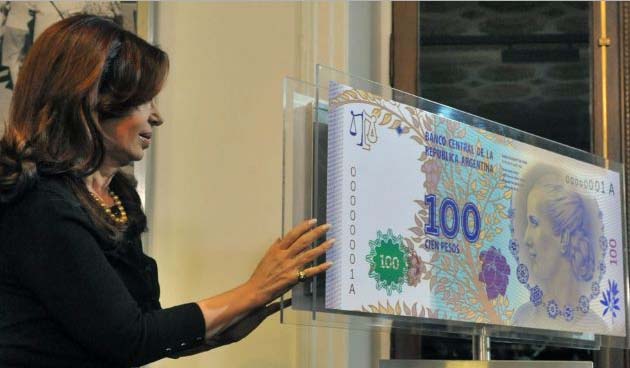
Presidenta argentina Cristina Fernández presenta el nuevo Eva Perón billete de 100 pesos

Presentación nuevo billete 100 pesos con la imagen de Eva Perón. Cristina Fernández Casa Rosada YouTube canál 07/25/2012:


El texto, Presentación del billete con la efigie de Eva Perón: Palabras de la Presidenta de la Nación


Tags: , , ,

Today is the anniversary of the death of Eva ("Evita") Perón

Argentina this week is observing the 60th anniversary of the death of Eva ("Evita") Perón, which was on July 26, 1952.

I recently saw this film, Eva Perón (1996), whose screenplay was written by José Pablo Feinmann, a philosopher who has written extensively on Argentine political history, including a multi-volume work on Peronism. It's not as entertaining as Evita, the musical by Andrew Lloyd Weber. But it's one of the better movies I've seen about a politician. It strikes a good balance in giving the audience some understanding of the very complex nature of Peronism. It also does a good job of showing the tragedy and passion as well as the fanaticism of Evita.


Following are Spanish-language reports fro TV Público Argentina on Evita.

Homenaje a Evita en la Legislatura porteña 07/24/2012:


Obra y legado de Eva Perón 07/25/2012


Evita, en las imágenes del fotógrafo Mazzarotolo 07/26/2012:


Tags: , , , ,

Monday, March 19, 2012

Marysa Navarro's Evita

A review of Evita (edición corregida, 2005) by Marysa Navarro


Marysa Navarro’s biography of Eva "Evita" Perón was first published in 1982, and she published an updated edition in 2005. It's a careful work aimed at establishing the biographical facts about the woman who became a living legend and remained a powerful political myth long after her death, and at describing her political role during her lifetime in the context of Juan Peron's political leadership and the development of the Peronist movement in Argentine politics.

María Eva Duarte was born in 1919 into the second family of Juan Duarte, an official in the province (state) of Buenos Aires, not to be confused with the City of Buenos Aires, which is the province of the Federal District. Eva and her four siblings were the second family in the since that Duarte was married and had a family with his wife, and also a family with Eva’s mother, Juana. The circumstances of her family situation, and the family’s economic struggles after her father died when she was six no doubt contributed to her later passion for the poor and the working class, though many kids growing up in similar circumstances developed no comparable passion.

At age 15, Eva moved to the City of Buenos Aires to pursue a career as an actress. Navarro avoids much speculation about the many versions of Eva’s earlier years that circulated, some of them decidedly intended to detract from her later prestige and influence. But it’s clear from her account that Eva’s move to Buenos Aires was voluntary on her part and that it showed a considerable amount of drive, ambition and personal courage. In Buenos Aires, she struggled for years, living from various stage productions. She eventually made her way into film and into the field where she had her greatest success in acting, radio theater.

Eva met Juan Domingo Perón (1895-1974) in 1944 and became his girlfriend and partner, marrying him in 1945. The widowed Perón was the Minister of Labor, Minister of War and vicepresident under the military government of Edelmiro Julián Farrell, which had originally taken power in 1943 from a democratic but very corrupt government that held sham elections. Eva enjoyed an unusual role in that she was often present at meetings of government officials and politicians where wives were normally not present, much less girlfriends.

Perón was aggressive in promoting the rights and power of labor unions and in pressing for social legislations protecting workers and increasing their wages and salaries, which made him particularly popular among workers. Other members of the military junta were both dubious enough of his pro-labor positions and jealous enough of his mass popularity that he was placed under arrest on October 9, 1945, beginning a crisis that became a founding myth of the Peronist movement. The union movement mobilized on a massive scale on Perón’s behalf, persuading the junta to release him and return him to office. The newly-freed Perón appeared to a massive crowd of workers gathered in Buenos Aires on October 17, which thenceforth became an official date of celebration for the Peronist movement. He married Eva four days later.

Elected President in Feburary 1946 with 56% of the vote, he presided over a newly-installed democratic government. Re-elected in 1951, his new term began in 1952, which would also be the year that Eva died of cancer, he served until 1955, when a reactionary military coup removed him from power and he went into exile in Spain. It was during the 1945-52 period when Eva became “Evita”, the tribune of the workers, the “descamisados” as she called them (literally, “the shirtless”).

The actions that made Eva into “Evita” were primarily her European trip in …, her work at the Labor Ministry as Perón’s unofficial but genuinely influential representative, her founding and leadership of the Peronist women’s party Partido Peronista Feminino, her leadership of the charitable Fundación Eva Perón and her impassioned speeches in campaigns, the radio and many public appearances on behalf of Perón and his movement.

Some of Ronald Reagan’s critics to this day mock his background as an actor. But if they had paid more attention to Evita’s career, they might have reflected that an actor’s skills are exceptionally useful in mass politics. She knew how to stage herself, and that’s an important skill for anyone really, but especially for a politician who has to appeal to large numbers of people who he or she will never meet personally.

Navarro carefully recounts Evita’s meeting with descamisados who came to her at the Labor Ministry with appeals for help of various kinds. The Fundación Eva Perón was financed largely by contributions from individuals and businesses, though it had enough substantial support from the government that Navarro considers it as an quasi-official governmental institution. And it’s accomplishments in setting up nursing schools, clinics, residences for unmarried working women, and individual housing for poor families, among its many functions, is genuinely impressive.

Evita’s oratory on behalf of Perón, his Partido Justicialista (PJ), the Peronist movement, the unions and the descamisados was also extremely popular among those groups, and was a key aspect of his influence and fame. Peronism was and is a particularly complex political phenomenon, but it was very much part of Evita’s life story, just as she was of its. The Peronist movement during its formative years doesn’t fit easily into a left-right schema. (Nor in its later years, for that matter.) It combined authoritarian elements with genuine pro-labor and democratic elements.

Perón himself admired Benito Mussolini’s Fascist movement and government in Italy. And we see some similar elements in the aspects of Evita’s career that Navarro chronicles: the cult of the Leader around Perón; prolific demagoguery; press censorship; pronounced anti-Communism.

On the other hand, Perón was democratically elected in both 1946 and 1951 in competitive elections. When his government and the Argentine democracy was overthrown in 1955, it was by a military coup backed by opposition leaders who never tired of calling Perón a dictator and totalitarian. Labor unions were independent and a powerful force advocating for the rights of workers, despite Perón’s success at getting labor leaders installed friendly to Perón and his party – which they had good reason to be. Unlike in Fascist Italy, Perón’s policies were aimed at increasing the wages and improving the working conditions of the working class, not at subordinating them to whims of their bosses. One of Perón’s signature achievements was establishing the vote for women in Argentina.

Argentine political theorist José Pablo Feinmann has suggested that Peronism is easier to define by its opponents, the “anti-Peronistas”, than by its supporters. (That’s my reading here of his argument in his “Prólogo” to a history of Peronsim in Página 12 of 25.11.2007) Perón and Evita named that that opponent “the oligarchy”. Navorro quotes Evita’s definition from La razón de mi vida, an autobiography ghostwritten for Evita but one that Evita endorsed as her own and which Navarro accepts as Evita’s statement of her position, though not always accurate about the facts of her life. Evita’s book put it this way:

Y conste que cuando hablo de oligarquía me refiero a todos los que in 1946 se opusieron a Perón: conservadores, radicales, socialistas y comunistas. Todos votaron por la Argentina del viejo régimen oligárquico, entregador y vendepatria. De ese pecado no se redimirán jamás. (p. 357 of Navorro)

[My translation:] And always when I speak of the oligarchy, I refer to all those who in 1946 opposed Perón: conservatives, radicals [i.e., classical liberals ], socialists and communists. They all voted for the Argentina of the old oligarchic regime, submissive and selling out their country. For this sin there will never be redemption.

This is also an example of the passion and demagogic edge of Evita’s rhetoric. Evita typically blasted the oligarchy, for instance, as "traidora y vendepatria" (treacherous and selling out their country) and the like. And working-class voters who supported socialist or communist candidates scarcely fit any usual definition of “oligarchy”, although in that passage she was referring to supporters of the oligarchs as well as the main villains themselves. Oligarchs in the narrow sense referred to the provincial landowners who commanded great wealth from their ranching and agricultural operations, as well as the older established industrial branches of the Argentine urban areas. And, in reality, as Navorro notes, Perón’s support, especially in 1945, was broad-based, including conservatives, liberals, unionists and the occasional renegade socialist and communist. Perón had wealthy backers along with union support, though the workers were clearly his main and most loyal voting base.

Despite Perón’s support for workers and Evita’s fiery polemics against the oligarchy, Peronist ideology framed itself as an appeal above classes and rejected the socialist idea of class struggle as such. Also, Evita’s declaration that voting against Perón was a sin from which there was no redemption, Perón’s government wasn’t rounding up opponents and putting them in concentration camps. In fact, as Navarro makes clear, Evita’s charitable work and advocacy for individual petitioners for assistance was not conditioned on party membership or activity. A plausible case can be made that the violence of the rhetoric in Argentine politics at the time was a sign of the weakness of democratic culture. Still, from 1930 to 1983 the country alternated between democratic governments and military dictatorships of varying levels of brutuality

But in the 1943-55 period, Peronism’s nastier rhetorical barking was worse than its bite, even after a failed coup attempt against Perón in 1951. Nobody was executed as a result of that pathetic little coup attempt. If Perón was trying to mimic Mussolini and Italian Fascism, he only succeeded in establishing a very weak-tea version of it.

Navarro discusses the difficulties presented by the polemical nature of the sources on Evita. On the one hand was Peronist hagiography, on the other extremely hostile polemics for the left parties and the genuine adherents of the oligarchy. The latter contributed a lot of sensationalist gossip. The former mixed her genuine accomplishments with conscious myth-making. One Peronist legend was that Evita organized the massive labor resistance to Perón’s arrest, which culminated in the signature historical event of October 17. This was just not the case.

The real existing María Eva Duarte de Perón of history

One of Perón’s signature achievements for which Evita was also given a larger role in the hagiography than she actually played was the establishment of female suffrage for the first time in Argentina. Evita supported this change and campaigned for it, but she did not initiate it with the government or the Peronist movement as her adorers would claim.

One of the challenging and contradictory aspects of Evita as an historical figure is her pioneering role as a female political leader in Argentina. Not only did she break the mold of the “first lady” of Argentina by becoming a prominent leader and popular idol in her own right. Her role as a female political leader itself was path-breaking in Argentine history, and no doubt opened many minds – and panicked many others – about the capabilities of women as public figures.

And yet she did not consider herself a feminist. Indeed, she took a hostile attitude toward feminism, which she say as an ideology of affluent ladies aligned with the oligarchy. It doesn’t seem accurate to see her as an advocate of a strictly traditional role for other women. She wasn’t an Argentine Phyllis Schlafley or Michelle Bachmann. She did complain bitterly of the unjust wages and lack of opportunities for working men that forced women into the labor force. But she and the Peronist movement backed female suffrage and got it enacted, and they recognized the important part of working women in the labor movement – though the established leadership of the major unions did fully share Evita’s views on that subject. One of the notable functions of her foundation was to provide lodging facilities for single working women. So she played an important role not just as a model for broader possibilities for women but as a direct support for some of those roles. Her role as leader of the Partido Peronista Feminino can also be seen in that light. Though Navarro does relate that Evita failed to develop other leaders within the party, preferring female party officials with a disinclination to show independent leadership.

Kitsch Evita and happy dancing workers

Navarro provides some brief discussion at the end of Evita’s post-mortem role as a symbol for various sides in the Argentine political struggles, an inspiration to Guevarist Argentine guerillas in the 1970s, and eventually musical kitsch in the form of Evita by Andrew Lloyd Webber and Tim Rice.

Tags: , ,