Showing posts with label war powers. Show all posts

Saturday, August 06, 2016

Does the NATO Treaty require the US to go to war?

This pair of commentaries highlight the question of whether the United States is obligated to go to war if a NATO member is somehow attacked:


One of more reckless bipartisan foreign policy assumptions of the last quarter-century was the eastern expansion of NATO, done without much thought of the risks and potential disadvantages.

Russia has been pushing back over the last eight years in Georgia and Ukraine, the latter in significant part a response to questionable "regime change" manuevers by the US and NATO there.

So if some Trump-type government takes over in, say, Estonia, and decides to stage some military provocation against Russia, does that mean the United States is obliged to restage Napolean's march on Moscow?

Article 5 of the North Atlantic Treaty says:

The Parties agree that an armed attack against one or more of them in Europe or North America shall be considered an attack against them all and consequently they agree that, if such an armed attack occurs, each of them, in exercise of the right of individual or collective self-defence recognised by Article 51 of the Charter of the United Nations, will assist the Party or Parties so attacked by taking forthwith, individually and in concert with the other Parties, such action as it deems necessary, including the use of armed force, to restore and maintain the security of the North Atlantic area.

Any such armed attack and all measures taken as a result thereof shall immediately be reported to the Security Council. Such measures shall be terminated when the Security Council has taken the measures necessary to restore and maintain international peace and security. [my emphasis]
But Article 11 (mistakenly referred to as Article IX in the Ko column) also says, "This Treaty shall be ratified and its provisions carried out by the Parties in accordance with their respective constitutional processes." (my emphasis)

Ko plausibly reads this as meaning that the NATO Treaty does not in any way override the US Constitutional provisions on war powers. Not that Congress has been much of a restraint on Presidential warmaking since, well, decades and decades.

But the obligation to go to war under the NATO Treaty is not automatic. Given the current contortions of NATO policy in the Middle East, Turkey's current differences with NATO members since the coup attempt of July 15, and various kinds of mischief-making around Ukraine and the Baltic states, this is probably something worth remembering.

Monday, December 31, 2012

Iran-Contra and the poisonous legacy of excessive Presidential power

The late Theodore Draper is one of my favorite historians. He researched the Iran-Contra affair extensively and wrote a lot about its longer-term implications.

In The Constitution in Danger New York Review of Books 03/01/1990 issue, he wrote about Old Man Bush's decision to invade Panama in 1989:

There was something about the intervention that made it a peculiarly presidential affair. President Bush behaved as if he were conducting a personal vendetta against Noriega. All that seemed to matter was that Noriega should be removed, as if the source of all the trouble in Panama were concentrated in one man. The administration and the press even gave the impression that all was lost if [Panama's military governor Manuel] Noriega escaped, all won if he did not.

Months before, Bush had said that the quarrel was solely with Noriega, not with the Panama Defense Forces. In his press conference on December 21, 1989, the day after the invasion, Bush confessed, "I've been frustrated that he’s been in power this long - extraordinarily frustrated." All that mattered, Bush added, was that "they would get rid of him and recognize a democratically elected government, [and] we could go back to more normalized relations."

We may yet hear that Abraham Lincoln and Franklin D. Roosevelt set the precedents for presidential initiatives of this kind. Compared to what they faced, however, Noriega’s threat to the national security of the United States was laughable. If the use of armed force should be reserved for a serious threat to the country, as we have long been led to believe, there was no such threat in Panama.

To use an armed invasion to kick out a goon the US had previously subsidized is to deaden our sensibilities to the havoc of war, big or little. [my emphasis]
His focus in that article was on the drastic claims for Presidential power made by various players in the Iran-Contra affairs. He doesn't mention it in this article, but Dick Cheney was responsible for the minority report in the Iran-Contra Congressional investigation, the report authored by Cheney's close associate David Addington. It is considered the first major elaborate of Cheney's theory of the Unitary Executive which became a basis (or excuse) for the lawlessness of his Presidential Administration fronted by George W. Bush. In 2006, Al Gore suggested this theory "ought to be more accurately described as the unilateral executive." (In Martin Luther King Day address, Gore compares wiretapping of Americans to surveillance of King Raw Story 01/16/2012)

Draper's warnings are even more striking now than when he wrote them:

The unfinished business of the Iran-contra affairs still haunts us. It reappears every time the President decides to take some critical action in foreign policy on his own.1 We have barely begun to face the issue, with the result that some Iran-contra variant is bound, sooner or later, to recur.

The Iran-contra affairs amounted to more than good plans gone wrong or even bad plans gone wildly wrong. They were symptomatic of a far deeper disorder in the American body politic. They were made possible by an interpretation of the Constitution which former National Security Adviser John M. Poindexter and Lieutenant Colonel Oliver L. North thought gave them a license to carry on their secret operations in the name of the President, without regard for any other branch of the government.2 One would not ordinarily think of Poindexter and North as authorities on the power of the presidency in foreign affairs. Yet, to justify their actions, they held forth on just this constitutional issue. A highly dubious theory of a presidential monopoly of foreign policy had filtered down to them. Their reasons reflected a school of thought that calls into question the constitutional foundations of this country.
Draper quotes James Madison from a 05/13/1798 letter to Thomas Jefferson about the danger for abuse of power in foreign policy:

The management of foreign relations appears to be the most susceptible of abuse of all the trusts committed to a Government, because they can be concealed or disclosed, or disclosed in such parts and at such times as will best suit particular views; and because the body of the people are less capable of judging, and are more under the influence of prejudices, on that branch of their affairs, than of any other. Perhaps it is a universal truth that the loss of liberty at home is to be charged to provisions against danger, real or pretended, from abroad.
ags: , , ,

Wednesday, March 07, 2012

Obama's assassination policy

This Monday, Attorney General Eric Holder defined due process for the execution of a US citizen as being a secret process in the Executive Branch to decide someone is a "terrorist" who should be killed. No indictments, no presentation of evidence to courts or the public, no fuss, no regrets, no accountability.

The President gave a press conference on Tuesday. None of the press questioners could rouse themselves to question him about it.

And, yes, this particular abusive and un-Constitutional use of Executive power is one that no even Dick Cheney claimed. This leads to a bad end. This disregard of Constitutional limitations on Executive power and warmaking are very much part of what lead Constitutional scholar and Nobel Peace Prize winner Obama to adopt the disastrous Look Forward, Not Back policy that gave Bush officials a pass on torture and assorted other crimes. This process leads only to worse and worse problems until its reversed. It's a breach of the Constitution, and a breach of the rule of law. The fact that any Republican President is likely to be worse doesn't mitigate the seriousness of Obama's policy; it only makes it worse, because it provides political and (to a certain extent) legal cover for more abusive practices in the future by both Republicans and Democrats. It's wrong. And the consequences are seriously bad.

Alyona Minkovski interviews human rights attorney and activist Scott Horton on the policy in The Obama Admins 'Death Committee' The Alyona Show 03/06/2012:


Here's a selection of critical commentary on this issue:

Emily Bazelon, Not-So-Innocent Abroad Slate 03/06/2012

Glenn Greenwald, Attorney General Holder defends execution without charges Salon 03/06/2012

Marcy Wheeler, Emptywheel: How Good Are DOJ’s Reasons for Burying Its Case against Anwar al-Awlaki? 03/05/2012; Eric Holder’s View on National Security: Three Branches. Except for When the Third becomes Inconvenient. 03/05/2012; Congress and Killing Oversight: Eric Holder v. Ron Wyden 03/05/2012; Holder’s Unproven Claims about Anwar al-Awlaki the AQAP Leader 03/05/2012

Abdon M. Pallasch, NU law profs’ questions for Attorney General Holder go unanswered Chicago Sun-Times 03/06/2012:

Professor Joseph Margulies has defended six detainees at Guantanamo and freed five of them.

When many of the professors, students and other listeners rose to give Holder a standing ovation before he spoke, Margulies remained seated, saying he wanted to hear what Holder said first.

"I was disappointed. I defy anyone to read that speech and show any differences between Obama and Bush on these issues," Margulies said. "They both say we are in a war not confined to particular battlefield. ... Both say we can target citizens without judicial oversight and that can happen anywhere in the world[.]"
Peter Van Buren, We Take Care of Our Own: Eric Holder and the End of Rights Huffington Post 03/07/2012:

Like most of the Bill of Rights, the Fifth Amendment to the Constitution is beautiful in its brevity and clarity. When you are saying something true, pure, clean and right, you often do not need many words: "... nor be deprived of life, liberty, or property, without due process of law."

There are no footnotes in the Fifth Amendment, no caveats, no secret memos, no exceptions for war, terrorism, mass rape, creation of concentration camps, acts of genocide, child torture or any evil. Those things are unnecessary, because in the beauty of what Lincoln offered to his audience as "a government of the people, by the people, for the people," the government would be made up of us, the purpose of government was to serve us, and the government would be beholden to us. Such a government would be incapable of killing its own citizens without care and debate and open trial.

With the excuse all tyrants proclaim, protecting the nation, on or about September 30, 2011 a U.S. drone fired a missile in Yemen and killed American Citizen Anwar al Awlaki, born in the United States and tragically devoted to al Qaeda. About a week later, the U.S. murdered al Awaki's 16 year old son. The U.S. had shot at the elder al Awlaki before, on May 7, 2011 under Obama's orders, and under the Bush administration. Before the U.S. government killed his son, attorneys for al Awlaki's father tried to persuade a U.S. District Court to issue an injunction preventing the government killing of al Awlaki. A judge dismissed the case, ruling the father did not have standing to sue. This was the first time in our nation's history that a father sought to sue to prevent the government from extra-legally killing his son. The judge in the case surrendered to his post-9/11 fear and wrote that it was up to the elected branches of government, not the courts, to determine whether the United States has the authority to murder its own citizens by decree.
Tags: , ,

Friday, October 21, 2011

Qaddafi's death and the Libya War

Another Bad Man is dead, this time Libya's Muammar Qaddafi. Time will soon tell whether that will bring something like peace to Libya or set the stage for a new phase in the civil war.

Here is a segment from RT's The Alyona Show featuring Robert Farley of the Lawyers Guns and Money blog discussing the Constitutional and practical issues around American intervention in the Libya War.


This is President Obama's announcement on Thursday 10/20/2011 of Qaddafi's demise with his framing of the American intervention:


The US intervention in Libya has not been popular at home. From George E. Condon Jr., Even Libya Victory Holds Little Promise for Obama's Success National Journal 10/20/2011:

"There was a good deal of interest in Libya during the first week of NATO bombing but relatively little since then," said Carroll Doherty, associate director of the Pew Research Center. He said that in the week that rebels captured Qaddafi's compound, only 22 percent said they were following the story very closely.

And those who did follow Libyan developments were less than enthusiastic about Obama’s policy. A Fox News poll conducted Aug. 29-31 found that only 30 percent favored the U.S. military involvement. A majority of 55 percent opposed it, with 14 percent unsure. The opposition included 66 percent of independents, 58 percent of Republicans, and 50 percent of Democrats. More recently a NBC News/Wall Street Journal poll showed 61 percent of the public views Obama’s foreign policies as favorable. The same poll shows they generally disapprove of his job performance.
The higher approval rate among Republicans is a reflection of Republican partisan politics. Our super-patriotic Republicans aren't as enthusiastic about what Bob Dole once infamously called "Democrat wars" as they were about Dick Cheney's wars.

Lindsay Graham, one of the Senate's War Trinity (along with Maverick McCain and Joe Lieberman), talked to McClatchy News about the partisan politics of the Libya War, as reported by William Douglas in Lindsey Graham says GOP opposed Libya mission because Obama was president 10/20/2011. Graham said, "Congress took an irrational view of the War Powers Act. I guarantee you that a lot Republicans who wanted the War Power Act invoked would not have asked for it to be invoked if President Obama were not president."

That's surely true. But the Madisonian conception of separation of powers counts on, among other things, crass political opportunism and institutional jealousy between Congress and the Executive to raise Constitutional issues. In the case of war powers, the courts have traditionally been hesitant to step in. So if Congress doesn't challenge the President for overstepping his authority in a military intervention, in becomes one more in a long series of precedents that puts the Congressional war powers as defined in the Constitution in de facto abeyance.

Charlotte Observer cartoonist Kevin Siers celebrated the death of Qaddafi this way:


,

Friday, June 03, 2011

Obama, Libya and Presidential war powers

Bruce Ackerman and Oona Hathaway write about a very serious issue in Obama's Illegal War Foreign Policy 06/01/2011. They make a persuasive case that the Obama Administration is currently waging war illegally in Libya. This is a big deal, even though Congress so far has been greeting it with a collective shrug of the shoulders.

As they explain, there is a War Powers Act that regulates the President's ability to conduct hostilities without Congressional approval. It's there for a good reason. The Act states that if 60 days passes without Congress authorizing a military campaign being conducted by the Executive, the President is obliged to terminate the hostilities within 30 days. The 60 days expired on May 20, on which date the Administration requested an authorization from Congress, which Congress has still not provided. That means President Obama is currently legally obligated to terminate all American participation in hostilities in Libya by June 29.

Since we're talking about law, one could plausibly argue that even though the war is illegal under the Constitution and the War Powers Act in that it hasn't yet been legally authorized, the Administration hasn't yet actually violated the Act because they have until June 29 to terminate hostilities or get Congressional approval.

Now, our Pod Pundits don't care about all this. With rare exceptions, they're completely on board with the notion that the US should be perpetually at war. And with the national security state and expansive Presidential war powers. We're unlikely to see any hard-hitting exposes on CBS or CNN of the Administration fighting without a legal basis in Libya.

The Beltway Village types are right to shrug it off, in one sense. Congress has to enforce the War Powers Act themselves. As Ackerman and Hathaway write, "Unlike with many other areas of law, the courts can't be counted on to translate abstract principles into concrete rules. So far as war-making is concerned, they have left it to the political branches to work the matter out -- which is precisely the purpose of the War Powers Resolution."

And Congress is not going to enforce it. They will give the President the authority to continue the Libya War. (See David Dayen, Boehner, GOP Crafts Legislation to Allow Continuation of US Mission in Libya FDL News 06/02/2011) As Glenn Greenwald (The war in Libya growing more illegal by the day Salon 06/02/2011) asks sarcastically, "Can we hear more now about how the two parties are so radically different that bipartisan cooperation is impossible? The Emperor has decreed that we will fight this war, and thus we will -- that seems to be the prevailing mindset."

It's the prevailing mindset that needs to change. US participation in this war was justified from the start on the dubious premise that a mass massacre would likely take place if we didn't enter the then-beginning civil war as a partisan of the anti-government side, even though it's far from clear even now just what kind of "free Libya" forces we are backing. US and NATO intervention virtually guaranteed a prolongation of armed hostilities in Libya, with lots of deaths involved and more to come. The fact that intervention added tremendously to pressure to prolong the conflict wouldn't necessarily be bad in itself. But it is bad that Congress has effectively buried their collective heads in the sand and refuse to exert any restraints on the Executive in this, even to demand accountability and information.

Perpetual war is bad. The President shouldn't be trying to maintain such a condition. Congress shouldn't be allowing it.

Tags: , ,

Monday, March 21, 2011

Kosovo and Libya Wars

The Kosovo War is a model for the Libya War in a number of ways. One thing to keep in mind about the Kosovo War, which is rightly seen as a NATO success, is that it took place in 1999. Today, in 2011, in a friendly ("permissive" in military jargon) environment for NATO after a successful war, the presence of a small number of NATO forces is still requires. As the NATO website reports (n.d., accessing 03/20/2011):

NATO has been leading a peace support operation in Kosovo since June 1999 in support of wider international efforts to build peace and stability in the area.

Today, some 8,700 troops from the NATO-led Kosovo Force (KFOR), provided by 32 countries (24 NATO and 8 non-NATO), are still deployed in Kosovo to help maintain a safe and secure environment and freedom of movement for all citizens, irrespective of their ethnic origin.
John Mearsheimer rightly characterizes the Obama Administration's general foreign policy approach as the liberal imperialist variant of a "global dominance" strategy, which the Clinton Administration also pursued. The Cheney-Bush Administration's version of the global dominance strategy was more a neoconservative-militarist one.

One distinction of the liberal-imperialist approach to war is touched on by The Atlantic's James Fallows in On Libya: 'What Happens Then?' 03/20/2011:

[I]t cannot reassure anyone who cares about America's viability as a republic that it is entering another war with essentially zero Congressional consultation or "buy-in," and with very little serious debate outside the Executive Branch itself. And there the debate was, apparently, mostly about changing the President's own mind. I recognize that there are times when national safety requires an Administration to respond quickly, without enduring the posturing and institutionalized dysfunction that is the modern Congress. Without going through all the arguments, I assert that this is not such a moment. To be more precise: the Administration has not made the public case that the humanitarian and strategic stakes in Libya are so unique as to compel intervention there (even as part of a coalition), versus the many other injustices and tragedies we deplore but do not go to war to prevent. I can think of several examples in my current part of the world. [He's writing from China.] [my emphasis]
None of these observations in themselves imply ill-will among the policymakers. Experience shows that ill-will and unworthy are never lacking in decisions to go to war. But the effects of these actions are not dependent on the goodwill or lack thereof of the policymakers.

Andrew Bacevich in " Neglected Trinity: Kosovo and the Crisis in U.S. Civil-Military Relations", his essay in the collection War Over Kosovo (2001), edited by himself and Eliot Cohen, talks about the "remarkable trinity" identified by the Prussian military theorist Carl von Clausewitz (1780-1831), whose work enjoys something like canonical stature with the US military today. For Clausewitz, this trinity of "reason, primordial violence, and chance" (Bacevich's summary) were three major tendencies affecting war.

Bacevich in that essay picks up a different "trinity" from a separate essay by Cohen and talks about how that played out in the US conduct of the Kosovo War. In Bacevich's short version, the new trinity was (1) the "geopolitical upheaval caused by the end of the Cold War," which among other things allowed the US to assert a far bigger military role in the Arab world; (2) "a redefinition of U.S. grand strategy," i.e., the strategy of global dominance begun by the Old Man Bush Administration and continued by the three succeeding Presidential Administrations; and, (3) "a novel conception of warfare that itself is a product of powerful technological and cultural influences have all contributed to this transformation," which in practice involved heavy reliance on airpower.

The latter consideration is focused on the idea of minimizing US casualties. This comes from a flawed but widespread assumption among military and foreign policy theorists that US casualties are the main reason the US public turns against wars, maybe the only reason. As Bacevich describes the approach that played out in several military situations but most especially in the Kosovo War:

... Clinton the commander in chief fashioned doctrine for employing American military power that bridges the gap between his grand strategic objectives and the public's limited willingness to exert itself on behalf of those objectives. The military component of Clinton's strategy requires minimal blood and only modest treasure - indeed, the cash flow on balance may be positive. And it does not unduly tax the nation's attention span. Finessing the deficit between ends and means, the new postliberal civil-military relationship that Clinton ushered into existence seemingly reconciles the irreconcilable. For this achievement, Bill Clinton, in his own way, deserves to rank alongside FDR and Reagan as one of the most influential commanders in chief in modern American history.
Initially, it appears to me that the Obama Administration is trying to pull off something like this in Libya. I doubt it will work very well.

Another similarity to the Clinton Administration's procedure on the Kosovo War: The Kosovo War occurred in 1999. In March 1999, the House voted a nonbinding concurrent resolution to authorize US peacekeepers for Kosovo. The Senate passed a nonbinding concurrent resolution authorizing air and missile operations against Serbia. "The war against Yugoslavia began on March 24 without any statutory or constitutional support," wrote Louis Fisher in Presidential War Power, 2nd edition (2004).

Republican Congressman Ernest Istook of Oklahoma said at the time, "President Clinton asked many nations to agree to attack Yugoslavia, but he failed to get permission from one crucial country, America."

Tags: , , , , ,

Tuesday, April 07, 2009

Congressional war powers


Republican Senator Jacob Collamer of Vermont

In the course of my research for my annual series of Confederate "Heritage" Month posts, I came across this speech of February 21, 1859, as recorded in The Congressional Globe (official record of Congressional speeches before The Congressional Record) by Republican Sen. Jacob Collamer of Vermont. He was speaking in opposition to the push by the slave states, encouraged by Democratic President James Buchanan, to seize Cuba and more of Mexico and perhaps other territories in Central America.

Mr. President, the Constitution provides that Congress shall declare war. What is war? I say, forcible occupation of any part of any country by armies is war. You need not qualify it by saying it is an act of war, that it is hostility, or something of that kind - it is war. Sir, when the Emperor of Russia took possession of the principalities of Moldavia and Wallachia with a military force, merely on the ground claimed to give protection to the Greek church, all Europe declared that war existed. They made no more declarations. It was prosecuted as a war, and terminated as a war, after all its scenes of blood. When Mexico sent an army across the Rio Grande they were driven out, after the battles of Palo Alto and Resaca de la Palma; but the act they did was to come over with an army, to cross the Rio Grande into a country which claimed; and what was done? Our Congress declared that war existed by the act of Mexico. So we ourselves have indorsed [sic] it, that the occupancy of any part of any country by a military force is war. Now, sir, I have merely this to say: when the Constitution says that Congress shall declare war, I take it, it necessarily implies this: that no war shall exist in this country by the act of the functionaries of this Government unless Congress has passed upon the constitutional causes of that war. When Power is given to them to declare war, there is given to them, and to them only, the power to judge whether there is occasion for a war; and it necessarily follows that if any war exists in this country, not declared upon us from abroad, but by the act of this country, if war exists by any other instrumentality than the declaration of Congress, it exists unconstitutionally.

The people of this country had been, long before the adoption of their form of Constitution, the colonists and descendants of the people of England. They had lived under a Government where the discretion of the king could involve the nation in war when he pleased; they had had enough of that; and accordingly, in the Constitution, they carefully reserved the power to make war to be alone in Congress. When it is said that really our people would be better protected abroad if it was known that the President could at once use force and make war when he pleased, that those Governments would be more careful in the treatment of our citizens, what does that mean? Why is means this: a monarchical form of Government with the power of war in the hands of the Executive, is a desirable Government, better than ours. It is a power needed, and it should be had, in the Executive. Sir, the Constitution is not so; the people thought it otherwise when they made it. But it is said the President can involve this nation in war whenever he pleases, in the exercise of his diplomatic power; he has nothing to do but to send an insolent correspondence to a foreign nation and involve the nation in war. Because the President may, by abusing the power that he has, make a war, is a miserable argument that we should give him the right to make war when he pleases without abusing anything. If he abuses his diplomatic power for such a purpose, he may be impeached. If you tell him he may use his discretion about going to war when one of our men is imprisoned in Mexico, he can go to war and cannot be impeached. It is no reason, because he has the power by abusing his diplomatic functions to involve this nation in war and subject himself to an impeachment, that, therefore, you shall give him the power to make war so that he shall do it without impeachment. [my emphasis]
Imagine having a Congress that could stand up to a President who wanted to, say, invade a country based on falsified intelligence, a country that was no threat to the United States, and an invasion sure to become a nightmare. Just to take a hypothetical example.

Today we have a President that just proposed a new defense budget that is wildly in excess of what is really required for national defense. But instead of exerting themselves to limit the President's and the Pentagon's proposals, they will most likely work hard to increase the budget. And Congressional oversight on the Iraq War, the Afghanistan-Pakistan War, and the various secret military projects that the Cheney-Bush administration had going on Lord-knows-where has been to put it mildly, pitiful.

Just to be clear: Obama does seem to be using his Republican Defense Secretary to start to at least clean up the predator-state style procurement and development processes that Rummy put in place. And that's a very good thing.

While I'm on the subject, I would sure like to see some real limits on the ability of companies to lobby for defense systems. The military budget should be to protect the country, not to provide self-developed markets for corporate boondoggles.

Tags:

Saturday, November 01, 2008

Jacob Collamer on Congressional war powers


Jacob Collamer (1791 - 1865), Republican Senator from Vermont

The Cheney-Bush administration will soon depart into the proverbial dustbin of history. But the destructive consequences of their misrule will remain with us for a long time. Identifiable consequence of their Christian jihad in Iraq, in particular, will continue for decades.

The next President and the next Congress will face the duty of reconstructing the rule of law and Constitutional government at the federal level, especially but by no means exclusively in foreign policy. I take it for granted that in the ugly alternative that John McCain becomes President, he will not recognize such a duty. On the contrary, after a McCain-Palin Presidency, that goal could also be pushed out for a generation or more.

This post presents a quotation from a speech in Congress in 1859 over whether President James Buchanan, the second-worst President of the United States after Bush Junior, should be granted the authority to seize the Spanish colony of Cuba. But, first, here's a more recent reminder from the late historian Arthur Schlesinger, Jr. about why war powers are a particularly important issue. From War and the American Presidency (2004):

For many months, however, President Bush's extraordinary reversal of the direction of American foreign policy had little effective opposition, or even debate. Why should this have been? After all, nothing in a democracy demands more searching discussion than the choice between peace and war. But voters rallied round the flag after September 11, 2001, because Americans felt, as never before, personal vulnerability to enemy attack. In this "homeland security" mood, Democrats believed that criticism of the president's policies might be mistaken for a deficiency of patriotism.

I think the press and television are also to be blamed for the absence of debate. Editorial pages of our most distinguished newspapers were shamefully - and incredibly - oblivious to the drastic significance of the shift to preventive war as the basis of American foreign policy. Comments by Cheney and Rumsfeld were given top billing in most American papers, even the New York Times, while reasoned speeches by Edward Kennedy and Robert Byrd opposing the rush to preventive war were consigned to a paragraph on the back pages or wholly ignored. A philanthropist had to pay the Times to print the full text of Byrd's powerful February 12, 2003, speech against the war in a full-page advertisement on March 9.
Sen. Jacob Collamer (1791 - 1865) of Vermont was an antislavery Republican who served in the Senate 1855-1865. The particular issue at hand was expansionism to the south, first of all the seizure of Cuba, which was then a Spanish colony. Southerners were increasingly aggressive in their demands that new Latin American territories, such as Cuba, Nicaragua and a larger portion of Mexico, be occupied and converted into American states. Slave states. Economics were part of the pressure. But what was key was the political imperative to territorial expansion that drove the Slave Power.

The following excerpt is from a speech of Collamer's of 02/21/1859 in the Senate, as reported by The Congressional Globe, which had not yet been succeeded by the Congressional Record as the official record of Congressional proceedings. He references the Mexican War, aka, la guerra de los Estados Unidos a México, assume the official version about Mexican territorial aggression to be true. His point gets to the generally accepted principle, although antislavery advocates were generally opposed to the Mexican War and contested President Polk's highly dubious factual claims about the official cause of war. Collamer to the Senate:

Mr. President, the Constitution provides that Congress shall declare war. What is war? I say, forcible occupation of any part of any country by armies is war. You need not qualify it by saying it is an act of war, that it is hostility, or something of that kind - it is war. Sir, when the Emperor of Russia took possession of the principalities of Moldavia and Wallachia with a military force, merely on the ground claimed to give protection to the Greek Church, all Europe declared that war existed. [He refers to the Crimean War of 1853-56.] They made no more declarations. It was prosecuted as a war, and terminated as a war, after all its scenes of blood. When Mexico sent an army across the Rio Grande they were driven out, after the battles of Palo Alto and Resaca de la Palma; but the act they did was to come over with an army, to cross the Rio Grande into a country which they claimed; and what was done? Our Congress declared that war existed by the act of Mexico. So we ourselves have indorsed [sic] it, that the occupancy of any part of any country by a military force is war. Now, sir, I have merely this to say: when the Constitution says that Congress shall declare war, I take it, it necessarily implies this: that no war shall exist in this country by the act of the functionaries of this Government unless Congress has passed upon the constitutional causes of that war. When power is given to them to declare war, there is given to them, and to them only, the power to judge whether there is occasion for a war; and it necessarily follows that if any war exists in this country, not declared upon us from abroad, but by the act of this country, if war exists by any other instrumentality than the declaration of Congress, it exists unconstitutionally.

The people of this country had been, long before the adoption of their form of Constitution, the colonists and descendants of the people of England. They had lived under a Government where the discretion of the king could involve the nation in war when he pleased; they had had enough of that; and accordingly, in the Constitution, they carefully reserved the power to make war to be alone in Congress. When it is said that really our people would be better protected abroad if it was known that the President could at once use force and make war when he pleased, that those Governments would be more careful in the treatment of our citizens, what does that mean? Why it means this: a monarchical form of Government with the power of war in the hands of the Executive, is a desirable Government, better than ours. It is a power needed, and it should be had, in the Executive. Sir, the Constitution is not so; the people thought otherwise when they made it. But it is said the President can involve this nation in war whenever he pleases, in the exercise of his diplomatic power; he has nothing to do but to send an insolent correspondence to a foreign nation and involve the nation in war. Because the President may, by abusing the power that he has, make a war, is a miserable argument that we should give him the right to make war when he pleases without abusing anything. If he abuses his diplomatic power for such a purpose, he may be impeached. If you tell him he may use his discretion about going to war when one of our men is imprisoned in Mexico, he can go to war and cannot be impeached. It is no reason, because he has the power by abusing his diplomatic functions to involve this nation in war and subject himself to an impeachment, that, therefore, you shall give him the power to make war so that he shall do it without impeachment.
For another historical footnote, the Czar of Russia at the time was regarded by democrats in Europe and in America as the symbol of reactionary, oppressive autocracy. Russia had confirmed their status as such in their important role in the repression of the democratic revolutions that swept Europe in 1848. Although Britain and France united with the (Islamic) Ottoman Empire to fight Russia in the Crimean War, the Czar was still widely regarded as the ultimate guarantee of monarchical government in most of Europe.

In that regard, it's worth noting that Collamer, born during George Washington's first term as President, recognized in this speech that the power to start wars was one of the most dangerous powers of a monarchy. And that giving the President the sole authority to initiate war was a fundamental contradiction of Democratic government. In this, he echoed what Congressman Abraham Lincoln had written 11 years to his friend William Herndon in a letter of 02/15/1849 about Presidential power to start a war on his own authority:

The provision of the Constitution giving the war-making power to Congress, was dictated, as I understand it, by the following reasons. Kings had always been involving and impoverishing their people in wars, pretending generally, if not always, that the good of the people was the object. This, our [Constitutional] Convention understood to be the most oppressive of all Kingly oppressions; and they resolved to so frame the Constitution that no one man should hold the power of bringing this oppression upon us.
Tags: , , , ,

Thursday, October 16, 2008

Restraining Executive war powers

I don't want to get overoptimistic here. But restraining Presidential power to make war is an important priority. A goal that's likely to have more success in an Obama administration than in a McCain government.

But no President is likely to volunteer to give up war powers that have accrued to Presidents over the years. With the exception in Obama's case of blatantly illegal and immoral things like the torture policy, which Cheney and Bush justified as part of the President's war powers. Not even that can be expected from McCain, who believes "America is the greatest force for good in the history of the world", as he said in his 10/07/08 debate with Obama.

Louis Fisher in the 2nd edition of his Presidential War Power (2004) discusses military interventions during the Clinton administration that deserve a fresh look by the Democratic base in the light of the Cheney-Bush foreign policy disasters. Fisher's focus is on the Constitutional issues of Executive authority on war. Whether or not the action was taken in a Constitutional way is not the same as whether a military action was advisable or not.

It does affect consideration of whether an action is moral. Classical Just War theory considers one of the key elements of a just war is that the war must be prosecuted by a legitimate, duly-consituted authority. If the President is prosecuting a war without Constitutional authority to do so, that is grounds for arguing that the war is not a just one. (Today's Republicans, of course, sneer at the concept of "just war". But that's another story.)

Clinton maintained the no-fly zones of questionable legitimacy that Bush had established over northern and southern Iraq that involved more-or-less continuous bombing of that country. The Gulf War of 1991 left long-standing commitments in its wake, which contributed to the events leading to the Iraq War of 2003-????, in no small part by effectively institutionalizing the notion that US military action against Iraq was neeeded. On the other hand, these no-fly zones were also a part of the successful disarming of Iraq of its "weapons of mass destruction". But, as we know only too well now, this didn't stop Cheney and Bush from invading Iraq under false claims about those WMDs anyway.

Clinton launched cruise missiles onto Baghdad in 1993 in retaliation for an alleged Iraqi plot to assassinate Old Man Bush. Twenty-three cruise Tomahawk missiles were aimed against Iraqi intelligence headquarters in Baghdad. There was no Cogressional approval and no prior consultation with Congress by the Clinton administration.

Old Man Bush began the intervention in Somalia in 1992 with no prior Congressional approval. Congress in February 1993 failed to pass a joint resolution approving of the intervention. Again, a military commitment had been created and the Clinton administration judged it necessary to prolong it. Once the notorious "Black Hawk Down" incident occurred in Mogadishu, Congressional Republicans began demanding immediate withdrawal of American troops. In October 1993 (the month of the incident), Clinton set a date for withdrawal of combat troops by the end of October 1994. He compromised with Congress on appropriation language specifying that withdrawal timeline.

Clinton initiated an humanitarian mission to Haiti in 1993. Congress passed a non-binding "sense of Congress" resolution that prior Congressional approval would be needed to send combat troops, with qualifying language for emergencies. In 1994, Congress passed another nonbinding resolution with an even broader exception clause for "national security".

In September 1993, Clinton announced he was ready to use force in Haiti. A hostile landing of American forces was averted only by the last-minute success of a Jimmy Carter-led peace mission. Congress passed legislation effectively saying Clinton's intention to use force was unauthorized, saying "the President should have sought and welcomed Congressional approval before deploying United States forices to Haiti".

NATO air strikes in Bosnia began in 1995. Congress passed another nonbinding sense-of-Congress resolution in 1993 saying Clinton should seek Congressional approval before committing US forces to enforce a Bosnian peace deal. In February 1994, US jets shot down four Serbian bombers. In April 1994, the US began air strikes against Bosnian Serb forces. When the NATO air strikes began in 1995, Clinton claimed United Nations authority for US participation in the action.

Clinton decided in 1995 to commit ground troops to Bosnia. Congress passed some non-binding limits. Clinton sent 20,000 troops in December. Some troops remained there until 2004. Congress did not formally authorize the action.

The Clinton administration launched more cruise missiles against Iraq in 1996. They claimed a highly dubious Congressional authority based on the 1991 Gulf War statute.

The spectacularly ill-named Operation Desert Fox took place in December, 1998. Mark Conversino of the Air War College writes in some detail about that operation in Operation DESERT FOX: Effectiveness With Unintended Effects Air & Space Power Journal 07/13/05. He calls the 4-day heavy bombardment a "major armed confrontation" between the US/Britain and Iraq. I posted about the operation in The secret and not-so-secret air war against Iraq prior to the 2003 invasion 02/22/07.

After Operation Desert Fox, writes Fisher, "the United States and Britain conducted repeated air strikes against Iraq, firing more missiles and hitting more targets than during the four-day operation in December 1998".

The infamously ill-fated cruise-missile attack on a chemical factory in the Sudan took place in 1998, based on very sloppy intelligence.

Clinton launched a major cruise missile attack on Afghanistan in 1998, attempting thereby essentially to assassinate Osama bin Laden.

Clinton in late 1998 authorized NATO to bomb in suport of Kosovars in Serbia (Kosovo was then part of Serbia). Italy, Germany and other parliaments voted to authorize their countries' approval. The German debate was very serious. By contrast, writes Fisher, "The U.S. Congress, supposedly the strongest legislature in the world, watched from the sidelines".

The Kosovo War occurred in 1999. In March 1999, the House voted a nonbinding concurrent resolution to authorize US peacekeepers for Kosovo. The Senate passed a nonbinding concurrent resolution authorizing air and missile operations against Serbia. "The war against Yugoslavia began on March 24 without any statutory or constitutional support," writes Fisher.

Republican Congressman Ernest Istook of Oklahoma said at the time, "President Clinton asked many nations to agree to attack Yugoslavia, but he failed to get permission from one crucial country, America."

Fisher summarizes, "Clinton's military initiatives were remarkable both for their frequency and the absence of any institutional checks, either legislative or judicial."

Tags: ,

Friday, February 16, 2007

Joe Lieberman: More Republican than the Republicans?

Josh Marshall quotes the administration toady, "Independent" Joe Lieberman, pleading with the Senate to let Dear Leader Bush and Dark Lord Cheney do whatever they want:

Even as our troops have begun to take Baghdad back step-by-step, there are many in this Congress who have nevertheless already reached a conclusion about the futility of America’s cause there, and declared their intention to put an end to this mission not with one direct attempt to cutoff funds, but step by political step. No matter what the rhetoric of this resolution, that is the reality of the moment. This non-binding measure before us is a first step toward a constitutional crisis that we can and must avoid. Let me explain what I mean by a constitutional crisis. Let us be clear about the likely consequences if we go down this path beyond this non-binding resolution. Congress has been given constitutional responsibilities. But the micro-management of war is not one of them. The appropriation of funds for war is. I appreciate that each of us here has our own ideas about the best way forward in Iraq, I respect those that take a different position than I, and I understand that many feel strongly that the President’s strategy is the wrong one. But the Constitution, which has served us now for more than two great centuries of our history, creates not 535 commanders-in-chief, but one - the President of the United States, who is authorized to lead the day to day conduct of war. Whatever our opinion of this war or its conduct, it is in no one’s interest to stumble into a debilitating confrontation between our two great branches of government over war powers. The potential for a constitutional crisis here and now is real, with congressional interventions, presidential vetoes, and Supreme Court decisions. If there was ever a moment for nonpartisan cooperation to agree on a process that will respect both our personal opinions about this war and our nation’s interests over the long term, this is it. (my emphasis)
How does a democracy die? This is one way.

The Cheney-Bush administration has been trampling on the Constitution even before the day they took office, thanks to invaluable assistance from the Scalia Five in taking office despite Al Gore's election victory in 2000.

The only reason there hasn't been a "Constititional crisis" is because the Republican Congress and, for the most part, the Republican-dominated federal judiciary were willing to roll over and play dead for Cheney's theory and practice of the Unilateral Executive form of government in which the President is bound neither by law or the Constitution. It's advocates call it the "Unitary Executive" theory, but Gore's "Unilateral Executive" label is more descriptive.

The phrase "Constitutional crisis" is normally used these days when there is an actual conflict among branches of the federal government over some substantive issue. So you could say that from 2001-2006, we had a "Constitutional trampling" instead of a Constitutional crisis.

Lieberman says a Constitutional crisis is something "that we can and must avoid". And he makes it clear that what he means is that Congress should avoid such a crisis by refusing to exercise its own war powers and by meekly agreeing to continued illegal and un-Constitutional practices by Cheney and Bush.

In other words, if we just act like there's no Constitution, we won't have any crisis over it!

Lieberman gets more and more pitiful as time goes on.

The reality is more like what Paul Krugman wrote earlier this year, that 2007 and 2008 are likely to be one long, rolling Constitutional crisis.

For more on the Cheneyist notion of the "commander-in-chief", see the post by Jack Balkin that I've referenced here before, Two Concepts of Commander-in-Chief Balinization blog 02/05/07.

Tags: , , ,

Sunday, January 28, 2007

More on the "Commander-in-Chief" power

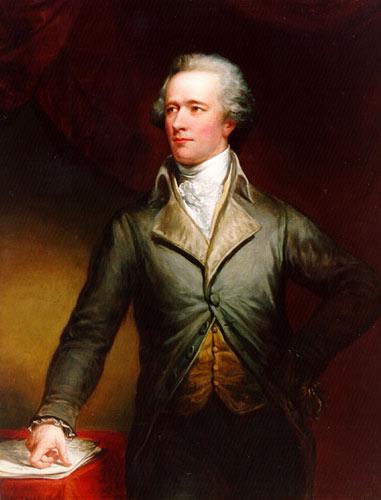
Alexander Hamilton (Photo courtesy http://www.foundingfathers.info/)

I've been thinking more about the Commander-in-Chief role of the President in the American Constitutional system. Because whether the Democrats like it or not, they have been placed in the position where in order to prevail politically, they have to fight for the Consititution against the Cheney theory of the Unilateral Executive. And the war power is the most important element in that fight, though by no means the only one.

Alexander Hamilton addressed the "commander-in-chief" role of the President in Federalist #69 (1788) in which he argued for the adopted of the proposed Constitution where he wrote:

The President is to be commander-in-chief of the army and navy of the United States. In this respect his authority would be nominally the same with that of the king of Great Britain, but in substance much inferior to it. It would amount to nothing more than the supreme command and direction of the military and naval forces, as first General and admiral of the Confederacy; while that of the British king extends to the DECLARING of war and to the RAISING and REGULATING of fleets and armies, all which, by the Constitution under consideration, would appertain to the legislature [Congress]. (my emphasis)
Hamilton compared the virtues of the Constitutional office of the President to that of the British monarchy. Hamilton in this piece takes a very different view of the status of the Presidency than the worshipful attitude today's Republicans show to George W. Bush:

The President of the United States would be an officer elected by the people for FOUR years; the king of Great Britain is a perpetual and HEREDITARY prince. The one would be amenable to personal punishment and disgrace; the person of the other is sacred and inviolable. The one would have a QUALIFIED negative upon the acts of the legislative body; the other has an ABSOLUTE negative. The one would have a right to command the military and naval forces of the nation; the other, in addition to this right, possesses that of DECLARING war, and of RAISING and REGULATING fleets and armies by his own authority.
Commenting on that essay by Hamilton, the great Constitutional scholar Edward Corwin wrote in Total War and the Constitution (1947):

Rendered freely, this appears to mean that in any war in which the United States becomes involved — one presumably declared by Congress — the President will be top general and top admiral of the forces provided by Congress, so that no one can be put over him or be authorized to give him orders in the direction of the said forces. But otherwise he will have no powers that any high military or naval commander who was not also President might not have. Additional testimony as to the purely military significance originally attached to the clause is afforded by Story's statement in his Commentaries, written nearly half a century later, that the only objection leveled against it in the States' ratifying conventions was that "it would be dangerous to let him [the President] command in person." "The propriety," Story adds, "of admitting the President to be Commander-in-Chief, so far as to give orders and have a general superintendency, was admitted." (my emphasis)
Corwin also cites Hamilton during the Washington administration as follows on Congressional war powers. This is made more notable by the fact that Hamilton, leader of the emerging Federalist Party, tended to advocate a more expansive view of Presidential power than the Jeffersonians:

Nevertheless, the executive cannot thereby control the exercise of that [Congressional] power. The legislature is still free to perform its duties, according to its own sense of them; though the executive, in the exercise of its constitutional powers, may establish an antecedent state of things, which ought to weigh in the legislative decision. The division of the executive power in the Constitution creates a concurrent authority in the cases to which it relates.
And Corwin quotes the following from the Supreme Court decision in Fleming v. Page (1850) - which does not seem to be available online, *%^$#@! - on the Commander-in-Chief power. The particular issue was whether the President on his own authority could annex the Mexican port of Tampico, which had been seized in the Mexican War:

His [the President's] duty and his power are purely military. As commander-in-chief, he is authorized to direct the movements of the naval and military forces placed by law at his command, and to employ them in the manner he may deem most effectual to harass and conquer and subdue the enemy. He may invade the hostile country, and subject it to the sovereignty and authority of the United States. But his conquests do not enlarge the boundaries of this Union, nor extend the operation of our institutions and laws beyond the limits before assigned to them by the legislative power. ...

In the distribution of political power between the great departments of government, there is such a wide difference between the power conferred on the President of the United States, and the authority and sovereignty which belong to the English crown, that it would be altogether unsafe to reason from any supposed resemblance between them, either as regards conquest in war, or any other subject where the rights and powers of the executive arm of the government are brought into question. (my emphasis)
(Hello, Supreme Court? Library of Congress? Shouldn't the full text of all Supreme Court decisions be available on-line by now? Has Cheney classified all the ones prior to 1890 or something?)

We should remember that at the time of the approval of the Constitution there were essentially no regular national Army and only a small Navy. To raise an Army, the national government had to call up state militias into national service, the same power being exercised today when National Guard (state militia) troops are called to regular service in the national armed forces. So these early discussions often talk about the national forces and the state militias when called into national service interchangeably.

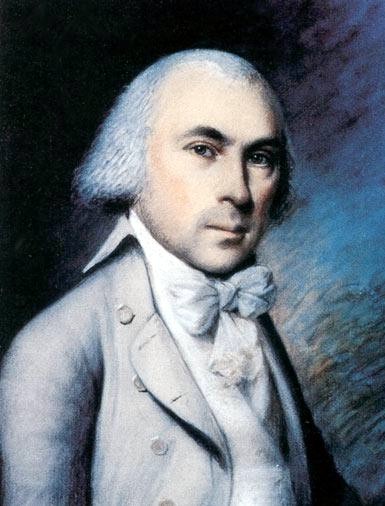
James Madison (Photo courtesy http://www.foundingfathers.info/)

In a debate in the Virginia Constitutional Covention of June 1788, James Madison addressed control over the state militias under the proposed Constitituion. He said:

The State Governments are to govern the militia, when not called forth for general national purposes; and Congress is to govern such part only as may be in the actual services of the United States. Nothing can be more certain and positive than this. It expressly empowers Congress to govern them when in the service of the United States. (my emphasis)
In other words, even though the President is Commander-in-Chief of the armed forces, it is Congress who governs them. "Nothing can be more certain and positive than this," said Madison.

Cheney's and Bush's supporters today are trying to make it sound altogether inappropriate for Congress to use its appropriation powers to set limits to the Executive's military discretion. The Founders saw the war powers of Congress very differently.

Madison's Federalist #41 1788) is particularly interesting in this regard. It was a general assumption among Americans at that time that a standing army, i.e., permanent professional national armed forces, were inherently a danger to freedom. A big reason for the Founders wanting to abandon the Articles of Confederation in favor of the Constitution was to provide more effective means for raising a national army and otherwise providing for the common defense than had been possible under the Articles.

Madison here is arguing for the Constitution and federal government's enhanced powers in that regard. But he did not at all discount the danger to free institutions of a standing army. Rather, he argued that a single nation could not determine solely on its own whether to have a standing army in given historical circumstances:

The fifteenth century was the unhappy epoch of military establishments in the time of peace. They were introduced by Charles VII. of France. All Europe has followed, or been forced into, the example. Had the example not been followed by other nations, all Europe must long ago have worn the chains of a universal monarch. Were every nation except France now to disband its peace establishments, the same event might follow. The veteran legions of Rome were an overmatch for the undisciplined valor of all other nations and rendered her the mistress of the world.

Not the less true is it, that the liberties of Rome proved the final victim to her military triumphs; and that the liberties of Europe, as far as they ever existed, have, with few exceptions, been the price of her military establishments. A standing force, therefore, is a dangerous, at the same time that it may be a necessary, provision. On the smallest scale it has its inconveniences. On an extensive scale its consequences may be fatal. On any scale it is an object of laudable circumspection and precaution. A wise nation will combine all these considerations; and, whilst it does not rashly preclude itself from any resource which may become essential to its safety, will exert all its prudence in diminishing both the necessity and the danger of resorting to one which may be inauspicious to its liberties.
Madison argued that a virtue of the proposed Constitution was that it allowed raising a sufficient national army when required but placed definite restrictions on it so that three people's elected representatives could control them. James Madison certainly did not suffer from the idolatry for the military that we see in today's authoritarian Republican Party, especially the Christian Right, and, sadly, in all to many Democrats. Madison wrote:

The clearest marks of this prudence are stamped on the proposed Constitution. The Union itself, which it cements and secures, destroys every pretext for a military establishment which could be dangerous.
And that vital safeguard was Congress' power of appropriation. The Constitution specifically limits the ability of Congress to appropriate funds for the military for longer than two years at a time, so that the elected representatives will be required to consider it again at least every two years:

Next to the effectual establishment of the Union, the best possible precaution against danger from standing armies is a limitation of the term for which revenue may be appropriated to their support. This precaution the Constitution has prudently added. I will not repeat here the observations which I flatter myself have placed this subject in a just and satisfactory light. But it may not be improper to take notice of an argument against this part of the Constitution, which has been drawn from the policy and practice of Great Britain. It is said that the continuance of an army in that kingdom requires an annual vote of the legislature; whereas the American Constitution has lengthened this critical period to two years. This is the form in which the comparison is usually stated to the public: but is it a just form? Is it a fair comparison? Does the British Constitution restrain the parliamentary discretion to one year? Does the American impose on the Congress appropriations for two years? On the contrary, it cannot be unknown to the authors of the fallacy themselves, that the British Constitution fixes no limit whatever to the discretion of the legislature, and that the American ties down the legislature to two years, as the longest admissible term.
See also Gleen Greenwald's post on this issue: Public servant v. Military Commander Unclaimed Territory blog 01/27/07.

Tags: , , ,